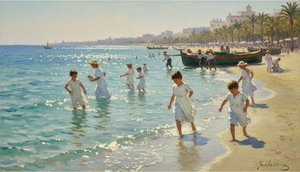
Antonio Muñoz Degrain (1840 - 1924)
Antonio Muñoz Degrain, a name perhaps less familiar today than some of his contemporaries, nevertheless occupies a significant place within the tapestry of 19th-century Spanish art. Born in Valencia in 1840, his life was one of artistic exploration and eventual triumph, marked by a fascinating transition from academic beginnings to an embrace of Impressionistic sensibilities. His father, a watchmaker, initially steered him towards architecture – a practical profession – but the pull of painting proved too strong. Muñoz Degrain’s early studies at the Real Academia de Bellas Artes de San Carlos in Valencia were short-lived; he soon sought a more independent path, venturing to Rome and immersing himself in a bohemian existence where self-teaching became his primary guide. This period of hardship and artistic freedom profoundly shaped his vision, prompting a return to Spain and the beginning of a career that would span decades and garner considerable acclaim.From Eclecticism to Impressionistic Visions
Muñoz Degrain’s early work reflected the eclectic tastes prevalent in Spanish art during the mid-19th century. He quickly gained recognition, exhibiting at the National Exhibition of Fine Arts in 1862 with a painting of the Pyrenees that earned an honorable mention – a promising start for the young artist. Throughout the following years, he became a regular participant in these exhibitions, steadily honing his skills and developing a reputation for landscapes imbued with dramatic flair. However, it was his ability to adapt and evolve that truly set him apart. While initially grounded in traditional techniques, Muñoz Degrain gradually moved towards Impressionism, embracing looser brushwork and a more vibrant palette. This shift wasn’t abrupt; rather, it was a gradual unfolding, influenced by his travels, observations of light, and a growing desire to capture the fleeting moments of nature with greater immediacy. His landscapes began to shimmer with an atmospheric quality, reflecting not just what he *saw*, but how he *felt* in response to the world around him.Literary Inspirations and Royal Commissions
Beyond his captivating landscapes, Muñoz Degrain demonstrated a remarkable ability to translate literary narratives onto canvas. He found inspiration in works of literature, bringing scenes to life with dramatic intensity and emotional depth. His painting *Othello and Desdemona* (1880), for example, is a powerful depiction of a pivotal moment from Shakespeare’s tragedy, showcasing his skill in capturing both psychological tension and visual drama. This talent didn’t go unnoticed by the Spanish court. In 1878, he received the Grand Cross of the Order of Charles III for his painting depicting Queen Isabella presenting her jewelry to Christopher Columbus – a work that not only demonstrated his technical prowess but also secured him royal patronage. Remarkably, this very image was later chosen for use on a $1 U.S. postage stamp in 1893, an unusual honor for a Spanish artist and a testament to the painting’s widespread appeal.A Legacy of Teaching and Artistic Leadership
Muñoz Degrain's influence extended beyond his own artistic creations; he was also a dedicated educator who shaped the next generation of Spanish painters. In 1879, he became a professor at the Real Academia de Bellas Artes de San Telmo, sharing his knowledge and passion with aspiring artists. Later, in 1898, he replaced Carlos de Haes as chair of landscape painting at the prestigious Real Academia de Bellas Artes de San Fernando in Madrid, eventually becoming its director in 1901. Among his students was a young Pablo Picasso, who held Muñoz Degrain in high regard. Upon his retirement in 1913, he generously donated many of his works to both the Academy of San Carlos and the Museu de Belles Arts de València, ensuring that his artistic legacy would endure for future generations. He passed away in Málaga in 1924 at the age of 83, leaving behind a body of work that continues to captivate and inspire. His paintings are not merely representations of landscapes or historical events; they are windows into a world seen through the eyes of an artist who dared to embrace change and explore the boundless possibilities of light and color.Vraag en antwoord
Welke stemmingen drukken de kunstwerken van Antonio Muñoz Degrain uit?
De werken van Antonio Muñoz Degrain kunnen per stemming worden bekeken op de Sfeercollectie pagina van de kunstenaar, waar de kunstwerken zijn gerangschikt op basis van hun vastgelegde stemmingen.
Kan ik de werken van Antonio Muñoz Degrain verkennen op onderwerp?
De werken van Antonio Muñoz Degrain kunnen per onderwerp worden verkend op de Onderwerpsindex pagina van de kunstenaar.
Hoeveel kunstwerken van Antonio Muñoz Degrain zijn beschikbaar om te bekijken?
U kunt 74 kunstwerken werken van Antonio Muñoz Degrain bekijken op de Alle kunstwerken-pagina.