Early Life and Career
Maurice de Vlaminck was born April 4, 1876, in Paris, France, to a Flemish father who instilled musical sensibilities through violin instruction and a mother from Lorraine who nurtured piano skills. This formative upbringing profoundly shaped his artistic vision. He embarked on his artistic journey relatively late in life, around the age of twenty, initially pursuing self-education before cultivating an instinctive approach to painting—a characteristic that would define his entire oeuvre. Before dedicating himself fully to art, he worked as a professional cyclist, honing physical endurance and developing a keen observational eye.The Fauvist Movement and Artistic Style
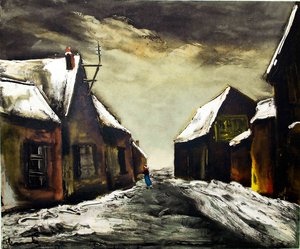
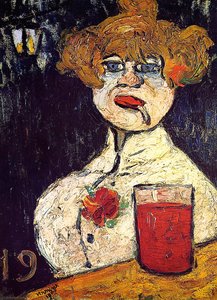
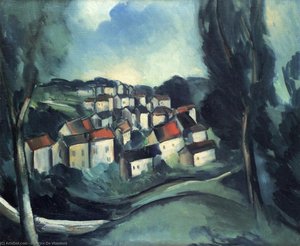
Maurice de Vlaminck stands as a cornerstone of the Fauvist movement (1904-1908), alongside André Derain and Henri Matisse—artists who revolutionized painting by rejecting academic conventions in favor of bold color palettes and simplified forms. This audacious group challenged established artistic dogma, prioritizing emotional expression over accurate representation. Vlaminck’s style is instantly recognizable for its energetic brushwork; thick, visible strokes convey dynamism and spontaneity, capturing the essence of his subjects with palpable immediacy. He eschewed meticulous detail, opting instead to distill landscapes and figures into their fundamental shapes—a deliberate decision designed to maximize expressive impact. The dominant color scheme – vibrant hues divorced from naturalistic standards – served as a conduit for conveying emotion; reds, yellows, and blues pulsed with intensity on the canvas. Notable early works like “Sur le zinc” (At the Bar) and “L’homme à la pipe” exemplify this distinctive aesthetic.Influences and Artistic Development
Impressionism undeniably influenced Vlaminck's compositional choices, mirroring the Impressionists’ fascination with capturing fleeting moments illuminated by sunlight. However, his artistic trajectory was decisively shaped by Vincent van Gogh—a connection forged during a visit to an exhibition where he expressed fervent admiration for the artist’s expressive technique and emotional depth. This influence is palpable in Vlaminck's own brushstrokes and tonal range. Furthermore, from 1908 onwards, Cézanne’s exploration of geometric forms and muted palettes exerted considerable sway over Vlaminck’s artistic sensibilities. He moved away from the luminous colors of Impressionism toward a more restrained palette—a stylistic shift that reflected his evolving preoccupation with capturing inner psychological states.Major Achievements and Historical Significance
Vlaminck's participation in the Salon d’automne exhibitions, particularly in 1905, cemented Fauvism’s position as a pivotal movement within modern art history. His canvases became emblems of artistic rebellion against tradition, championing spontaneity and emotional honesty. Critics lauded his paintings for their raw energy and uncompromising vision—qualities that continue to resonate with audiences today. He bridged the gap between Impressionism and Expressionism, fostering a dialogue between observation and subjective experience. Vlaminck’s legacy resides in his unwavering commitment to artistic innovation and his ability to convey profound emotion through color and form.Available Works
Today, Maurice de Vlaminck's paintings reside in prestigious museums across the globe—including Musée d’Orsay and Tate Modern—and are treasured by discerning collectors worldwide. Reproductions of masterpieces such as “Bougival” and “The Bridge at Chatou” offer a captivating glimpse into his distinctive Fauvist style, inviting viewers to contemplate the enduring power of artistic expression. TopImpressionists presents an exceptional opportunity to explore Vlaminck’s oeuvre—a testament to his singular contribution to the history of art.Vraag en antwoord
Waar kan ik de kunstwerken van Maurice de Vlaminck bekijken in een 3D-galerie?
De 3D-galerie van Maurice de Vlaminck is een pagina waarop de kunstwerken van de kunstenaar worden gepresenteerd in een virtuele driedimensionale galerie.
In welke stad en welk land is Maurice de Vlaminck geboren?
Maurice de Vlaminck werd geboren in Parijs, in Frankrijk.
Waar komt Maurice de Vlaminck vandaan?
Maurice de Vlaminck werd geboren in Frankrijk.