Early Life and Artistic Beginnings
Sanford Robinson Gifford, a name synonymous with the serene beauty of American landscapes, was born on July 10th, 1823, in Greenfield, New York – a small town nestled amidst the rolling hills of Saratoga County. His early life unfolded within a family that valued both industry and artistic inclination; his father, a successful foundry owner, fostered an environment where creativity wasn’t merely tolerated but encouraged. Gifford's childhood was spent in Hudson, a picturesque riverside town steeped in history and natural splendor – a setting that would profoundly shape his future artistic vision. While formal art training began modestly, with instruction from Henry Ary, a local landscape painter, Gifford’s burgeoning talent quickly outgrew these initial lessons. He sought guidance from John Rubens Smith, a British watercolorist who had established himself as a respected mentor in the Hudson Valley, and later benefited from studies at the National Academy of Design in New York City. This diverse educational foundation laid the groundwork for his distinctive style, blending technical skill with an intuitive understanding of light, color, and atmosphere.The Luminist Influence and European Sojourn
Gifford’s artistic journey took a pivotal turn when he encountered the burgeoning movement known as Luminism – a subgenre of the Hudson River School characterized by its emphasis on soft, diffused light and atmospheric effects. Inspired by artists like Thomas Cole and Frederic Church, Gifford began to capture the essence of nature not through dramatic detail or bold outlines, but through subtle gradations of color and an almost ethereal quality of light. This approach resonated deeply with his own artistic sensibilities, leading him to prioritize mood and feeling over precise representation. In 1855-1857, Gifford embarked on a transformative journey to Europe, a period that proved instrumental in refining his technique and broadening his artistic horizons. He immersed himself in the art of masters such as Turner, absorbing their innovative approaches to light and color. His travels extended across England, Scotland, France, Belgium, Holland, and Germany, each experience contributing to his evolving aesthetic vocabulary. This European sojourn wasn’t merely a sightseeing trip; it was an intensive period of study and experimentation, allowing him to translate the lessons he learned into his own unique style.Masterpieces from the Rocky Mountains to Italy
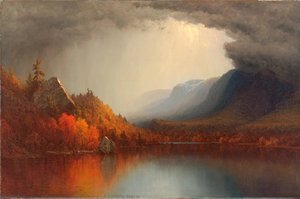
Upon his return to America in 1857, Gifford established a studio in New York City, where he found himself surrounded by fellow artists – including Albert Bierstadt and Frederic Church – who shared his passion for landscape painting. This vibrant artistic community provided both inspiration and competition, fueling his creative drive. During this period, Gifford produced some of his most celebrated works, capturing the grandeur of the Rocky Mountains in 1870 as part of a Hayden expedition led by Ferdinand Vandeveer Hayden. The expedition offered him unparalleled opportunities to sketch and paint the dramatic landscapes of Wyoming, Utah, and Colorado – experiences that profoundly influenced his artistic perspective. Simultaneously, he continued to explore familiar subjects within the Hudson Valley, producing iconic paintings like *Mount Mansfield* (1858) and *Tivoli* (1868), both now housed in the Metropolitan Museum of Art. *Tivoli*, a particularly luminous depiction of an Italian landscape, stands as a testament to his mastery of light and atmosphere, transporting the viewer to a realm of serene beauty.Legacy and Historical Significance
Sanford Robinson Gifford’s contributions to American landscape painting are undeniable and continue to resonate today. His work is characterized by its evocative sense of place, its masterful use of light and color, and its profound connection to the natural world. He played a significant role in establishing Luminism as a distinct artistic style, influencing generations of landscape painters who followed. Gifford’s paintings were exhibited at prestigious venues such as the National Academy of Design and the Exposition Universelle in Paris, solidifying his reputation as one of America's leading artists. After his death on August 29th, 1880, a comprehensive catalog of his work was published – a remarkable testament to his prolific career, documenting over 700 paintings. Today, Gifford’s works are cherished in museums across the country, including the Metropolitan Museum of Art, where *Tivoli* remains a captivating centerpiece of its collection. His legacy endures as a symbol of American artistic achievement and a reminder of the enduring power of nature to inspire beauty and contemplation.- view gifford’s tivoli at the metropolitan museum of art
- learn more about sanford robinson gifford on wikipedia
- explore the hudson river school art movement on TopImpressionists
Vraag & Antwoord
Kan ik de werken van Sanford Robinson Gifford bekijken op basis van stemming?
De Sfeerruimte van Sanford Robinson Gifford is een pagina waarop de kunstwerken van de kunstenaar zijn gerangschikt op stemming.
In welke stad en welk land is Sanford Robinson Gifford geboren?
Sanford Robinson Gifford werd geboren in Greenfield, in Verenigde Staten van Amerika.
Hoeveel kunstwerken van Sanford Robinson Gifford zijn beschikbaar om te bekijken?
U kunt 221 kunstwerken werken van Sanford Robinson Gifford bekijken op de Alle kunstwerken-pagina.