

Shown: · With its frame:
 Forhåndsvisning
 Send
Send Del
Del
 Vis detaljer
 Utskriftsvennlig guide

 Last ned bilde
 Liknende objekter
 Røntgenundersøkelse
 Lysbildefremvisning
 Q&A
Q&A Statistikk

Nkr 2589
Håndlaget oljereproduksjon
Håndmalt olje på lerret i din valgte størrelse og ramme, laget på bestilling av våre kunstnere. ( Bytt til trykk Bytt til digitalt bilde)
Dette kunstverket er beskyttet av opphavsrett
Kunstverket som vises på denne siden er beskyttet av opphavsretten, noe som betyr at vi ikke har juridisk tillatelse til å lage eller selge identiske reproduksjoner. Denne beskyttelsen håndheves i henhold til internasjonale avtaler som for eksempel Bernerkonvensjonen og av nasjonale lover, inkludert de som er fastsatt i Amerikansk lov om opphavsrett – Tittel 17.
Som et respektfullt og lovlig alternativ tilbyr vi skreddersydde, håndmalte kunstverk inspirert av originalen. Våre dyktige og profesjonelle kunstnere studerer nøye originalens stil, stemning og kunstneriske essens for å skape et nytt og unikt verk som vekker den samme følelsen – samtidig som det forblir en original skapelse i seg selv.
Denne metoden er i fullt samsvar med opphavsrettslige regler, da den ikke innebærer kopiering eller duplisering av det beskyttede kunstverket. I stedet er det snakk om en kreativ nytolkning – et nytt maleri som er inspirert av originalen, men ikke identisk med den.
 Les mer om dette
Size
·Standardformat
skreddersydd
CM
INCH
Velg mellom våre forhåndsdefinerte størrelser som bevarer kunstverkets opprinnelige proporsjoner.
Loading sizes...

bredde
høyde
Skriv inn ønsket bredde og høyde for å tilpasse bildet til din ramme eller vegg. Siden dette er håndmalt, kan kunstneren male litt mer rundt motivet eller beskjære det noe dersom du velger et annet format — valget er ditt. Vi sender deg en digital mockup til godkjenning før maleriet påbegynnes. Bildet som vises på denne siden representerer ikke det faktiske resultatet — kun mockuppen viser det endelige uttrykket.
Finish
·
White Nkr1

Blurside Nkr1

Extended Nkr1

P118B Nkr10

P118H Nkr10

P118W Nkr10

P438Z Nkr10

P508JH Nkr12

P508YH Nkr12

P805H Nkr10

P805Z Nkr10

P919BZ Nkr10

P919G Nkr10

P919XJ Nkr10

P959ZH Nkr10

P968JZ Nkr12

W106C Nkr8

W218G Nkr10

W218JH Nkr8

W218Y Nkr10

W307PJ Nkr10

W316G Nkr10

W316PJ Nkr8

W316Y Nkr10

W398PJ Nkr8

W4111J Nkr10

W500HY Nkr15

W500JH Nkr15

W692G Nkr12

W849H Nkr8

W940BG Nkr15

W953PJ Nkr8

H24-GOLD Nkr30

H24-SILVER Nkr30

H36-GOLD Nkr45

H36-SILVER Nkr45
Shipped in a protective tube, ready for your own framer.
Above 105 cm the frame is shipped as a kit for a professional framer — read the details.
Extras
optionalWhat do the extras include?
Examples of what can be changed: Replace face with customer photo; Add pet (e.g., replace cat with dog); Include hidden message in background; Change background landscape or elements.
After order, TopImpressionists.com team will email client for instructions and provide a mockup preview
After order, TopImpressionists.com team will email client for instructions and provide a mockup preview
Verdensomspennende levering () på 3–4 uker i stedet for standard 5 uker. (1 November). Ingen kompromisser med kvaliteten.
Beskyttende ferniss
Navneskilt
Detaljer om gravert bronseplate
This elegant plaque features the artist's name and the title of the artwork, finely engraved for a timeless presentation.
It is made from bronze with a refined, elegant finish. The text is precisely laser-engraved for a sharp and permanent result. Measuring 9x2 cm, the plaque is compact yet easy to read. It's built to be durable and scratch-resistant, offering a professional, museum-quality look. Mounting is simple thanks to the included adhesive backing.
Detaljer om gjennomsiktig akrylplate
The plaque includes essential engraved details such as the artist's name, the title of the artwork, the date it was created, the type of media used-like oil on canvas or watercolor-a brief description of the piece, and a QR code that links to the complete artwork information.
It is crafted from clear acrylic, offering a sleek, modern appearance. The text is UV-engraved in black to ensure strong visual contrast. With a size of 10x15 cm, it ensures optimal readability. It comes equipped with two metal hooks for secure wall mounting. The plaque is designed to be weather-resistant, making it suitable for various environments, and it includes interactive features that work seamlessly with smartphone scanning.
Detaljer om plakett i svart akryl
This elegant plaque includes engraved information such as the artist's name, the title of the artwork, the date it was created, the type of media used (like oil on canvas or watercolor), a short description of the artwork, and a QR code for quick access to more information.
The plaque itself is made from refined black acrylic with a premium finish. The text is laser-engraved in white for high contrast and readability. Its size is 10x15 cm, designed to be easy to read. It comes with two metal hooks for professional mounting. The design is sleek and fits any interior style. It is also weather-resistant and durable, with built-in digital integration for mobile compatibility.
Glassalternativet er kun tilgjengelig i størrelser under 110 cm
 Glassalternativet er kun tilgjengelig i størrelser under 110 cm
- Gratis ekspressfrakt over hele verden
- Lerretsduk av lin av høy kvalitet
- Full transportforsikring
- Garanti for refusjon av toll og importavgifter
- Garantert fargegjengivelse
- 100 dagers returrett ved fabrikasjonsfeil
- 100% pengene tilbake-garanti
- Rabatt ved flere kjøp


Beskrivelse av objektet
Explore Georges Braque's masterful still lifes—featuring serene landscapes and subtle color palettes—in *The Poetry of Things*, a London exhibition celebrating his enduring legacy beyond Cubism.
Om kunstneren
Georges Braque’s «Harbor i Normandie» (1909) revolusjonerte kubismen med fragmenterte former og dynamisk komposisjon – et tidløst kunstverk!
About the painting
A Quiet Revolution in Still Life
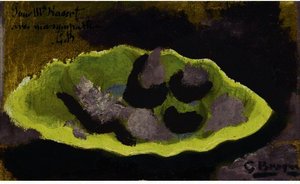
To gaze upon Georges Braque’s “Dead Nature” is to witness a profound moment of stillness within the turbulent currents of modern art history. Created in 1930, this work serves as a masterful testament to the artist's ability to find complexity within simplicity. While at first glance the painting appears to be a humble arrangement of fruit and glass, it is, in truth, a sophisticated exploration of how we perceive the physical world. Braque does not merely present a bowl of fruit; he invites the viewer into a reconstructed reality where the boundaries between object and space begin to dissolve. For the discerning collector or interior designer, this piece offers a captivating focal point that brings an intellectual depth and a sense of timelessness to any curated space.
The composition centers on a ceramic bowl, rendered in soft greenish-yellow tones, which holds a collection of fruit that seems to pulse with a muted, internal light. Beside it, a glass vessel catches the ambient light, its transparency interrupted by the rhythmic application of paint. Braque’s mastery lies in his ability to use geometric planes—subtle cubes and cylinders—to overlap and intersect, disrupting traditional perspective. This technique, a hallmark of his Cubist evolution, forces the eye to move across the canvas, discovering new facets of form with every glance. The interplay of light and shadow is not merely decorative but structural, creating a sense of weight and presence that anchors the entire composition.
The Alchemy of Texture and Tone
Braque’s technical prowess is most evident in his deliberate use of color and texture to evoke emotion. He moves away from the vibrant, almost aggressive palettes of his earlier Fauvist influences, opting instead for a harmonious arrangement of earthy ochres, deep umbers, and subtle creams. These muted tones create a sophisticated atmosphere that feels both grounded and ethereal. The artist employs delicate glazing techniques to build layers of depth, allowing light to seemingly trapped beneath the surface of the paint. This creates a tactile quality; one can almost feel the coolness of the glass and the matte smoothness of the ceramic bowl.
The emotional impact of “Dead Nature” is one of contemplative peace. There is no frantic movement here, only the quiet dignity of objects existing in a state of permanent repose. For those looking to decorate a sanctuary-like environment—perhaps a study, a library, or a minimalist living area—this artwork provides a sense of stability and intellectual rigor. It does not demand attention through loud colors but earns it through its nuanced textures and the subtle tension between its fragmented shapes. It is a piece that rewards slow looking, offering new layers of meaning to anyone willing to linger before its surface.
A Legacy of Visionary Thought
Understanding “Dead Nature” requires acknowledging the historical weight Braque carried as a pioneer of the Cubist movement. Alongside Pablo Picasso, Braque dismantled the "window onto the world" that had defined Western art since the Renaissance. He replaced it with a multidimensional experience, prioritizing how an object is known by the mind rather than just how it is seen by the eye. This painting represents a mature stage of this journey, where the radical experiments of his youth have settled into a refined, poetic language of form.
Owning a high-quality reproduction of such a seminal work allows for the integration of art history into the modern home. It is more than a decorative element; it is an invitation to participate in the dialogue of the avant-garde. Whether placed in a contemporary setting with clean lines or nestled within a classic, traditional interior, “Dead Nature” acts as a bridge between the revolutionary spirit of the early 20th century and the aesthetic sensibilities of today. It remains a profound symbol of how art can transform the mundane into the extraordinary.
Spørsmål og svar
Hvorfor er den opphavsrettslige statusen til "Dead nature" slik den er?
Opphavsrettslig status for "Dead nature" – fortsatt beskyttet av opphavsretten – følger av kunstnerens dødsår, 1963.
Hvor plasserer "Dead nature" seg blant Georges Braque sine gjentakende motiver?
"Dead nature" skildrer bowl, ceramics, reflection, dots, contrast, composition, monochrome, mens de dokumenterte temaene til Georges Braque er geometric abstraction, picasso collaboration, formal exploration, minimalist aesthetic, cubist legacy. En sammenligning av disse viser hvordan verket relaterer seg til kunstnerens faste motiver.
Hvordan kan jeg se "Dead nature" av Georges Braque som en lysbildefremvisning?
Se lysbildefremvisningen her: Bildekarusell for "Dead nature" av Georges Braque.
Quick facts and art quiz
About Georges Braque

Georges Braque
1882 - 1963, Frankrike
Om kunstneren
Early Life and Artistic Foundations
Georges Braque, født i Argenteuil ved Paris i 1882, begynte en reise dypt forankret i det stadig skiftende landskapet til moderne kunst. Hans barndom i en familie av husmalere og dekoratører la ikke bare grunnlag for en teknisk mesterskap over materialer, men også en tidlig forståelse for form og struktur. Selv om han først fulgte i farens fotspor i håndverkstiden, førte hans iboende kunstneriske impulser snart til formell utdannelse ved École des Beaux-Arts i Le Havre, og markerte starten på hans vei mot å bli en av de mest innflytelsesrike malerne på det 20. århundre. Denne bakgrunnen – en blanding av praktisk håndverkssjappe og akademisk studie – ville vise seg å være avgjørende da han senere dekonstruerte og reimplementerte tradisjonelle kunstneriske konvensjoner.
Da han flyttet til Paris i 1902, fortsatte Braque studiene ved Académie Humbert, og fordypet seg i den pulserende kunstneriske miljøet i byen. Det var her han møtte kunstnere som Marie Laurencin og Francis Picabia, og etablerte forbindelser som ville forme hans tidlige utvikling. Hans innledende verk reflekterte de dominerende influensene fra impresjonisme og postimpresjonisme, men en avgjørende møte med den dristige fargen og det uttrykksfulle friheten i fauvismen i 1905 tenner en ny retning i hans kunstneriske utforskning.
The Embrace of Fauvism and the Dawn of Cubism
Braques overtagelse av fauvistiske prinsipper – karakterisert ved intens, ikke-naturalistisk farge og emosjonell uttrykk – illustreres levende i malerier som The Patience. Denne perioden så ham arbeide sammen med kunstnere som Henri Matisse og André Derain, eksperimentere med livlige paletter og forenklede former. Imidlertid var Braques engasjement med fauvismen ikke bare etterlignende; han infuserte det med en unik sans forhetning, tempererte bevegelsens ukontrollerte utbrudd med en mer dempet og analytisk tilnærming.
Et vendepunkt kom i 1907 med hans eksponering mot retrospektivet av Paul Cézannes verk. Cézannes vektlegging av geometriske former og flere perspektiver hadde en dyptgripende innvirkning på Braque, og la grunnlaget for hans banebrytende samarbeid med Pablo Picasso. Fra 1908 begynte disse to kunstneriske titanene en intens intellektuell utveksling som ville føre til fødselen av kubisme – en revolusjonerende bevegelse som knuste tradisjonelle forestillinger om representasjon.
Sammen utviklet Braque og Picasso analytisk kubisme, dekonstruerte objekter i fragmenterte geometriske former og presenterte dem fra flere perspektiver samtidig. Verk som Houses at L'Estaque demonstrerer denne tidlige fasen, og viser en radikal avvik fra konvensjonelle perspektiver og et fokus på den underliggende strukturen til formene.
Innovation Through Fragmentation and Collage
Partnerskapet mellom Braque og Picasso fortsatte å presse grensene for kunstnerisk uttrykk, noe som førte til utviklingen av syntetisk kubisme rundt 1912. Denne fasen så introduksjonen av collage – integreringen av virkelige materialer som avisutklipp og tapetet i maleriene. Denne innovasjonen utfordret den tradisjonelle hierarkiet mellom kunst og skulptur, og uskarpet grensene mellom kunst og liv.
Braques banebrytende bruk av *papier collé* (pasted paper) markerte et betydelig vendepunkt i hans kunstneriske utvikling. Ved å integrere fragmenter av hverdagsgjenstander inn i komposisjonene sine, forstyrret han den illusjonistiske plassen til tradisjonelt maleri og introduserte et nytt nivå med materialitet og tekstur.
Krigen i 1914 brøt ut, og avbrøt denne intense samarbeidet, da Braque ble kalt inn for militærtjeneste. Hans krigserfaringer påvirket dypt hans kunstneriske visjon, noe som førte til at han utforsket mer personlige og lyriske temaer i sitt etterkrigsverk.
Later Years and Enduring Legacy
Etter krigen utviklet Braques stil seg utover de strenge grensene for tidlig kubisme, og integrerte elementer av klassisk komposisjon og en ny interesse for landskap. Mens han beholdt de geometriske innflytelser som hadde definert hans tidligere arbeid, utviklet han en mer nyansert og kontemplativ tilnærming til maleri.
I løpet av hele sin karriere fortsatte Braque å utforske de grunnleggende prinsippene for form, rom og representasjon. Han eksperimenterte med forskjellige materialer og teknikker, og presset grensene for kunstnerisk uttrykk frem til sin død i 1963. Hans innflytelse på etterfølgende generasjoner av kunstnere er ubestridelig, og har formet banen for moderne kunst og inspirert utallige malere, skulptører og collagister.
Influences and Notable Works
- Influenced By: Henri Matisse, André Derain, Paul Cézanne
- Key Works: Houses at L'Estaque, The Patience, Violin and Palette, Mandola
- Impact on Art History: Revolutionized 20th-century art through Cubism; challenged traditional notions of perspective and representation.
Quick facts about Georges Braque
- Artistic Movement Or Style: Kubisme, Fauvisme
- Artists Or Movements Influenced By This Artist: ['Impressionisme']
- Artists Who Influenced This Artist:
- Henri Matisse
- Pablo Picasso
- Date Of Birth: 13 mai 1882
- Date Of Death: 31 aug 1963
- Full Name: Georges Braque
- Nationality: Fransk
- Notable Artworks:
- Huse ved L'Estaque
- Tålmodighet
- Fiolin og palett
- Place Of Birth: Argenteuil, Frankrike
Utforsk kunstverk organisert etter temaer, stiler og kjennetegn.


Georges Braque
Dead nature
() ·
With its frame: · Hand-painted in oil on linen
Total