

 Forhåndsvisning
 Send
Send Del
Del
 Vis detaljer
 Utskriftsvennlig guide

 Last ned bilde
 Liknende objekter
 Røntgenundersøkelse
 Lysbildefremvisning
 Q&A
Q&A Statistikk
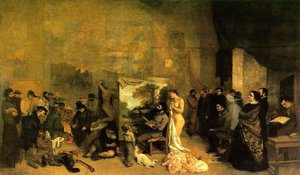
The Painter's Studio

- 361.0 x 598.0 cm


 Vis hele teksten
Gustave Courbets «Hvetesilter» er et ikonisk realistisk maleri som skildrer hverdagsarbeid og samfunnets realiteter. Opplev detaljrikdommen og den dype menneskelige fortellingen i dette mesterverket fra 1854.
Få en utskriftsklar fil som går langt utover forhåndsvisningen på nett. Hvert digitale bilde vi selger er hentet fra en høyoppløselig master i vår database – vanligvis mellom 5 000 og 15 000 piksler bred – slik at du kan trykke stort, beskjære tett eller gjenskape fine detaljer med full trygghet.
Ingen filer forlater studioet vårt uten å bli bearbeidet. En digital ekspert kontrollerer fargene mot det originale maleriet og korrigerer dem ved behov, for deretter å forbedre klarhet og detaljrikdom med profesjonelle retusjeringsverktøy — alltid tro mot kunstnerens penselstrøk og stil. Resultatet er et bilde som fremstår som selve maleriet, ikke som en skann med filter.
Du godkjenner før ferdigstilling: vår ekspert sender bildet på e-post til din vurdering innen 72 timer. Ikke fornøyd? Be om forbedringer eller korrigeringer, eller be om refusjon dersom kvaliteten ikke svarer til forventningene.
Dette er kvaliteten forlag, designstudioer, gallerier og trykkerier stoler på.
Digitalt bilde
Last ned en høyoppløselig fil til personlig bruk, utskrift og kreative prosjekter. ( Bytt til trykk Kjøp håndmalt maleri)
Inkludert i alle bestillinger av digitale bilder
Ekspert på digital levering, garantert
Når du velger TopImpressionists.com, får du ikke bare et bilde – du mottar et profesjonelt etterbehandlet digitalt kunstverk, skapt med presisjon og med en garantert tilfredshetsgaranti. Her er alt som automatisk følger med din bestilling:

Rask levering på e-post
Din høyoppløselige digitale bildefil sendes til din e-post innen 72 timer etter bestilling – klar til umiddelbar bruk.

KI-forbedret digital fil
Ditt kunstverk blir profesjonelt optimalisert ved hjelp av avanserte AI-verktøy og manuell redigering, noe som sikrer maksimal detaljrikdom, klarhet og fargegjengivelse.

Gratis livslang nyutlevering
Har du ved et uhell slettet eller mistet filen din? Ingen bekymring – vi sender den på nytt når som helst, helt gratis.

Ingen importavgifter – noen gang
Nyt ditt kunstverk umiddelbart uten toll, avgifter eller leveringskostnader – digitale nedlastinger er alltid avgiftsfrie.

Garantert fargenøyaktighet
Vi sikrer at det digitale bildet gjenspeiler de originale fargene så nøyaktig som mulig ved hjelp av profesjonelle verktøy og fargehåndtering.

100 dagers fornøydhetsgaranti
Hvis du ikke er fornøyd med ditt digitale bilde, vil vi revidere det eller refundere 100% innen 100 dager – uten spørsmål.

100% Penggaranti
Ikke fornøyd? Få full refusjon innen 100 dager etter at du har mottatt din digitale fil – uten spørsmål.

Rabatt ved storkjøp
Kjøp 3 bilder, spar 10% - Kjøp 5, spar 15% - Kjøp 10+, spar 20%. Ideelt for kreative prosjekter, gallerier og byråer.
A Bold Declaration of Realism: Gustave Courbet’s “The Painter’s Studio”
Dr. Steven Zucker begins his exploration of Gustave Courbet's monumental canvas, "The Painter’s Studio," at the Musée d’Orsay in Paris, highlighting its significance as a pivotal moment in artistic history and rejecting from the official exposition. This expansive oil painting—measuring 361 x 598 cm—immediately commands attention with its sheer scale and uncompromising depiction of everyday life, marking a decisive break from the idealized landscapes and mythological narratives favored by earlier generations of artists.- Subject Matter: The scene portrays a bustling studio inhabited by Courbet himself and several prominent figures representing diverse social strata – intellectuals, artists, and patrons. These individuals engage in conversation and activity, creating an atmosphere of intellectual ferment and artistic ambition.
- Style & Technique: Courbet’s masterful brushwork characterizes the painting's style, employing a technique known as Impasto—thickly applied paint—to imbue the canvas with palpable texture and depth. This deliberate disregard for academic conventions underscores his commitment to portraying reality without embellishment or romantic sentimentality.
- Historical Context: Created in 1855 during the Second Industrial Revolution, “The Painter’s Studio” reflects the broader societal shifts of its time. The painting's rejection from the Paris World Fair served as a catalyst for Courbet to organize his own exhibition, "The Pavilion of Realism," demonstrating defiance against artistic hierarchies and asserting the primacy of observation.
Allegorical Layers: Decoding Symbolism
Beyond its immediate visual impact, “The Painter’s Studio” is laden with symbolic representations that delve into themes of artistic struggle, social hierarchy, and the role of inspiration. At the center stands Courbet himself, absorbed in his work while facing away from a nude model—a deliberate gesture signifying his rejection of Academic art's preoccupation with idealized beauty. This compositional choice powerfully communicates Courbet’s belief that true artistry stems from confronting uncomfortable truths and embracing the complexities of human experience.- The Model: The nude figure embodies Academic ideals – purity, grace, and perfection—representing precisely what Courbet sought to dismantle through his unflinching realism.
- The Figures Around the Table: The intellectuals and artists gathered around the table represent the influential figures who championed Courbet’s vision. Their presence underscores the importance of intellectual discourse and artistic collaboration in shaping cultural values.
A Legacy of Influence
Courbet's audacious act of self-promotion solidified his position as a champion of Realism, profoundly impacting subsequent art movements. Artists like Impressionists and Cubists drew inspiration from Courbet’s pioneering approach to depicting the world around them—abandoning illusion for direct observation and prioritizing expressive brushwork over meticulous detail. “The Painter’s Studio” remains an enduring testament to Courbet's artistic conviction and continues to inspire artists and collectors alike, reminding us that art can serve as a powerful vehicle for social commentary and intellectual exploration.Emotional Resonance
Ultimately, "The Painter’s Studio" transcends mere visual representation; it evokes a palpable sense of atmosphere—one brimming with ambition, contemplation, and perhaps even defiance. Courbet's masterful use of color and texture invites viewers to immerse themselves in the scene, fostering an emotional connection to the artist’s unwavering commitment to portraying reality without compromise. It stands as a timeless masterpiece, capturing not only the visual splendor of 19th-century Paris but also the enduring spirit of artistic rebellion.Spørsmål og svar
Er "The Painter's Studio" av Gustave Courbet et lyst eller mørkt kunstverk?
"The Painter's Studio" har en samlet lysstyrke på deep_shadow, og luminansen er Dark.
Hvordan forenes kontrast og harmoni i "The Painter's Studio"?
Fargekomposisjonen i "The Painter's Studio" av Gustave Courbet forener en Bold kontrast med en Strong Color Unity harmoni.
Hvilken metning og intensitet har "The Painter's Studio" av Gustave Courbet?
Fargene i "The Painter's Studio" av Gustave Courbet har en Muted metning med en Monochromatic intensitet.
Lignende kunstverk




Om kunstneren
A Rebel’s Brush: The Life and Legacy of Gustave Courbet
Jean Désiré Gustave Courbet, born in Ornans, France, on June 10, 1819, stands as a monumental figure in the history of art – a defiant iconoclast who irrevocably altered the trajectory of painting during the mid-nineteenth century. More than simply capturing visual impressions; his artistic journey embodies a profound rejection of convention and an unwavering dedication to portraying reality with uncompromising honesty. His upbringing within a moderately prosperous bourgeois family fostered an early appreciation for artistic pursuits, nurtured by his mother’s encouragement – a formative influence that propelled him toward a revolutionary vision of artistic expression. Formal training commenced at the École des Beaux-Arts in Paris in 1839, yet Courbet swiftly recognized the limitations imposed by the prevailing academic doctrines and Romantic idealism. While acknowledging connections to artists like Eugène Delacroix and Théodore Géricault – figures who wrestled with grand narratives and emotional intensity – Courbet deliberately distanced himself from these approaches, prioritizing observation over imagination and truth above all else. He sought not to embellish or glorify but to confront viewers with the unvarnished face of existence.The Birth of Realism: Challenging Artistic Conventions
Courbet’s artistic breakthrough arrived through a radical departure from established aesthetic standards. Unlike Romantic painters who favored mythological tales and heroic portrayals, he turned his gaze toward the everyday lives of ordinary individuals – laborers, peasants, and rural communities – subjects largely ignored by the art world of his time. This commitment to depicting reality without embellishment—a stance that would become synonymous with Realism—immediately provoked censure from critics accustomed to idealized representations steeped in beauty and grandeur. Early canvases explored landscapes and portraits, yet he soon gravitated toward scenes of working-class life, rendered on a scale traditionally reserved for monumental historical paintings. This deliberate decision wasn’t merely stylistic; it was an assertion of dignity and importance – recognizing the inherent value within these marginalized segments of society. The masterpiece *The Stone Breakers* (1849), tragically destroyed during World War II, exemplifies this ethos—a stark depiction of two laborers engaged in arduous toil, their faces obscured by exhaustion and grime. This painting challenged the very notion of what constituted “worthy” subject matter for artistic endeavor.Major Works and Artistic Philosophy
Courbet’s artistic philosophy extended beyond mere subject matter; it encompassed a revolutionary technique – *impasto*. He applied paint thickly onto the canvas, creating textured surfaces that captured the physicality of the medium itself. This method mirrored his belief in portraying reality as accurately as possible, rejecting illusionistic techniques favored by earlier artists. Notable works like *A Burial at Ornans* (1850-51) and *The Painter’s Studio* (1855) solidified his reputation as a provocateur who championed artistic freedom and confronted societal prejudices. The latter painting served as an allegorical manifesto, reflecting Courbet's conviction that art should engage with pressing social issues—a stance that resonated powerfully with contemporaries and cemented his legacy as a champion of intellectual independence. His participation in the Salon des Refusés in 1863 – an exhibition showcasing rejected artworks deemed unsuitable by the official Salon – underscored his defiance against artistic orthodoxy and reaffirmed his commitment to challenging conventional norms. Landscapes like *View in the Forest of Fontainebleau* (1855) were imbued with a similar spirit of realism, capturing the natural beauty without romantic embellishment.Legacy and Historical Significance
Gustave Courbet’s influence on subsequent art movements is undeniable. While he acknowledged influences from artists such as Caravaggio for their dramatic use of light and shadow—a stylistic homage to artistic predecessors—his impact transcended mere imitation. He fundamentally reshaped the landscape of painting by liberating Impressionists and Post-Impressionists from the constraints of academic tradition, encouraging them to explore new avenues of perception and representation. His unwavering advocacy for artistic liberty served as an inspiration to generations of artists who sought to express their convictions through creative endeavors. Courbet died in Paris on April 29, 1877, leaving behind a corpus of work that continues to captivate audiences worldwide—a testament to the enduring power of art to provoke thought and inspire transformative change. He remains an unparalleled figure in artistic history, forever remembered as the herald of Realism and a courageous voice for artistic integrity.
Gustave Courbet
1819 - 1877 , Frankrike
Kort om kunstneren
- Artistic Movement Or Style: Realisme
- Artists Or Movements Influenced By This Artist:
- Impressionisme
- Postimpressionisme
- Artists Who Influenced This Artist:
- Eugène Delacroix
- Théodore Géricault
- Caravaggio
- Date Of Birth: 10 Juni 1819
- Date Of Death: 31 Desember 1877
- Full Name: Gustave Courbet
- Nationality: Fransk
- Notable Artworks:
- Steinknackare
- Begravning i Ornans
- Målarens Studio
- Place Of Birth: Orléans, Frankrike