Se i rommet
 Del som digitalt kort
 Del
Del
 Detaljer
 Studentguide

 Last ned
 Liknende objekter
 Røntgen
 Lysbildefremvisning
 Besøksstatistikk
Evening - Distant Tower


This painting is housed at Musée du Louvre and Musée d'Orsay. Explore reproductions on TopImpressionists and Wikipedia.
 Les mer
Oppdag Jean-Baptiste Corot (1796-1875), en fransk mester av atmosfæriske landskaper som broget neoklassisisme og impresjonisme. Beundre hans rolige malerier og varige innflytelse på kunsthistorien.
Håndlaget oljereproduksjon
Håndmalt olje på lerret i din valgte størrelse og ramme, laget på bestilling av våre kunstnere. ( Bytt til trykkversjon Gå til digitalt bilde)




P118B Nkr10

P118H Nkr10

P118W Nkr10

P438Z Nkr10

P508JH Nkr12

P508YH Nkr12

P805H Nkr10

P805Z Nkr10

P919BZ Nkr10

P919G Nkr10

P919XJ Nkr10

P959ZH Nkr10

P968JZ Nkr12

W106C Nkr8

W218G Nkr10

W218JH Nkr8

W218Y Nkr10

W307PJ Nkr10

W316G Nkr10

W316PJ Nkr8

W316Y Nkr10

W398PJ Nkr8

W4111J Nkr10

W500HY Nkr15

W500JH Nkr15

W692G Nkr12

W849H Nkr8

W940BG Nkr15

W953PJ Nkr8




Standardformat
tilpasset
CM
INCH
Velg mellom våre forhåndsdefinerte størrelser som bevarer kunstverkets opprinnelige proporsjoner.
Loading sizes...

bredde
høyde
Skriv inn bredden og høyden du trenger, slik at den passer til din ramme eller vegg. Dette er håndmalt, så for en størrelse med en annen form kan kunstneren male litt mer rundt bildet, eller beskjære det noe — du velger selv. Vi sender deg en digital mockup for godkjenning før maleriet påbegynnes. Bildet som vises på denne siden viser ikke det faktiske resultatet — kun mockuppen gjør det.
Eksempler på hva som kan endres: Erstatt ansikt med bilde av kunden; Legg til kjæledyr (f.eks. bytt ut katt med hund); Inkluder en skjult melding i bakgrunnen; Endre bakgrunnslandskap eller elementer.
Etter bestilling vil TopImpressionists.com-teamet sende e-post til kunden for instruksjoner og sende et utkast (mockup) som forhåndsvisning.
Etter bestilling vil TopImpressionists.com-teamet sende e-post til kunden for instruksjoner og sende et utkast (mockup) som forhåndsvisning.
Verdensomspennende levering () på 3–4 uker i stedet for standard 5 uker. (27 October). Ingen kompromisser med kvaliteten.

Gratis ekspressfrakt over hele verden

Lerretsduk av høykvalitets lin

Full transportforsikring

Garanti for refusjon av toll og importavgifter

Garantert fargeekthet

100 dagers returrett ved fabrikasjonsfeil

100% pengene tilbake-garanti

Mengderabatt
 Glassalternativet er kun tilgjengelig i størrelser under 110 cm

Evening - Distant Tower
Reproduksjonsmetode
Format på reproduksjon
-


Totalpris
Nkr 2563
The Composition of Twilight
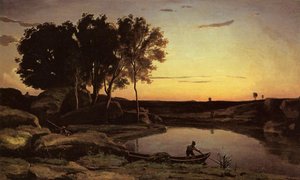
In Evening - Distant Tower, the landscape is defined by a layering of light and shadow across a forest setting at dusk. The foreground contains dark, silhouetted trees that frame the central view. These vertical forms are rendered in muted, earthy tones, creating a boundary for the eye. Beyond this immediate layer, the sky transitions through shades of orange and yellow, suggesting the presence of a setting sun. A small building or tower is visible on the horizon, its shape softened by the atmospheric haze of the evening. The light appears diffused, filtering through the foliage to create a sense of depth between the closer trees and the distant landscape elements.
The painting utilizes glazing, a technique where thin, translucent washes of pigment are applied over previous layers. This method builds a luminosity within the sky and the leaves. The brushwork avoids sharp, precise outlines in favor of soft edges that mimic the effect of twilight. The color palette relies on tonal variations rather than high contrast, using pearly-gold tones and pinkish-yellow clouds to establish the atmosphere of the late day.
Historical Context and Artistic Intent
Created around 1860, this oil on canvas represents a period of transition in French landscape painting. The work sits between the structured traditions of Neoclassicism and the emerging focus on light found in Impressionism. While the composition maintains a clear structure with its anchored focal points, the emphasis shifts toward capturing the sensory experience of a specific moment in time. The artist focused on the subtle interplay of light and shadow, prioritizing atmospheric effects over meticulous topographical detail.
The painting is currently held within the collection of the Musée d'Orsay in Paris, France. It reflects a movement toward plein-air observation, where the goal was to translate the actual appearance of nature onto the canvas. The use of light to suggest the passage of time—moving from day into darkness—introduces themes of transition and quietude. The presence of the distant tower provides a sense of scale, placing human architecture within the larger expanse of the natural environment.
Spørsmål og svar
Hva er reproduksjonsrettighetene til "Evening - Distant Tower" hos Musée d'Orsay?
Opphavsretten til "Evening - Distant Tower" av Jean-Baptiste-Camille Corot er klar: verket er i det frie domene – opphavsretten har utløpt. At det befinner seg hos Musée d'Orsay, endrer ikke denne statusen.
Hvilken atmosfære har "Evening - Distant Tower"?
Den overordnede stemningen i "Evening - Distant Tower" av Jean-Baptiste-Camille Corot er Serene. Stemningen beskriver verkets generelle atmosfære.
Hvilken stemning og følelse forenes i "Evening - Distant Tower"?
"Evening - Distant Tower" av Jean-Baptiste-Camille Corot formidler en Tranquil følelse innenfor en overordnet Serene stemning.
Relaterte kunstverk



Kunstnerbiografi
A Life Immersed in Light and Landscape
Jean-Baptiste-Camille Corot, a name that resonates with the tranquil beauty of 19th-century French landscape painting, was born into a comfortable Parisian bourgeois family on July 16, 1796. Though initially steered towards a commercial path, destiny – and perhaps an innate artistic sensibility – intervened. His early years were marked by an unconventional upbringing; entrusted to the care of a nurse in the countryside near L’Isle-Adam until age four, he developed a profound connection with nature that would indelibly shape his artistic vision. This initial immersion in rural tranquility stood in stark contrast to the bustling city life awaiting him, yet it laid the foundation for a lifelong pursuit of capturing the ephemeral qualities of light and atmosphere. His parents, successful milliners, provided financial stability, allowing Corot the freedom to explore his burgeoning passion for painting after an unsuccessful attempt at mercantile pursuits – a rare privilege for aspiring artists of that era. This support was crucial, enabling him to dedicate himself fully to artistic training without the immediate pressures of earning a livelihood.From Academic Foundations to Plein-Air Innovation
Corot’s formal artistic education began with studies under Achille Etna Michallon and later Jean-Victor Bertin, both esteemed landscape painters steeped in the neoclassical tradition. This grounding instilled in him a meticulous approach to composition and form, emphasizing clarity and structure. However, Corot wasn't content merely replicating established styles; he yearned for something more authentic, a way to convey not just *what* he saw, but *how* it felt to be immersed within the landscape. A pivotal moment arrived with his first journey to Italy in 1825. The Roman Campagna, bathed in golden light and steeped in history, ignited his imagination. He spent years sketching and painting en plein air – directly from nature – a practice that was still relatively uncommon at the time. This dedication to direct observation allowed him to capture the subtle nuances of light and shadow, the delicate atmospheric effects that would become hallmarks of his style. He wasn’t simply recording topographical details; he was striving to evoke a mood, a feeling of tranquility and harmony. His early Italian works demonstrate a clarity of form and bright palette influenced by classical ideals, yet already hint at the softer, more evocative approach that would define his mature style. He meticulously studied the masters, copying their work in the Roman galleries, but always filtered these lessons through his own increasingly sensitive perception of nature.A Bridge Between Traditions
Corot’s artistic development wasn't linear; it was a delicate balancing act between tradition and innovation. He exhibited regularly at the Paris Salon, initially gaining recognition for works rooted in neoclassical conventions. However, as he continued to explore plein-air painting, his style began to evolve. He moved away from highly finished, detailed compositions towards looser brushwork and a more muted palette. This shift wasn't a rejection of academic principles entirely; rather, it was an attempt to infuse them with the immediacy and emotional resonance of direct observation. He became a master of tonalism, using subtle variations in value to create depth and atmosphere. His landscapes weren’t about dramatic narratives or grand gestures; they were about quiet contemplation, the beauty of everyday scenes – a forest glade, a sun-dappled meadow, a tranquil riverbank. This approach resonated with a growing audience seeking respite from the rapid industrialization and social upheaval of 19th-century France. He skillfully blended elements of realism with an almost poetic sensibility, creating landscapes that felt both familiar and deeply personal. He wasn’t interested in grand pronouncements or political statements; his art was about finding beauty in the ordinary, elevating the commonplace to a realm of serene contemplation.Legacy and Enduring Influence
Jean-Baptiste-Camille Corot’s influence on subsequent generations of artists is immeasurable. He served as a crucial link between the neoclassical tradition and the emerging Impressionist movement. Artists like Monet, Pissarro, and Sisley deeply admired his ability to capture the fleeting effects of light and atmosphere, and they built upon his innovations in their own groundbreaking work. Corot’s emphasis on direct observation and plein-air painting paved the way for the Impressionists' radical departure from studio-based practices. However, Corot wasn’t simply a precursor to Impressionism; he was a unique and significant artist in his own right. His vast output – encompassing landscapes, portraits, and figure studies – continues to captivate audiences with its serene beauty and emotional depth. His works can be found in major museums around the world, including the Musée des Beaux-Arts in Dunkirk and the Musée Courbet in Ornans, France, as well as the National Gallery in London and the Metropolitan Museum of Art in New York. He died on February 22, 1875, leaving behind a legacy that continues to inspire artists and art lovers alike – a testament to the enduring power of light, landscape, and quiet contemplation. The Repose, Interrupted Reading, and Agostina remain iconic examples of his mastery, showcasing his ability to capture both the physical world and the inner life of his subjects with remarkable sensitivity and grace. His influence extends beyond painting; he fostered a spirit of artistic freedom and encouraged younger artists to find their own voice, solidifying his place as a pivotal figure in the history of art.
Jean-Baptiste-Camille Corot
1796 - 1875 , Frankrike
Kort om kunstneren
- Artistic Movement Or Style: Realisme, Impressjonisme
- Artists Or Movements Influenced By This Artist:
- Monet
- Pissarro
- Sisley
- Artists Who Influenced This Artist:
- Michallon
- Bertin
- Date Of Birth: 16. juli 1796
- Date Of Death: 22. februar 1875
- Full Name: Jean-Baptiste-Camille Corot
- Nationality: Fransk
- Notable Artworks:
- The Repose
- Interrupted Reading
- Agostina
- Place Of Birth: Paris, Frankrike
Relaterte artikler

Capturing Emotion: A Journey Through the Soul of Expressionist Landscapes
Explore the profound emotional depth of Expressionist landscapes. Discover how Post-Impressionist masters moved beyond light to capture the soul through vibrant color and form. A curated journey for true art lovers seeking the beauty of expressive mastery.
Utforsk kunstverk organisert etter temaer, stiler og kjennetegn.