Forhåndsvisning
 Send
Send Del
Del
 Vis detaljer
 Utskriftsvennlig guide

 Last ned bilde
 Liknende objekter
 Røntgenundersøkelse
 Lysbildefremvisning
 Spørsmål og svar
 Statistikk
Black Cross


 Vis hele teksten
Kazimir Malevich (1878-1935): Ukrainsk pioner innen abstrakt kunst & Suprematism. Oppdag ikoniske verk som Svart kvadrat, geometriske former og ren følelseskraftens innflytelse på 20. århundrets kunst.
Giclée / Kunsttrykk
Giclée- eller lerretsprint av museumskvalitet med rask produksjon og fleksible valgmuligheter for etterbehandling. ( Kjøp håndmalt maleri Bytt til digitalt bilde)




P118B Nkr10

P118H Nkr10

P118W Nkr10

P438Z Nkr10

P508JH Nkr12

P508YH Nkr12

P805H Nkr10

P805Z Nkr10

P919BZ Nkr10

P919G Nkr10

P919XJ Nkr10

P959ZH Nkr10

P968JZ Nkr12

W106C Nkr8

W218G Nkr10

W218JH Nkr8

W218Y Nkr10

W307PJ Nkr10

W316G Nkr10

W316PJ Nkr8

W316Y Nkr10

W398PJ Nkr8

W4111J Nkr10

W500HY Nkr15

W500JH Nkr15

W692G Nkr12

W849H Nkr8

W940BG Nkr15

W953PJ Nkr8




Standardformat
skreddersydd
CM
INCH
Velg mellom våre forhåndsdefinerte størrelser som bevarer kunstverkets opprinnelige proporsjoner.
Loading sizes...

bredde
høyde
Skriv inn ønsket bredde og høyde for å tilpasse trykket til din ramme eller vegg. Et trykk kan kun beskjæres, aldri skaleres opp utover motivets opprinnelige størrelse, noe som betyr at et format med andre proporsjoner vil føre til tap av deler av bildet. Vi sender deg en digital mockup for godkjenning før vi starter trykkeprosessen. Bildet som vises på denne siden viser ikke den faktiske beskjæringen — det er kun mockuppen som viser dette.
Verdensomspennende levering () på 2 uker i stedet for standard 4/5 uker. (5 November)

Gratis ekspressfrakt over hele verden

Lerretsduk av lin av høy kvalitet

Full transportforsikring

Garanti for refusjon av toll og importavgifter

Garantert fargegjengivelse

100 dagers returrett ved fabrikasjonsfeil

100% pengene tilbake-garanti

Rabatt ved flere kjøp
 Glassalternativet er kun tilgjengelig i størrelser under 110 cm

Black Cross
Giclée / Kunsttrykk
Størrelse på reproduksjon
-


Totalpris for valgte alternativer
Nkr 669
Black Cross by Kazimir Malevich: A Revolution in Geometric Abstraction
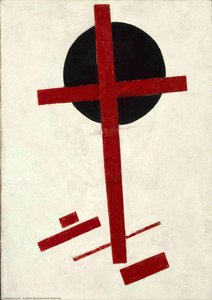
Kazimir Severinovich Malevich’s *Black Cross*, painted in 1915, stands as an emblem of Suprematism—a radical artistic movement that irrevocably altered the landscape of early 20th-century art. Born in Kyiv Oblast, Ukraine, in 1879 to a Polish family steeped in cultural traditions, Malevich’s formative years instilled within him a profound appreciation for visual narratives and folk artistry – an influence subtly woven into his groundbreaking explorations of pure geometric abstraction. This movement, spearheaded by Malevich himself in 1913, rejected the conventions of representational art, asserting that true artistic expression resided not in mirroring reality but in distilling it to its fundamental elements: simple shapes and colors devoid of illusionistic depth.- The Composition: At first glance, *Black Cross* presents a deceptively austere scene—a large black cross dominating a pristine white background punctuated by a smaller black square positioned centrally. This stark contrast immediately establishes a dynamic tension between opposing forces, mirroring Malevich’s philosophical conviction that art should transcend the limitations of objective observation and tap into the realm of pure feeling.
- Suprematism's Core Principles: Understanding *Black Cross* necessitates grasping the tenets of Suprematism. As articulated in “The Suprematism Art Movement: A Revolution in Abstract Art,” Malevich’s audacious démarche challenged established artistic dogma, questioning whether art could truly capture the essence of human experience beyond mere visual depiction.
- Technique and Materiality: Executed in oil on canvas, *Black Cross* exemplifies Malevich's meticulous attention to detail—a hallmark of his disciplined approach. The artist employed a layering technique, applying thin washes of white pigment to create subtle gradations within the background, thereby enhancing the perceived depth and dimensionality of the artwork despite its apparent simplicity.
Historical Context: Challenging Artistic Tradition
Painted during the turbulent years preceding World War I and amidst the burgeoning fervor for avant-garde experimentation across Europe, *Black Cross* arrived on the artistic scene as a defiant rebuke to prevailing stylistic trends—particularly Cubism’s fragmentation of form. Malevich's decision to abandon representational imagery was not merely aesthetic; it represented a profound epistemological assertion – a belief that art could liberate itself from the constraints of mimetic reproduction and unlock access to a more primal, spiritual dimension. The painting embodies the spirit of its time—a yearning for innovation and a rejection of inherited artistic conventions.Symbolism Beyond Representation
Despite its apparent lack of recognizable imagery, *Black Cross* resonates with layers of symbolic significance. The black cross itself harkens back to Christian iconography—representing sacrifice, faith, and redemption—yet Malevich deliberately stripped away any explicit religious connotations. Instead, he sought to convey a more universal concept: the primacy of pure artistic feeling over objective observation. The juxtaposition of black and white serves as a powerful visual metaphor for duality – darkness and light, silence and dynamism – reflecting Malevich’s preoccupation with exploring the fundamental forces shaping human consciousness.Emotional Impact and Legacy
*Black Cross* continues to captivate viewers today with its arresting simplicity and profound emotional resonance. Its austere palette—confined to monochrome hues—forces contemplation upon the observer, prompting a visceral response rooted in intuition rather than rational analysis. As exemplified by other artists of his era, such as Wassily Kandinsky’s *Concerning the Spiritual in Art*, Malevich's pioneering work paved the way for subsequent movements in abstract art—inspiring generations of artists to pursue radical experimentation and redefine the boundaries of artistic expression. Its enduring influence testifies to the transformative power of Suprematism and its indelible mark on the history of modern art.Spørsmål og svar
Hvem er kunstneren bak "Black Cross"?
Kunstneren bak "Black Cross" er Kazimir Malevich. Verket er katalogisert under Kazimir Malevich sitt navn.
Har "Black Cross" sterke lys-mørke-kontraster?
Kontrastnivået i "Black Cross" av Kazimir Malevich er Statement.
Hva anbefales en reproduksjon av "Black Cross" av Kazimir Malevich til?
Anbefalt bruk av et trykk av "Black Cross" er Accent.
Om kunstneren
Kazimir Malevich: En pioner innen abstrakt kunst
Tidlig liv og påvirkninger
- Født i Kyiv-regionen i Ukraina i 1878 inn i en polsk familie, ble Kazimir Severinovich Malevichs tidlige år formet av det ukrainske kulturlandskapet og dets rike folkekultur.
- Hans oppvekst ga ham en dyp verdsettelse for tradisjonelle kunstneriske uttrykk, noe som senere skulle prege hans verk på en subtil måtermåte.
- Den formelle utdannelsen startet i Kyiv, men Malevich søkte raskt bredere kunstneriske horisonter ved å bevege seg mot Moskva, hvor han til slutt ble en del av de fremvoksende avantgarde-bevegelsene i Europa.
- Viktige påvirkninger: Tidlig eksponering for folkekunst, kombinert med et ønske om moderne uttrykk, la selve fundamentet for hans unike stil.
Kunstnerisk utvikling og sentrale bevegelser
- I begynnelsen utforsket Malevich ulike stiler, inkludert impresjonisme, symbolisme, fauvisme og kubisme. En avgjørende reise til Paris i 1912 eksponerte ham for de nyeste utviklingene innen europeisk kunst.
- Han beveget seg gradvis bort fra representative former, i søken etter et rent kunstnerisk språk basert på geometriske former og farge.
- Dette førte til utviklingen av suprematisme rundt 1915 – en abstrakt bevegelse fokusert på «det rene følelsens overlegenhet» i kunsten.
- Suprematismen forkastet ethvert forsøk på å avbilde objekter fra den synlige verden, og prioriterte i stedet grunnleggende geometriske former som kvadrater, sirkler og rektangler.
Store bragder og bemerkelsesverdige verk
- Svart kvadrat (1915): Hans kanskje mest berømte verk, som representerer et radikalt brudd med tradisjonell kunst og regnes som et grunnleggende stykke innen abstrakt maleri.
- Hvit på hvit (1918): En serie som utforsker formens og fargens renhet, med hvite geometriske former mot en hvit bakgrunn – noe som presset abstraksjonen til dens ytterste grenser.
- Stroyuschiysya dom [Hus under konstruksjon] (1916): Et tidlig eksempel på suprematisme som viser hans unike perspektiv på ukrainsk kultur gjennom abstrakte former.
- Han skrev også omfattende om kunstteori, hvor han artikulerte de filosofiske prinsippene bak suprematismen og argumenterte for en ny kunstnerisk bevissthet.
Historisk betydning og ettermæle
- Malevichs arbeid hadde en dyp innvirkning på utviklingen av det 20. århundrets abstrakte kunst, og påvirket bevegelser som minimalisme og konstruktivisme.
- Han utfordret konvensjonelle forestillinger om representasjon og banet vei for ikke-objektiv kunst.
- Hans ideer om ren følelse og geometrisk abstraksjon fortsetter å resonnere hos kunstnere den dag i dag.
- Til tross for politisk forfølgelse under Stalin – hvor han først ble støttet, men deretter undertrykt – holdt Malevich ut i sin kunstneriske praksiv og undervisning.
- Innflytelse på senere kunstnere: Han påvirket direkte kunstnere som El Lissitzky og formet indirekte utallige andre gjennom suprematismens varige arv.
Siste år og død
- I sine senere år vendte Malevich tilbake til figurativt maleri, i et forsøk på å syntetisere sine abstrakte prinsipper med representative former.
- Han fortsatte å undervise og skrive om kunst helt frem til sin død i Leningrad (nå St. Petersburg) i 1935.
- Hans arbeid forble relativt ukjent i flere tiår etter hans død, men opplevde en renessanse i andre halvdel av det 20. århundre, noe som sementerte hans plass som en av de viktigste skikkelsene i moderne kunsthistorie.

Kazimir Malevich
1878 - 1935 , Ukraina
Kort om kunstneren
- Artistic Movement Or Style: Suprematisme, Abstrakt kunst
- Artists Or Movements Influenced By This Artist:
- Minimalisme
- Konstruktivisme
- El Lissitzky
- Artists Who Influenced This Artist:
- Impressionisme
- Fauvisme
- Cubisme
- Date Of Birth: 1878
- Date Of Death: 1935
- Full Name: Kazimir Severinovich Malevich
- Nationality: Ukrainsk/Russisk
- Notable Artworks:
- Svart sirkel
- Komposisjon
- White on White
- Place Of Birth: Kyiv, Ukraina
Relaterte artikler

Kazimir Malevich' Top 25 Kunstverk: En Suprematistisk Reise for Din Vegg
Oppdag Kazimir Malevich' 25 mest ikoniske kunstverk! Fordyp deg i Suprematismens verden, fra det banebrytende 'Svart Kvadrat' til subtile fargepaletter. Finn din perfekte maleri reproduksjon og interiørinspirasjon på TopImpressionists.com.

Geometrisk Abstraksjon: Topp 10 Mesterverk for Kunstelskere – TopImpressionists.com
Utforsk de 10 mest innflytelsesrike verkene innen geometrisk abstraksjon! Oppdag historiene bak Mondrian, Kandinsky og Malevich. Finn inspirasjon til interiøret med TopImpressionists.coms eksklusive reproduksjoner – museumskvalitet for ditt hjem. Utforsk samlingen online!

Kazimir Malevich: Pioneering Suprematism & the Quest for Non-Objective Art
Explore the revolutionary art of Kazimir Malevich & his groundbreaking Suprematism movement. Discover the origins, core principles, and lasting impact of this pivotal force in modern abstract painting.

Suprematism Explained: The Radical Geometry and Pure Feeling of Kazimir Malevich
Explore the radical world of Suprematism. Discover how Kazimir Malevich revolutionized modern art through pure geometric abstraction, non-objective form, and the supremacy of feeling. An essential guide for art students and collectors seeking deep historical context.

Beyond Form & Color: Geometric Abstraction's Evolution in 20th/21st Century Art
Explore the evolution of geometric abstraction from Cubism to contemporary art. Discover key artists like Malevich & Mondrian, investment insights, and expert collecting advice at TopImpressionists.
Utforsk kunstverk organisert etter temaer, stiler og kjennetegn.