
Shown: · With its frame:
 Forhåndsvisning
 Send
Send Del
Del
 Vis detaljer
 Utskriftsvennlig guide

 Last ned bilde
 Liknende objekter
 Røntgenundersøkelse
 Lysbildefremvisning
 Q&A
Q&A Statistikk
 Graphite
- WallArt
- Renaissance
 Renaissance
 22.0 x 15.0 cm
 Acción Cultural Española
Nkr 2590
Håndlaget oljereproduksjon
Håndmalt olje på lerret i din valgte størrelse og ramme, laget på bestilling av våre kunstnere. ( Bytt til trykk Bytt til digitalt bilde)
Size
·Standardformat
skreddersydd
CM
INCH
Velg mellom våre forhåndsdefinerte størrelser som bevarer kunstverkets opprinnelige proporsjoner.
Loading sizes...

bredde
høyde
Skriv inn ønsket bredde og høyde for å tilpasse bildet til din ramme eller vegg. Siden dette er håndmalt, kan kunstneren male litt mer rundt motivet eller beskjære det noe dersom du velger et annet format — valget er ditt. Vi sender deg en digital mockup til godkjenning før maleriet påbegynnes. Bildet som vises på denne siden representerer ikke det faktiske resultatet — kun mockuppen viser det endelige uttrykket.
 Les mer om dette
Finish
·
White Nkr1

Blurside Nkr1

Extended Nkr1

P118B Nkr10

P118H Nkr10

P118W Nkr10

P438Z Nkr10

P508JH Nkr12

P508YH Nkr12

P805H Nkr10

P805Z Nkr10

P919BZ Nkr10

P919G Nkr10

P919XJ Nkr10

P959ZH Nkr10

P968JZ Nkr12

W106C Nkr8

W218G Nkr10

W218JH Nkr8

W218Y Nkr10

W307PJ Nkr10

W316G Nkr10

W316PJ Nkr8

W316Y Nkr10

W398PJ Nkr8

W4111J Nkr10

W500HY Nkr15

W500JH Nkr15

W692G Nkr12

W849H Nkr8

W940BG Nkr15

W953PJ Nkr8

H24-GOLD Nkr30

H24-SILVER Nkr30

H36-GOLD Nkr45

H36-SILVER Nkr45
Shipped in a protective tube, ready for your own framer.
Above 105 cm the frame is shipped as a kit for a professional framer — read the details.
Extras
optionalWhat do the extras include?
Examples of what can be changed: Replace face with customer photo; Add pet (e.g., replace cat with dog); Include hidden message in background; Change background landscape or elements.
After order, TopImpressionists.com team will email client for instructions and provide a mockup preview
After order, TopImpressionists.com team will email client for instructions and provide a mockup preview
Verdensomspennende levering () på 3–4 uker i stedet for standard 5 uker. (31 October). Ingen kompromisser med kvaliteten.
Beskyttende ferniss
Navneskilt
Detaljer om gravert bronseplate
This elegant plaque features the artist's name and the title of the artwork, finely engraved for a timeless presentation.
It is made from bronze with a refined, elegant finish. The text is precisely laser-engraved for a sharp and permanent result. Measuring 9x2 cm, the plaque is compact yet easy to read. It's built to be durable and scratch-resistant, offering a professional, museum-quality look. Mounting is simple thanks to the included adhesive backing.
Detaljer om gjennomsiktig akrylplate
The plaque includes essential engraved details such as the artist's name, the title of the artwork, the date it was created, the type of media used-like oil on canvas or watercolor-a brief description of the piece, and a QR code that links to the complete artwork information.
It is crafted from clear acrylic, offering a sleek, modern appearance. The text is UV-engraved in black to ensure strong visual contrast. With a size of 10x15 cm, it ensures optimal readability. It comes equipped with two metal hooks for secure wall mounting. The plaque is designed to be weather-resistant, making it suitable for various environments, and it includes interactive features that work seamlessly with smartphone scanning.
Detaljer om plakett i svart akryl
This elegant plaque includes engraved information such as the artist's name, the title of the artwork, the date it was created, the type of media used (like oil on canvas or watercolor), a short description of the artwork, and a QR code for quick access to more information.
The plaque itself is made from refined black acrylic with a premium finish. The text is laser-engraved in white for high contrast and readability. Its size is 10x15 cm, designed to be easy to read. It comes with two metal hooks for professional mounting. The design is sleek and fits any interior style. It is also weather-resistant and durable, with built-in digital integration for mobile compatibility.
Glassalternativet er kun tilgjengelig i størrelser under 110 cm
 Glassalternativet er kun tilgjengelig i størrelser under 110 cm
- Gratis ekspressfrakt over hele verden
- Lerretsduk av lin av høy kvalitet
- Full transportforsikring
- Garanti for refusjon av toll og importavgifter
- Garantert fargegjengivelse
- 100 dagers returrett ved fabrikasjonsfeil
- 100% pengene tilbake-garanti
- Rabatt ved flere kjøp


Beskrivelse av objektet
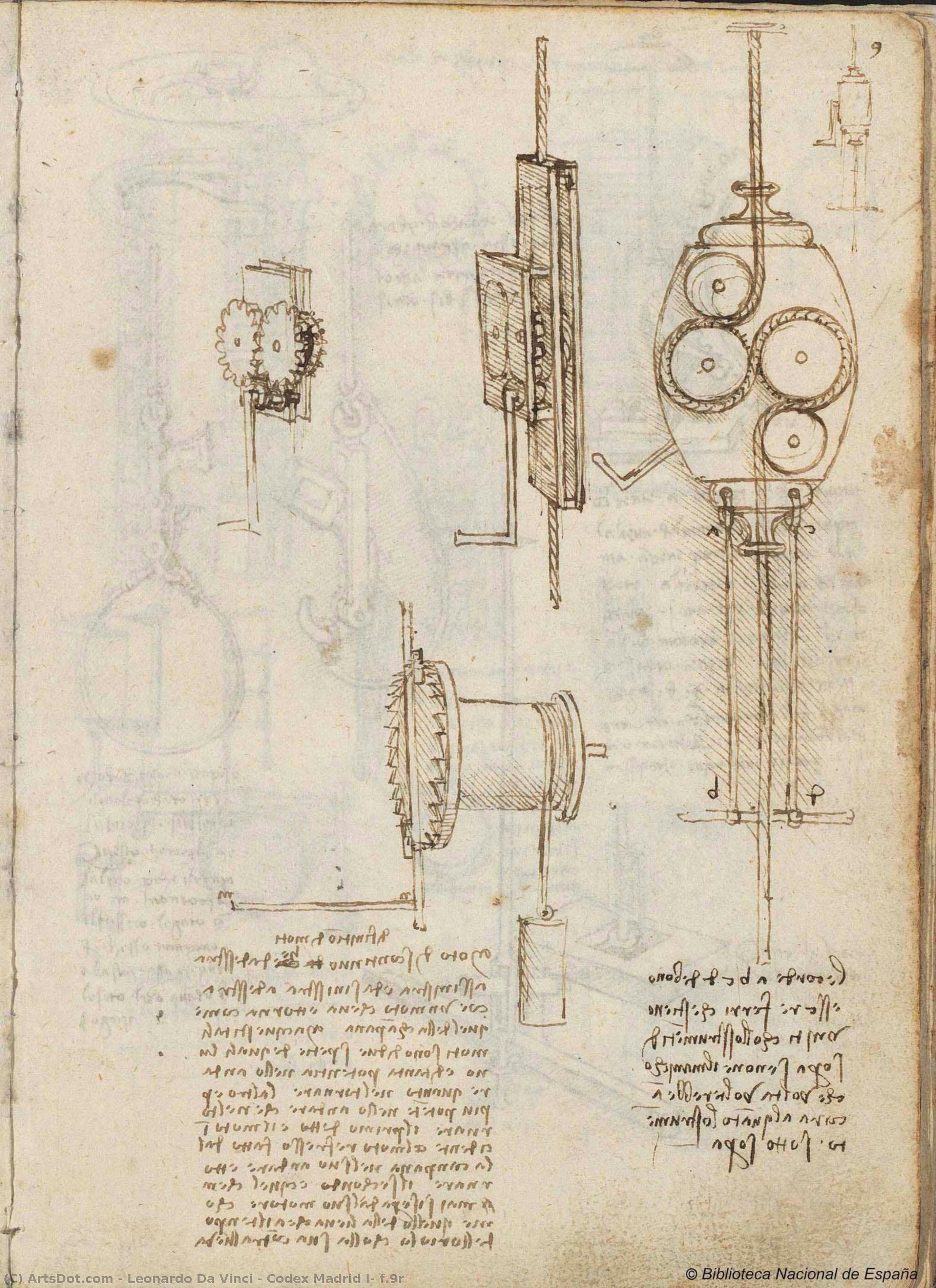
Explore Leonardo da Vinci's Codex Madrid I, f.9r – a meticulously detailed drawing of an ingenious mechanical device schematics labeled in Latin. Admire the Renaissance master’s scientific curiosity and artistic brilliance.
Om kunstneren
Utforsk Leonardo da Vinci (1452-1519): Renessansegeni bak Mona Lisa og Det siste måltid! Oppdag hans sfumato-teknikk, anatomiske studier og banebrytende oppfinnelser.
About the painting
A Mechanical Revelation: Decoding Leonardo’s Vision
To gaze upon the Codex Madrid I, folio 9r is to witness a profound moment of intellectual transcendence, where the boundaries between scientific inquiry and artistic mastery dissolve into a single, breathtaking vision. This singular drawing by Leonardo da Vinci serves as much more than a mere technical schematic; it is a window into the very soul of the Renaissance mind. Within these delicate graphite lines, we find the restless spirit of a polymath who refused to accept the limits of the known world. The folio presents an intricate, detailed illustration of an experimental hydraulic device, a complex machine that whispers of Da Vinci’s relentless pursuit of understanding the natural world through the lens of practical engineering and geometric precision.
The subject matter itself is a testament to Leonardo's fascination with the mechanics of life and motion. The drawing portrays a detailed schematic of what appears to be an experimental hydraulic device, perhaps conceived as a method for lifting heavy objects or channeling the raw power of water. Each component is rendered with such meticulous care that one can almost sense the movement of fluid through its channels. There is a quiet, rhythmic beauty in the way the machine's parts are laid out, suggesting a harmony between human ingenuity and the elemental forces of nature. For the collector or the admirer of fine art, this piece offers a rare glimpse into the "pre-industrial" imagination—a blueprint for a future that Leonardo was already dreaming of centuries before its time.
The Mastery of Line and Light
Technically, the folio is a masterclass in observational drawing. Executed with graphite on paper, the work demonstrates Da Vinci's unparalleled ability to use simple tools to convey profound structural integrity. The lines are not merely marks on a page; they are carefully calculated strokes designed to communicate accurate proportions and weight. Through subtle yet effective shading, Leonardo creates a sense of three-dimensional depth, allowing the various mechanical components to emerge from the paper with a palpable presence. This interplay of light and shadow does more than define shape—it breathes life into the inanimate, transforming a technical diagram into a work of evocative fine art.
The aesthetic appeal of this piece lies in its deceptive simplicity. While the content is scientific, the execution is deeply artistic. The way the text—labels written in Latin—intertwines with the mechanical drawings creates a beautiful, organic texture across the parchment. This integration of language and image reflects the Renaissance ideal that art and science are not separate disciplines, but rather two sides of the same coin. For an interior designer, such a piece provides a sophisticated focal point, offering a sense of intellectual depth and historical gravity to any curated space.
A Legacy of Infinite Curiosity
The historical context of the Codex Madrid I places it within the heart of Leonardo’s most prolific era. During this period, Da Vinci was actively engaged in developing technologies that would bridge the gap between medieval tradition and modern innovation. This drawing is a tangible manifestation of his belief that by documenting our observations, we can unlock the secrets of the universe for future generations. It represents a period of significant advancement in engineering and mechanics, where the artist’s eye was just as vital to discovery as the scientist's logic.
Beyond its mechanical utility, the folio carries a profound emotional impact. There is an inherent sense of wonder embedded in every stroke—a feeling of standing on the precipice of discovery. It evokes a sense of nostalgia for the era of the "universal man," reminding us of a time when human potential seemed limitless. Owning or displaying a high-quality reproduction of this work is not merely about decorating a wall; it is about inviting the spirit of innovation, curiosity, and timeless genius into one's personal environment. It serves as a constant reminder that through observation and imagination, we can decode the very mechanics of our existence.
Spørsmål og svar
Er bildet av "Codex Madrid I, f.9r" av Leonardo Da Vinci i det frie domene?
Opphavsrettslig status for "Codex Madrid I, f.9r" av Leonardo Da Vinci: verket er fritt tilgjengelig – opphavsretten har utløpt. Dette avgjør om det er tillatt å lage frie reproduksjoner av bildet.
Hvor kjent er "Codex Madrid I, f.9r" av Leonardo Da Vinci?
Popularitetsnivået som er registrert for "Codex Madrid I, f.9r" av Leonardo Da Vinci, er Iconic.
Hvordan harmonerer fargene i "Codex Madrid I, f.9r" med hverandre?
Fargene i "Codex Madrid I, f.9r" av Leonardo Da Vinci utviser en Unified Palette harmoni. Harmoni beskriver hvordan fargene samspiller med hverandre.
Quick facts and art quiz
About Leonardo Da Vinci

Leonardo Da Vinci
1452 - 1519, Italia
Om kunstneren
Leonardo da Vincis liv og ettermæle.
Leonardo di ser Piero da Vinci, født i 1452 nær den toskanske landsbyen Vinci, står utvilsomt som den mest universelt anerkjente skikkelsen fra renessansen – et ekte polygen som med sin umettelige nysgjerrighet beveget seg på tvers av disipliner og etterlot et uutslettelig preg på kunst, vitenskap og ingeniørkunst. Selve navnet hans har blitt synonymt med genialitet, et vitnesbyrd om hans ekstraordinære bredde i talent og visjonære tenkning. Leonardo ble født utenfor ekteskap av Piero da Vinci, en notarius, og Caterina, en bondekvinne, og hans tidlige liv var ukonvensjonente, men det ga ham tilgang til både den praktiske verden og en dyp forståelse for naturen som skulle forme hans kunstneriske visjon. Han mottok en grunnleggende utdanning i lesing, skriving og aritmetikk, men det var lærlingtiden under Andrea del Verrocchio i Firenze som virkelig tente hans kreative gnist. I Verrocchios verksted lærte ikke Leonardo bare å male eller skulpturere; han ble fordypet i en verden av teknisk ferdighet, der han mestret metallarbeid, snekring, tegning og de intrikate detaljene i den kunstneriske skapelsen – et fundament som han senere skulle bygge sin mangefasetterte genialitet på. Selv i denne formative perioden svirret ryktene om hans eksepsjonelle talent, og historier forteller at Verrocchio selv la ned penselen etter å ha vært vitne til Leonardos overlegne evner.
Milanesiske innovasjoner og kunstnerisk blomstring
I 1482 påbegynte Leonardo et nytt kapittel da han trådte inn i tjenesten til Ludovico Sforza, hertugen av Milano. Dette var ikke bare en kunstnerisk stilling; Leonardo fungerte som militæringeniør, arkitekt, skulptør og designer for hoffet – et bevis på hans mangfoldige ferdigheter. Han utformet innovative festningsverk, designet forseggjorte scenografier og skisserte til og med planer for fantastiske maskiner. Det var imidlertid i denne perioden han begynte arbeidet på et av sine mest ikoniske mesterverk: Det siste måltid. Malt som en freske i refektoriet i klosteret Santa Maria delle Grazie, transcenderer verket ren representasjon; det er en dyp utforskning av menneskelige følelser og psykologisk drama, som fanger det nøyaktige øyeblikket Kristus kunngjør sitt svik. Komposisjonen, som var banebrytende for sin tid, og den mesterlige bruken av perspektiv, skulle prege vestlig kunst i århundrer fremover. Selv om mange skulpturelle prosjekter forble ufullstendige under hans milanesiske periode, fortsatte Leonardos oppfinnsomme ånd å blomstre og la grunnlaget for fremtidige vitenskapelige oppdagelser.
Returen til Firenze og jakten på perfeksjon
Etter den franske invasjonen av Milano i 1499, vendte Leonardo tilbake til Firenze, en by som befant seg på toppen av sin kunstneriske utvikling. Selv om han fullførte færre verk i denne perioden, var deres innvirkning enorm. Det var her han begynte arbeidet med det som skulle bli verdens kanskje mest berømte maleri: Mona Lisa (La Gioconda). Motivets gåtefulle smil og fengslende blikk har fascinert betraktere i generasjoner, mens Leonardos revolusjonerende sfumato-teknikk – den subtile overgangen mellom lys og skygge for å skape uklare konturer og atmosfærisk perspektiv – bidro betydelig til maleriets eteriske kvalitet. Denne perioden var også preget av en kontinuerlig foredling av hans anatomiske studier, drevet av et urokkelig ønske om å forstå menneskekroppen med vitenskapelig presisjon. Han dissekerte lik og dokumenterte muskler, bein og organer med nitid nøyaktighet i en serie utrolig detaljerte tegninger som lå århundrer forut for sin tid.
Et ettermæle hinsides kunsten: Vitenskap, oppfinnelser og varig innflytelse
Leonardos senere år var preget av reiser mellom Firenze, Milano og Roma, hvor han alltid ble ettertraktet for sin ekspertise, men ofte etterlot prosjekter ufullstendige – kanskje en refleksjon av hans rastløse intellekt og de enorme omfangene av hans interesser. I 1516 takket han ja til en invitasjon fra kong Frans I om å leve og arbeide ved Château du Clos Lucé nær Amboise i Frankrike, hvor han tilbrakte sine siste år. Han døde der i 1519 og etterlot seg en enorm arv som strekker seg langt utover kunstens domene. Hans notatbøker avslører banebrytende arbeid innen anatomi, optikk, hydraulikk, geologi og kartografi – og han konseptualiserte oppfinnelser som lå århundrer forut for sin tid, inkludert flyvemaskiner, stridsvogner og avanserte våpen. Leonardo da Vincis innvirkning på kunsthistorien er uoppnåelig stor. Han hevet kunstnerens status fra dyktig håndverker til intellektuell skikkelse, og demonstrerte at kunstnerisk skapelse kunne næres av vitenskapelig undersøkelse og en dyp forståelse av den naturlige verden. Hans malerier hylles for sin realisme, psykologiske dybde og innovative teknikker. Han forblir et symbol på menneskelig nysgjerrighet, kreativitet og den utrettelige jakten på kunnskap – en sann legemliggjøring av renessansens ånd, hvis arv fortsetter å inspirere med ærefrykt og fascinasjon flere århundrer etter hans død.
Viktige bragder og varig betydning
- Maleri: Mona Lisa, Det siste måltid, Madonnan i klippene, Bebudelsen
- Tegning og skissering: Omfattende anatomiske studier, ingeniørdesign (flyvemaskiner, våpen), botaniske illustrasjoner
- Vitenskap og ingeniørkunst: Banebrytende arbeid innen anatomi, optikk, hydraulikk, geologi og kartografi. Konseptualiserte oppfinnelser som lå århundrer forut for sin tid.
Quick facts about Leonardo Da Vinci
- Artistic Movement Or Style: Høyrenessansen
- Artists Or Movements Influenced By This Artist: ['Renessansekunst']
- Artists Who Influenced This Artist: ['Andrea del Verrocchio']
- Date Of Birth: 15. april 1452
- Date Of Death: 2. mai 1519
- Full Name: Leonardo di ser Piero da Vinci
- Nationality: Italiensk
- Notable Artworks:
- Mona Lisa
- Nattverden
- Vitruviansk mann
- Place Of Birth: Vinci, Italia
Utforsk kunstverk organisert etter temaer, stiler og kjennetegn.


Leonardo Da Vinci
Codex Madrid I, f.9r
() ·
With its frame: · Hand-painted in oil on linen
Total