

Shown: · With its frame:
 Forhåndsvisning
 Send
Send Del
Del
 Vis detaljer
 Utskriftsvennlig guide

 Last ned bilde
 Liknende objekter
 Røntgenundersøkelse
 Lysbildefremvisning
 Q&A
Q&A Statistikk
 Chalk
Chalk- Northern Renaissance
 1520
1520 316.0 x 215.0 cm
 Staatliche Museen zu Berlin
Nkr 2590
Håndlaget oljereproduksjon
Håndmalt olje på lerret i din valgte størrelse og ramme, laget på bestilling av våre kunstnere. ( Bytt til trykk Bytt til digitalt bilde)
Size
·Standardformat
skreddersydd
CM
INCH
Velg mellom våre forhåndsdefinerte størrelser som bevarer kunstverkets opprinnelige proporsjoner.
Loading sizes...

bredde
høyde
Skriv inn ønsket bredde og høyde for å tilpasse bildet til din ramme eller vegg. Siden dette er håndmalt, kan kunstneren male litt mer rundt motivet eller beskjære det noe dersom du velger et annet format — valget er ditt. Vi sender deg en digital mockup til godkjenning før maleriet påbegynnes. Bildet som vises på denne siden representerer ikke det faktiske resultatet — kun mockuppen viser det endelige uttrykket.
 Les mer om dette
Finish
·
White Nkr1

Blurside Nkr1

Extended Nkr1

P118B Nkr10

P118H Nkr10

P118W Nkr10

P438Z Nkr10

P508JH Nkr12

P508YH Nkr12

P805H Nkr10

P805Z Nkr10

P919BZ Nkr10

P919G Nkr10

P919XJ Nkr10

P959ZH Nkr10

P968JZ Nkr12

W106C Nkr8

W218G Nkr10

W218JH Nkr8

W218Y Nkr10

W307PJ Nkr10

W316G Nkr10

W316PJ Nkr8

W316Y Nkr10

W398PJ Nkr8

W4111J Nkr10

W500HY Nkr15

W500JH Nkr15

W692G Nkr12

W849H Nkr8

W940BG Nkr15

W953PJ Nkr8

H24-GOLD Nkr30

H24-SILVER Nkr30

H36-GOLD Nkr45

H36-SILVER Nkr45
Shipped in a protective tube, ready for your own framer.
Above 105 cm the frame is shipped as a kit for a professional framer — read the details.
Extras
optionalWhat do the extras include?
Examples of what can be changed: Replace face with customer photo; Add pet (e.g., replace cat with dog); Include hidden message in background; Change background landscape or elements.
After order, TopImpressionists.com team will email client for instructions and provide a mockup preview
After order, TopImpressionists.com team will email client for instructions and provide a mockup preview
Verdensomspennende levering () på 3–4 uker i stedet for standard 5 uker. (31 October). Ingen kompromisser med kvaliteten.
Beskyttende ferniss
Navneskilt
Detaljer om gravert bronseplate
This elegant plaque features the artist's name and the title of the artwork, finely engraved for a timeless presentation.
It is made from bronze with a refined, elegant finish. The text is precisely laser-engraved for a sharp and permanent result. Measuring 9x2 cm, the plaque is compact yet easy to read. It's built to be durable and scratch-resistant, offering a professional, museum-quality look. Mounting is simple thanks to the included adhesive backing.
Detaljer om gjennomsiktig akrylplate
The plaque includes essential engraved details such as the artist's name, the title of the artwork, the date it was created, the type of media used-like oil on canvas or watercolor-a brief description of the piece, and a QR code that links to the complete artwork information.
It is crafted from clear acrylic, offering a sleek, modern appearance. The text is UV-engraved in black to ensure strong visual contrast. With a size of 10x15 cm, it ensures optimal readability. It comes equipped with two metal hooks for secure wall mounting. The plaque is designed to be weather-resistant, making it suitable for various environments, and it includes interactive features that work seamlessly with smartphone scanning.
Detaljer om plakett i svart akryl
This elegant plaque includes engraved information such as the artist's name, the title of the artwork, the date it was created, the type of media used (like oil on canvas or watercolor), a short description of the artwork, and a QR code for quick access to more information.
The plaque itself is made from refined black acrylic with a premium finish. The text is laser-engraved in white for high contrast and readability. Its size is 10x15 cm, designed to be easy to read. It comes with two metal hooks for professional mounting. The design is sleek and fits any interior style. It is also weather-resistant and durable, with built-in digital integration for mobile compatibility.
Glassalternativet er kun tilgjengelig i størrelser under 110 cm
 Glassalternativet er kun tilgjengelig i størrelser under 110 cm
- Gratis ekspressfrakt over hele verden
- Lerretsduk av lin av høy kvalitet
- Full transportforsikring
- Garanti for refusjon av toll og importavgifter
- Garantert fargegjengivelse
- 100 dagers returrett ved fabrikasjonsfeil
- 100% pengene tilbake-garanti
- Rabatt ved flere kjøp


Beskrivelse av objektet
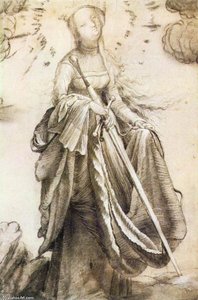
Admire Matthias Grünewald's 'St Catherine,' a captivating chalk drawing from 1520. Explore the Northern Renaissance master’s unique style, featuring a serene saint and symbolic details – available as a hand-painted replica.
Om kunstneren
Matthias Grünewald var en fremtredende tysk renessanse-maler kjent for sin dramatiske og følelsesladde religiøse kunst, spesielt Isenheim-altarretavlen. Hans verk utforsker lidelse og åndelighet med et unikt, middelalderlig uttrykk.
About the painting
The Enigmatic Saint: Matthias Grünewald’s St Catherine
Matthias Grünewald's 1520 chalk drawing, “St Catherine,” is more than just a portrait; it’s a profound meditation on faith, scholarship, and the enduring power of medieval symbolism. This remarkable work, currently residing in the Staatliche Museen zu Berlin, offers a captivating glimpse into the artist’s unique vision – a synthesis of late Gothic sensibilities with nascent Renaissance influences. Grünewald, a pivotal figure in German art, deliberately eschewed the prevailing Italian humanist trends, instead drawing deeply from the rich traditions of Central European religious painting, resulting in an intensely personal and emotionally resonant style.
The image depicts St Catherine from the waist up, her head tilted slightly downwards as if lost in contemplation. Her posture exudes a quiet dignity, while the subtle turn of her neck invites us into her inner world. She’s dressed in a gown with voluminous sleeves – a detail that speaks to both the formality of her status and the luxurious fabrics favored by wealthy patrons during the period. Crucially, she holds two objects: an open book or manuscript, symbolizing her role as a learned scholar, and a sword raised upright, representing her martyrdom and unwavering faith. These symbols aren’t merely decorative; they are potent visual statements about Catherine's life and devotion.
A Study in Northern Renaissance Technique
Grünewald’s masterful technique is immediately apparent. The drawing is executed with exquisite detail using chalk on paper, a medium that allowed for the delicate shading and fine lines characteristic of his work. Notice the subtle gradations of tone – the way light catches on her dress, the modeling of her face, and the atmospheric haze in the background. This meticulous attention to texture and form creates a remarkable sense of depth and realism, despite the relatively small scale of the piece. The artist’s use of chalk also lends a slightly ethereal quality to the image, contributing to its contemplative mood.
Furthermore, Grünewald's style deviates significantly from the prevailing Renaissance aesthetic. Unlike the idealized figures favored by artists like Albrecht Dürer, Catherine is rendered with a certain distortion – her proportions aren’t perfectly symmetrical, and her features possess an expressive intensity. This deliberate departure from classical ideals reflects Grünewald’s commitment to conveying emotional truth rather than purely visual accuracy. The background, deliberately minimalistic, consists of only a few suggestive lines—perhaps hinting at a cloudy sky or an abstract representation of the heavens – further emphasizing the saint's presence and drawing our focus entirely onto her.
Historical Context and Symbolic Resonance
Created in 1520, “St Catherine” exists within a fascinating transitional period in art history. Grünewald was working at a time when the influence of Italian Renaissance humanism was beginning to spread across Europe, yet he remained firmly rooted in the traditions of late medieval Central European painting. The saint herself holds significant religious importance – she is venerated as a martyr and patron saint of scholars, librarians, and translators. Her story, recounted in early Christian hagiographies, details her conversion after being saved from execution by St Peter, who recognized her divine calling.
Interestingly, the figure of Catherine has been associated with intellectual pursuits for centuries. Her association with learning stems from her devotion to scripture and her role as a translator of the Bible. The book she holds in the drawing symbolizes this scholarly dedication, while the sword represents her willingness to defend her faith against persecution. The combination of these symbols creates a powerful image of a woman who embodies both spiritual strength and intellectual prowess.
A Legacy of Emotion and Innovation
“St Catherine” is a testament to Matthias Grünewald’s artistic genius – a work that seamlessly blends technical skill with profound emotional depth. It's a poignant reminder of the artist’s ability to capture not just the likeness of his subject, but also her inner world. The drawing’s enduring appeal lies in its ability to evoke a sense of quiet contemplation and spiritual yearning. As a significant example of Northern Renaissance art, it continues to inspire artists and scholars alike, offering a valuable window into the artistic and intellectual landscape of 16th-century Germany.
Spørsmål og svar
Hvilken orientering har "St Catherine" av Matthias Grünewald?
Formatet på "St Catherine" er Portrait. Dette er nyttig når du planlegger hvor en reproduksjon skal plasseres.
Hvilket museum har det originale verket "St Catherine"?
Du kan se originalen av "St Catherine" på Staatliche Museen zu Berlin, Berlin, Germany.
Hvilken teknikk er "St Catherine" laget med?
Matthias Grünewald brukte Chalk-teknikken i "St Catherine". Teknikken definerer det materielle uttrykket til det originale verket.
Quick facts and art quiz
About Matthias Grünewald

Matthias Grünewald
1480 - 1528, Tyskland
Om kunstneren
Matthias Grünewald: Liv og ettermæle
Tidlig liv og kunstneriske begynnelse
Matthias Grünewald, født Mathis Gothart Neithardt rundt 1470-1475 i Würzburg, Tyskland, var en skjellsettende skikkelse i den tyske renessansen. Til tross for at han levde i en tid som i økende grad ble påvirket av italienske renessanseidealer, forble Grünewald dypt forankret i de kunstneriske tradisjonelse fra senmiddelalderens Sentral-Europa. Det er få detaljer tilgjengelige om hans tidlige liv, men det er kjent at han mottok sin kunstneriske opplæring, sannsynligvis innenfor lokale verksteder.
Kunstnerisk utvikling og påvirkninger
Grünewalds kunstneriske utvikling ble formet av de rådende nordeuropeiske tradisjonene preget av realisme, emosjonell intensitet og detaljert observasjon. Hans arbeid viser tydelig påvirkning fra kunstnere som Albrecht Dürer og Martin Schongauer, men han staket ut sin egen unike vei, karakterisert av dramatisk uttrykk og levende farger. Han var ikke direkte involvert i de humanistiske kretsene som var fremtredende i Italia; i stedet tjente kunsten hans primært religiøse formål, der den reflekterte sin tids åndelige angst og eksistensielle spørsmål.
Hovedverker og kunstnerisk stil
- Isenheim-altaret (1512-1516): Dette mesterverket, som huseres i Musée d'Unterlinden i Colmar, regnes som Grünewalds magnum opus. Det skildrer scener fra Kristi liv med en hjemsøkende realisme, med et særlig fokus på lidelse og frelse.
- Korsfestelsen (ca. 1502-150: Et tidlig verk som demonstrerer hans utviklende stil, og som viser frem intens emosjon og anatomisk detaljrikdom.
- Jomfruen ved bebudelsen (1512-14): En studie til Isenheim-altaret som avslører hans nitidige planleggingsprosess.
- Moses (1511): En tegning som fremhever Grünewalds ferdighet i å fange uttrykksfulle figurer og dramatiske positurer.
Grünewalds stil utmerker seg ved følgende elementer:
- Dramatisk komposisjon: Han benyttet dynamiske arrangementer for å forsterke den emosjonelle slagkraften.
- Levende fargepalett: Bruken av intense, ofte kontrasterende farger skapte en kraftfull visuell opplevelse.
- Realistisk fremstilling av lidelse: Grünewald vek ikke unna å portrettere den fysiske og emosjonelle smerten knyttet til de religiøse fortellingene.
- Uttrykksfulle figurer: Hans skikkelser er gjennomsyret av sterke følelser og psykologisk dybde.
Historisk betydning og ettermæle
Grünewalds arbeid står som et vitnesbyrd om den vedvarende kraften i middelalderens kunstneriske tradisjoner i Tyskland under renessansen. Han bygget bro mellom den sengotiske stilen og den fremvoksende renessansen, og skapte et unikt visuelt språk som resonnerte med hans samtidige. Hans innflytelse kan ses hos senere tyske kunstnere som fortsatte å utforske temaer som religiøs glød og emosjonell intensitet. Selv om han i stor grad ble glemt i århundrene etter sin død i 1528, opplevde Grünewald en renessanse på 1800-tallet, og i dag anerkjennes han som en av de viktigste malerne i den tyske renessansen. Hans kunst fortsetter å trollbinde betrakteren med sin rå emosjon, tekniske briljans og dype åndelige alvor.
Videre utforskning
Oppdag mer om Matthias Grünewalds liv og verk hos: TopImpressionists
Quick facts about Matthias Grünewald
- Artistic Movement Or Style: Sen middelalderkunst
- Artists Or Movements Influenced By This Artist: ['Albrecht Dürer']
- Artists Who Influenced This Artist:
- Albrecht Dürer
- Hans Holbein den eldre
- Date Of Birth: ca. 1470/1480
- Date Of Death: 31. august 1528
- Full Name: Matthias Grünewald
- Nationality: Tysk
- Notable Artworks:
- Isenheim Altarpiece
- Korsfestelsen
- Place Of Birth: Würzburg, Tyskland
Utforsk kunstverk organisert etter temaer, stiler og kjennetegn.


Matthias Grünewald
St Catherine
() ·
With its frame: · Hand-painted in oil on linen
Total