


 Forhåndsvisning
 Send
Send Del
Del
 Vis detaljer
 Utskriftsvennlig guide

 Last ned bilde
 Liknende objekter
 Røntgenundersøkelse
 Lysbildefremvisning
 Q&A
Q&A Statistikk
The Grammar


Paul Sérusier's 'The Grammar' (1892) is an iconic Cloisonnism painting, pioneering abstract art & inspiring the Nabis movement. Explore its symbolism and artistic innovation.
 Vis hele teksten
Paul Sérusier (1864-1927) var en fransk maler som banet vei for abstrakt kunst og inspirerte Nabis-bevegelsen. Kjent for sin cloisonnism-stil og verk som "The Talisman", var han en pioner innen moderne kunst.
Giclée / Kunsttrykk
Giclée- eller lerretsprint av museumskvalitet med rask produksjon og fleksible valgmuligheter for etterbehandling. ( Kjøp håndmalt maleri Bytt til digitalt bilde)




P118B Nkr10

P118H Nkr10

P118W Nkr10

P438Z Nkr10

P508JH Nkr12

P508YH Nkr12

P805H Nkr10

P805Z Nkr10

P919BZ Nkr10

P919G Nkr10

P919XJ Nkr10

P959ZH Nkr10

P968JZ Nkr12

W106C Nkr8

W218G Nkr10

W218JH Nkr8

W218Y Nkr10

W307PJ Nkr10

W316G Nkr10

W316PJ Nkr8

W316Y Nkr10

W398PJ Nkr8

W4111J Nkr10

W500HY Nkr15

W500JH Nkr15

W692G Nkr12

W849H Nkr8

W940BG Nkr15

W953PJ Nkr8




Standardformat
skreddersydd
CM
INCH
Velg mellom våre forhåndsdefinerte størrelser som bevarer kunstverkets opprinnelige proporsjoner.
Loading sizes...

bredde
høyde
Skriv inn ønsket bredde og høyde for å tilpasse trykket til din ramme eller vegg. Et trykk kan kun beskjæres, aldri skaleres opp utover motivets opprinnelige størrelse, noe som betyr at et format med andre proporsjoner vil føre til tap av deler av bildet. Vi sender deg en digital mockup for godkjenning før vi starter trykkeprosessen. Bildet som vises på denne siden viser ikke den faktiske beskjæringen — det er kun mockuppen som viser dette.
Verdensomspennende levering () på 2 uker i stedet for standard 4/5 uker. (30 October)

Gratis ekspressfrakt over hele verden

Lerretsduk av lin av høy kvalitet

Full transportforsikring

Garanti for refusjon av toll og importavgifter

Garantert fargegjengivelse

100 dagers returrett ved fabrikasjonsfeil

100% pengene tilbake-garanti

Rabatt ved flere kjøp
 Glassalternativet er kun tilgjengelig i størrelser under 110 cm

The Grammar
Giclée / Kunsttrykk
Størrelse på reproduksjon
-


Totalpris for valgte alternativer
Nkr 664
The Grammar: A Pioneering Exploration of Abstraction
Paul Sérusier’s “Grammar,” painted in 1892, stands as a pivotal work not just within the artist's oeuvre but also as a foundational piece in the development of modern art. More than simply a portrait, it’s an intensely personal and experimental exploration of color, form, and the very nature of representation – a bold step towards abstraction that profoundly influenced generations of artists to come. The painting depicts a woman seated on the ground, absorbed in reading a book, a scene rendered with remarkable intimacy and a deliberate departure from traditional academic styles.
Sérusier’s artistic journey was deeply intertwined with the burgeoning Nabis movement, a group of Symbolist painters who sought to move beyond mere imitation of nature towards expressing inner emotions and spiritual truths. He initially studied at the Académie Julian, but it was his summer sojourn in Pont-Aven, Brittany, that proved transformative. There, under the tutelage of Paul Gauguin – a figure whose influence extended far beyond technique – Sérusier encountered the revolutionary approach of Cloisonnism, championed by Gauguin himself. This style, characterized by sharply defined outlines and areas of flat color applied in small, separate strokes, aimed to mimic the appearance of stained glass, creating a sense of luminous clarity and symbolic resonance.
Cloisonnism and the Language of Color
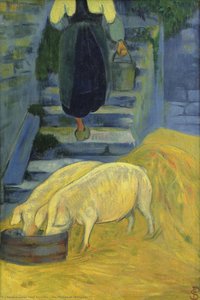
“Grammar” exemplifies this Cloisonnism technique with striking precision. The woman’s figure is not rendered through subtle gradations of tone but rather defined by bold, distinct outlines – a deliberate simplification that prioritizes color and form over meticulous detail. Sérusier employs a vibrant palette, dominated by deep blues, greens, and ochres, creating an atmosphere both serene and slightly melancholic. The colors aren’t blended; instead, they are applied in small, separate strokes, building up layers of hue and texture. This technique, combined with the flattened perspective, creates a sense of immediacy and directness, as if the painting is capturing a fleeting moment of contemplation.
Crucially, Sérusier’s use of color isn't merely descriptive; it carries symbolic weight. The blues evoke a sense of introspection and mystery, while the greens suggest connection to nature – a key theme in Symbolist art. The muted ochres contribute to the painting’s overall feeling of quietude and contemplation. The deliberate choice of colors, rather than realistic representation, is central to the work's expressive power.
A Study in Form and Abstraction
Beyond its technical mastery, “Grammar” represents a significant shift towards abstraction. While not entirely devoid of recognizable forms – the woman’s figure, the book, the surrounding objects – the painting prioritizes the exploration of color and form over strict representation. The simplified shapes, flattened perspective, and emphasis on pure color anticipate later developments in abstract art, foreshadowing the work of artists like Kandinsky and Mondrian. It's a deliberate move away from photographic realism towards a more subjective and expressive approach to visual language.
The painting’s title, “Grammar,” is particularly intriguing. It suggests that Sérusier was not simply depicting a scene but rather exploring the fundamental building blocks of artistic expression – the elements of color, line, and form – in a way that transcends traditional representation. The book itself becomes a symbol of knowledge and contemplation, inviting the viewer to engage with the painting on a deeper level.
Legacy and Inspiration
“Grammar” remains a vital work in the history of modern art, demonstrating Sérusier’s pioneering spirit and his profound influence on subsequent generations. It's a testament to the power of abstraction to convey emotion, ideas, and spiritual truths. Reproductions of this evocative painting continue to inspire artists and collectors alike, offering a glimpse into the heart of artistic innovation and the enduring quest for new forms of visual expression.
Spørsmål og svar
Kan jeg bruke utvidet virkelighet (AR) for å se "The Grammar" av Paul Sérusier i mitt eget rom?
"The Grammar" av Paul Sérusier kan forhåndsvises på din egen vegg via kunstverkets Se i AR-side ved bruk av utvidet virkelighet (AR) på en kompatibel enhet.
Hvordan relaterer stilen i "The Grammar" seg til kunstnerens epoke?
"The Grammar" av Paul Sérusier tilhører Cloisonnism / Nabis-retningen, innenfor skaperens tallet-epoke.
Hvilken metning og intensitet har "The Grammar" av Paul Sérusier?
Fargene i "The Grammar" har en metning på Muted og en intensitet på Monochromatic.
Lignende kunstverk




Om kunstneren
Early Life and Artistic Foundations
Paul Sérusier, born on November 9th, 1864, in the heart of Paris, was a painter whose journey toward abstract art began within the vibrant artistic circles of late 19th-century France. His upbringing, rooted in a prosperous middle-class family with Flemish heritage, provided him with both stability and exposure to cultural refinement. Unlike his father’s aspirations for a business career, young Paul harbored an unwavering passion for painting, a desire that led him to enroll at the Académie Julian in 1885. This institution, known for its progressive approach to art education, offered a space where he could hone his skills and encounter fellow artists who would profoundly influence his artistic development. Crucially, it was during this period that Sérusier encountered Maurice Denis, a kindred spirit who would later become a key figure in the revival of religious imagery within French painting. The Académie Julian’s environment fostered experimentation and challenged traditional academic styles, laying the groundwork for Sérusier's future explorations into new forms of expression.The Pont-Aven Years: Cloisonnism and Gauguin’s Influence
Sérusier’s artistic trajectory took a decisive turn in the summer of 1888 when he traveled to Pont-Aven, a small coastal village in Brittany. This location held particular significance as it served as a gathering place for a group of artists—including Paul Gauguin, Émile Bernard, and others—who were seeking inspiration from the region’s rugged landscapes and timeless traditions. Under the watchful eye of Gauguin, Sérusier embarked on a period of intense artistic experimentation, culminating in the creation of *Bois d’Amour* (The Lovers' Wood), often referred to as “The Talisman.” This painting stands as a pivotal work in Sérusier’s career, embodying the principles of cloisonnism—a technique characterized by bold, flat forms delineated by dark contours. Gauguin encouraged Sérusier to move beyond traditional representation and embrace a more symbolic approach, emphasizing color and form over precise detail. The influence of this period is undeniable; *Bois d’Amour* represents a radical departure from academic painting, foreshadowing the development of abstract art and establishing Sérusier as a pioneer in this nascent movement.The Nabis: A Collective Pursuit of Synthesis
Following his time at Pont-Aven, Sérusier became a founding member of the *Nabis*, a small but influential group of artists who sought to synthesize diverse artistic influences—including Post-Impressionism, Symbolism, and Japanese art. The name “Nabis” derives from the Hebrew word for “prophet,” reflecting the group’s ambition to create works that possessed spiritual depth and conveyed profound emotions. Alongside figures such as Paul Gauguin, Pierre Bonnard, Édouard Vuillard, and Maurice Denis, Sérusier explored themes of color, pattern, and decorative design, often employing a flattened perspective and simplified forms. The Nabis aimed to move beyond mere imitation of nature, instead focusing on capturing the essence of their subjects through evocative color palettes and symbolic imagery. Their work was characterized by a quiet intensity and a subtle sense of mystery, inviting viewers to engage with the paintings on an emotional level.Notable Works and Lasting Legacy
Throughout his career, Sérusier produced a body of work that is both visually striking and intellectually stimulating. Key works include *L’aversé* (The Shower), exhibited at the Musée d'Orsay in Paris, which showcases his masterful use of color and composition; *Portrait of Paul Ranson*, also held within the Musée d'Orsay, demonstrating his ability to capture personality through subtle gestures and expressions; and *Le Serpent Étranglement* (The Snake Eaters), a powerful depiction of a Breton legend housed at the National Museum in Warsaw. Beyond these individual pieces, Sérusier’s legacy lies in his pioneering role as a precursor to abstract art and his influence on subsequent generations of artists. His exploration of cloisonnism, his embrace of color and pattern, and his willingness to challenge conventional artistic norms paved the way for the development of modern art movements such as Synthetism and Cubism. Sérusier’s later years were dedicated to teaching at the École Ranson, where he imparted his knowledge and inspired a new cohort of artists. He passed away on October 7th, 1927, in Morlaix, leaving behind a rich artistic legacy that continues to resonate with art lovers today.Artistic Influences and Connections
Paul Sérusier’s artistic development was profoundly shaped by a confluence of influences. The teachings of Paul Gauguin at Pont-Aven were particularly transformative, encouraging him to prioritize color and form over traditional representation. Furthermore, his exposure to Japanese prints—which were gaining popularity in Europe during this period—inspired him to experiment with flattened perspectives and simplified compositions. Sérusier’s work also reflects the broader artistic currents of the late 19th century, including Post-Impressionism, Symbolism, and the Arts and Crafts movement. His connection to Maurice Denis was especially significant; Denis's emphasis on religious imagery and his belief in the power of color and line profoundly influenced Sérusier’s approach to painting. The Nabis group itself served as a crucible for artistic exchange, fostering experimentation and pushing the boundaries of contemporary art.
Paul Sérusier
1864 - 1927 , Frankrike
Kort om kunstneren
- Artistic Movement Or Style: Post-Impressionisme
- Artists Or Movements Influenced By This Artist: ['Les Nabis']
- Artists Who Influenced This Artist:
- Paul Gauguin
- Maurice Denis
- Date Of Birth: 9. november 1864
- Date Of Death: 7. oktober 1927
- Full Name: Louis-Paul-Henri Sérusier
- Nationality: Fransk
- Notable Artworks:
- L'averse (1893)
- Portrett av Paul Ranson (1890)
- Melancholy (1890)
- Slangeeterne (1894)
- Place Of Birth: Paris, Frankrike
Relaterte artikler

The Soul of Color: A Journey into the Emotional Resonance of Lyrical Abstraction
Embark on a cultural journey through Lyrical Abstraction. Explore how masters like Kandinsky used color and motion to translate emotion into visual poetry. Discover the profound beauty of abstract expressionism and learn to curate emotional resonance in your own art collection.
Utforsk kunstverk organisert etter temaer, stiler og kjennetegn.


