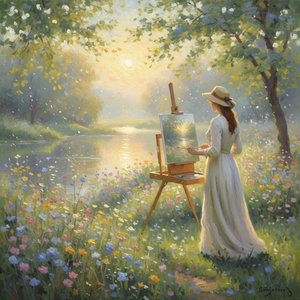
A Moment Frozen in Impressionist Light
Pierre-Auguste Renoir’s “Woman in a Red Blouse” transcends mere visual representation; it embodies the very essence of Impressionism—a movement dedicated to capturing fleeting moments and conveying emotion through subtle color palettes and loose brushstrokes. Created in 1895 during Renoir’s prolific artistic peak, this painting stands as a testament to his unparalleled ability to distill the beauty of everyday life into an unforgettable image. It exemplifies Renoir's distinctive style, differentiating him from the more academically focused painters of his time and securing its place among the most celebrated artworks of the era.
Impressionist Style: Capturing Ephemeral Beauty
Renoir’s Impressionist approach is immediately discernible in “Woman in a Red Blouse.” Unlike the meticulously rendered surfaces characteristic of Neoclassical art, this piece prioritizes spontaneity and immediacy. The artist deliberately eschews painstaking detail, opting instead for brushstrokes that vibrate with warmth—primarily achieved through golden hues—drawing the viewer's gaze into the scene. Consider Claude Monet’s “Impression, soleil levant,” currently housed at Musée Marmottan Monet in Paris; Monet similarly sought to convey the ethereal quality of nature – a shared ambition that underscores Renoir’s artistic vision. This stylistic choice reflects the broader Impressionist movement’s fascination with capturing transient sensations and atmospheric conditions, mirroring the aesthetic ideals prevalent in Parisian society during Renoir's lifetime.
Detailed Analysis: Color Palette & Brushwork
Renoir skillfully employs a vibrant color palette to heighten the painting’s emotional impact. The dominant hue—a rich crimson—dominates the blouse, radiating warmth and vitality against the muted tones of the background. Renoir achieves this effect through layering thin washes of pigment, allowing colors to blend seamlessly and creating an illusion of depth. Furthermore, his characteristic brushstrokes – loose, visible marks that convey movement and texture – contribute significantly to the painting’s overall atmosphere. These strokes are applied with a rhythmic cadence, mirroring the gentle sway of the woman seated calmly with her hands folded—a deliberate gesture intended to evoke serenity and repose. The artist's technique is particularly evident in capturing the subtle nuances of light filtering through the window, enhancing the painting's luminous quality.
Historical Context & Symbolism
“Woman in a Red Blouse” emerged during a period marked by significant artistic experimentation and intellectual debate—the Impressionist movement challenged traditional conventions and championed subjective experience as paramount to artistic expression. Renoir’s depiction of domestic tranquility reflects the prevailing social values of the Belle Époque, capturing a moment of quiet contemplation amidst the bustling energy of Parisian life. The red blouse itself can be interpreted symbolically – representing passion, vitality, and perhaps even femininity—elements that resonate throughout Renoir's oeuvre. Its placement in the composition directs the viewer’s attention to the central figure, emphasizing her stillness and conveying an aura of gracefulness.
Handmade Oil Painting Reproductions: Bringing Renoir’s Vision Home
High-quality reproductions of “Woman in a Red Blouse” are available on TopImpressionists.com, allowing art enthusiasts to experience the enduring beauty and artistic brilliance of this Impressionist masterpiece firsthand. These reproductions utilize traditional oil painting techniques—mimicking Renoir's original process—ensuring that they faithfully reproduce the artwork’s nuanced color palette and textural richness. By acquiring a handmade reproduction, you can immerse yourself in Renoir’s legacy – a timeless testament to Impressionism’s ability to capture the essence of human emotion and artistic innovation. The Musée d’Orsay in Paris houses an impressive collection of Impressionist paintings, showcasing masterpieces by Monet, Degas, Cézanne, and Renoir himself. For more information on the museum's exhibitions and collections, visit /art/list/?Filter=QY4678-Musée-d’Orsay-(Paris)-France.
### Additional Resources:
Woman in a Red Bluse – Explore this iconic artwork!
Woman in a Red Bluse Pinterest – Discover more about Renoir’s artistic style and inspirations.
Woman in a Red Bluse Facebook – View captivating images and learn about Renoir’s artistic journey.
Woman in a Red Bluse Artchive – Delve deeper into the details of this Impressionist masterpiece.
https://TopImpressionists.com – Order your own high-quality reproduction today!
Photo Description: The image is a painting of a woman in a red blouse sitting down with her hands on her lap. She has long hair that is pulled back into a bun. The woman appears to be looking at the viewer, possibly smiling or frowning. The painting is an impressionistic style and was created by Pierre-Auguste Renoir in 1895.
Size: Unknown
Date: 1895
ARTIST INFORMATION:
==================
Artist: Pierre-Auguste Renoir
Birth Year: 1841
Death Year: 1919
Birth City: Limoges
Birth Country: France
Biography:
A Life Bathed in Light: The World of Pierre-Auguste Renoir
Born in the provincial French city of Limoges in 1841, Pierre-Auguste Renoir’s journey from humble beginnings as a porcelain painter to becoming a celebrated master of Impressionism is a testament to his unwavering dedication and artistic vision. His early life was marked by a move to Paris with his family, seeking economic opportunity, an experience that would profoundly shape his artistic sensibilities. The bustling city, with its vibrant street life and diverse characters, became the wellspring of inspiration for much of his later work. Initially apprenticed to paint porcelain – a practical necessity dictated by financial constraints – young Renoir found solace in frequent visits to the Louvre, where he meticulously studied the Old Masters, absorbing their techniques and developing an appreciation for beauty that would become a hallmark of his style. This early exposure ignited within him a passion for capturing fleeting moments and conveying emotion through subtle color palettes and loose brushstrokes—a technique that distinguishes him from the more academically focused painters of his time.



 Bestill trykk
 Send
Send Del med andre
 Vis detaljer

 Last ned bildet
 Liknende objekter
 Røntgenundersøkelse
 Lysbildefremvisning

 Vis hele teksten






































 Glassalternativet er kun tilgjengelig i størrelser under 110 cm