


 Se i rommet
 Del som digitalt kort
 Del
Del
 Detaljer
 Studentguide

 Last ned
 Liknende objekter
 Røntgen
 Lysbildefremvisning
 Besøksstatistikk
The Smithy, Szeliwy, No. 2
 Oil On Canvas
- WallArt
- Impressionism
 1906
1906- Modern
 66.0 x 91.0 cm
Explore Robert Bevan’s ‘The Smithy, Szeliwy, No. 2’ – an early 20th-century oil painting capturing rural life in a vibrant Impressionistic style. Discover its charm & historical significance.
 Les mer
Robert Polhill Bevan (1865–1925): Britisk maler og medlem av Camden Town Gruppen. Pionjør innen fauvisme, kjent for levende landskap og scener fra dagliglivet.
Kjøp et høyoppløselig, forbedret digitalt bilde med langt høyere kvalitet enn forhåndsvisningen på nettet.
Hver fil er omhyggelig klargjort av våre egne spesialister ved hjelp av avanserte verktøy og profesjonell manuell retusjering. Vi sørger for at hvert bilde har eksepsjonell klarhet, presis fargegjengivelse og fine detaljer.
Den endelige filen leveres via e-post innen 72 timer, optimalisert for umiddelbar bruk i profesjonelle, redaksjonelle og trykte miljøer. Dette er den samme kvaliteten som benyttes av ledende designstudioer, utgivere og gallerier.
Digitalt bilde
Last ned en høyoppløselig fil til personlig bruk, utskrift og kreative prosjekter. ( Bytt til trykkversjon Bestill håndmalt reproduksjon)
Inkludert i alle bestillinger av digitale bilder
Profesjonell digital levering, garantert
Når du velger TopImpressionists.com, får du ikke bare et bilde – du mottar et profesjonelt etterbehandlet digitalt kunstverk, skapt med presisjon og med en garantert tilfredshetsgaranti. Her er alt som automatisk følger med din bestilling:

Rask levering på e-post
Din høyoppløselige digitale bildefil sendes til din e-post innen 72 timer etter bestilling – klar til umiddelbar bruk.

KI-forbedret digital fil
Ditt kunstverk blir profesjonelt optimalisert ved hjelp av avanserte AI-verktøy og manuell redigering, noe som sikrer maksimal detaljrikdom, klarhet og fargegjengivelse.

Gratis livslang nybestilling
Har du ved et uhell slettet eller mistet filen din? Ingen bekymring – vi sender den på nytt når som helst, helt gratis.

Ingen importavgifter – noen gang
Nyt ditt kunstverk umiddelbart uten toll, avgifter eller leveringskostnader – digitale nedlastinger er alltid avgiftsfrie.

Garantert fargenøyaktighet
Vi sikrer at det digitale bildet gjenspeiler de originale fargene så nøyaktig som mulig ved hjelp av profesjonelle verktøy og fargehåndtering.

100 dagers tilfredshetsgaranti
Hvis du ikke er fornøyd med ditt digitale bilde, vil vi revidere det eller refundere 100% innen 100 dager – uten spørsmål.

100% Penggaranti
Ikke fornøyd? Få full refusjon innen 100 dager etter at du har mottatt din digitale fil – uten spørsmål.

Rabatt ved storkjøp
Kjøp 3 bilder, spar 10% - Kjøp 5, spar 15% - Kjøp 10+, spar 20%. Ideelt for kreative prosjekter, gallerier og byråer.
A Window into Rural Tranquility
In the quiet corners of the early twentieth century, there existed a profound beauty in the rhythmic simplicity of village life, a sentiment captured with breathtaking tenderness in Robert Polhill Bevan’s 1906 masterpiece, The Smithy, Szeliwy, No. 2. This evocative oil on canvas serves as more than just a depiction of a landscape; it is a portal into a bygone era of communal harmony and pastoral grace. As the viewer gazes upon the scene, they are immediately drawn into a world where time seems to slow, anchored by the presence of horses and the steady, unhurried movement of a horse-drawn carriage. The painting breathes with the life of a small community, presenting a vignette of daily existence that feels both intimately personal and universally nostalgic.
The composition is masterfully orchestrated to guide the eye through a narrative of movement and stillness. In the foreground, the sturdy presence of two horses provides a sense of weight and reality, their forms rendered with a tactile quality that suggests the very strength required for rural labor. As the gaze wanders toward the middle ground, a carriage emerges, acting as a bridge between the figures in the foreground and the architectural heart of the village. This arrangement creates a layered depth that invites the observer to wander through the painting, discovering the subtle interactions between man, beast, and the built environment.
The Impressionistic Soul and Technique
Bevan, a pioneer of British Modernism, utilizes an impressionistic vocabulary to imbue this scene with light and atmosphere. Rather than relying on the rigid precision of academic realism, he employs short, broken brushstrokes that dance across the canvas, building a rich, impasto-like texture. This technique is particularly striking on the roof of the traditional building and the wheels of the cart, where the thick application of paint catches the light, creating a sense of physical presence and luminosity. The artist’s hand is visible in every stroke, lending the work an organic, breathing quality that celebrates the act of creation itself.
The color palette is a warm, soulful embrace of earth tones. Ochres, deep reds, and rich browns dominate the landscape, evoking the sun-drenched dust of a country lane and the weathered wood of farm implements. These warm hues are artfully punctuated by soft greens and muted blues in the foliage and sky, providing a cooling contrast that prevents the composition from feeling heavy. This careful balance of temperature creates a diffused, soft lighting effect, reminiscent of an overcast afternoon where the sun struggles gently to break through the clouds, casting a dreamlike haze over the distant horizon.
A Timeless Legacy for the Modern Collector
Beyond its technical brilliance, The Smithy, Szeliwy, No. 2 carries a profound emotional resonance. It symbolizes a longing for simplicity and a reverence for the enduring cycles of nature and tradition. For the discerning collector or interior designer, this painting offers a sophisticated anchor for any space. Its ability to evoke tranquility makes it an ideal centerpiece for a study, a library, or a living area designed for reflection. The artwork does not merely decorate a wall; it transforms an environment, infusing it with a sense of history and a quiet, dignified warmth.
Whether one is drawn to the historical significance of Bevan’s role in the transition toward modernism or simply captivated by the pastoral charm of the subject matter, this piece remains a timeless investment. A high-quality reproduction of such a work allows the magic of 1906 to reside within a contemporary home, offering a continuous dialogue between the heritage of British art and the aesthetics of modern living. It is an invitation to pause, to breathe, and to reconnect with the enduring beauty of the everyday.
Spørsmål og svar
Hva forklarer opphavsrettssituasjonen til "The Smithy, Szeliwy, No. 2" av Robert Polhill Bevan?
"The Smithy, Szeliwy, No. 2" av Robert Polhill Bevan er i det frie domene – opphavsretten har utløpt. Opphavsretten beregnes fra kunstnerens dødsår, og Robert Polhill Bevan døde i 1925.
Hvilken historisk periode stammer "The Smithy, Szeliwy, No. 2" av Robert Polhill Bevan fra?
"The Smithy, Szeliwy, No. 2" av Robert Polhill Bevan stammer fra Modern-perioden. Denne perioden gir verkets historiske kontekst.
Hvilket rom anbefales "The Smithy, Szeliwy, No. 2" av Robert Polhill Bevan for, med tanke på fargene?
Med sin Dark palett, anbefales "The Smithy, Szeliwy, No. 2" av Robert Polhill Bevan for et Coffee Shop. Fargene er en av grunnene til denne anbefalingen.
Relaterte kunstverk


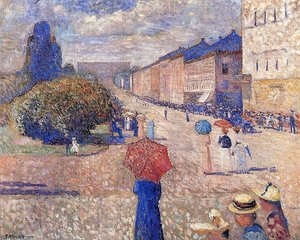


Kunstnerbiografi
A Pioneer of British Modernism: The Life and Art of Robert Polhill Bevan
Robert Polhill Bevan, born in Hove in 1865, occupies a pivotal yet often understated position within the narrative of early 20th-century British art. Emerging from a Quaker background steeped in banking connections – his parents were Richard Alexander Bevan and Laura Maria Polhill – he defied conventional expectations to become a daring innovator, a key figure in the transition from Impressionism towards more radical explorations of color and form. His journey was one of constant experimentation, absorbing influences from across Europe while forging a distinctly personal artistic vision that would profoundly impact the development of modern art in Britain. Bevan’s early education at Westminster School of Art under Fred Brown provided a solid foundation, but it was his subsequent studies at the Académie Julian in Paris that truly ignited his creative spark. There, he encountered a constellation of rising stars – Paul Sérusier, Pierre Bonnard, Édouard Vuillard, and Maurice Denis – artists who were challenging academic conventions and embracing new approaches to painting. These encounters proved formative, exposing Bevan to the principles of synthetism and laying the groundwork for his future explorations.Brittany, Fauvism, and the Search for Pure Color
The impact of Brittany on Bevan’s artistic development cannot be overstated. Two significant journeys in 1890 and 1891 immersed him in the atmosphere of Pont-Aven, a small coastal town that had become a magnet for artists seeking an alternative to Parisian salon culture. The bold colors and simplified forms championed by artists like Gauguin resonated deeply with Bevan, influencing his early drawings and prints. He was particularly drawn to the luminous landscapes of Breton Brittany, where he spent considerable time studying the works of Paul Gauguin and Vincent van Gogh. This fascination fueled his experimentation with pure color – a technique that would foreshadow the emergence of Fauvism on the continent – as evidenced by paintings like “The Chestnut Tree” and “Landscape in the Blackdown Hills.” Bevan’s approach wasn't merely decorative; it was driven by a desire to capture the emotional intensity of the natural world, mirroring the expressive fervor characteristic of Impressionist painters. The influence of Cézanne is also discernible in his compositions, particularly in his use of geometric forms and flattened perspectives – elements that would contribute to the development of Cubism alongside Picasso and Braque.Collective Visions: The Camden Town Group and Beyond
Bevan was not an artist who worked in isolation. He actively sought connection with like-minded individuals, playing a crucial role in the formation of several influential art groups. As a founding member of the Camden Town Group – alongside artists such as Spencer Gore and Joseph Crawhall – he joined forces with fellow painters determined to depict modern urban life and challenge established artistic norms. This collective spirit extended to his involvement with the London Group and the Cumberland Market Group, furthering his commitment to progressive artistic movements. The group’s aim was to break away from academic traditions and explore new visual languages—a bold undertaking that reflected the broader intellectual currents of the era. Bevan's engagement with these groups fostered a dynamic exchange of ideas, shaping his artistic trajectory and contributing to the evolution of British art. He collaborated closely with fellow Camden Town Group members on projects exploring themes of social realism and psychological introspection – demonstrating a willingness to engage with pressing societal concerns through artistic expression.Landscapes, Urban Scenes, and Lasting Legacy
Bevan’s oeuvre is characterized by a remarkable range of subjects—portraits capturing the dignity of individuals—and urban scenes documenting the realities of modern life (“The Cab Horse”). However, he is perhaps best remembered for his landscapes – particularly those depicting the Blackdown Hills near Hove. His paintings embody a profound appreciation for the beauty and tranquility of rural England, rendered with meticulous detail and infused with vibrant color palettes. Works like “In the Downs Near Lewes” and “The Rosemary Canvas” exemplify this mastery, showcasing Bevan’s ability to convey both the physical grandeur and emotional resonance of the natural world. His distinctive style—characterized by bold brushstrokes and a masterful use of light—established him as a leading British painter of the early years of the 20th Century. Bevan's influence extended beyond his own artistic output, inspiring subsequent generations of painters to embrace experimentation and explore new visual vocabularies. He remains a vital figure for understanding the complex evolution of British art during this transformative period – securing his place as one of the most important artists of his time.- Notable artworks: “The Farmhouse”, “Ploughing on the Downs”, “Queen’s Grove”, “The Cab Horse”
- Places of Residence: Hove, Sussex; Marlpitts Cottage, Luppitt
- Artistic Influences: Paul Gauguin, Cézanne, Vincent van Gogh

Robert Polhill Bevan
1865 - 1925 , Storbritannia
Kort om kunstneren
- Artistic Movement Or Style: Fauvism, Divisionism
- Artists Who Influenced This Artist:
- Paul Gauguin
- Velázquez
- Goya
- Renoir
- Date Of Birth: 1865
- Date Of Death: 1925
- Full Name: Robert Polhill Bevan
- Nationality: Britisk
- Notable Artworks:
- The Farmhouse
- Ploughing on the Downs
- Queen’s Grove
- The Cab Horse
- Place Of Birth: Hove, United Kingdom