

 Forhåndsvisning
 Send
Send Del
Del
 Vis detaljer
 Utskriftsvennlig guide

 Last ned bilde
 Liknende objekter
 Røntgenundersøkelse
 Lysbildefremvisning
 Spørsmål og svar
 Statistikk
Chez Mouquin


Delve into William James Glackens' masterpiece 'Chez Mouquin,' a captivating Ashcan School painting depicting Parisian social life and capturing the spirit of early 1905 New York.
 Vis hele teksten
Utforsk realistiske malerier av William James Glackens (1870-1938), en pioner innen Ashcan School. Oppdag levende bilder av tidlig 20.-århundrets New York og Paris, som fanger dagliglivet med imponerende detaljer.
Giclée / Kunsttrykk
Giclée- eller lerretsprint av museumskvalitet med rask produksjon og fleksible valgmuligheter for etterbehandling. ( Kjøp håndmalt maleri Bytt til digitalt bilde)




































Standardformat
skreddersydd
CM
INCH
Velg mellom våre forhåndsdefinerte størrelser som bevarer kunstverkets opprinnelige proporsjoner.
Loading sizes...

bredde
høyde
Skriv inn ønsket bredde og høyde for å tilpasse trykket til din ramme eller vegg. Et trykk kan kun beskjæres, aldri skaleres opp utover motivets opprinnelige størrelse, noe som betyr at et format med andre proporsjoner vil føre til tap av deler av bildet. Vi sender deg en digital mockup for godkjenning før vi starter trykkeprosessen. Bildet som vises på denne siden viser ikke den faktiske beskjæringen — det er kun mockuppen som viser dette.
Verdensomspennende levering () på 2 uker i stedet for standard 4/5 uker. (3 November)

Gratis ekspressfrakt over hele verden

Lerretsduk av lin av høy kvalitet

Full transportforsikring

Garanti for refusjon av toll og importavgifter

Garantert fargegjengivelse

100 dagers returrett ved fabrikasjonsfeil

100% pengene tilbake-garanti

Rabatt ved flere kjøp
 Glassalternativet er kun tilgjengelig i størrelser under 110 cm

Chez Mouquin
Giclée / Kunsttrykk
Størrelse på reproduksjon
-


Totalpris for valgte alternativer
Nkr 672
Chez Mouquin: A Snapshot of Parisian Bohemia
William James Glackens’ “Chez Mouquin,” completed in 1905, stands as a quintessential emblem of the Ashcan School—a movement that irrevocably altered the course of American art. Rejecting the idealized landscapes and mythological narratives favored by their predecessors, Glackens and his fellow artists sought to portray the gritty realities of urban life with unflinching honesty.
The painting depicts a scene within Mouquin’s Restaurant, a popular Parisian establishment frequented by artists and intellectuals during the Belle Époque. At its center is Jeanne Mouquin, the proprietor's wife, engaged in conversation with James B. Moore, a wealthy playboy known for his patronage of the arts. Glackens himself subtly captures the atmosphere of the dining room, reflecting the faces of fellow attendees—Charles Fitzgerald, an art critic and Edith Glackens, his wife—creating a tableau vivant that encapsulates the spirit of artistic camaraderie.
Glackens’ masterful technique exemplifies Ashcan Realism. Employing muted tones—primarily browns, ochres, and blacks—he skillfully captures the dim lighting of the restaurant, enhancing the sense of intimacy and immediacy. The brushstrokes are loose and expressive, conveying movement and capturing the subtle nuances of facial expressions. Glackens' deliberate use of chiaroscuro – dramatic contrasts between light and dark – draws attention to key figures and contributes to the painting’s overall mood.
A Reflection of Artistic Vision
“Chez Mouquin” isn’t merely a depiction of a social gathering; it’s a profound statement about Glackens' artistic philosophy. Like many Ashcan artists, he eschewed grand narratives in favor of capturing everyday moments—the conversations, gestures, and expressions that define human experience. This approach aligns with the broader Ashcan ethos: to portray American life as it truly is – flawed, vibrant, and brimming with potential.
Glackens’ influence extends beyond his stylistic choices. He championed a rejection of academic conventions, prioritizing observation and emotional resonance over meticulous detail. His work anticipates the modernist impulse toward simplification and abstraction, foreshadowing developments that would reshape art in subsequent decades.
Historical Context: The Belle Époque
The painting’s setting—Paris during the Belle Époque (roughly 1871-1914)—provides crucial context for understanding its significance. This era witnessed unprecedented social and cultural transformation, fueled by industrialization, urbanization, and burgeoning artistic experimentation. Artists like Glackens sought to document these changes, capturing the dynamism of a society undergoing rapid modernization.
Mouquin’s Restaurant itself was a hub of intellectual discourse and artistic activity—a place where writers, painters, and musicians convened to discuss ideas and inspire one another. Glackens' portrayal captures this atmosphere perfectly, reflecting the optimism and ambition that characterized the Belle Époque.
Symbolism & Emotional Impact
"Chez Mouquin" speaks volumes about the human condition—the desire for connection, the pursuit of beauty amidst chaos, and the celebration of shared experience. The muted palette contributes to a contemplative mood, inviting viewers to linger on the faces of the figures depicted.
Glackens’ ability to convey emotion through subtle gestures and expressions underscores his commitment to realism as a means of capturing psychological truth. “Chez Mouquin” remains a powerful reminder that art can illuminate the complexities of human life and inspire us to appreciate the beauty found in ordinary moments—a legacy cemented by its prominent place within the Art Institute of Chicago’s collection.
Spørsmål og svar
Hvilken farge dominerer i "Chez Mouquin"?
Den dominerende fargen i "Chez Mouquin" av William James Glackens er Gray (#959982).
Hvilken teknikk og stil karakteriserer "Chez Mouquin" av William James Glackens?
"Chez Mouquin" av William James Glackens kombinerer Oil On Canvas-teknikken med Contemporary Realism-stilen. Teknikk og stilretning beskriver verkets utførelse og estetiske uttrykk.
Hvilken størrelse anbefales for "Chez Mouquin" i et Living Room?
For et Living Room anbefales det å trykke "Chez Mouquin" i størrelsen Large.
Lignende kunstverk


Om kunstneren
A Pioneer of Ashcan Realism
William James Glackens (1870 – 1938) stands as a cornerstone figure in American art, indelibly shaping the landscape of realism during the early twentieth century. Born in Philadelphia on March 13th, 1870, to Elizabeth Finn Glackens and Samuel Glackens—a clerk for the Pennsylvania Railroad—his artistic journey began with an innate fascination for drawing, a passion nurtured by his formative years. This inclination propelled him towards enrollment at the Pennsylvania Academy of Fine Arts, where he honed his skills under the guidance of Thomas Anshutz, a celebrated realist who profoundly influenced Glackens’ stylistic approach.The Ashcan School and Its Vision
Glackens' artistic trajectory coincided with the emergence of the Ashcan School—a movement that fiercely rejected the prevailing aesthetic conventions of its time. Rejecting idealized beauty and grandeur, the Ashcan School championed a gritty portrayal of urban life in New York City, mirroring the realities faced by ordinary people. Alongside Louis Glackens, his brother, Glackens established this influential group, determined to depict the everyday struggles and triumphs of working-class communities with uncompromising honesty. This commitment to realism distinguished him from many of his contemporaries and cemented his place within art history.Glackens’ Artistic Style: Detail and Atmosphere
Glackens' paintings are characterized by their masterful execution—particularly in capturing atmosphere and detail. He favored dark hues, skillfully blending them to create immersive environments that conveyed the palpable energy of city streets. His technique involved meticulous observation and painstaking brushwork, resulting in canvases brimming with texture and nuance. Notably, Glackens’ artistic sensibilities were shaped by the Impressionist painter Pierre Auguste Renoir, whose influence can be discerned in his later works—characterized by a brighter palette and an emphasis on capturing fleeting moments of beauty amidst urban bustle.Illustrative Career and Patronage
Beyond his studio practice, Glackens cultivated a prolific career as an illustrator for newspapers and magazines based in Philadelphia and New York City. This engagement with journalistic illustration honed his visual storytelling abilities and broadened his artistic repertoire. Furthermore, Glackens played a crucial role in bolstering American art heritage by collaborating with Albert C. Barnes—a wealthy philanthropist—to acquire European paintings for the Barnes Foundation in Philadelphia. This ambitious undertaking significantly enriched the foundation’s collection and solidified Glackens' reputation as an advocate for artistic excellence.Notable Works and Legacy
Glackens’ artistic legacy extends beyond his individual creations. His masterpiece, “The Shoppers,” exemplifies his ability to distill complex urban narratives into evocative visual representations—now housed in the New Realism Collection at TopImpressionists.com. Similarly, “View of Haarlem with Bleaching Grounds,” a painting by Jacob Isaakszoon van Ruysdael (ruysdael), showcases Glackens’ dedication to replicating the meticulous detail and craftsmanship of Dutch masters. His enduring influence continues to inspire artists today, securing his place as one of America's foremost realist painters—a testament to his unwavering commitment to portraying the human experience with profound sensitivity and artistic integrity.
William James Glackens
1870 - 1938 , USA
Kort om kunstneren
- Artistic Movement Or Style: Ashcan School
- Artists Or Movements Influenced By This Artist: ['Pierre Auguste Renoir']
- Artists Who Influenced This Artist: ['Thomas Anshutz']
- Date Of Birth: Philadelphia, USA (1870)
- Date Of Death: Westport, CT (1938)
- Full Name: William James Glackens
- Nationality: Amerikaner
- Notable Artworks:
- The Shoppers
- View of Haarlem
- Place Of Birth: Philadelphia
Relaterte artikler

Capturing the Light: A Journey Through the Soul of American Impressionism and the Hudson River School
Explore the luminous beauty of American Impressionism and the Hudson River School. Discover a curated journey through light, landscape, and history, celebrating the enduring legacy of masters through exquisite, hand-painted oil reproductions for the discerning art lover.

The Unvarnished Truth: A Cultural Journey Through the Soul of American Realism
Explore the profound beauty of American Realism. From the Ashcan School's urban grit to intimate portraits, discover how artists captured the authentic soul of a nation through unvarnished truth and masterful observation.
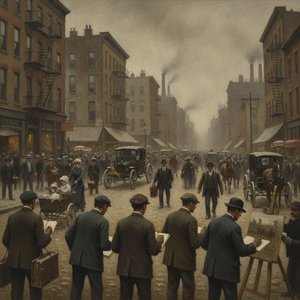
The Ashcan School: Capturing the Raw, Unfiltered Soul of Urban Life through American Realism
Discover the raw beauty of the Ashcan School. Explore how masters like Bellows and Henri captured the gritty, vibrant soul of early 20th-century New York through profound American Realism and evocative urban landscapes.
Utforsk kunstverk organisert etter temaer, stiler og kjennetegn.

