


 Se i rommet
 Del som digitalt kort
 Del
Del
 Detaljer
 Studentguide

 Last ned
 Liknende objekter
 Røntgen
 Lysbildefremvisning
 Besøksstatistikk
Children Roller Skating


William Glackens' "Children Roller Skating" (1918) captures a lively street scene of kids enjoying their pastime, showcasing the artist’s signature realism and vibrant style.
 Les mer
Utforsk realistiske malerier av William James Glackens (1870-1938), en pioner innen Ashcan School. Oppdag levende bilder av tidlig 20.-århundrets New York og Paris, som fanger dagliglivet med imponerende detaljer.
Håndlaget oljereproduksjon
Håndmalt olje på lerret i din valgte størrelse og ramme, laget på bestilling av våre kunstnere. ( Bytt til trykkversjon Gå til digitalt bilde)




P118B Nkr10

P118H Nkr10

P118W Nkr10

P438Z Nkr10

P508JH Nkr12

P508YH Nkr12

P805H Nkr10

P805Z Nkr10

P919BZ Nkr10

P919G Nkr10

P919XJ Nkr10

P959ZH Nkr10

P968JZ Nkr12

W106C Nkr8

W218G Nkr10

W218JH Nkr8

W218Y Nkr10

W307PJ Nkr10

W316G Nkr10

W316PJ Nkr8

W316Y Nkr10

W398PJ Nkr8

W4111J Nkr10

W500HY Nkr15

W500JH Nkr15

W692G Nkr12

W849H Nkr8

W940BG Nkr15

W953PJ Nkr8




Standardformat
tilpasset
CM
INCH
Velg mellom våre forhåndsdefinerte størrelser som bevarer kunstverkets opprinnelige proporsjoner.
Loading sizes...

bredde
høyde
Skriv inn bredden og høyden du trenger, slik at den passer til din ramme eller vegg. Dette er håndmalt, så for en størrelse med en annen form kan kunstneren male litt mer rundt bildet, eller beskjære det noe — du velger selv. Vi sender deg en digital mockup for godkjenning før maleriet påbegynnes. Bildet som vises på denne siden viser ikke det faktiske resultatet — kun mockuppen gjør det.
Eksempler på hva som kan endres: Erstatt ansikt med bilde av kunden; Legg til kjæledyr (f.eks. bytt ut katt med hund); Inkluder en skjult melding i bakgrunnen; Endre bakgrunnslandskap eller elementer.
Etter bestilling vil TopImpressionists.com-teamet sende e-post til kunden for instruksjoner og sende et utkast (mockup) som forhåndsvisning.
Etter bestilling vil TopImpressionists.com-teamet sende e-post til kunden for instruksjoner og sende et utkast (mockup) som forhåndsvisning.
Verdensomspennende levering () på 3–4 uker i stedet for standard 5 uker. (26 October). Ingen kompromisser med kvaliteten.

Gratis ekspressfrakt over hele verden

Lerretsduk av høykvalitets lin

Full transportforsikring

Garanti for refusjon av toll og importavgifter

Garantert fargeekthet

100 dagers returrett ved fabrikasjonsfeil

100% pengene tilbake-garanti

Mengderabatt
 Glassalternativet er kun tilgjengelig i størrelser under 110 cm

Children Roller Skating
Reproduksjonsmetode
Format på reproduksjon
-


Totalpris
Nkr 2560
William James Glackens’ “Children Roller Skating” – A Snapshot of Urban Joy
“Children Roller Skating,” painted in 1918 by William James Glackens, isn't merely a depiction of children enjoying an afternoon pastime; it’s a vibrant distillation of early 20th-century American life—a fleeting moment of unadulterated joy captured amidst the grit and bustle of New York City. Glackens, a key figure in the Ashcan School movement, rejected the idealized portrayals favored by the National Academy of Design, instead choosing to focus on the realities of everyday existence, often portraying it with a distinctive, almost frenetic energy. This painting exemplifies his talent for imbuing ordinary scenes with an extraordinary sense of life and movement.
The scene unfolds on a busy city street, likely in Greenwich Village, a neighborhood known for its bohemian spirit during this period. A group of children, rendered in Glackens’ characteristic bold brushstrokes and rich, dark palette, are engaged in spirited roller skating. Their faces are alight with laughter and excitement, their limbs moving with an infectious energy that spills out onto the canvas. The composition is dynamic—a swirling mass of movement and color—reflecting the lively atmosphere of the street. Glackens masterfully uses loose brushwork to convey a sense of spontaneity and immediacy, as if he’s capturing the scene in real-time.
A Window into the Ashcan School
Glackens' work is deeply rooted in the principles of the Ashcan School, an artistic movement that emerged in New York City around 1908. Rejecting the polished surfaces and mythological subjects favored by academic art, the Ashcan artists sought to portray the realities of urban life—the crowded streets, the working-class neighborhoods, and the everyday struggles of ordinary people. Glackens’ “Children Roller Skating” perfectly embodies this ethos. It's a far cry from the carefully staged portraits that dominated the art world at the time; instead, it offers an unfiltered glimpse into the lives of New Yorkers.
The painting’s style is distinctly American—a blend of realism and impressionism. Glackens employs a vibrant color palette, using dark blues, greens, and browns to create a sense of depth and atmosphere. He also utilizes broken brushstrokes and contrasting colors to capture the movement and energy of the scene. The figures are not rendered with meticulous detail but rather suggested through loose brushwork and expressive gestures. This technique contributes to the painting’s overall dynamism and immediacy.
Symbolism and Context
Beyond its immediate depiction of children roller skating, the painting carries a subtle layer of symbolism. Roller skating was a popular pastime in early 20th-century America, particularly among young people. It represented freedom, recreation, and a break from the constraints of Victorian society. The scene captures a moment of carefree joy—a reminder that even amidst the challenges of urban life, there is always room for laughter and play.
Furthermore, the painting reflects the changing social landscape of New York City at the turn of the century. The city was undergoing rapid industrialization and urbanization, leading to overcrowding, poverty, and social unrest. However, despite these challenges, there was also a sense of optimism and progress—a belief in the potential for a brighter future. “Children Roller Skating” captures this duality—the juxtaposition of hardship and hope, chaos and joy.
A Timeless Image of American Life
“Children Roller Skating” is more than just a painting; it’s a snapshot of a bygone era—a vibrant testament to the spirit of New York City in 1918. Glackens' masterful use of color, brushwork, and composition creates an image that is both captivating and emotionally resonant. It invites us to step back in time and experience the joy and energy of a group of children roller skating on a busy city street. Reproductions of this work offer a beautiful way to bring a piece of American history into your home or office, reminding us of the simple pleasures of life and the enduring power of art.
Spørsmål og svar
Er fargene i "Children Roller Skating" av William James Glackens livlige eller dempede?
Fargene i "Children Roller Skating" av William James Glackens viser en Clear Color Presence metning med en Vivid intensitet.
Hvilken farge skiller seg mest ut i "Children Roller Skating"?
Walnut (#705535) er den dominerende fargen i "Children Roller Skating" av William James Glackens.
Hvilken følelse er "Children Roller Skating" forbundet med?
"Children Roller Skating" av William James Glackens formidler en Nostalgic emosjonell tone.
Relaterte kunstverk


Kunstnerbiografi
A Pioneer of Ashcan Realism
William James Glackens (1870 – 1938) stands as a cornerstone figure in American art, indelibly shaping the landscape of realism during the early twentieth century. Born in Philadelphia on March 13th, 1870, to Elizabeth Finn Glackens and Samuel Glackens—a clerk for the Pennsylvania Railroad—his artistic journey began with an innate fascination for drawing, a passion nurtured by his formative years. This inclination propelled him towards enrollment at the Pennsylvania Academy of Fine Arts, where he honed his skills under the guidance of Thomas Anshutz, a celebrated realist who profoundly influenced Glackens’ stylistic approach.The Ashcan School and Its Vision
Glackens' artistic trajectory coincided with the emergence of the Ashcan School—a movement that fiercely rejected the prevailing aesthetic conventions of its time. Rejecting idealized beauty and grandeur, the Ashcan School championed a gritty portrayal of urban life in New York City, mirroring the realities faced by ordinary people. Alongside Louis Glackens, his brother, Glackens established this influential group, determined to depict the everyday struggles and triumphs of working-class communities with uncompromising honesty. This commitment to realism distinguished him from many of his contemporaries and cemented his place within art history.Glackens’ Artistic Style: Detail and Atmosphere
Glackens' paintings are characterized by their masterful execution—particularly in capturing atmosphere and detail. He favored dark hues, skillfully blending them to create immersive environments that conveyed the palpable energy of city streets. His technique involved meticulous observation and painstaking brushwork, resulting in canvases brimming with texture and nuance. Notably, Glackens’ artistic sensibilities were shaped by the Impressionist painter Pierre Auguste Renoir, whose influence can be discerned in his later works—characterized by a brighter palette and an emphasis on capturing fleeting moments of beauty amidst urban bustle.Illustrative Career and Patronage
Beyond his studio practice, Glackens cultivated a prolific career as an illustrator for newspapers and magazines based in Philadelphia and New York City. This engagement with journalistic illustration honed his visual storytelling abilities and broadened his artistic repertoire. Furthermore, Glackens played a crucial role in bolstering American art heritage by collaborating with Albert C. Barnes—a wealthy philanthropist—to acquire European paintings for the Barnes Foundation in Philadelphia. This ambitious undertaking significantly enriched the foundation’s collection and solidified Glackens' reputation as an advocate for artistic excellence.Notable Works and Legacy
Glackens’ artistic legacy extends beyond his individual creations. His masterpiece, “The Shoppers,” exemplifies his ability to distill complex urban narratives into evocative visual representations—now housed in the New Realism Collection at TopImpressionists.com. Similarly, “View of Haarlem with Bleaching Grounds,” a painting by Jacob Isaakszoon van Ruysdael (ruysdael), showcases Glackens’ dedication to replicating the meticulous detail and craftsmanship of Dutch masters. His enduring influence continues to inspire artists today, securing his place as one of America's foremost realist painters—a testament to his unwavering commitment to portraying the human experience with profound sensitivity and artistic integrity.
William James Glackens
1870 - 1938 , USA
Kort om kunstneren
- Artistic Movement Or Style: Ashcan School
- Artists Or Movements Influenced By This Artist: ['Pierre Auguste Renoir']
- Artists Who Influenced This Artist: ['Thomas Anshutz']
- Date Of Birth: Philadelphia, USA (1870)
- Date Of Death: Westport, CT (1938)
- Full Name: William James Glackens
- Nationality: Amerikaner
- Notable Artworks:
- The Shoppers
- View of Haarlem
- Place Of Birth: Philadelphia
Relaterte artikler

Capturing the Light: A Journey Through the Soul of American Impressionism and the Hudson River School
Explore the luminous beauty of American Impressionism and the Hudson River School. Discover a curated journey through light, landscape, and history, celebrating the enduring legacy of masters through exquisite, hand-painted oil reproductions for the discerning art lover.
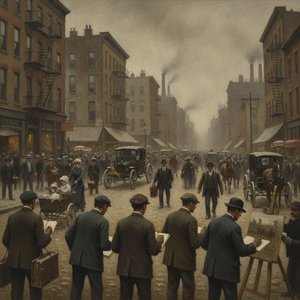
The Ashcan School: Capturing the Raw, Unfiltered Soul of Urban Life through American Realism
Discover the raw beauty of the Ashcan School. Explore how masters like Bellows and Henri captured the gritty, vibrant soul of early 20th-century New York through profound American Realism and evocative urban landscapes.

The Unvarnished Truth: A Cultural Journey Through the Soul of American Realism
Explore the profound beauty of American Realism. From the Ashcan School's urban grit to intimate portraits, discover how artists captured the authentic soul of a nation through unvarnished truth and masterful observation.
Utforsk kunstverk organisert etter temaer, stiler og kjennetegn.

