


 Se i rommet
 Del som digitalt kort
 Del
Del
 Detaljer
 Studentguide

 Last ned
 Liknende objekter
 Røntgen
 Lysbildefremvisning
 Besøksstatistikk
Blueacanthus

Admire 'Blueacanthus,' a stunning William Morris reproduction! Explore intricate Arts & Crafts design, vibrant blues & greens, and Victorian elegance. Hand-painted art for your space.
William Morris var en norsk kunstner og designer som ble kjent for sin rolle i Arts & Crafts-bevegelsen og sitt fokus på naturlig skjønnhet og håndverkstradisjoner. Utforsk hans ikoniske tekstiler og veggmalerier samt hans sosialt engasjerte verk!
 Les mer
Giclée / Kunsttrykk
Giclée- eller lerretsprint av museumskvalitet med rask produksjon og fleksible valgmuligheter for etterbehandling. ( Bestill håndmalt reproduksjon Gå til digitalt bilde)




P118B Nkr10

P118H Nkr10

P118W Nkr10

P438Z Nkr10

P508JH Nkr12

P508YH Nkr12

P805H Nkr10

P805Z Nkr10

P919BZ Nkr10

P919G Nkr10

P919XJ Nkr10

P959ZH Nkr10

P968JZ Nkr12

W106C Nkr8

W218G Nkr10

W218JH Nkr8

W218Y Nkr10

W307PJ Nkr10

W316G Nkr10

W316PJ Nkr8

W316Y Nkr10

W398PJ Nkr8

W4111J Nkr10

W500HY Nkr15

W500JH Nkr15

W692G Nkr12

W849H Nkr8

W940BG Nkr15

W953PJ Nkr8




Standardformat
tilpasset
CM
INCH
Velg mellom våre forhåndsdefinerte størrelser som bevarer kunstverkets opprinnelige proporsjoner.
Loading sizes...

bredde
høyde
Du kan oppgi egne mål for å tilpasse en spesifikk ramme eller et bestemt område. Dersom den valgte størrelsen ikke samsvarer med det originale bildets proporsjoner, vil vi enten beskjære kunstverket eller utvide bildet med en speilet eller ensfarget kant. En digital mockup vil bli sendt til din godkjenning før produksjonen starter.
Vennligst merk at forhåndsvisningen på skjermen ikke gjenspeiler den faktiske beskjæringen eller utvidelsen. Kun mockuppen vil vise den endelige komposisjonen nøyaktig.
Selv om tilpassede størrelser er tilgjengelige, anbefaler vi å velge et mål fra den forhåndsdefinerte listen for å bevare de originale proporsjonene.
Verdensomspennende levering () på 2 uker i stedet for standard 4/5 uker. (14 October)

Gratis ekspressfrakt over hele verden

Lerretsduk av høykvalitets lin

Full transportforsikring

Garanti for refusjon av toll og importavgifter

Garantert fargeekthet

100 dagers returrett ved fabrikasjonsfeil

100% pengene tilbake-garanti

Mengderabatt
 Glassalternativet er kun tilgjengelig i størrelser under 110 cm

Blueacanthus
Giclée / Kunsttrykk
Format på reproduksjon
-


Totalpris
Nkr 643
Kunstnerbiografi
A Life Rooted in Nature and Romance
William Morris, born on March 24, 1834, in Walthamstow, Essex, emerged from a comfortably affluent middle-class background—a circumstance that afforded him the freedom to pursue passions rather than professions. His father’s success as a financier provided not only security but also an environment where aesthetic sensibilities could flourish. Morris's childhood was deeply shaped by the English countryside surrounding his home and a fascination with tales of medieval chivalry, laying the groundwork for a lifelong devotion to both natural beauty and romantic narratives. These early influences weren’t merely sentimental; they formed the core of his artistic philosophy. He wasn’t simply *inspired* by nature or the past—he believed in their inherent moral and aesthetic superiority to the rapidly industrializing present. His formal education at Oxford University initially steered him toward a clerical path, but it was within the vibrant intellectual circles of the university that his true calling began to take shape. He joined “The Set,” a group of students who shared an intense interest in art, literature, and medieval history, forging friendships—most notably with Edward Burne-Jones—that would profoundly impact his artistic trajectory. It was during this period that he encountered the writings of John Ruskin, whose critique of industrial society and advocacy for craftsmanship resonated deeply with Morris’s burgeoning beliefs.The Arts & Crafts Revolution
Following Oxford, a brief foray into architecture quickly gave way to painting, as Morris collaborated with Dante Gabriel Rossetti on mural projects. However, it was the founding of Morris, Marshall, Faulkner & Co. in 1861—later known simply as Morris & Co.—that marked a pivotal moment, not just in his career but in the history of design. This wasn’t merely a business venture; it was an attempt to create a new way of life, one where art permeated every aspect of daily existence and craftsmanship was valued above all else. Alongside Burne-Jones, Rossetti, Philip Webb, and others, Morris sought to revive traditional techniques and produce beautiful, well-made objects for the home. The firm’s early work was profoundly influenced by Red House, a home Morris commissioned from Webb—a structure that embodied the Arts & Crafts ideal of creating a unified aesthetic environment through handcrafted furnishings and decoration. Morris became a leading voice in the burgeoning Arts & Crafts movement, championing handmade craftsmanship as an antidote to the perceived dehumanizing effects of mass production. He believed passionately that art should be accessible to all, not just the wealthy elite, and that it should be integrated into everyday life—a radical notion at a time when design was often seen as separate from function. This conviction extended beyond mere aesthetics; it was rooted in a deep social conscience and a desire to improve the lives of working people.A Legacy Woven in Textiles, Poetry, and Print
While Morris & Co. encompassed a wide range of decorative arts—furniture, stained glass, carpets—he is perhaps most celebrated for his textile designs. These weren’t simply patterns; they were intricate narratives woven with flowing floral motifs, lush foliage, and rich, evocative colors. His wallpapers, in particular, revolutionized interior design, moving away from the sterile imitations prevalent during the Victorian era toward nature-inspired creations that were both beautiful and functional. He didn't just *design* these patterns; he immersed himself in the process of their creation, understanding the nuances of dyeing techniques and weaving methods. Morris’s contribution to literature was equally significant. His poems explored themes of mythology, folklore, and spirituality—often infused with a deep reverence for nature and medieval traditions. Works like “The Song of Merlin” and “Lilacs” exemplify his poetic vision and demonstrate his ability to convey complex ideas through lyrical prose. Furthermore, Morris revived the art of tapestry making, producing large-scale narrative tapestries based on medieval romances and Arthurian legends—works that showcased his skill as a storyteller and his deep connection to the past.Socialism, Conservation, and Enduring Influence
Morris’s commitment extended beyond aesthetics into the realm of social activism. He became increasingly involved in socialist politics, advocating for workers' rights and social reform. He believed that a truly beautiful society couldn’t exist without economic equality and justice—a conviction that informed both his art and his political writings. This wasn’t abstract theorizing; he actively supported various socialist causes and used his platform to raise awareness about the plight of working people. Morris recognized the importance of preserving historic buildings and landscapes for future generations. He understood that these structures weren't merely relics of the past but vital links to cultural identity and artistic inspiration. The William Morris Gallery in Walthamstow stands as a testament to his enduring legacy, showcasing his work and providing insights into his life and ideas. His vision of a world where beauty and utility are intertwined—and where art is accessible to all—remains as relevant today as it was in the 19th century. He wasn’t just an artist; he was a visionary who sought to transform society through the power of design, craftsmanship, and social justice.
William Morris
1834 - 1896 , Storbritannia
Kort om kunstneren
- Artistic Movement Or Style: Arts & Crafts
- Artists Who Influenced This Artist:
- John Ruskin
- Edward Burne-Jones
- Date Of Birth: March 24, 1834
- Date Of Death: October 3, 1896
- Full Name: William Morris
- Nationality: Britisk
- Notable Artworks:
- Sun og måne engler
- Eikblader i Alle helgen
- Judas Maccabaeus
- Place Of Birth (City And Country): Walthamstow, UK
Relaterte artikler

R.A. Benjamin Williams: Victorian Genre Painting & Social Commentary
Explore the captivating world of Benjamin Williams Leader's Victorian genre paintings. Discover his mastery of naturalism, social commentary & lasting influence on British art. Expert insights at TopImpressionists.
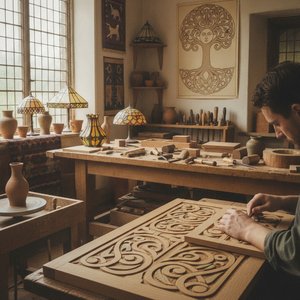
The Arts and Crafts Movement: Rediscovering the Soul of Handcrafted Artistry and Timeless Design
Explore the profound beauty of the Arts and Crafts Movement. Discover how the legacy of William Morris and handcrafted artistry offers a timeless antidote to mass production, inspiring soulful, luxury interiors through organic integrity and masterful craftsmanship.

William Powell Frith: Narratives of Victorian Society & the Rise of Realist Painting
Explore the life & works of William Powell Frith, the 'greatest British painter of social scenes.' Discover his iconic Victorian genre paintings and learn about his lasting impact on realist art. Hand-painted reproductions available.

The Arts and Crafts Movement: Reclaiming the Soul of Art through Handcrafted Beauty and Timeless Design
Explore the profound legacy of the Arts and Crafts Movement. From William Morris’s organic vision to the rebellion against industrialism, discover the enduring beauty of craftsmanship. Find expert art history insights and museum-quality, hand-painted oil reproductions at TopImpressionists.com.

William Salter: A Life Immersed in Colour – Victorian Botanical Art & Social Vision
Explore the life & art of William Salter (1804-1875), a Victorian master renowned for his botanical illustrations and striking portraits. Discover his social vision & legacy at TopImpressionists.
Utforsk kunstverk organisert etter temaer, stiler og kjennetegn.

