
Przedstawiony: · Wraz z ramą:
 Podgląd w skali 1:1
 Wyślij jako kartkę
 Udostępnij
 Szczegóły dzieła
 Przewodnik

 Pobierz obraz
 Podobne obiekty
 RTG
RTG Pokaz slajdów
 Pytania i odpowiedzi
 Statystyki
- 56.0 x 79.0 cm


zł 1052
Ręcznie malowana reprodukcja olejowa
Ręcznie malowany obraz olejny na płótnie, wykonany na zamówienie przez naszych artystów w wybranym przez Ciebie wymiarze i oprawie. ( Przełącz na wydania drukowane Przejdź do wersji cyfrowej)
Wymiar
·Standardowy format
personalizowane
CM
INCH
Wybierz spośród naszych standardowych rozmiarów, które zachowują oryginalne proporcje dzieła sztuki.
Ładowanie rozmiarów...

szerokość
wysokość
Wpisz wymaganą szerokość i wysokość, aby obraz pasował do Twojej ramy lub ściany. Ponieważ jest to dzieło malowane ręcznie, w przypadku rozmiaru o innych proporcjach artysta może domalować nieco więcej wokół obrazu lub przyciąć jego fragmenty — wybór należy do Ciebie. Przed rozpoczęciem pracy prześlemy Ci cyfrową wizualizację do zatwierdzenia. Obraz widoczny na tej stronie nie przedstawia rzeczywistego efektu — jedynie wizualizacja oddaje realny rezultat.
 Dowiedz się więcej
Wykończenie
·
Białe krawędzie zł1

rozmyte krawędzie zł1

Przedłużony zł1

P118B zł10

P118H zł10

P118W zł10

P438Z zł10

P508JH zł12

P508YH zł12

P805H zł10

P805Z zł10

P919BZ zł10

P919G zł10

P919XJ zł10

P959ZH zł10

P968JZ zł12

W106C zł8

W218G zł10

W218JH zł8

W218Y zł10

W307PJ zł10

W316G zł10

W316PJ zł8

W316Y zł10

W398PJ zł8

W4111J zł10

W500HY zł15

W500JH zł15

W692G zł12

W849H zł8

W940BG zł15

W953PJ zł8

H24-GOLD zł30

H24-SILVER zł30

H36-GOLD zł45

H36-SILVER zł45
Dostarczane w ochronnej tubie, gotowe do oprawienia przez Twojego ramiarza.
Dodatki
opcjonalneCo obejmują dodatki?
Przykłady możliwych zmian: Zastąpienie twarzy zdjęciem klienta; Dodanie zwierzęcia (np. zamiana kota na psa); Ukrycie wiadomości w tle; Zmiana krajobrazu lub elementów tła.
Po złożeniu zamówienia zespół TopImpressionists.com skontaktuje się z klientem drogą mailową w celu uzyskania instrukcji i prześle podgląd projektu
Po złożeniu zamówienia zespół TopImpressionists.com skontaktuje się z klientem drogą mailową w celu uzyskania instrukcji i prześle podgląd projektu
Dostawa na całym świecie () w ciągu 3–4 tygodni zamiast standardowych 5 tygodni. (9 Listopad). Bez kompromisów w kwestii jakości.
Lakier ochronny
Etykieta obiektu
Szczegóły grawerowanej brązowej tabliczki
This elegant plaque features the artist's name and the title of the artwork, finely engraved for a timeless presentation.
It is made from bronze with a refined, elegant finish. The text is precisely laser-engraved for a sharp and permanent result. Measuring 9x2 cm, the plaque is compact yet easy to read. It's built to be durable and scratch-resistant, offering a professional, museum-quality look. Mounting is simple thanks to the included adhesive backing.
Szczegóły przezroczystej tabliczki akrylowej
The plaque includes essential engraved details such as the artist's name, the title of the artwork, the date it was created, the type of media used-like oil on canvas or watercolor-a brief description of the piece, and a QR code that links to the complete artwork information.
It is crafted from clear acrylic, offering a sleek, modern appearance. The text is UV-engraved in black to ensure strong visual contrast. With a size of 10x15 cm, it ensures optimal readability. It comes equipped with two metal hooks for secure wall mounting. The plaque is designed to be weather-resistant, making it suitable for various environments, and it includes interactive features that work seamlessly with smartphone scanning.
Szczegóły czarnej tabliczki akrylowej
This elegant plaque includes engraved information such as the artist's name, the title of the artwork, the date it was created, the type of media used (like oil on canvas or watercolor), a short description of the artwork, and a QR code for quick access to more information.
The plaque itself is made from refined black acrylic with a premium finish. The text is laser-engraved in white for high contrast and readability. Its size is 10x15 cm, designed to be easy to read. It comes with two metal hooks for professional mounting. The design is sleek and fits any interior style. It is also weather-resistant and durable, with built-in digital integration for mobile compatibility.
Opcja ze szkłem jest dostępna wyłącznie w rozmiarach poniżej 110 cm
 Opcja ze szkłem jest dostępna wyłącznie w rozmiarach poniżej 110 cm
- Bezpłatna ekspresowa wysyłka na cały świat
- Wysokiej jakości płótno lniane
- Pełne ubezpieczenie przesyłki
- Gwarancja zwrotu należności celnych i podatków importowych
- Gwarancja wiernego odwzorowania kolorów
- 100-dniowa polityka zwrotów (tylko w przypadku wad)
- Gwarancja 100% zwrotu pieniędzy
- Zniżka przy zakupie wielu sztuk


Opis obiektu
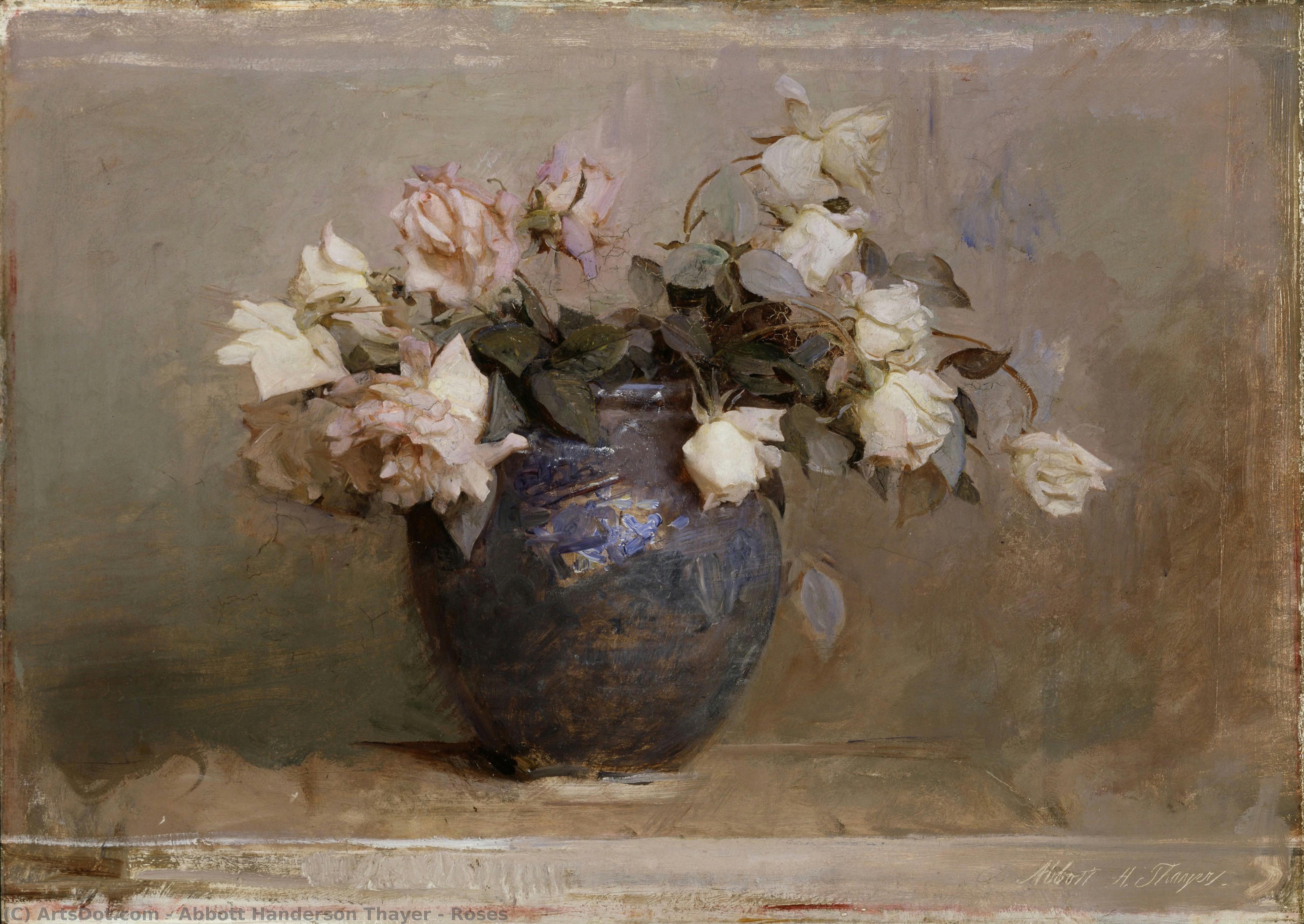
Elegant 1890 still life of pink and white roses by Abbott Handerson Thayer; capture the delicate beauty of this floral masterpiece for your collection.
Biografia artysty
Abbott Handerson Thayer (1849-1921) – amerykański malarz znany z idealistycznych portretów, krajobrazów i fascynacji kamuflażem. Jego dzieła inspirują do obserwacji natury i piękna.
O obrazie
A Symphony in Petals: Exploring Abbott Handerson Thayer's "Roses"
To gaze upon this exquisite still life, "Roses," is to step into a moment of cultivated, fragrant stillness. Painted around 1890, this work by Abbott Handerson Thayer captures more than just a collection of blooms; it arrests the very essence of ephemeral beauty. The arrangement itself—a vibrant gathering of pink and white roses mingled with creamy carnations, all cradled within a graceful blue vase—speaks of careful composition and natural abundance. Thayer’s hand guides the viewer's eye across the velvety textures of the petals, inviting an intimate appreciation for the delicate architecture of nature.
Mastery in Light and Texture: The Technique
Thayer’s technique here is a beautiful marriage of realism and the soft suggestion of impressionism. While the forms are rendered with enough precision to admire the subtle veining on each petal, the overall effect bathes the scene in a luminous quality. One can almost feel the cool porcelain of the blue vase and smell the sweet perfume rising from the clustered blossoms. His handling of light is particularly noteworthy; it seems to filter through the petals, giving them an inner glow that elevates this simple arrangement into something truly monumental. This masterful depiction of texture—the smooth curve of the vase contrasting with the myriad soft folds of the roses—is what gives the piece its enduring visual richness.
Symbolism and Sentiment: The Language of Flowers
In art history, flowers have always served as eloquent messengers, and this bouquet is no exception. Roses, in particular, carry a weight of symbolism—from deep passion to pure admiration, depending on their hue. Here, the interplay between the vibrant pinks and pristine whites suggests a dialogue between burgeoning romance and enduring purity. The inclusion of carnations adds another layer, often associated with fascination or distinction. Together, these blooms create a visual poem about the cycle of life itself: breathtaking beauty at its peak, yet inherently transient.
A Touch of Late Victorian Elegance
Dating to 1890, "Roses" sits beautifully within the late nineteenth-century artistic milieu, a time when artists were navigating between academic tradition and burgeoning modern sensibilities. Thayer’s background, blending influences from Paris with American naturalism, is perfectly reflected here. The piece possesses an undeniable elegance—a refined sensibility that speaks to the tastes of a sophisticated collector or those designing a space meant to evoke timeless grace. It is art that does not shout for attention but rather whispers its beauty into the quiet corners of a room.
Bringing the Still Life Home
For the admirer of fine art, this reproduction offers an unparalleled opportunity to possess a piece steeped in history and artistry. Whether placed above a mantelpiece or used as a focal point in a dining area, "Roses" introduces an immediate sense of cultivated calm. It is more than mere decoration; it is a contemplation—a daily reminder to pause, breathe deeply, and appreciate the exquisite, fleeting perfection found in nature's most delicate offerings.
Pytania i odpowiedzi
W jaki sposób "Roses" balansuje światło i cień?
Zarejestrowane wartości dla „Roses” – Abbott Handerson Thayer to: jasność balanced, luminancja Soft Shadow.
Co przedstawia "Roses" i jaką ma atmosferę?
„Roses” – Abbott Handerson Thayer łączy w sobie flowers, vase, roses, botanical art, american impressionism, symbolism, light, detail z Serene atmosferą.
Jak opisany jest nastrój dzieła „Roses” – Abbott Handerson Thayer?
"Roses" ma Serene atmosferę.
Najważniejsze informacje i quiz o sztuce
O Abbott Handerson Thayer

Abbott Handerson Thayer
1849 - 1921, Stany Zjednoczone
Biografia artysty
Early Life and Training
Abbott Handerson Thayer, a name synonymous with ethereal beauty and the evocative spirit of New England, was born in Boston in 1849. His early years were steeped in a love for art, nurtured by his family’s appreciation for culture and aesthetics – a legacy that would profoundly shape his artistic journey. Following his birth, the Thayer family relocated to Woodstock, Vermont, where Abbott spent his formative years immersed in the natural world, an experience that would later become a cornerstone of his artistic vision. This early exposure to both art and nature laid the foundation for his distinctive style, characterized by its delicate balance between realism and romanticism. Formal training commenced at the Brooklyn Art School, followed by further studies at the National Academy of Design in New York City. Crucially, he also spent a formative period in Paris, immersing himself in the artistic currents of the École des Beaux-Arts under the tutelage of renowned masters like Henri Lehmann and Jean-Léon Gerome – experiences that broadened his technical skills and exposed him to diverse artistic approaches.Artistic Career and Style
Thayer’s artistic career unfolded across several distinct phases, each marked by a unique evolution in his subject matter and technique. Initially, he focused on commissioned portraits, establishing himself as a respected portraitist within the New York art scene. However, a significant turning point occurred after personal tragedies – the loss of his wife, Kate, and later his young children – profoundly impacted his artistic direction. This period witnessed a shift towards allegorical paintings, often depicting women and children as angelic figures or embodiments of idealized virtues. These works were not merely decorative; they reflected Thayer’s deeply felt spirituality and his desire to find solace in the beauty of the divine. His style was characterized by a masterful command of light and color, combined with an almost Pre-Raphaelite sensibility – a deliberate harkening back to the artistic conventions of the late 15th century. He skillfully blended realism with impressionistic techniques, creating images that were both meticulously detailed and imbued with a sense of ethereal beauty. Notable works from this period include “The Virgin” (1890), a breathtaking depiction of maternal grace and serenity, and “Portrait of a Young Woman” (1888), which captures the essence of youthful innocence and vulnerability.Influence and Legacy
Thayer’s artistic journey was deeply influenced by several key figures and movements. The transcendentalist philosophy of Ralph Waldo Emerson and Henry David Thoreau, with their emphasis on the interconnectedness of humanity and nature, profoundly shaped his worldview and informed his artistic vision. He sought to capture the spiritual essence of the natural world, believing that art could serve as a conduit for experiencing the divine. Furthermore, he was deeply impacted by the burgeoning field of scientific understanding, particularly the germ theory of disease, which led him to adopt an unusually hygienic lifestyle – a reflection of his concern for health and well-being. His meticulous attention to detail, combined with his deep appreciation for nature, also drew inspiration from the work of Audubon, whose detailed illustrations of birds captivated audiences across America. Thayer’s legacy extends far beyond his individual works; he played a crucial role in popularizing the concept of camouflage in military applications, collaborating with George de Forest Brush to develop techniques that would prove invaluable during World War I. His contributions to this field cemented his place as a pioneer in the intersection of art and science.The Monadnock Years and Artistic Isolation
Following the loss of his family, Abbott Handerson Thayer sought refuge in Dublin, New Hampshire, establishing a secluded compound at the foot of Mount Monadnock. This period marked a significant shift in his artistic focus, as he turned increasingly to landscape painting and depictions of his immediate surroundings. The stark beauty of the mountain, with its rugged terrain and dramatic light, provided endless inspiration for his work. He deliberately created an environment of isolation, eschewing social gatherings and embracing a life of quiet contemplation. This deliberate withdrawal from the outside world allowed him to cultivate a deep connection with nature and to explore the spiritual dimensions of his art. His studio became a sanctuary—a place where he could immerse himself in the act of painting, capturing the essence of the landscape and reflecting on the mysteries of existence. During this time, Thayer developed a unique approach to color and composition, utilizing muted tones and atmospheric effects to convey a sense of serenity and timelessness.Museum Collections and Continuing Recognition
Abbott Handerson Thayer’s artistic legacy is reflected in the collections of numerous museums across North America. His works are prominently featured at the Museum Art Association of Richmond, where several portraits stand as testaments to his skill and artistry. The Cameron Art Museum in Wilmington, Delaware, also houses a significant collection of his landscape and still life paintings. Beyond these established institutions, Thayer’s art continues to be appreciated by collectors and enthusiasts worldwide. His distinctive style—characterized by its ethereal beauty, spiritual depth, and meticulous attention to detail—remains remarkably relevant today. The Smithsonian American Art Museum recognizes him as a key figure in the development of American art, celebrating his contributions to portraiture, landscape painting, and the broader cultural landscape of the late 19th and early 20th centuries.Krótkie informacje o Abbott Handerson Thayer
- Artistic Movement Or Style: Impressionizm i Realizm
- Artists Or Movements Influenced By This Artist: ['George de Forest Brush']
- Artists Who Influenced This Artist: ['Henry D. Morse']
- Date Of Birth: 12 sierpnia 1849
- Date Of Death: 29 maja 1921
- Full Name: Abbott Handerson Thayer
- Nationality: Amerykanin
- Notable Artworks:
- The Virgin
- Anioł
- Matka i dziecko
- Place Of Birth: Boston, USA


Abbott Handerson Thayer
Roses
() ·
Wraz z ramą: · Ręcznie malowane farbami olejnymi na płótnie lnianym
Suma