

Shown: · With its frame:
 Podgląd w skali 1:1
 Wyślij jako kartkę
 Udostępnij
 Szczegóły dzieła
 Przewodnik

 Pobierz obraz
 Podobne obiekty
 RTG
RTG Pokaz slajdów
 Q&A
Q&A Statystyki
 Oil On Canvas
- WallArt
- Neoclassical Style
 1836
1836- 19th Century
 51.0 x 42.0 cm
 Musée Fabre
zł 1036
Ręcznie malowana reprodukcja olejowa
Ręcznie malowany obraz olejny na płótnie, wykonany na zamówienie przez naszych artystów w wybranym przez Ciebie wymiarze i oprawie. ( Przełącz na wydania drukowane Przejdź do wersji cyfrowej)
Size
·Standardowy format
personalizowane
CM
INCH
Wybierz spośród naszych standardowych rozmiarów, które zachowują oryginalne proporcje dzieła sztuki.
Loading sizes...

szerokość
wysokość
Wpisz wymaganą szerokość i wysokość, aby obraz pasował do Twojej ramy lub ściany. Ponieważ jest to dzieło malowane ręcznie, w przypadku rozmiaru o innych proporcjach artysta może domalować nieco więcej wokół obrazu lub przyciąć jego fragmenty — wybór należy do Ciebie. Przed rozpoczęciem pracy prześlemy Ci cyfrową wizualizację do zatwierdzenia. Obraz widoczny na tej stronie nie przedstawia rzeczywistego efektu — jedynie wizualizacja oddaje realny rezultat.
 Dowiedz się więcej
Finish
·
White zł1

Blurside zł1

Extended zł1

P118B zł10

P118H zł10

P118W zł10

P438Z zł10

P508JH zł12

P508YH zł12

P805H zł10

P805Z zł10

P919BZ zł10

P919G zł10

P919XJ zł10

P959ZH zł10

P968JZ zł12

W106C zł8

W218G zł10

W218JH zł8

W218Y zł10

W307PJ zł10

W316G zł10

W316PJ zł8

W316Y zł10

W398PJ zł8

W4111J zł10

W500HY zł15

W500JH zł15

W692G zł12

W849H zł8

W940BG zł15

W953PJ zł8

H24-GOLD zł30

H24-SILVER zł30

H36-GOLD zł45

H36-SILVER zł45
Shipped in a protective tube, ready for your own framer.
Above 105 cm the frame is shipped as a kit for a professional framer — read the details.
Extras
optionalWhat do the extras include?
Examples of what can be changed: Replace face with customer photo; Add pet (e.g., replace cat with dog); Include hidden message in background; Change background landscape or elements.
After order, TopImpressionists.com team will email client for instructions and provide a mockup preview
After order, TopImpressionists.com team will email client for instructions and provide a mockup preview
Dostawa na całym świecie () w ciągu 3–4 tygodni zamiast standardowych 5 tygodni. (29 Październik). Bez kompromisów w kwestii jakości.
Lakier ochronny
Etykieta obiektu
Szczegóły grawerowanej brązowej tabliczki
This elegant plaque features the artist's name and the title of the artwork, finely engraved for a timeless presentation.
It is made from bronze with a refined, elegant finish. The text is precisely laser-engraved for a sharp and permanent result. Measuring 9x2 cm, the plaque is compact yet easy to read. It's built to be durable and scratch-resistant, offering a professional, museum-quality look. Mounting is simple thanks to the included adhesive backing.
Szczegóły przezroczystej tabliczki akrylowej
The plaque includes essential engraved details such as the artist's name, the title of the artwork, the date it was created, the type of media used-like oil on canvas or watercolor-a brief description of the piece, and a QR code that links to the complete artwork information.
It is crafted from clear acrylic, offering a sleek, modern appearance. The text is UV-engraved in black to ensure strong visual contrast. With a size of 10x15 cm, it ensures optimal readability. It comes equipped with two metal hooks for secure wall mounting. The plaque is designed to be weather-resistant, making it suitable for various environments, and it includes interactive features that work seamlessly with smartphone scanning.
Szczegóły czarnej tabliczki akrylowej
This elegant plaque includes engraved information such as the artist's name, the title of the artwork, the date it was created, the type of media used (like oil on canvas or watercolor), a short description of the artwork, and a QR code for quick access to more information.
The plaque itself is made from refined black acrylic with a premium finish. The text is laser-engraved in white for high contrast and readability. Its size is 10x15 cm, designed to be easy to read. It comes with two metal hooks for professional mounting. The design is sleek and fits any interior style. It is also weather-resistant and durable, with built-in digital integration for mobile compatibility.
Opcja ze szkłem jest dostępna wyłącznie w rozmiarach poniżej 110 cm
 Opcja ze szkłem jest dostępna wyłącznie w rozmiarach poniżej 110 cm
- Bezpłatna ekspresowa wysyłka na cały świat
- Wysokiej jakości płótno lniane
- Pełne ubezpieczenie przesyłki
- Gwarancja zwrotu należności celnych i podatków importowych
- Gwarancja wiernego odwzorowania kolorów
- 100-dniowa polityka zwrotów (tylko w przypadku wad)
- Gwarancja 100% zwrotu pieniędzy
- Zniżka przy zakupie wielu sztuk


Opis obiektu
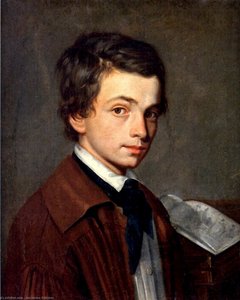
Admire Alexandre Cabanel's "Self Portrait as a Child" (1836), a poignant early work showcasing youthful introspection & academic mastery. Oil on canvas, Musée Fabre. Shop high-quality reproductions now!
Biografia artysty
Poznaj Alexandre Cabanelę (1823-1889), mistrza francuskiego malarstwa akademickiego znanego z dzieł klasycznych i historycznych, takich jak 'Złoto Wenus'. Eksploruj portrety, sceny religijne oraz jego trwały wpływ.
About the painting
Self Portrait as a Child: A Window into Cabanel’s Soul
Alexandre Cabanel's "Self Portrait as a Child," painted in 1836, is more than just a charming depiction of youth; it’s a profoundly intimate glimpse into the formative years of one of France’s most celebrated academic artists. Housed within the walls of the Musée Fabre in Montpellier, this oil on canvas piece transcends its modest dimensions (51 x 42 cm) to offer a poignant meditation on identity, aspiration, and the very beginnings of artistic vision. The painting immediately draws the viewer in with its quiet intensity – a young man, barely into his teens, sits thoughtfully, a book open before him, his gaze direct and unwavering.
Neoclassical Roots & Romantic Awakening
Cabanel’s work exemplifies the fascinating transitional period between Neoclassicism and Romanticism in French art. Born in Montpellier in 1823, he was steeped in the classical ideals championed by Jacques-Louis David – a legacy evident in the meticulous detail of his brushwork and the idealized beauty of his subject. However, "Self Portrait as a Child" hints at the burgeoning Romantic sensibility, particularly in the boy’s contemplative pose and the subtle melancholy that permeates the scene. This early work demonstrates Cabanel's mastery over both style and technique, foreshadowing his later successes in depicting historical and mythological narratives with remarkable realism and emotional depth.
A Study in Technique & Composition
The painting’s technical brilliance is immediately apparent. Cabanel’s command of oil on canvas is exceptional; the smooth gradations of color, the delicate modeling of form, and the precise rendering of textures – particularly in the book and the boy's clothing – speak to years of dedicated training. The composition itself is carefully considered. The seated pose, with the direct gaze and the open book, creates a sense of immediacy and invites the viewer into the young man’s world. It’s not merely a portrait; it’s an intimate dialogue between artist and subject, a self-examination captured on canvas.
Symbolism & The Artist's Journey
"Self Portrait as a Child" is laden with symbolic weight. The book represents knowledge, aspiration, and the pursuit of artistic excellence – qualities that were central to Cabanel’s own life. The contemplative pose suggests a moment of self-reflection, a questioning of one’s place in the world and the path one intends to follow. This early work is crucial because it reveals Cabanel's dedication to his craft from a young age, demonstrating an innate talent nurtured by rigorous training. It offers a rare and valuable insight into the genesis of a master artist’s career – a testament to the power of observation, discipline, and a profound connection with one’s artistic heritage.
Pytania i odpowiedzi
Ile lat miał Alexandre Cabanel, gdy powstało dzieło „Self Portrait as a Child”?
Alexandre Cabanel stworzył/a "Self Portrait as a Child" w wieku 13 lat. Artysta urodził/a się w 1823, a datowanie dzieła to 1836.
Czy dostępna jest prezentacja w formie pokazu slajdów dla „Self Portrait as a Child” – Alexandre Cabanel?
Dostępna jest prezentacja zdjęć: strona Prezentacja slajdów dzieła „Self Portrait as a Child” – Alexandre Cabanel.
Jakie miejsce w historii sztuki zajmuje „Self Portrait as a Child” – Alexandre Cabanel?
Dzieło „Self Portrait as a Child” – Alexandre Cabanel klasyfikuje się jako Neoclassical Style, pochodzące z okresu 19th Century.
Quick facts and art quiz
About Alexandre Cabanel

Alexandre Cabanel
1823 - 1889, Francja
Biografia artysty
Alexandre Cabanel - A Master of Academic Style
Alexandre Cabanel (ur. 28 września 1823 w Montpellier, zm. 23 stycznia 1889 w Paryżu) – malarz francuski. Był jednym z głównych przedstawicieli akademickiego eklektyzmu.
Born in Montpellier in 1823, Cabanel was the son of a carpenter and began his artistic apprenticeship at the local art school in Montpellier at the age of ten, demonstrating an aptitude that warranted special attention. Five years later, he received a scholarship to study in Paris in 1839, entering the École des Beaux-Arts under the tutelage of François-Édouard Picot.
Picot, himself a student of Jacques-Louis David (1748-1825), imparted a rigorous training rooted in classical principles—a foundation that would profoundly shape Cabanel’s artistic trajectory. The curriculum wasn't solely focused on technique; it encompassed a broad education in literature, history, and philosophy, fostering an intellectual depth that informed his subject matter.
His early attempts at the Prix de Rome scholarship, though initially unsuccessful, demonstrated ambition and a willingness to refine his skills. Finally, in 1845, he achieved this honor, granting him a period of study at the Villa Medici in Rome—a pivotal experience for any aspiring French artist.
The Roman Years and Rise to Prominence
Rome proved transformative for Cabanel. Immersed in the art and culture of antiquity, he absorbed the lessons of the Renaissance masters, studying their compositions, techniques, and mastery of form. This period wasn’t merely about copying the old masters; it was a process of internalizing classical ideals and adapting them to his own artistic vision.
During this time, he forged a crucial relationship with Alfred Bruyas, an avid art collector who became Cabanel's patron. Bruyas commissioned several works from the artist, including *Albaydé*, *La Chiaruccia*, and *Man Contemplating, A Young Roman Monk*—paintings that reveal Cabanel’s growing skill in depicting both historical subjects and evocative scenes imbued with romantic sensibility.
The breakthrough moment arrived in 1863 with *The Birth of Venus*. This painting, a stunning depiction of the goddess emerging from the sea, caused an immediate sensation—and not without controversy. While celebrated for its exquisite rendering of the female form and masterful technique, it also drew criticism from some quarters who found it overly sensual or lacking in originality.
However, Napoleon III himself purchased the work for his personal collection, solidifying Cabanel’s reputation and ensuring his place among the most sought-after artists of the Second Empire.
A Master of Academic Style
Cabanel's artistic style is firmly rooted in academic realism—a tradition that emphasized precise draftsmanship, meticulous attention to detail, and a commitment to classical ideals of beauty. He excelled at portraying historical, mythological, and religious subjects, often imbuing them with a sense of drama and emotional intensity.
His portraits were equally admired for their ability to capture not only the physical likeness of his sitters but also their character and personality. Cabanel possessed an exceptional talent for rendering flesh tones with remarkable realism, creating figures that seemed to breathe on the canvas.
He wasn’t simply replicating reality; he was idealizing it—striving to create images that embodied classical notions of harmony, balance, and proportion. This pursuit of idealized beauty often led him to refine and perfect his subjects, resulting in paintings that were both technically flawless and aesthetically pleasing.
Legacy and Influence
By 1864, Cabanel had achieved a level of success that allowed him to accept a professorship at the École des Beaux-Arts—a position he held until his death in 1889. As a teacher, he influenced generations of artists, imparting his knowledge and skills to aspiring painters.
Among his notable pupils were numerous successful artists who carried on the traditions of academic painting. His work continued to be exhibited and celebrated, and he retained a loyal following among collectors and patrons.
Quick facts about Alexandre Cabanel
- Artistic Movement Or Style: Akademia
- Artists Or Movements Influenced By This Artist: ['Impressionizm']
- Artists Who Influenced This Artist:
- Jacques-Louis David
- François Édouard Picot
- Date Of Birth: 28 września 1823
- Date Of Death: 23 stycznia 1889
- Full Name: Alexandre Cabanel
- Nationality: Francuz
- Notable Artworks:
- Święty Jan Chrzestny
- Narodziny Wenus
- Place Of Birth: Montpellier, Francja
Odkryj dzieła sztuki uporządkowane według tematów, stylów i cech charakterystycznych.


Alexandre Cabanel
Self Portrait as a Child
() ·
With its frame: · Hand-painted in oil on linen
Total