


 Podgląd w skali 1:1
 Wyślij jako kartkę
 Udostępnij
 Szczegóły dzieła
 Przewodnik

 Pobierz obraz
 Podobne obiekty
 RTG
RTG Pokaz slajdów
 Q&A
Q&A Statystyki
 Top100
Moret-sur-Loing


Zapraszamy na reprodukcję obrazu Alfreda Sisley'ego „Moret-sur-Loing” - spokojnej impresjonistycznej krajobrazówkę zatopioną w ciepłym świetle zachodu słońca. Klasyka sztuki francuskiego pejzażu, doskonała dekoracja wnętrz.
 Rozwiń treść
Alfred Sisley – francuski impresjonista, mistrz spokojnych krajobrazów i rzek. Uchwycił ulotne światło Francji z delikatną precyzją. Odkryj jego piękno!
Giclée / Wydruk artystyczny
Wydruki giclée lub płótna o jakości muzealnej, szybka realizacja i szeroki wybór opcji wykończenia. ( Zamów ręcznie malowaną reprodukcję Przejdź do wersji cyfrowej)




P118B zł10

P118H zł10

P118W zł10

P438Z zł10

P508JH zł12

P508YH zł12

P805H zł10

P805Z zł10

P919BZ zł10

P919G zł10

P919XJ zł10

P959ZH zł10

P968JZ zł12

W106C zł8

W218G zł10

W218JH zł8

W218Y zł10

W307PJ zł10

W316G zł10

W316PJ zł8

W316Y zł10

W398PJ zł8

W4111J zł10

W500HY zł15

W500JH zł15

W692G zł12

W849H zł8

W940BG zł15

W953PJ zł8




Standardowy format
personalizowane
CM
INCH
Wybierz spośród naszych standardowych rozmiarów, które zachowują oryginalne proporcje dzieła sztuki.
Loading sizes...

szerokość
wysokość
Wpisz wymaganą szerokość i wysokość, aby dopasować grafikę do ramy lub ściany. Wydruk można jedynie przyciąć, nigdy nie powiększając go poza oryginalny obraz, dlatego format o innych proporcjach spowoduje utratę części kompozycji. Przed rozpoczęciem druku prześlemy Ci cyfrowy podgląd do zatwierdzenia. Obraz wyświetlany na tej stronie nie pokazuje rzeczywistego przycięcia — jedynie podgląd oddaje ten efekt.
Dostawa na cały świat () w ciągu 2 tygodni zamiast standardowych 4/5 tygodni. (30 Październik)

Bezpłatna ekspresowa wysyłka na cały świat

Wysokiej jakości płótno lniane

Pełne ubezpieczenie przesyłki

Gwarancja zwrotu należności celnych i podatków importowych

Gwarancja wiernego odwzorowania kolorów

100-dniowa polityka zwrotów (tylko w przypadku wad)

Gwarancja 100% zwrotu pieniędzy

Zniżka przy zakupie wielu sztuk
 Opcja ze szkłem jest dostępna wyłącznie w rozmiarach poniżej 110 cm

Moret-sur-Loing
Giclée / Wydruk artystyczny
Wymiary reprodukcji
-


Cena całkowita
zł 268
Spokojne arcydzieło impresjonizmu
"Moret-sur-Loing", namalowane przez Alfreda Sisley'a w 1888 roku, stanowi urzekający przykład impresjonistycznego malarstwa pejzażowego, które zaprasza widza do spokojnego nadbrzeżnego miasteczka, skąpanego w łagodnej łunie zachodzącego słońca. To wykwintne dzieło ukazuje mistrzostwo Sisley'a w operowaniu światłem i atmosferą, czyniąc je cennym nabytkiem dla każdego entuzjasty lub kolekcjonera sztuki.
Tematyka i kompozycja
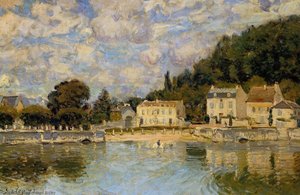
Dzieło przedstawia malownicze miasteczko Moret-sur-Loing, położone nad rzeką Loing we Francji. Scena ta charakteryzuje się spokojnymi odbiciami w tafli wody, urokliwą zabudową oraz dominującym kościołem z wysoką wieżą i okrągłą basztą. Kompozycja Sisley'a cechuje się zrównoważonym rozłożeniem elementów, tworząc harmonijny i zapraszający krajobraz, który wciąga widza w to pełne spokoju otoczenie.
Styl i technika
Impresjonistyczny styl Sisley'a jest wyraźnie widoczny w "Moret-sur-Loing" poprzez nacisk na uchwycenie światła i nastroju, zamiast skupiania się na drobnych detalach. Luźne, płynne pociągnięcia pędzla oraz żywa paleta barw są znakami rozpoznawczymi tego stylu, przyczyniając się do dynamicznego i spontanicznego odczucia obrazu. Sisley prawdopodobnie użył farb olejnych na płótnie, co pozwoliło na bogate mieszanie kolorów i teksturalne zróżnicowanie, wzmacniające ogólny efekt wizualny.
Kontekst historyczny
Alfred Sisley, brytyjsko-francuski malarz impresjonista, poświęcił życie utrwalaniu piękna natury poprzez swoją sztukę. Urodzony w Paryżu w 1839 roku, studiował pod okiem szwajcarskiego artysty Marca-Charlesa-Gabriela Gleyre'a w École des Beaux-Arts, gdzie zaprzyjaźnił się z innymi wybitnymi twórcami, takimi jak Frédéric Bazille, Claude Monet czy Pierre-Auguste Renoir. "Moret-sur-Loing" powstało w okresie, gdy Sisley osiadł w samym Moret-sur-Loing – miasteczku, które stało się dla niego niezwykle ważnym źródłem inspiracji do tworzenia pejzaży.
Symbolika i oddziaływanie emocjonalne
Tematyka "Moret-sur-Loing" przywołuje poczucie pokoju i nostalgii. Kościelna wieża i okrągła baszta mogą symbolizować wspólnotę oraz historię, podczas gdy spokojna rzeka reprezentuje ciszę i upływ czasu. Miękkie, wypełnione chmurami niebo oraz impresjonistyczne pociągnięcia pędzla tworzą marzycielską, niemal eteryczną jakość, która potęguje emocjonalny przekaz dzieła. Obraz ten jest idealny dla osób pragnących wprowadzić atmosferę ukojenia i ponadczasowego piękna do swoich domów lub przestrzeni pracy.
Dlaczego warto wybrać tę reprodukcję?
Dla miłośników sztuki, kolekcjonerów oraz projektantów wnętrz "Moret-sur-Loing" oferuje wyjątkową okazję do posiadania wysokiej jakości reprodukcji słynnego impresjonistycznego arcydzieła. Spokojna scena i żywa paleta barw sprawiają, że jest to idealny wybór do nadania elegancji i wyrafinowania każdemu pomieszczeniu. Bez względu na to, czy szukasz inspiracji dla kreatywności, pragniesz stworzyć kojący nastrój, czy po prostu chcesz docenić piękno impresjonizmu, ta reprodukcja z pewnością zachwyci i zrobi wrażenie.
Pytania i odpowiedzi
Kiedy powstało dzieło "Moret-sur-Loing" i do jakiego nurtu należy?
"Moret-sur-Loing" powstało w 1888 roku jako dzieło należące do nurtu Impressionist Landscape. Data powstania oraz przynależność do tego kierunku osadzają dzieło w kontekście historii sztuki.
Gdzie mogę znaleźć statystyki dotyczące „Moret-sur-Loing” – Alfred Sisley?
Dla dzieła „Moret-sur-Loing” dostępna jest strona Statystyki wyświetleń. Przedstawia ona miesięczną liczbę odwiedzin tego dzieła oraz innych prac artysty, z podziałem na kraje i języki.
Czy mogę przyjrzeć się bliżej dziełu "Moret-sur-Loing"?
Strona Analiza rentgenowska dzieła „Moret-sur-Loing” – Alfred Sisley to interaktywny podgląd, który pozwala na przeglądanie jedenastu warstw optycznych obrazu, w tym widoku w stylu rentgenowskim.
Podobne dzieła






Biografia artysty
A Life Immersed in Light and Landscape
Alfred Sisley, a name often whispered alongside those of Monet, Renoir, and Pissarro, occupies a unique and profoundly beautiful space within the Impressionist movement. Born in Paris on October 30, 1839, to British parents—William Sisley, a silk merchant, and Felicia Sell, a music enthusiast—he carried a dual heritage that subtly informed his artistic vision. Though he would spend nearly his entire life in France, Sisley retained British citizenship, a fact that brought him personal disappointment later in life when applying for French naturalization was refused. His early years were comfortably bourgeois, affording him the opportunity to pursue studies initially intended for a commercial career in London at the age of eighteen. However, the allure of art proved too strong, and he returned to Paris in 1861, embarking on formal training under Swiss artist Marc-Charles-Gabriel Gleyre at the École des Beaux-Arts. It was here, amidst the burgeoning artistic ferment of the era, that Sisley forged crucial friendships with Monet, Renoir, and Bazille—relationships that would profoundly shape his artistic trajectory. These companions shared a rebellious spirit, rejecting the rigid conventions of academic painting in favor of capturing the fleeting effects of light and atmosphere directly from nature.The Quiet Master of Impressionism
Sisley’s dedication to *plein air* painting—working outdoors, directly observing the natural world—was unwavering. Unlike some of his contemporaries who experimented with diverse genres, Sisley remained steadfastly committed to landscape throughout his career. This focused devotion allowed him to refine a distinctive style characterized by tranquility, delicate color palettes, and a subtle rendering of light. His canvases are often awash in pale shades of green, pink, purple, dusty blue, and cream, creating an atmosphere of serene contemplation. While the early works remain largely lost to time, his mature paintings reveal a meticulous observation of nature combined with a poetic sensibility. He wasn’t interested in grand narratives or dramatic gestures; instead, he found beauty in the everyday—in the gentle flow of rivers, the dappled light filtering through trees, and the quiet charm of rural life. His early struggles for recognition were compounded by his father's financial difficulties following the Franco-Prussian War in 1870, forcing Sisley to rely solely on the sale of his art for sustenance—a precarious existence that shadowed much of his career. He was a true Impressionist, but one who often labored in relative obscurity during his lifetime.Rivers, Canals, and the Essence of Place
Recurring themes permeate Sisley’s oeuvre, most notably his fascination with water. River landscapes became a signature subject, exemplified by his series of paintings created during a trip to England in 1874 along the Thames near Molesey. These works, capturing the tranquil beauty of the river and its surroundings, are considered among his finest achievements—a “perfect moment of Impressionism,” as art historian Kenneth Clark described them. He also developed a deep connection with Moret-sur-Loing, where he lived for many years, immortalizing its canals, bridges, and surrounding countryside in numerous canvases. Paintings like "Watermill near Moret," "Barges on the Loing Canal, Spring", and “Fields around the Forest” showcase his ability to imbue ordinary scenes with a sense of poetic grace. He didn’t merely depict these places; he captured their *essence*, conveying not just what they looked like but how they felt—the gentle breeze, the warmth of the sun, the quiet murmur of the water. This sensitivity to atmosphere and mood is perhaps Sisley's most enduring legacy.Influences and a Lasting Legacy
Sisley’s artistic influences were multifaceted. Gleyre’s academic training provided a foundation in technique, while the camaraderie with Monet, Renoir, and Bazille fostered a shared commitment to Impressionist principles. He absorbed their emphasis on capturing fleeting moments of light and atmosphere but developed his own unique voice—one characterized by restraint and subtlety. Though he often labored in relative obscurity during his lifetime, Sisley’s work is now celebrated for its beauty, sensitivity, and unwavering dedication to portraying nature. His influence can be seen in the works of later landscape painters who sought to capture the ephemeral qualities of light and atmosphere with similar nuance. He was a true master of light, atmosphere, and the quiet poetry of the natural world.- Major Themes: Landscapes, riverscapes, canals, rural life, atmospheric effects.
- Key Characteristics: Delicate color palettes, subtle rendering of light, tranquil mood, *plein air* painting.
- Influences: Marc-Charles-Gabriel Gleyre, Claude Monet, Pierre-Auguste Renoir, Frédéric Bazille, Barbizon school painters.
A Biographical Sketch
Alfred Sisley was born in Paris on October 30, 1839, to affluent British parents. His father, William Sisley, was in the silk business, and his mother, Felicia Sell, was a cultivated music connoisseur. He spent his early years in London, studying for a career in commerce before returning to Paris in 1861 with a fervent desire to pursue art. It was at the École des Beaux-Arts that he encountered Gleyre and formed lasting friendships with Monet, Renoir, and Bazille—artists who shared his passion for capturing the fleeting effects of light and atmosphere. Sisley’s early works, though largely lost, demonstrated an emerging talent for depicting landscapes with a delicate touch and a keen eye for detail. The Franco-Prussian War significantly impacted his life, leading to financial hardship and forcing him to rely on the sale of his paintings for survival. Despite these challenges, he continued to paint tirelessly, developing his signature style—characterized by its tranquil mood, subtle color palettes, and masterful rendering of light. He spent much of his later years in Moret-sur-Loing, where he found inspiration in the surrounding countryside and created some of his most beloved works. Alfred Sisley died on January 29, 1899, in Moret-sur-Loing, leaving behind a legacy as one of the most serene and beautiful Impressionists. His paintings remain cherished for their ability to transport viewers to quiet corners of France—a testament to his lifelong dedication to capturing the essence of light and landscape.
Alfred Sisley
1839 - 1899 , Francja
Krótka nota
- Artistic Movement Or Style: Impresjonizm
- Artists Or Movements Influenced By This Artist: ['Barbizon']
- Artists Who Influenced This Artist:
- Gleyre
- Monet
- Renoir
- Date Of Birth: 1839-10-30
- Date Of Death: 1899-01-29
- Full Name: Alfred Sisley
- Nationality: Brytyjsko-Francuz
- Notable Artworks:
- Kanał Saint-Martin
- Mroźny dzień w Louveciennes
- Regaty w Molesey
- Place Of Birth: Paryż, Francja
Powiązane artykuły

Dining Room Elegance: Transforming Your Space with Impressionist Masterpieces
Elevate your dining room with the luminous beauty of Impressionist masterpieces. Discover how hand-painted Claude Monet and Renoir reproductions can transform your space into a sanctuary of light, color, and timeless elegance for your home.

The Luminous Living Room: Curating Your Space with Timeless Impressionist Masterpieces
Transform your living room with the luminous beauty of Impressionist masterpieces. Discover museum-quality, hand-painted oil reproductions from Monet to Renoir, curated for the discerning collector seeking timeless elegance and soulful interior design.

Capturing the Drama: How Impressionist Light and Shadow Transform Your Living Space
Discover how the luminous light and dramatic shadows of Impressionist masterpieces can transform your home. Explore expert insights on using Renoir, Monet, and Cézanne to create a serene, culturally rich sanctuary through museum-quality, hand-painted oil reproductions.

Capturing the Light of Amsterdam: A Journey Through Impressionist Masterpieces of the Dutch Canals
Embark on a visual journey through the luminous Amsterdam canals. Discover how Impressionist masters captured the fleeting light of the Dutch landscape through evocative brushwork and color. Explore the timeless beauty of these masterpieces for your private art collection.

Capturing the Soul: The Ethereal Magic and Timeless Technique of Impressionist Portraiture
Discover the ethereal beauty of Impressionist portraiture. Explore how masters like Monet and Renoir captured light and soul through brushwork, and learn how to bring this timeless magic into your home with exquisite, hand-painted oil reproductions from TopImpressionists.com.
Odkryj dzieła sztuki uporządkowane według tematów, stylów i cech charakterystycznych.


