

Shown: · With its frame:
 Podgląd w skali 1:1
 Wyślij jako kartkę
 Udostępnij
 Szczegóły dzieła
 Przewodnik

 Pobierz obraz
 Podobne obiekty
 RTG
RTG Pokaz slajdów
 Q&A
Q&A Statystyki
 Oil On Canvas
- WallArt
- Early Modern Indian
 1941
1941- Modern
 440.0 x 865.0 cm
 National Gallery of Modern Art
zł 1336
Ręcznie malowana reprodukcja olejowa
Ręcznie malowany obraz olejny na płótnie, wykonany na zamówienie przez naszych artystów w wybranym przez Ciebie wymiarze i oprawie. ( Przełącz na wydania drukowane Przejdź do wersji cyfrowej)
Size
·Standardowy format
personalizowane
CM
INCH
Wybierz spośród naszych standardowych rozmiarów, które zachowują oryginalne proporcje dzieła sztuki.
Loading sizes...

szerokość
wysokość
Wpisz wymaganą szerokość i wysokość, aby obraz pasował do Twojej ramy lub ściany. Ponieważ jest to dzieło malowane ręcznie, w przypadku rozmiaru o innych proporcjach artysta może domalować nieco więcej wokół obrazu lub przyciąć jego fragmenty — wybór należy do Ciebie. Przed rozpoczęciem pracy prześlemy Ci cyfrową wizualizację do zatwierdzenia. Obraz widoczny na tej stronie nie przedstawia rzeczywistego efektu — jedynie wizualizacja oddaje realny rezultat.
 Dowiedz się więcej
Finish
·
White zł1

Blurside zł1

Extended zł1

P118B zł10

P118H zł10

P118W zł10

P438Z zł10

P508JH zł12

P508YH zł12

P805H zł10

P805Z zł10

P919BZ zł10

P919G zł10

P919XJ zł10

P959ZH zł10

P968JZ zł12

W106C zł8

W218G zł10

W218JH zł8

W218Y zł10

W307PJ zł10

W316G zł10

W316PJ zł8

W316Y zł10

W398PJ zł8

W4111J zł10

W500HY zł15

W500JH zł15

W692G zł12

W849H zł8

W940BG zł15

W953PJ zł8

H24-GOLD zł30

H24-SILVER zł30

H36-GOLD zł45

H36-SILVER zł45
Shipped in a protective tube, ready for your own framer.
Above 105 cm the frame is shipped as a kit for a professional framer — read the details.
Extras
optionalWhat do the extras include?
Examples of what can be changed: Replace face with customer photo; Add pet (e.g., replace cat with dog); Include hidden message in background; Change background landscape or elements.
After order, TopImpressionists.com team will email client for instructions and provide a mockup preview
After order, TopImpressionists.com team will email client for instructions and provide a mockup preview
Dostawa na całym świecie () w ciągu 3–4 tygodni zamiast standardowych 5 tygodni. (31 Październik). Bez kompromisów w kwestii jakości.
Lakier ochronny
Etykieta obiektu
Szczegóły grawerowanej brązowej tabliczki
This elegant plaque features the artist's name and the title of the artwork, finely engraved for a timeless presentation.
It is made from bronze with a refined, elegant finish. The text is precisely laser-engraved for a sharp and permanent result. Measuring 9x2 cm, the plaque is compact yet easy to read. It's built to be durable and scratch-resistant, offering a professional, museum-quality look. Mounting is simple thanks to the included adhesive backing.
Szczegóły przezroczystej tabliczki akrylowej
The plaque includes essential engraved details such as the artist's name, the title of the artwork, the date it was created, the type of media used-like oil on canvas or watercolor-a brief description of the piece, and a QR code that links to the complete artwork information.
It is crafted from clear acrylic, offering a sleek, modern appearance. The text is UV-engraved in black to ensure strong visual contrast. With a size of 10x15 cm, it ensures optimal readability. It comes equipped with two metal hooks for secure wall mounting. The plaque is designed to be weather-resistant, making it suitable for various environments, and it includes interactive features that work seamlessly with smartphone scanning.
Szczegóły czarnej tabliczki akrylowej
This elegant plaque includes engraved information such as the artist's name, the title of the artwork, the date it was created, the type of media used (like oil on canvas or watercolor), a short description of the artwork, and a QR code for quick access to more information.
The plaque itself is made from refined black acrylic with a premium finish. The text is laser-engraved in white for high contrast and readability. Its size is 10x15 cm, designed to be easy to read. It comes with two metal hooks for professional mounting. The design is sleek and fits any interior style. It is also weather-resistant and durable, with built-in digital integration for mobile compatibility.
Opcja ze szkłem jest dostępna wyłącznie w rozmiarach poniżej 110 cm
 Opcja ze szkłem jest dostępna wyłącznie w rozmiarach poniżej 110 cm
- Bezpłatna ekspresowa wysyłka na cały świat
- Wysokiej jakości płótno lniane
- Pełne ubezpieczenie przesyłki
- Gwarancja zwrotu należności celnych i podatków importowych
- Gwarancja wiernego odwzorowania kolorów
- 100-dniowa polityka zwrotów (tylko w przypadku wad)
- Gwarancja 100% zwrotu pieniędzy
- Zniżka przy zakupie wielu sztuk


Opis obiektu
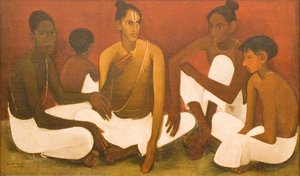
A serene scene of four figures bathed in soft light defines Amrita Sher-Gil’s 1941 masterpiece Brahmacharis, blending Post-Impressionism with Indian tradition for those seeking to possess a piece of modern history.
Biografia artysty
Odkryj Amrita Sher-Gil (1913-1941), pionierkę malarstwa węgiersko-indyjskiego, która łączyła style Wschodu i Zachodu. Poznaj jej poruszające portrety i dziedzictwo jako ikony nowoczesnej sztuki Indii.
About the painting
A Radiant Echo of Tradition: The Soul of Amrita Sher-Gil’s ‘Brahmacharis’
In the vast tapestry of modern Indian art, few names shimmer with as much intensity and brevity as Amrita Sher-Gil. Her masterpiece, Brahmacharis, completed in 1941, serves as a profound window into a pivotal moment where European modernism met the ancient, rhythmic pulse of India. The painting presents a serene horizontal composition, capturing four figures seated upon the earth, bathed in a diffused, ethereal light that seems to emanate from within the canvas itself. There is an immediate, palpable stillness to the scene—a quietude that invites the viewer to pause and enter a state of shared contemplation alongside the subjects. Sher-Gil does not merely observe her subjects; she inhabits their world, translating the daily existence of South Indian life into a visual poem of dignity and grace.
The emotional resonance of Brahmacharis lies in its ability to evoke empathy through a subtle, melancholic beauty. The figures, representing students or celibates, possess eyes that seem to hold a weight of introspection, perhaps hinting at the quiet struggles and spiritual aspirations of their station. This humanistic impulse is what elevates the work from a mere ethnographic study to a deeply moving piece of fine art. For the collector or the interior designer, this painting offers more than just aesthetic appeal; it provides a focal point of profound emotional depth, capable of anchoring a room with its sense of peace and historical gravity.
A Synthesis of Worlds: Technique and Aesthetic Mastery
Technically, Brahmacharis is a triumph of stylistic synthesis. Sher-Gil, having refined her skills in the studios of Paris, brought the sophisticated techniques of European Post-Impressionism to the Indian landscape. She utilized oil on canvas with a meticulous, layered approach, eschewing heavy, distracting brushstrokes in favor of a smooth, luminous surface. This technique allows for a soft, muted atmosphere where light feels even and gentle, rather than harsh or dramatic.
Yet, while her method was rooted in Western tradition, her visual language was deeply indebted to the heritage of India. The composition draws heavily from the flattened perspective and stylized outlines found in Indian miniature paintings. This creates a beautiful tension between depth and flatness; while there is a slight sense of overlapping figures that suggests space, the overall effect remains elegantly two-dimensional. Her palette is a masterful celebration of the earth: rich ochres, deep reds, warm browns, and vibrant greens are harmonized with the stark, pure white of the figures' garments. This color story does not just decorate the canvas; it breathes life into the cultural identity of the subjects, making the painting feel like a living fragment of tradition.
An Enduring Legacy for the Discerning Collector
To possess a reproduction of Brahmacharis is to hold a piece of art history that bridges two great civilizations. The work stands as a testament to Sher-Gil’s unique ability to navigate her dual heritage—Hungarian and Indian—to create something entirely new and undeniably modern. For those seeking to curate spaces that reflect sophistication, cultural depth, and a connection to the avant-garde, this painting offers unparalleled inspiration.
Whether placed in a private gallery, a scholarly study, or a contemporary living space, the artwork acts as a silent storyteller. It brings with it the warmth of the Indian sun and the quiet strength of a tradition that refuses to be forgotten. In an era of fleeting digital imagery, the enduring, tactile beauty of Sher-Gil’s vision provides a much-needed sense of permanence and soulful elegance.
Pytania i odpowiedzi
Czy kolory w „Brahmacharis” – Amrita Sher-Gil są nasycone czy stonowane?
Dzieło „Brahmacharis” – Amrita Sher-Gil charakteryzuje się Clear Color Presence nasyceniem kolorów.
Jaką popularność cieszy się "Brahmacharis" w obrębie nurtu Early Modern Indian?
„Brahmacharis” figuruje w katalogu jako dzieło o Iconic wśród prac należących do nurtu Early Modern Indian.
Jaki układ ma „Brahmacharis” – Amrita Sher-Gil?
Dzieło „Brahmacharis” – Amrita Sher-Gil ma format Panoramic. Format ten określa proporcje kompozycji.
Quick facts and art quiz
About Amrita Sher-Gil

Amrita Sher-Gil
1913 - 1941, Słowacja
Biografia artysty
Życie łączące światy: Historia Amryty Sher-Gil
Amrita Sher-Gil, nazwisko będące synonimem świtu nowoczesnej sztuki indyjskiej, była artystką, której krótka, lecz żarząca się kariera pozostawiła niezatarty ślad w krajobrazze kulturowym. Urodzona w 1913 roku w Budapeszencie dla niezwykle różnorodnego pochodzenia – Umrao Singh Sher-Gil Majithia, sikhistowskiego arystokraty i uczonego, oraz Marie Antoinette Gottesmann, węgierskiej żydowskiej śpiewaczki operowej – jej życie miało stać się opowieścią o fascynujących kontrastach. To unikalne dziedzictwo zaszczepiło w niej wrażliwość, która głęboko ukształtowała jej wizję artystyczną, pozwalając z niezwykłą głębią poruszać się w złożoności tożsamości i przynależności. Od najmłodszych lat Amrita wykazywała przedwczesny talent do malarstwa, pobierając formalne lekcje już w wieku ośmiu lat. Dzieciństwo w Budapeszcie obcowało ją z bogatą tkaniną europejskiej sztuki i kultury, podczas gdy lata spędzone w Indiach rozbudziły w niej narastającą fascynację ich tętniącymi życiem tradycjami i realiami społecznymi. Kluczowe okazało się wsparcie jej wuja, Ervina Baktaya, indologa; dostrzegł on jej potencjał i udzielał krytycznych uwag, kładąc solidne fundamenty pod jej rozwój artystyczny.Z paryskich pracowni do indyjskiej duszy
Formalne kształcenie zaprowadziło Amritę do Paryża w 1929 roku, gdzie zapisała się do Académie de la Grande Chaumière pod okiem Pierre Vaillenta i Luciena Simona, a później uczęszczała do École des Beaux-Arts. Zanurzona w bohemie miasta, chłonęła wpływy europejskiego modernizmu, w szczególności dzieła Paula Cézanne’a i Paula Gauguina. Jednak głęboka przemiana nastąpiła po jej powrocie do Indii w 1934 roku. Nie było to jedynie przesunięcie geograficzne; był to artystyczny powrót do domu. Zainspirowana majestatem malarstwa mogolskiego, delikatnym liryzmem miniatur Pahari oraz starożytnymi freskami z Ajanty, Amrita zaczęła zgłębiać indyjską tematykę z nową pasją. Pragnęła uchwycić esencję codzienności – cichą godność społeczności wiejskich, intymne chwile dzielone między kobietami, surowe piękno indyjskiego krajobrazu. Był to punkt zwrotny w jej artystycznej podróży, gdy świadomie odeszła od czysto zachodnich stylów, wyruszając na poszukiwania unikalnego, indyjskiego języka wizualnego.Wyrazisty styl: Kolor, forma i psychologiczna głębia
Styl Amryty Sher-Gil jest natychmiast rozpoznawalny dzięki odważnemu użyciu koloru, uproszczonym formom i ekspresyjnym postaciom. Posiadała niezwykłą zdolność przekazywania psychologicznej głębi w swoich portretach, chwytając nie tylko fizyczne podobieństwo modeli, ale także ich życie wewnętrzne, nadzieje i zmagania. Jej obrazy charakteryzują się poczuciem cichej intensywności, melancholijnym pięknem, które rezonuje z widzami nawet dzisiaj. Dzieła takie jak „Young Girls” (1932), które przyniosły jej międzynarodowe uznanie – zdobywając złoty medal i status adiunkta Grand Salon w Paryżu – demonstrują jej mistrzostwo w kompozycji i kolorze. „Self Portrait (7)” oraz „Sleep” jeszcze bardziej ukazują ewoluującą wizję artystyczną, ujawniając gotowość do eksperymentowania z formą oraz eksplorowania tematów tożsamości i zmysłowości. Nie tylko przedstawiała to, co widziała; przesycała swoje płótna emocjami, tworząc dzieła, które są jednocześnie wizualnie olśniewające i głęboko poruszające.Dziedzictwo i trwały wpływ
Tragicznie krótkie życie Amryty Sher-Gil – zmarła w 1941 roku w wieku zaledwie 28 lat – nie oddaje ogromu wpływu, jaki wywarła na sztukę indyjską. Słusznie uznaje się ją za pionierkę nowoczesnego malarstwa indyjskiego, która połączyła zachodnie techniki artystyczne z rodzimymi tradycjami, torując drogę przyszłym pokoleniom twórców. Jej twórczość subtelnie krytykowała nierówności społeczne i badała tematy tożsamości, płci oraz klasy w kolonialnych Indiach, czyniąc ją artystką wyprzedzającą swoją epokę. Dziś jej obrazy należą do najcenniejszych dzieł indyjskich malarek, co stanowi świadectwo ich historycznego znaczenia i artystycznej wartości. Poza biegłością techniczną, dziedzictwo Amryty Sher-Gil tkwi w jej zdolności do uchwycenia duszy Indii – ich piękna, złożoności i nieprzemijającego ducha. Jej osobiste listy, ujawniające skomplikowane relacje, w tym romanse z kobietami, oferują dalszy wgląd w życie i perspektywę artystki, dodając kolejną warstwę do zrozumienia tej niezwykłej kobiety i jej sztuki. Pozostaje ikoną, symbolem artystycznej innowacji i kulturowej fuzji, której twórczość nieustannie inspiruje i zachwyca odbiorców na całym świecie.Najważniejsze dzieła
- Young Girls (1932): Kluczowe wczesne dzieło, które przyniosło jej międzynarodową sławę.
- Self Portrait (7): Ukazuje ewoluujący styl i poszukiwania tożsamości.
- Sleep (1933): Poruszający akt, odzwierciedlający jej unikalną wizję artystyczną.
- Village Scene (1936-37): Uchwyca esencję wiejskiego życia w Indiach z niezwykłą wrażliwością.
- Three Women (1934): Potężne przedstawienie kobiecej wspólnoty i odporności.
Quick facts about Amrita Sher-Gil
- Artistic Movement Or Style: Nowoczesna sztuka indyjska, Awangarda
- Artists Or Movements Influenced By This Artist: Nowocześni artyści indyjscy
- Artists Who Influenced This Artist:
- Paul Cézanne
- Paul Gauguin
- Date Of Birth: 30 stycznia 1913
- Date Of Death: 5 grudnia 1941
- Full Name: Amrita Sher-Gil
- Nationality: Węgiersko-indyjska
- Notable Artworks:
- Young Girls
- Self Portrait (7)
- Sleep
- Place Of Birth: Budapeszt, Słowacja
Podobne dzieła


Amrita Sher-Gil
Brahmacharis
() ·
With its frame: · Hand-painted in oil on linen
Total