

Shown: · With its frame:
 Podgląd w skali 1:1
 Wyślij jako kartkę
 Udostępnij
 Szczegóły dzieła
 Przewodnik

 Pobierz obraz
 Podobne obiekty
 RTG
RTG Pokaz slajdów
 Q&A
Q&A Statystyki
zł 1036
Ręcznie malowana reprodukcja olejowa
Ręcznie malowany obraz olejny na płótnie, wykonany na zamówienie przez naszych artystów w wybranym przez Ciebie wymiarze i oprawie. ( Przełącz na wydania drukowane Przejdź do wersji cyfrowej)
Size
·Standardowy format
personalizowane
CM
INCH
Wybierz spośród naszych standardowych rozmiarów, które zachowują oryginalne proporcje dzieła sztuki.
Loading sizes...

szerokość
wysokość
Wpisz wymaganą szerokość i wysokość, aby obraz pasował do Twojej ramy lub ściany. Ponieważ jest to dzieło malowane ręcznie, w przypadku rozmiaru o innych proporcjach artysta może domalować nieco więcej wokół obrazu lub przyciąć jego fragmenty — wybór należy do Ciebie. Przed rozpoczęciem pracy prześlemy Ci cyfrową wizualizację do zatwierdzenia. Obraz widoczny na tej stronie nie przedstawia rzeczywistego efektu — jedynie wizualizacja oddaje realny rezultat.
 Dowiedz się więcej
Finish
·
White zł1

Blurside zł1

Extended zł1

P118B zł10

P118H zł10

P118W zł10

P438Z zł10

P508JH zł12

P508YH zł12

P805H zł10

P805Z zł10

P919BZ zł10

P919G zł10

P919XJ zł10

P959ZH zł10

P968JZ zł12

W106C zł8

W218G zł10

W218JH zł8

W218Y zł10

W307PJ zł10

W316G zł10

W316PJ zł8

W316Y zł10

W398PJ zł8

W4111J zł10

W500HY zł15

W500JH zł15

W692G zł12

W849H zł8

W940BG zł15

W953PJ zł8

H24-GOLD zł30

H24-SILVER zł30

H36-GOLD zł45

H36-SILVER zł45
Shipped in a protective tube, ready for your own framer.
Above 105 cm the frame is shipped as a kit for a professional framer — read the details.
Extras
optionalWhat do the extras include?
Examples of what can be changed: Replace face with customer photo; Add pet (e.g., replace cat with dog); Include hidden message in background; Change background landscape or elements.
After order, TopImpressionists.com team will email client for instructions and provide a mockup preview
After order, TopImpressionists.com team will email client for instructions and provide a mockup preview
Dostawa na całym świecie () w ciągu 3–4 tygodni zamiast standardowych 5 tygodni. (29 Październik). Bez kompromisów w kwestii jakości.
Lakier ochronny
Etykieta obiektu
Szczegóły grawerowanej brązowej tabliczki
This elegant plaque features the artist's name and the title of the artwork, finely engraved for a timeless presentation.
It is made from bronze with a refined, elegant finish. The text is precisely laser-engraved for a sharp and permanent result. Measuring 9x2 cm, the plaque is compact yet easy to read. It's built to be durable and scratch-resistant, offering a professional, museum-quality look. Mounting is simple thanks to the included adhesive backing.
Szczegóły przezroczystej tabliczki akrylowej
The plaque includes essential engraved details such as the artist's name, the title of the artwork, the date it was created, the type of media used-like oil on canvas or watercolor-a brief description of the piece, and a QR code that links to the complete artwork information.
It is crafted from clear acrylic, offering a sleek, modern appearance. The text is UV-engraved in black to ensure strong visual contrast. With a size of 10x15 cm, it ensures optimal readability. It comes equipped with two metal hooks for secure wall mounting. The plaque is designed to be weather-resistant, making it suitable for various environments, and it includes interactive features that work seamlessly with smartphone scanning.
Szczegóły czarnej tabliczki akrylowej
This elegant plaque includes engraved information such as the artist's name, the title of the artwork, the date it was created, the type of media used (like oil on canvas or watercolor), a short description of the artwork, and a QR code for quick access to more information.
The plaque itself is made from refined black acrylic with a premium finish. The text is laser-engraved in white for high contrast and readability. Its size is 10x15 cm, designed to be easy to read. It comes with two metal hooks for professional mounting. The design is sleek and fits any interior style. It is also weather-resistant and durable, with built-in digital integration for mobile compatibility.
Opcja ze szkłem jest dostępna wyłącznie w rozmiarach poniżej 110 cm
 Opcja ze szkłem jest dostępna wyłącznie w rozmiarach poniżej 110 cm
- Bezpłatna ekspresowa wysyłka na cały świat
- Wysokiej jakości płótno lniane
- Pełne ubezpieczenie przesyłki
- Gwarancja zwrotu należności celnych i podatków importowych
- Gwarancja wiernego odwzorowania kolorów
- 100-dniowa polityka zwrotów (tylko w przypadku wad)
- Gwarancja 100% zwrotu pieniędzy
- Zniżka przy zakupie wielu sztuk


Opis obiektu
Biografia artysty
Charles-François Daubigny (1817-1878) – francuski malarz Barbizon, prekursor impresjonizmu. Jego pejzaże oddają atmosferę i światło Francji. Odkryj jego dzieła na TopImpressionists!
About the painting
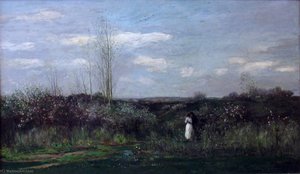
The Spring Landscape painting by Charles-François Daubigny is a beautiful representation of a woman walking through a field with trees in the background. Created in 1862, this artwork showcases the artist's unique style and technique. As a leading online platform specializing in handmade oil paintings reproductions and print on canvas of famous artwork, https://TopImpressionists.com offers a wide range of oil painting reproductions, including the works of Charles-François Daubigny.
The Alte Nationalgalerie, where the painting is housed, is a prominent art museum located in Berlin, Germany. It is part of the Staatliche Museen zu Berlin (National Museums in Berlin) and houses an extensive collection of European art from the 13th to the 20th centuries.
For more information on Charles-François Daubigny and his works, visit https://TopImpressionists.com. You can also explore the Nationalgalerie collection and learn more about the Barbizon School and Impressionism.
The Artist and His Style
Charles-François Daubigny was a French painter, representative of the Barbizon School, and an important precursor of Impressionism. His early traditional style changed when he met Camille Corot in 1852. He came under the influence of Gustave Courbet from 1852 onward. Daubigny for his part influenced Claude Monet, who he got to know in 1866 when he visited England.The Painting
The Spring Landscape painting is a stunning example of the artist's ability to capture the essence of nature. The woman walking through the field, surrounded by trees and a beautiful sky, creates a sense of serenity and peace. The painting measures 133 x 240 cm and is made with oil on canvas, giving it a vibrant and eye-catching appearance.The Alte Nationalgalerie, where the painting is housed, is a prominent art museum located in Berlin, Germany. It is part of the Staatliche Museen zu Berlin (National Museums in Berlin) and houses an extensive collection of European art from the 13th to the 20th centuries.
For more information on Charles-François Daubigny and his works, visit https://TopImpressionists.com. You can also explore the Nationalgalerie collection and learn more about the Barbizon School and Impressionism.
- View Charles-François Daubigny paintings on /art/list/?Filter=charles+fran%C3%A7ois+daubigny,charles,daubigny&
- Learn more about the Nationalgalerie on /art/list/?Filter=A@D3AMAR-The-Nationalgalerie-of-Berlin-Germany:-A-Comprehensive-Guide
Pytania i odpowiedzi
Kto stworzył "Spring Landscape" i w jakim roku?
Autorem dzieła "Spring Landscape" jest Charles-François Daubigny, a datowanie pracy pochodzi z 1862 roku.
Gdzie mogę znaleźć przewodnik do "Spring Landscape"?
Przewodnik po "Spring Landscape" to strona Karta informacyjna dla uczniów dzieła sztuki – nadrukowalna karta informacyjna zawierająca opis utworu, informacje o autorstwie oraz tabelę danych (artysta, daty, technika, wymiary oryginału, kolekcja).
Czy mogę zobaczyć „Spring Landscape” – Charles-François Daubigny na własnej ścianie przed zakupem?
Strona Podgląd w AR dzieła „Spring Landscape” – Charles-François Daubigny wykorzystuje rozszerzoną rzeczywistość, aby dzięki kompatybilnemu urządzeniu pokazać obraz w Twojej własnej przestrzeni.
Quick facts and art quiz
About Charles-François Daubigny

Charles-François Daubigny
1817 - 1878, Francja
Biografia artysty
A Pioneer of Atmospheric Impressionism: The Life and Art of Charles-François Daubigny
Charles-François Daubigny, born in Paris in 1817, emerged from a family deeply rooted in artistic tradition—his father, Edmé François Daubigny, and uncle, Pierre Daubigny, both painters, provided him with an early foundation. However, young Charles quickly sought to forge his own distinctive path, moving beyond the constraints of academic painting toward a more direct engagement with the natural world. His initial training under Paul Delaroche instilled technical proficiency, yet it was a journey through Italy in 1836, undertaken independently with fellow artist Henri Mignan, that truly ignited his artistic vision. This experience fostered an profound appreciation for landscape and a desire to capture its essence not as idealized scenery, but as a vibrant, living entity. Returning to Paris, Daubigny balanced commercial commissions—illustrating books and decorating panels—with his burgeoning passion for *plein air* painting, a practice that would become the cornerstone of his career. He found himself part of a thriving artistic community at the Rue des Amandiers-Popincourt, fostering collaboration and shared exploration of innovative approaches to art.The Barbizon Circle and the Embrace of Nature
Daubigny’s artistic trajectory took a significant turn in 1843 when he settled in Barbizon, a small hamlet nestled within the Forest of Fontainebleau. This marked his formal association with the Barbizon School, a group of artists who deliberately rejected the polished artifice of academic painting in favor of direct observation and honest representation of rural life and landscape. Unlike earlier landscape painters who often sketched outdoors and completed their works in the studio, the Barbizon artists—including Théodore Rousseau, Jean-François Millet, and Camille Corot—embraced *en plein air* painting as a fundamental principle. Daubigny’s friendship with Corot proved particularly influential; together they explored the forests of Fontainebleau, meticulously capturing the subtle nuances of light and atmosphere. This shared pursuit led to a deep understanding of how light interacts with surfaces, creating an illusion of depth and volume that was central to their artistic vision. Daubigny's innovative approach involved utilizing his own “Botin,” a specially constructed boat, which he used as a mobile studio to navigate the rivers of France—primarily the Seine and the Oise—allowing him unparalleled access to diverse landscapes and fostering an intimate connection with nature. This unique method became synonymous with his artistic practice, symbolizing his commitment to painting directly from life and experiencing the world firsthand.A Bridge Between Realism and Impressionism
Daubigny’s work occupies a fascinating and somewhat ambiguous position in 19th-century art history—he served as a crucial bridge between the realism of the Barbizon School and the nascent impressionistic movement. While firmly rooted in the Barbizon tradition's emphasis on faithful representation and sincerity, his paintings increasingly incorporated elements that foreshadowed the innovations of Monet, Renoir, and their contemporaries. He began to prioritize capturing fleeting moments of light, subjective perception, and atmospheric effects—qualities that would become hallmarks of impressionism. Daubigny experimented with techniques such as *cliché verre*, a process combining photography and printmaking, demonstrating an openness to new technologies and artistic possibilities. This experimentation allowed him to capture the ephemeral qualities of light and weather in ways previously unseen. Paintings like “Harvest” (1857) and "The Ponds of Gylieu" (1864) exemplify his ability to evoke a sense of mood and atmosphere, transporting the viewer into the heart of the French countryside. He wasn’t merely recording what he saw; he was conveying *how* it felt to be present in that moment—the warmth of the sun, the coolness of the shade, the subtle shifts in color.Notable Works and Lasting Influence
Charles-François Daubigny left behind a rich artistic legacy that continues to resonate today. His influence extended beyond his immediate circle of students—including his son Karl, Achille Oudinot, and Hippolyte Camille Delpy—to inspire generations of landscape painters. He played a pivotal role in fostering connections between the Barbizon School and the burgeoning Impressionist movement, introducing artists like Claude Monet and Paul Cézanne to new ways of seeing and painting. His commitment to *plein air* painting, his masterful rendering of atmospheric effects, and his willingness to embrace innovation paved the way for the radical artistic transformations that would define the late 19th century. Daubigny’s paintings are now held in prestigious museums around the world, including the Musée d'Orsay in Paris and the Cincinnati Art Museum, serving as a testament to his enduring contribution to the history of art. He remains a pivotal figure—a master of atmospheric realism who anticipated the arrival of Impressionism and helped shape the course of modern painting.- Harvest (1857): A quintessential example of Daubigny’s ability to capture rural life and atmosphere, now housed in the Musée d'Orsay.
- The Ponds of Gylieu (1864): Demonstrates his mastery of landscape painting and atmospheric perspective, currently at the Cincinnati Art Museum.
- Moonlight (1865): Showcases Daubigny’s skill in rendering nocturnal scenes with subtle light effects.
- Auvers-sur-Oise (1868): A captivating depiction of the French countryside, reflecting his deep connection to the region.
- Seascape (1876): An impressionistic depiction of waves and coastal beauty.
Key Characteristics of Daubigny’s Art
Atmospheric Perspective:** Daubigny was particularly adept at creating a sense of depth and distance through the skillful manipulation of light, color, and texture. Use of Light:* He meticulously observed how light transformed landscapes throughout the day, capturing fleeting moments of brilliance and shadow. Direct Observation:** Daubigny’s paintings are rooted in direct observation of nature, reflecting his commitment to *plein air* painting. Innovative Techniques:* His experimentation with *cliché verre* demonstrated a willingness to embrace new technologies and artistic approaches. Subject Matter:* Primarily focused on rural landscapes, rivers, and the French countryside.Quick facts about Charles-François Daubigny
- Artistic Movement Or Style: Szkoła Barbizon, Impresjonizm
- Artists Or Movements Influenced By This Artist:
- Impresjonizm
- Szkoła Barbizon
- Artists Who Influenced This Artist:
- Camille Corot
- Gustaw Courbet
- Date Of Birth: 15 lutego 1817
- Date Of Death: 19 lutego 1878
- Full Name: Charles-François Daubigny
- Nationality: Francuz
- Notable Artworks:
- Żniwo (1857)
- Stawy Gylieu (1864)
- Światło księżyca (1865)
- Auvers-sur-Oise (1868)
- Place Of Birth: Paryż, Francja
Odkryj dzieła sztuki uporządkowane według tematów, stylów i cech charakterystycznych.


Charles-François Daubigny
Spring Landscape
() ·
With its frame: · Hand-painted in oil on linen
Total