
 Podgląd w skali 1:1
 Wyślij jako kartkę
 Udostępnij
 Szczegóły dzieła
 Przewodnik

 Pobierz obraz
 Podobne obiekty
 RTG
RTG Pokaz slajdów
 Q&A
Q&A Statystyki
October Morning


Discover "October Morning" by Dwight William Tryon – a serene landscape painting capturing autumn's beauty. Explore its history, value & more at Invaluable.
 Rozwiń treść
Dwight Tryon – wybitny malarz tonalistyczny znany z melancholijnych krajobrazów i portretów, inspirowany szkołą barbizon i Whistlerem, oddający piękno natury w subtelnych kolorach i atmosferze.
Giclée / Wydruk artystyczny
Wydruki giclée lub płótna o jakości muzealnej, szybka realizacja i szeroki wybór opcji wykończenia. ( Zamów ręcznie malowaną reprodukcję Przejdź do wersji cyfrowej)




P118B zł10

P118H zł10

P118W zł10

P438Z zł10

P508JH zł12

P508YH zł12

P805H zł10

P805Z zł10

P919BZ zł10

P919G zł10

P919XJ zł10

P959ZH zł10

P968JZ zł12

W106C zł8

W218G zł10

W218JH zł8

W218Y zł10

W307PJ zł10

W316G zł10

W316PJ zł8

W316Y zł10

W398PJ zł8

W4111J zł10

W500HY zł15

W500JH zł15

W692G zł12

W849H zł8

W940BG zł15

W953PJ zł8




Standardowy format
personalizowane
CM
INCH
Wybierz spośród naszych standardowych rozmiarów, które zachowują oryginalne proporcje dzieła sztuki.
Loading sizes...

szerokość
wysokość
Wpisz wymaganą szerokość i wysokość, aby dopasować grafikę do ramy lub ściany. Wydruk można jedynie przyciąć, nigdy nie powiększając go poza oryginalny obraz, dlatego format o innych proporcjach spowoduje utratę części kompozycji. Przed rozpoczęciem druku prześlemy Ci cyfrowy podgląd do zatwierdzenia. Obraz wyświetlany na tej stronie nie pokazuje rzeczywistego przycięcia — jedynie podgląd oddaje ten efekt.
Dostawa na cały świat () w ciągu 2 tygodni zamiast standardowych 4/5 tygodni. (31 Październik)

Bezpłatna ekspresowa wysyłka na cały świat

Wysokiej jakości płótno lniane

Pełne ubezpieczenie przesyłki

Gwarancja zwrotu należności celnych i podatków importowych

Gwarancja wiernego odwzorowania kolorów

100-dniowa polityka zwrotów (tylko w przypadku wad)

Gwarancja 100% zwrotu pieniędzy

Zniżka przy zakupie wielu sztuk
 Opcja ze szkłem jest dostępna wyłącznie w rozmiarach poniżej 110 cm

October Morning
Giclée / Wydruk artystyczny
Wymiary reprodukcji
-


Cena całkowita
zł 268
October Morning: A Symphony of Autumnal Light by Dwight William Tryon
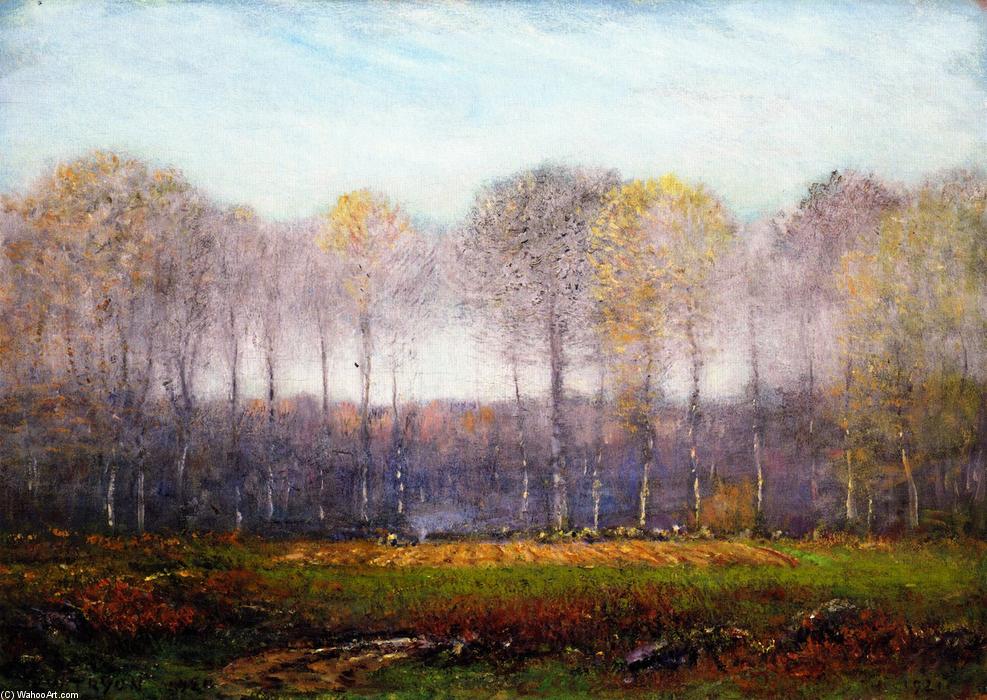
Dwight William Tryon’s “October Morning” isn't merely a landscape painting; it’s an immersion into the heart of a fleeting autumnal moment, captured with a delicate precision and imbued with a profound sense of tranquility. Painted in 1921, during a period when American art was increasingly embracing tonalism – a style prioritizing mood and atmosphere over sharp detail – this piece exemplifies Tryon's signature approach: a quiet contemplation of the natural world rendered through subtle color shifts and luminous washes.
The scene unfolds within a gently sloping meadow, bisected by a meandering stream reflecting the soft hues of the sky. A carefully arranged row of trees dominates the midground, their branches reaching upwards like supplicating arms, each leaf painted with an almost impossibly delicate gradation of greens, yellows, and ochres – a testament to Tryon’s mastery of layering thin glazes of oil paint. These aren't the bold, vibrant colors of Impressionism; instead, they are muted, atmospheric, evoking the fading warmth of the sun as it dips below the horizon. The distant trees recede into a hazy blue-grey, creating an illusion of depth and vastness that draws the viewer’s eye into the painting’s serene embrace.
The Tonalist's Palette: Technique and Style
Tryon’s technique is characterized by its meticulous attention to light and shadow. He employed a ‘wet-on-wet’ approach, applying paint while it was still wet on the canvas, allowing colors to blend seamlessly and creating soft edges that contribute to the painting's ethereal quality. The absence of harsh outlines or defined forms reinforces this sense of atmospheric depth. The use of thin glazes – multiple layers of translucent color applied over each other – builds up the image gradually, resulting in a luminous surface that seems to glow from within. This technique is deeply rooted in the Barbizon school of painting, which emphasized capturing the essence of nature rather than its literal representation.
Notably, Tryon’s work aligns with the broader artistic currents of his time. Influenced by James McNeill Whistler's emphasis on tonal harmony and color relationships, he sought to evoke a feeling of quiet contemplation and spiritual connection through his art. His paintings are often described as “luminist,” though he predates the more formalized Luminist movement, sharing its core principles of capturing fleeting moments of light and atmosphere.
Symbolism and Emotional Resonance
“October Morning” is rich in symbolic meaning, reflecting a deep connection to the rhythms of nature. The row of trees, stretching towards the horizon, can be interpreted as a symbol of resilience and endurance – mirroring the steadfastness of nature through the changing seasons. The stream, flowing gently across the meadow, represents the passage of time and the cyclical nature of life. The muted colors evoke feelings of peace, nostalgia, and melancholy—a poignant reminder of the beauty of impermanence.
More than just a depiction of a landscape, “October Morning” is an invitation to pause, reflect, and connect with the natural world. It’s a painting that speaks to our deepest longings for tranquility and connection, offering a moment of respite from the complexities of modern life. The soft light and muted colors create a sense of warmth and serenity, inviting the viewer to lose themselves in the beauty of this autumnal scene.
A Legacy of Serenity: Tryon’s Enduring Appeal
Dwight William Tryon's work continues to resonate with audiences today due to its timeless appeal. His paintings capture a sense of quietude and beauty that transcends time, offering viewers a glimpse into the heart of nature. His dedication to capturing subtle nuances of light and color has earned him recognition as one of America’s most important landscape painters. Reproductions of “October Morning” are prized by collectors and interior designers alike, bringing a touch of serenity and autumnal charm to homes and galleries around the world.
Pytania i odpowiedzi
Jaki jest dominujący kolor w „October Morning” – Dwight William Tryon?
Dominującym kolorem dzieła „October Morning” – Dwight William Tryon jest Putty (#dbe5e5).
Czy "October Morning" charakteryzuje się silnym kontrastem światłocienia?
„October Morning” – Dwight William Tryon prezentuje Statement kontrast między jasnymi a ciemnymi partiami dzieła.
Jak opisuje się paletę kolorystyczną dzieła „October Morning” – Dwight William Tryon?
Paleta dzieła „October Morning” – Dwight William Tryon jest opisywana jako Neutrals. Stanowi ona zwięzłe zestawienie barw użytych w pracy.
Podobne dzieła


Biografia artysty
Early Life and Artistic Beginnings
Dwight William Tryon, a name synonymous with serene American landscapes, emerged from the quiet beauty of Connecticut in 1849. Born in Hartford to Anson Tryon and Delia O. Roberts, his early life was marked by a poignant loss – the untimely death of his father at a young age. This formative experience instilled within him a deep appreciation for the natural world, shaping his artistic sensibilities from the outset. His childhood unfolded on the family’s farm in East Hartford, an immersion in rural life that proved profoundly influential. Far removed from formal art training initially, Tryon's innate talent blossomed organically. He found solace and inspiration not just in observing nature, but also in engaging with it directly – sketching diligently during his time as a clerk at a local bookstore. It was there, amidst the shelves of instructional manuals, that he began to cultivate his artistic skills independently, studying techniques and principles through self-directed learning. This early dedication culminated in his first sale in 1870, a modest but significant milestone that validated his burgeoning talent. Subsequent local exhibitions further showcased his growing promise, hinting at a future destined for wider recognition. In 1873, he achieved a pivotal moment when he was accepted into the prestigious National Academy of Design, marking the formal beginning of his artistic career.European Influences and the Shaping of a Style
Driven by an ambition to refine his craft and broaden his artistic horizons, Tryon embarked on a transformative journey to France in 1876. This pivotal move represented more than just a relocation; it signified a deliberate pursuit of formal training and exposure to the vibrant artistic currents of Europe. He enrolled at the École des Beaux-Arts in Paris, immersing himself in the techniques and philosophies of renowned instructors. However, his education extended far beyond the confines of the classroom. Recognizing the value of direct experience, Tryon actively sought guidance from a diverse group of luminaries – Jacquesson de la Chevreuse, Charles-François Daubigny, Henri Harpignies, and Jean Baptiste-Antoine Guillemet. These encounters profoundly shaped his artistic development, exposing him to a range of approaches and inspiring him to synthesize new ideas. Initially, Tryon’s style leaned towards Luminism, a movement characterized by its emphasis on atmospheric effects, the subtle play of light, and a delicate rendering of color. Yet, as he continued to study and experiment, he gradually diverged from this established tradition, drawn to the principles of the Barbizon School—a movement that prioritized direct observation of nature, a more subdued palette, and a focus on capturing the essence of the natural world. The Barbizon School’s emphasis on realism and its rejection of academic conventions resonated deeply with Tryon's own artistic sensibilities. During his time in France, he was also significantly influenced by James McNeill Whistler, whose tonalist style—characterized by harmonious color arrangements and subtle gradations of tone—left an indelible mark on Tryon’s approach to landscape painting.Mature Style and Atmospheric Landscapes
By the late 1880s, Dwight William Tryon had fully realized his distinctive artistic vision – a signature style that would solidify his place as a leading American Tonalist. His canvases are immediately recognizable for their carefully composed arrangements of trees, often positioned in the middle distance to create a visual bridge between a luminous sky and a foreground landscape. These scenes frequently evoke a sense of tranquility, melancholy, and the passage of time. Tryon’s masterful use of color—characterized by muted tones, subtle gradations, and an avoidance of harsh contrasts—contributes significantly to the atmospheric mood of his paintings. He skillfully captured the nuances of light and shadow, creating a sense of depth and realism that belies the simplicity of his palette. Beyond landscapes, Tryon also excelled at depicting seascapes, employing pastel techniques to capture the expansive beauty of water, sky, and shoreline under varying weather conditions. His ability to convey atmosphere—the subtle shifts in light, the delicate interplay of color, and the overall mood of a scene—is perhaps his most remarkable achievement. *Salt-Marsh, December*, which garnered first prize at the Tennessee Centennial Exposition in 1897, stands as a testament to this skill, showcasing his talent for capturing the serene beauty of the natural world. His paintings were consistently exhibited nationally, gaining recognition at prestigious venues such as the Pennsylvania Academy of Fine Arts and the Montross Gallery.Patronage, Recognition, and Lasting Legacy
The trajectory of Tryon’s career received a significant boost through his relationship with Charles Lang Freer, a discerning collector who became his most important patron. Freer acquired dozens of Tryon's works, providing invaluable financial support that allowed the artist to dedicate himself fully to his craft. This generous patronage resulted in many of Tryon’s paintings finding their way into the Freer Gallery of Art as part of the Smithsonian Institution, ensuring their preservation and accessibility for future generations. Further recognition came in 1908 when he received the prestigious Carnegie Prize at the Carnegie Exhibition, cementing his position among the leading artists of his time. Throughout his career, Tryon remained an active member of several prominent art organizations, including the Society of American Artists, the American Watercolor Society, and the National Institute of Arts and Letters (now the American Academy of Arts and Letters). In 1887, he established a summer home in South Dartmouth, Massachusetts, which served as his primary residence for the remainder of his life. He also dedicated himself to education, teaching at Smith College from 1886 to 1923, where he founded the Tryon Gallery of Art. Dwight William Tryon passed away in 1925, leaving behind a rich artistic legacy defined by his contribution to American Tonalism and his exceptional ability to capture atmospheric landscapes and seascapes with delicate color and refined feeling. His works continue to be celebrated and are held in prominent collections such as the Smithsonian American Art Museum and the Freer Gallery of Art, ensuring that his vision endures for generations to come.
Dwight William Tryon
1849 - 1925 , Stany Zjednoczone
Krótka nota
- Artistic Movement Or Style: Tonalizm, Barbizon
- Artists Or Movements Influenced By This Artist: ['Amerykański Tonalizm']
- Artists Who Influenced This Artist:
- Whistler
- Daubigny
- Harpignies
- Date Of Birth: 13 sierpień 1849
- Date Of Death: 1 lipca 1925
- Full Name: Dwight William Tryon
- Nationality: Amerykański
- Notable Artworks:
- Mokry las
- Zalewy
- Góry
- Place Of Birth: Hartford, USA
Powiązane artykuły

The Magic of Tonalism: Capturing Mood, Mist, and Atmospheric Emotion in Landscape Art
Discover the ethereal beauty of Tonalism. Explore how master artists use mist, soft light, and muted palettes to capture profound emotion and atmospheric mood in landscape painting. A deep dive into this quiet, introspective art movement for true connoisseurs.