A Vision of England: The Life and Art of Eric Ravilious
Eric Ravilious, born in 1903 in Eastbourne, Sussex, was an artist whose work became inextricably linked with a romanticized yet deeply felt vision of interwar Britain. His life, though tragically cut short, produced a body of paintings, watercolors, wood engravings and designs that continue to resonate today as powerful evocations of landscape, place, and the English temperament. Ravilious wasn’t a product of formal artistic lineage; his early training was at Eastbourne School of Art followed by the Royal College of Art in London, where he studied under Paul Nash and K.R. Henderson. This period proved pivotal, exposing him to both the modernist currents sweeping Europe and the enduring traditions of British landscape painting. However, Ravilious quickly forged his own path, rejecting outright abstraction for a style that was uniquely personal – a blend of meticulous observation, subtle color palettes, and a quiet, almost melancholic lyricism. He wasn’t interested in grand statements or dramatic compositions; instead, he found beauty in the everyday, the overlooked corners of the English countryside, the functional elegance of industrial architecture, and the intimate details of domestic life.
From Modernism to National Identity
Ravilious's early work demonstrated a clear engagement with modernist principles, particularly Cubism and Futurism. He experimented with fractured forms and dynamic perspectives, but these explorations were always tempered by his inherent love for representational imagery. A turning point came in the 1930s when he became associated with the Unit One group, alongside artists like Nash, Henry Moore, and Barbara Hepworth. This association further solidified his position within the avant-garde, yet it also prompted a shift towards more explicitly British subject matter. He began to travel extensively throughout England, documenting its landscapes, buildings, and people with an almost archaeological precision. His paintings of chalk hills, coastal towns, and rural interiors are not merely depictions; they are imbued with a sense of history, memory, and the weight of tradition. This period saw him develop his signature style – smooth, precise watercolor washes, often combined with delicate pen and ink detailing. He wasn’t simply painting what he *saw*, but rather what he *felt* about England, its past glories and present anxieties. The looming threat of war subtly permeated his work, adding a layer of poignancy to his idyllic scenes.
War Artist and Lasting Legacy
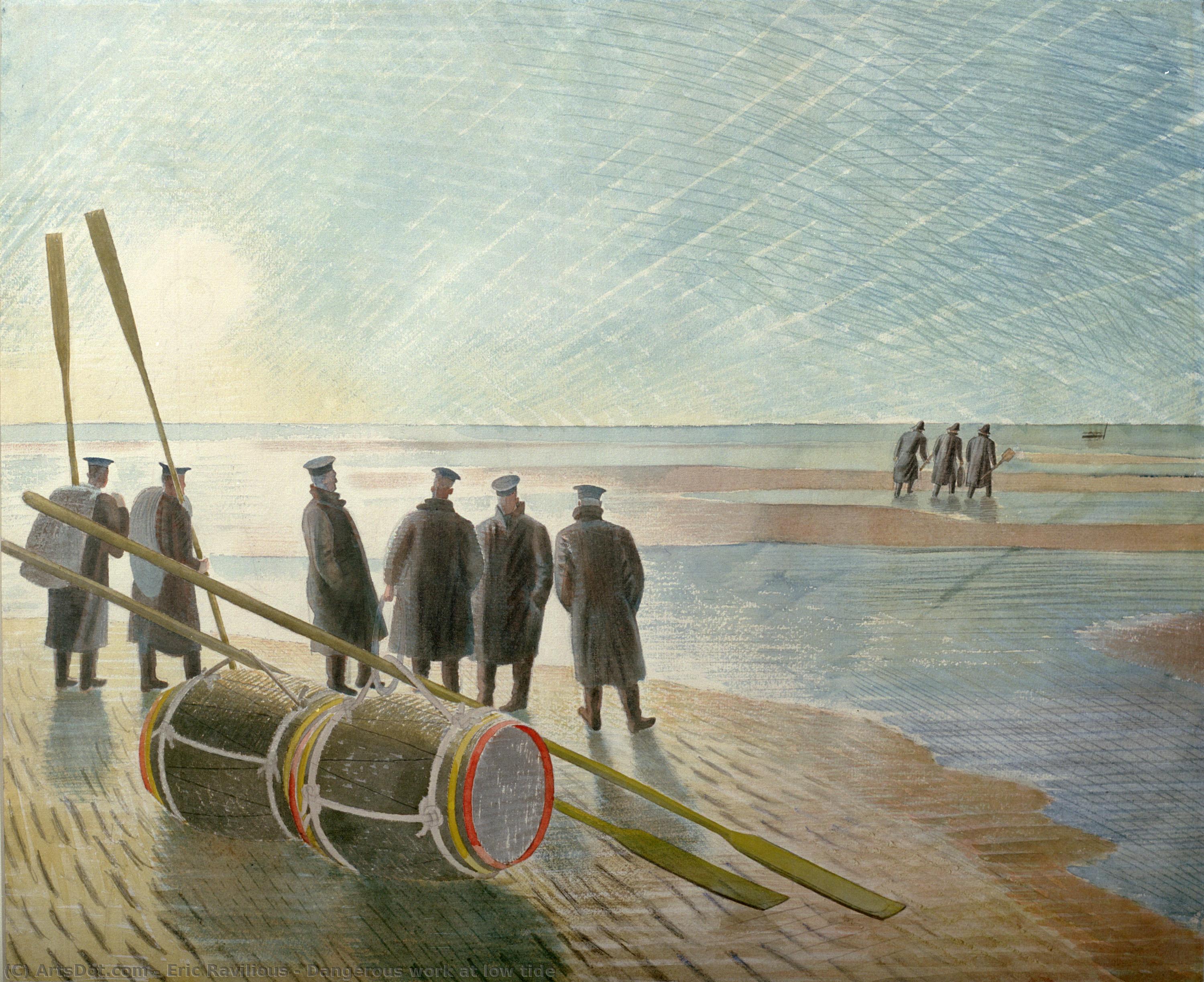
With the outbreak of World War II, Ravilious was commissioned as an official war artist in 1939. Unlike many artists who focused on dramatic battle scenes, Ravilious’s wartime work remained true to his artistic sensibilities. He documented naval operations, aircraft production, and life on military bases with a quiet dignity and understated realism. His paintings of submarines interiors, for example, are remarkable for their claustrophobic intensity and the meticulous rendering of machinery and equipment. However, it was while stationed in Iceland, documenting meteorological work, that tragedy struck. In September 1942, his plane crashed in the North Atlantic, and Ravilious perished at the age of only 39. His death cut short a career that had barely begun to reach its full potential. Despite his premature demise, Ravilious left behind a substantial body of work that has continued to grow in recognition and appreciation since his death.
Influences and Artistic Techniques
Ravilious’s artistic influences were diverse, ranging from the early watercolorists like J.M.W. Turner and Samuel Palmer to the modernist painters Paul Nash and Edward Bawde. He admired the precision of Pieter Bruegel the Elder and the Japanese woodblock prints he encountered at the British Museum. However, he synthesized these influences into a style that was uniquely his own. His technique involved a meticulous process of observation, sketching, and watercolor washes. He often worked *en plein air*, capturing the light and atmosphere of a scene before refining it in the studio.
- Watercolor Mastery: Ravilious’s watercolors are characterized by their smooth, translucent washes and delicate color palettes. He built up layers of color gradually, creating a sense of depth and luminosity.
- Pen and Ink Detailing: He often combined his watercolors with precise pen and ink detailing, adding texture and definition to his compositions.
- Wood Engraving: Ravilious was also a skilled wood engraver, producing numerous prints that shared the same aesthetic qualities as his paintings – meticulous observation, subtle color palettes, and a quiet lyricism.
- Design Work: Beyond painting, Ravilious worked extensively in design, creating ceramics for Wedgwood, wallpaper patterns, and book illustrations. This diverse output demonstrates his versatility and commitment to integrating art into everyday life.
Historical Significance and Enduring Appeal
Eric Ravilious’s work occupies a unique place in British art history. He captured the spirit of interwar England at a time of profound social and political change, offering a vision that was both romanticized and deeply realistic. His paintings are not simply nostalgic depictions of a bygone era; they are imbued with a sense of melancholy, anxiety, and the weight of tradition.
His work speaks to a longing for stability and continuity in a world increasingly fractured by conflict and uncertainty. In recent years, there has been a renewed appreciation for Ravilious’s art, fueled by a growing interest in British landscape painting and the rediscovery of overlooked artists. His paintings are now widely exhibited and collected, and his designs continue to inspire contemporary artists and designers. He remains a powerful symbol of English identity, reminding us of the beauty and fragility of our cultural heritage. The enduring appeal of Ravilious’s work lies in its quiet intimacy, its meticulous observation, and its profound sense of place – qualities that resonate deeply with audiences today.


 Podgląd w skali
 Kup wydruk
 Wyślij jako kartkę
 Udostępnij
 Szczegóły dzieła

 Pobierz
 Podobne obiekty
 RTG
RTG Pokaz slajdów

 Rozwiń treść






































 Opcja ze szkłem jest dostępna wyłącznie w rozmiarach poniżej 110 cm



