


 Zobacz w skali 1:1
 Wyślij
 Udostępnij
 Szczegóły
 Przewodnik

 Pobierz plik obrazu
 Podobne obiekty
 RTG
RTG Pokaz slajdów
 Statystyki
Autumn
 Oil On Canvas
- WallArt
- Hudson River School
 1875
1875- 19th Century
 39.0 x 61.0 cm
 Muzeum Thyssen-Bornemisza
Experience Frederic Edwin Church’s "Autumn," a breathtaking Luminist masterpiece capturing the sublime beauty of Seneca Lake in 1875. This panoramic river landscape, rich with ochre and azure hues, embodies Victorian contemplation and offers a stunning opportunity to own a piece of Hudson River School history.
 Czytaj więcej
Frederic Edwin Church (1826-1900) – amerykański malarz pejzażysta z Hudson River School, znany z monumentalnych i realistycznych obrazów krajobrazowych, w tym "Serce Andów". Jego prace oddają piękno natury i mają ogromne znaczenie dla historii sztuki.
Ręcznie malowana reprodukcja olejowa
Ręcznie malowany obraz olejny na płótnie, wykonany na zamówienie przez naszych artystów w wybranym przez Ciebie wymiarze i oprawie. ( Przełącz na wersję drukowaną Przełącz na wersję cyfrową)




P118B zł10

P118H zł10

P118W zł10

P438Z zł10

P508JH zł12

P508YH zł12

P805H zł10

P805Z zł10

P919BZ zł10

P919G zł10

P919XJ zł10

P959ZH zł10

P968JZ zł12

W106C zł8

W218G zł10

W218JH zł8

W218Y zł10

W307PJ zł10

W316G zł10

W316PJ zł8

W316Y zł10

W398PJ zł8

W4111J zł10

W500HY zł15

W500JH zł15

W692G zł12

W849H zł8

W940BG zł15

W953PJ zł8




Standardowy
na zamówienie
CM
INCH
Wybierz spośród naszych standardowych rozmiarów, które zachowują oryginalne proporcje dzieła sztuki.
Loading sizes...

szerokość
wysokość
Wpisz wymaganą szerokość i wysokość, aby obraz pasował do Twojej ramy lub ściany. Ponieważ jest to dzieło malowane ręcznie, w przypadku rozmiaru o innym proporcji artysta może domalować nieco więcej wokół obrazu lub przyciąć fragmenty — wybór należy do Ciebie. Przed rozpoczęciem pracy prześlemy Ci cyfrową wizualizację do zatwierdzenia. Obraz widoczny na tej stronie nie przedstawia rzeczywistego efektu — jedynie wizualizacja oddaje realny rezultat.
Przykłady możliwych zmian: Zamień twarz na zdjęcie klienta; Dodaj zwierzę domowe (np. zamień kota na psa); Ukryj wiadomość w tle; Zmień krajobraz lub elementy tła.
Po złożeniu zamówienia zespół TopImpressionists.com skontaktuje się z klientem drogą mailową w celu uzyskania instrukcji i prześle wizualizację projektu
Po złożeniu zamówienia zespół TopImpressionists.com skontaktuje się z klientem drogą mailową w celu uzyskania instrukcji i prześle wizualizację projektu
Dostawa na całym świecie () w ciągu 3–4 tygodni zamiast standardowych 5 tygodni. (21 Październik). Bez kompromisów w kwestii jakości.

Bezpłatna ekspresowa wysyłka na cały świat

Wysokiej jakości płótno lniane

Pełne ubezpieczenie transportowe

Gwarancja zwrotu należności celnych i podatków importowych

Gwarancja idealnego odwzorowania barw

100-dniowy okres na zwrot dzieła w przypadku wykrycia wad produkcyjnych

Gwarancja 100% zwrotu pieniędzy

Oferta przy zakupie wielu sztuk
 Opcja ze szkłem jest dostępna wyłącznie w rozmiarach poniżej 110 cm

Autumn
Technika wykonania
Rozmiar reprodukcji
-


Suma do zapłaty
zł 1021
A Symphony in Ochre and Azure: Exploring Frederic Edwin Church’s Autumn
The painting “Autumn,” executed by Frederic Edwin Church in 1875, stands as a testament to the Hudson River School's unwavering devotion to capturing the sublime beauty of the American wilderness. More than just a depiction of a picturesque landscape, it embodies a profound philosophical contemplation on mortality and regeneration—themes deeply rooted in Victorian sensibilities and subtly interwoven into Church’s masterful artistic vision.Subject Matter and Composition
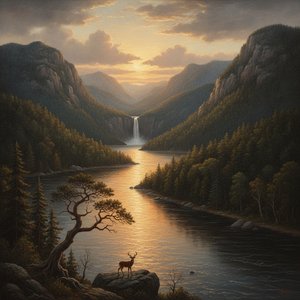
Church meticulously rendered a panoramic vista overlooking Seneca Lake in New York State. Dominating the scene is a majestic river winding its way through a densely populated forest, reflecting the fiery hues of a setting sun. Scattered amongst the trees are prominent rocks and boulders, anchoring the composition and providing textural contrast against the flowing water. Notably, perched atop one of these rocks is a solitary bird—a deliberate inclusion that serves as a poignant symbol of resilience and hope amidst the encroaching darkness of autumn. The artist’s careful attention to detail ensures every element contributes to the overall impression of serene grandeur.Style and Technique: Luminism Elevated
Church's approach aligns perfectly with Luminism, an artistic movement characterized by its emphasis on diffused light and atmospheric perspective—techniques pioneered by Thomas Cole and championed by Church himself. Unlike Impressionists who sought to capture fleeting moments of sensory experience, Church aimed for a more contemplative portrayal of nature’s enduring power. He achieved this through painstaking layering of thin glazes applied over a textured underpainting, meticulously blending colors to create an illusion of depth and luminosity. The resulting surface possesses remarkable brilliance, capturing the ethereal glow of twilight and conveying the palpable warmth of the fading sun.Historical Context: Victorian Romanticism’s Embrace of Nature
“Autumn” emerged during the height of Victorian Romanticism—a period marked by a fervent belief in emotion and imagination as pathways to spiritual understanding. Artists like Church wrestled with existential questions concerning humanity's place within the cosmos, seeking solace and inspiration in the grandeur of God’s creation. The painting reflects this intellectual climate through its symbolic representation of decay followed by rebirth—mirroring the cyclical rhythms of nature and offering a comforting reassurance that beauty persists even amidst inevitable decline. Furthermore, Church’s work coincided with burgeoning scientific interest in geology and botany, influencing his artistic choices and reinforcing his conviction in portraying landscapes accurately while simultaneously conveying their emotional resonance.Symbolism: Light, Darkness, and Renewal
The dominant color palette—ochre yellows and azure blues—is deliberately symbolic. The golden light of the sunset represents divine illumination and signifies the promise of eternal life, countering the encroaching darkness that symbolizes mortality. However, Church doesn’t present darkness as solely negative; rather, it serves as a backdrop against which the bird's presence illuminates the enduring spirit of nature. This juxtaposition underscores the Victorian preoccupation with themes of death and resurrection—a cornerstone of spiritual belief during the era.Emotional Impact: A Balm for the Soul
“Autumn” transcends mere visual representation; it aspires to evoke profound emotional responses in the viewer. The painting’s tranquil atmosphere invites contemplation, prompting reflection on the beauty of impermanence and reaffirming faith in a benevolent Creator. Its luminous quality imbues the scene with warmth and serenity—a comforting reminder that even as seasons change and life diminishes, nature continues its ceaseless cycle of renewal. Collectors and interior designers alike recognize “Autumn”’s enduring appeal precisely because it captures not just a landscape but also an intangible essence of human experience – a timeless meditation on beauty, faith, and the cyclical rhythms of existence.Pytania i odpowiedzi
Jakie emocje budzi "Autumn" jako prezent?
"Autumn" niesie ze sobą Calm nastrój, a zarekomendowany pomysł na prezent to Anniversary.
Jak mogę pobrać obraz dzieła „Autumn” autorstwa Frederic Edwin Church?
Możliwość pobrania dzieła „Autumn”: strona Pobierz oferuje wysokiej rozdzielczości cyfrowe zdjęcie do pobrania.
Jak silny jest kontrast w „Autumn” autorstwa Frederic Edwin Church?
„Autumn” autorstwa Frederic Edwin Church prezentuje Bold kontrast między jasnymi a ciemnymi partiami dzieła.
Biografia artysty
A Pioneer of American Landscape: The Life and Art of Frederic Edwin Church
Frederic Edwin Church, born in Hartford, Connecticut, on May 4th, 1826, emerged as a pivotal figure in the blossoming landscape tradition of 19th-century America. His lineage was steeped in New England history—a direct descendant of Puritan pioneers—and his family’s prosperity afforded him opportunities rare for aspiring artists of the time. This financial stability allowed Church to dedicate himself wholeheartedly to his artistic pursuits, a path that would ultimately lead him to become one of the most celebrated and influential painters of the Hudson River School. His early training began at the age of eighteen under the tutelage of Thomas Cole, the very founder of this distinctly American art movement. These formative years spent in Catskill, New York, were crucial, instilling in Church a deep reverence for nature and a commitment to capturing its grandeur on canvas. The apprenticeship wasn’t merely technical; it was an immersion into a philosophy that saw landscape not just as scenery, but as a reflection of the divine and a symbol of national identity.The Rise of a Master: Style and Influences
Church quickly distinguished himself from his contemporaries through a remarkable ability to blend meticulous realism with a romantic sensibility. His paintings are characterized by an astonishing level of detail, capturing the textures of foliage, the play of light on water, and the imposing scale of mountains with breathtaking accuracy. He meticulously studied geological formations, plant life, and atmospheric conditions, incorporating these observations into his compositions. However, this wasn’t simply photographic representation; Church infused his work with a dramatic flair, employing sweeping panoramic views, vibrant color palettes—often achieved through innovative techniques to capture the fleeting effects of light—and a masterful command of atmospheric perspective. He was deeply influenced by the scientific explorations of Alexander von Humboldt, whose writings on the interconnectedness of nature resonated profoundly with the artist. Church saw in Humboldt’s work a call to experience and depict the world directly, moving beyond purely theoretical knowledge. This influence is evident in his later expeditions to South America and his attempts to convey not just the visual beauty of these landscapes but also their underlying geological and botanical complexities. The Oxbow, completed in 1836, stands as an early testament to this synthesis of observation and imagination—a romantic vision of the American wilderness that would become a hallmark of his style. His technique involved “hidden” brushstrokes, creating smooth surfaces that enhanced the realism and luminosity of his paintings.Ventures into the Wild: Travels and Major Works
Church’s ambition extended beyond the familiar landscapes of New England and New York. Driven by a thirst for firsthand experience and inspired by Humboldt's writings, he embarked on daring expeditions to remote corners of the world. These journeys—to South America in 1853 and 1857, and later to the Arctic regions—provided him with an unparalleled wealth of visual material. The Heart of the Andes, completed in 1859, is perhaps his most ambitious undertaking, a monumental canvas that sought to encapsulate the entire ecosystem of the Andean mountains. The painting was exhibited in a specially constructed gallery, illuminated by skylights, creating an immersive experience for viewers and solidifying Church’s reputation as a master showman as well as an artist. He meticulously documented the flora, fauna, and geological features of these regions, incorporating them into his paintings with remarkable accuracy. His later works, such as *Niagara* (1857), showcased his ability to capture the dramatic power of nature—the cascading water, the swirling mist, and the ethereal light—with breathtaking effect. Church’s expeditions weren't merely about documenting landscapes; they were transformative experiences that shaped his artistic vision and deepened his appreciation for the interconnectedness of all things.A New Approach to Exhibition: The Power of Spectacle
Church revolutionized the way art was presented in America by pioneering immersive exhibition techniques. Recognizing that a painting could be more than just a static object, he sought to create an experience for viewers—a journey into the heart of the depicted landscape. For his monumental canvases like *The Heart of the Andes* and *Icebergs: The North*, Church constructed elaborate galleries with carefully controlled lighting, temperature, and sound effects. He often employed multiple paintings in a single exhibition, creating a panoramic effect that transported viewers to distant lands. These exhibitions were not simply displays of art; they were theatrical events designed to evoke emotion and inspire awe. His approach challenged the traditional notion of the gallery as a quiet space for contemplation and ushered in a new era of public engagement with art.Legacy and Impact on American Art
Frederic Edwin Church’s influence on American landscape painting is undeniable. He elevated the genre to new heights of artistic achievement and popular acclaim, inspiring generations of artists to explore the beauty and majesty of the natural world. His innovative exhibition practices—presenting single paintings in dramatic settings—set a precedent for future art displays and helped to cultivate a broader public appreciation for art. Beyond his painting, Church was also a dedicated conservationist, advocating for the preservation of Niagara Falls and playing a role in the establishment of national parks. He understood that art could be a powerful tool for raising awareness about environmental issues and inspiring action. His home, Olana, designed and built with his own hands overlooking the Hudson River, stands as a testament to his artistic vision and his deep connection to the landscape.- Church’s work bridged the gap between Romanticism and Realism.
- He pioneered immersive exhibition techniques that captivated audiences.
- His advocacy for conservation foreshadowed the modern environmental movement.

Frederic Edwin Church
1826 - 1900 , Stany Zjednoczone
Najważniejsze informacje
- Artistic Movement Or Style: Hudson River School
- Artists Or Movements Influenced By This Artist: ['Amerykańska sztuka krajobrazowa']
- Artists Who Influenced This Artist:
- Thomas Cole
- Alexander von Humboldt
- Date Of Birth: 4 maja 1826
- Date Of Death: 7 kwietnia 1900
- Full Name: Frederic Edwin Church
- Nationality: Amerykański
- Notable Artworks:
- Niagara
- Serce Andów
- Place Of Birth: Hartford, USA
Zobacz także powiązane artykuły

Szkoła Rzeki Hudson: 10 arcydzieł, które ukształtowały pejzaż amerykańskiej sztuki | TopImpressionists
Odkryj 10 arcydzieł Szkoły Rzeki Hudson – malarstwo krajobrazowe Cole'a, Churcha i Bierstadta. Poznaj historię artystów i inspiracje romantyzmu amerykańskiego. Reprodukcje obrazów najwyższej jakości na TopImpressionists.com! Eksploruj kolekcję online.

Robert Spencer: Luminism, Narrative & the American Landscape Tradition
Explore the captivating world of Luminism & the Hudson River School with our expert analysis. Discover the history, artists, and enduring beauty of 19th-century American landscape painting. Find museum-quality reproductions at TopImpressionists.

Capturing the American Spirit: A Journey Through Iconic Landscapes and the Legacy of the Hudson River School
Explore the profound beauty of American art history. From the Hudson River School to iconic landscapes, discover a curated journey through the masterpieces that defined a nation's spirit and the enduring legacy of American Romanticism.

Sublime Krajobrazy: Narodziny Amerykańskiej Tożsamości Artystycznej i Rola Szkoły Hudson River
Odkryj fascynującą historię Szkoły Hudson River i narodziny amerykańskiej tożsamości artystycznej. Poznaj kluczowych artystów, techniki malarskie i inspiracje. Reprodukcje najwyższej jakości na TopImpressionists.com!
Epic Landscapes & Wild Nature: The Power of the Hudson River School's Sublime Artistry
Explore the breathtaking power of the Hudson River School. Journey through epic American landscapes, from Thomas Cole's sublime vistas to Luminist light, and discover how these timeless masterpieces continue to inspire modern collectors and art lovers worldwide.
Odkryj dzieła sztuki uporządkowane według tematów, stylów i cech charakterystycznych.


