

Shown: · With its frame:
 Podgląd w skali 1:1
 Wyślij jako kartkę
 Udostępnij
 Szczegóły dzieła
 Przewodnik

 Pobierz obraz
 Podobne obiekty
 RTG
RTG Pokaz slajdów
 Q&A
Q&A Statystyki
- 92.0 x 131.0 cm


zł 1048
Ręcznie malowana reprodukcja olejowa
Ręcznie malowany obraz olejny na płótnie, wykonany na zamówienie przez naszych artystów w wybranym przez Ciebie wymiarze i oprawie. ( Przełącz na wydania drukowane Przejdź do wersji cyfrowej)
Size
·Standardowy format
personalizowane
CM
INCH
Wybierz spośród naszych standardowych rozmiarów, które zachowują oryginalne proporcje dzieła sztuki.
Loading sizes...

szerokość
wysokość
Wpisz wymaganą szerokość i wysokość, aby obraz pasował do Twojej ramy lub ściany. Ponieważ jest to dzieło malowane ręcznie, w przypadku rozmiaru o innych proporcjach artysta może domalować nieco więcej wokół obrazu lub przyciąć jego fragmenty — wybór należy do Ciebie. Przed rozpoczęciem pracy prześlemy Ci cyfrową wizualizację do zatwierdzenia. Obraz widoczny na tej stronie nie przedstawia rzeczywistego efektu — jedynie wizualizacja oddaje realny rezultat.
 Dowiedz się więcej
Finish
·
White zł1

Blurside zł1

Extended zł1

P118B zł10

P118H zł10

P118W zł10

P438Z zł10

P508JH zł12

P508YH zł12

P805H zł10

P805Z zł10

P919BZ zł10

P919G zł10

P919XJ zł10

P959ZH zł10

P968JZ zł12

W106C zł8

W218G zł10

W218JH zł8

W218Y zł10

W307PJ zł10

W316G zł10

W316PJ zł8

W316Y zł10

W398PJ zł8

W4111J zł10

W500HY zł15

W500JH zł15

W692G zł12

W849H zł8

W940BG zł15

W953PJ zł8

H24-GOLD zł30

H24-SILVER zł30

H36-GOLD zł45

H36-SILVER zł45
Shipped in a protective tube, ready for your own framer.
Above 105 cm the frame is shipped as a kit for a professional framer — read the details.
Extras
optionalWhat do the extras include?
Examples of what can be changed: Replace face with customer photo; Add pet (e.g., replace cat with dog); Include hidden message in background; Change background landscape or elements.
After order, TopImpressionists.com team will email client for instructions and provide a mockup preview
After order, TopImpressionists.com team will email client for instructions and provide a mockup preview
Dostawa na całym świecie () w ciągu 3–4 tygodni zamiast standardowych 5 tygodni. (3 Listopad). Bez kompromisów w kwestii jakości.
Lakier ochronny
Etykieta obiektu
Szczegóły grawerowanej brązowej tabliczki
This elegant plaque features the artist's name and the title of the artwork, finely engraved for a timeless presentation.
It is made from bronze with a refined, elegant finish. The text is precisely laser-engraved for a sharp and permanent result. Measuring 9x2 cm, the plaque is compact yet easy to read. It's built to be durable and scratch-resistant, offering a professional, museum-quality look. Mounting is simple thanks to the included adhesive backing.
Szczegóły przezroczystej tabliczki akrylowej
The plaque includes essential engraved details such as the artist's name, the title of the artwork, the date it was created, the type of media used-like oil on canvas or watercolor-a brief description of the piece, and a QR code that links to the complete artwork information.
It is crafted from clear acrylic, offering a sleek, modern appearance. The text is UV-engraved in black to ensure strong visual contrast. With a size of 10x15 cm, it ensures optimal readability. It comes equipped with two metal hooks for secure wall mounting. The plaque is designed to be weather-resistant, making it suitable for various environments, and it includes interactive features that work seamlessly with smartphone scanning.
Szczegóły czarnej tabliczki akrylowej
This elegant plaque includes engraved information such as the artist's name, the title of the artwork, the date it was created, the type of media used (like oil on canvas or watercolor), a short description of the artwork, and a QR code for quick access to more information.
The plaque itself is made from refined black acrylic with a premium finish. The text is laser-engraved in white for high contrast and readability. Its size is 10x15 cm, designed to be easy to read. It comes with two metal hooks for professional mounting. The design is sleek and fits any interior style. It is also weather-resistant and durable, with built-in digital integration for mobile compatibility.
Opcja ze szkłem jest dostępna wyłącznie w rozmiarach poniżej 110 cm
 Opcja ze szkłem jest dostępna wyłącznie w rozmiarach poniżej 110 cm
- Bezpłatna ekspresowa wysyłka na cały świat
- Wysokiej jakości płótno lniane
- Pełne ubezpieczenie przesyłki
- Gwarancja zwrotu należności celnych i podatków importowych
- Gwarancja wiernego odwzorowania kolorów
- 100-dniowa polityka zwrotów (tylko w przypadku wad)
- Gwarancja 100% zwrotu pieniędzy
- Zniżka przy zakupie wielu sztuk


Opis obiektu
Biografia artysty
Georges de La Tour (1593-1652): Francuski mistrz światła i cienia, znany z dramatycznych scen religijnych i oświetlonych świecami. Odkryj jego unikalny styl i trwałe dziedzictwo.
About the painting
A Moment Frozen in Shadow: Georges de La Tour’s ‘The Dice Players’
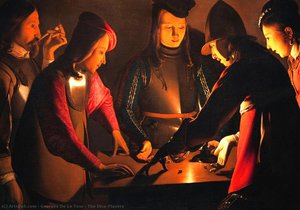
Georges de La Tour's “The Dice Players,” completed around 1650, is more than just a depiction of gambling; it’s an arresting exploration of faith and human vulnerability rendered with the masterful precision characteristic of Tenebrism—a technique that elevates this seemingly simple scene into a profound meditation on spirituality. Painted in stark contrast between light and darkness, the artwork exemplifies the Baroque aesthetic's preoccupation with dramatic emotion and psychological depth.The Anatomy of Darkness: Tenebrism Technique
De La Tour’s signature style is undeniably Tenebrism, derived from Italian “tenebroso,” meaning shadowy or dusky. This method involves plunging the majority of the canvas into impenetrable darkness—almost absolute black—while strategically illuminating select areas with pools of intense light emanating from a single candle. The candlelight casts dramatic shadows across the faces and hands of the players, emphasizing their concentration and highlighting the vulnerability inherent in their pursuit of fortune. Notice how the artist meticulously renders the textures of fabric and skin, capturing subtle nuances that contribute to the overall realism despite the pervasive gloom. This careful attention to detail underscores De La Tour’s commitment to portraying human experience with unflinching honesty.A Scene Steeped in Religious Symbolism
While ostensibly depicting a mundane activity—dice playing—the painting resonates with deeper religious symbolism. The darkened room itself can be interpreted as representing purgatory, the shadowy recesses of the soul awaiting redemption. The candle flame symbolizes divine grace and illuminates the players’ faces, suggesting that even amidst worldly pursuits, faith remains present. Furthermore, the dice themselves are often associated with chance and fate—themes central to Christian theology concerning God's providence. De La Tour subtly invites contemplation on these concepts, elevating the scene beyond mere entertainment into a visual parable.Historical Context: The Quiet Reformation
“The Dice Players” emerged during the turbulent period of the French Reformation (1562-1648), when Catholicism and Protestantism clashed violently across Europe. Despite the outward appearance of piety—the candlelit interior, the solemn expressions of the figures—there’s an underlying tension within the artwork. The players are absorbed in their game, seemingly oblivious to the spiritual implications of their actions. This juxtaposition speaks to the anxieties of the time – a questioning spirit challenging established dogma and prompting reflection on moral responsibility. De La Tour's depiction captures this subtle unease, reflecting the broader societal debates surrounding faith and morality prevalent during his era.Emotional Resonance: Intimacy and Vulnerability
Ultimately, “The Dice Players” succeeds in conveying a powerful emotional resonance. The artist’s masterful use of chiaroscuro creates an atmosphere of palpable intimacy—we are drawn into the players' world, witnessing their intense focus and confronting their vulnerability. There is no grand gesture or triumphant proclamation; instead, De La Tour presents us with a quiet tableau that speaks volumes about human nature. It’s a painting that lingers in the mind long after viewing, prompting reflection on themes of ambition, faith, and the inescapable realities of mortality—a testament to De La Tour's enduring artistic vision.Pytania i odpowiedzi
Czy kolory w "The Dice Players" są intensywne czy stonowane?
Intensywność barw w dziele „The Dice Players” wynosi Balanced. Intensywność określa, jak nasycone wydają się kolory.
Gdzie mogę kupić wydruk „The Dice Players” – Georges de La Tour?
Aby zamówić wydruk dzieła „The Dice Players” – Georges de La Tour, wystarczy przejść na jego stronę Wydruk artystyczny premium: szlachetna odbitka na płótnie bawełnianym lub archiwalnym papierze o strukturze płótna.
Gdzie mogę zobaczyć podgląd dzieła "The Dice Players"?
Aby podglądnąć reprodukcję dzieła „The Dice Players” – Georges de La Tour, otwórz stronę Podgląd w pomieszczeniu danego utworu.
Quick facts and art quiz
About Georges de La Tour

Georges de La Tour
1593 - 1652, Francja
Biografia artysty
A Life Bathed in Shadow: The Enigmatic World of Georges de La Tour
Georges de La Tour, a name that resonates with the hushed reverence reserved for masters of light and shadow, remains one of the most compelling figures of the French Baroque. Born in 1593 in Vic-sur-Seille, a small town nestled within the Duchy of Lorraine, his life unfolded against a backdrop of religious fervor and political upheaval. While details surrounding his early training remain somewhat elusive—scholars speculate about potential journeys to Italy or apprenticeships with local artists like Jacques Bellange—the seeds of his artistic vision were undoubtedly sown in this environment. He wasn’t born into an artistically established family; his father was a baker, yet the circumstances of his mother's lineage hint at a possible connection to nobility, a subtle influence perhaps reflected in the dignity and quiet grace that permeate his work. In 1617 he married Diane Le Nerf, establishing a stable home life in Lunéville, where he would spend much of his career serving both the French court and the Dukes of Lorraine. This dual patronage allowed him to flourish, yet it was within the intimate confines of domestic scenes and religious contemplation that his true genius found expression.The Dance of Light and Darkness: Artistic Influences and Development
De La Tour’s artistic journey wasn't one of radical innovation but rather a masterful synthesis of existing influences, transformed through the lens of his unique sensibility. The dramatic chiaroscuro—the stark contrast between light and dark—that defines his paintings owes an undeniable debt to Caravaggio, the Italian master who revolutionized painting with his intensely realistic and emotionally charged scenes. However, De La Tour didn’t simply imitate; he filtered Caravaggism through the prism of Dutch Caravaggisti, particularly those from the Utrecht School like Hendrick Terbrugghen. This fusion resulted in a style that was both powerful and restrained, characterized by a muted palette dominated by earth tones and subtle gradations of light. His early works, predating 1630, exhibit a greater vibrancy and dynamism, reflecting the influence of the Utrecht school. But as his career progressed, he moved towards an increasingly introspective and minimalist aesthetic. He began to pare down compositions, focusing on essential forms and reducing extraneous details, creating scenes that felt both timeless and deeply personal. This evolution wasn’t merely technical; it was a reflection of his growing spiritual depth and his desire to convey profound emotional truths through the simplest of means.Candlelight and Contemplation: Major Works and Recurring Themes
The hallmark of De La Tour's oeuvre is undoubtedly his masterful use of candlelight, which he employed not merely as a source of illumination but as a metaphor for divine grace and spiritual awakening. His paintings are often set at night, with figures bathed in the warm, flickering glow of a single candle or lamp. This creates an atmosphere of intimacy and quiet contemplation, drawing the viewer into the scene and inviting them to share in the emotional experience of the subjects. The Fortune-Teller, painted around 1630, exemplifies this early style—a lively genre scene rendered with sharp observation and dramatic lighting. But it is his later religious works that truly showcase his genius. Adoration of the Shepherds, created around 1640, demonstrates his ability to imbue a traditional subject with profound emotional resonance. The figures are not idealized or heroic; they are ordinary people, humbled by the presence of the divine. The Tears of Saint Peter, painted in the 1650s, is a particularly poignant example of his psychological insight—the apostle’s grief rendered with heartbreaking subtlety and realism. Saint Joseph the Carpenter, another iconic work, depicts a serene domestic scene, highlighting De La Tour's mastery of capturing the quiet dignity of everyday life. These paintings aren’t simply depictions of religious events; they are meditations on faith, doubt, and the human condition.A Rediscovered Legacy: Historical Significance and Enduring Appeal
Despite achieving recognition during his lifetime—he was appointed “Painter to the King” by Louis XIII in 1638—De La Tour’s work fell into relative obscurity after his death in 1652. For centuries, many of his paintings were misattributed to other artists, and his name faded from art historical memory. It wasn't until the early 20th century that a concerted effort was made to rediscover and re-evaluate his oeuvre, led by scholars like Hermann Voss. This rediscovery revealed an artist of extraordinary originality and depth, whose work bridged the gap between Caravaggism and French Classicism. De La Tour’s innovative use of light and shadow, combined with his psychological insight into his subjects, continues to captivate audiences today. His paintings offer a glimpse into 17th-century life and spirituality, reflecting both the religious fervor and the social realities of his time. *He remains celebrated for his ability to imbue everyday scenes with profound meaning and emotional depth*, reminding us that even in the darkest of times, there is always hope to be found in the flickering light of faith and human connection. His influence can be seen in later artists who explored similar themes of introspection and spiritual longing, solidifying his place as a pivotal figure in the history of European art.Quick facts about Georges de La Tour
- Artistic Movement Or Style: Barok, Tenebrism
- Artists Or Movements Influenced By This Artist: ['Francuska Klasyka']
- Artists Who Influenced This Artist:
- Caravaggio
- Terbrugghen
- Date Of Birth: 13 marca 1593
- Date Of Death: 30 stycznia 1652
- Full Name: Georges de La Tour
- Nationality: Francuz
- Notable Artworks:
- Fortune Teller
- Uznanie Syna
- Święty Sebastian
- Place Of Birth: Vic-le-Comte, Francja
Odkryj dzieła sztuki uporządkowane według tematów, stylów i cech charakterystycznych.


Georges de La Tour
The Dice Players
() ·
With its frame: · Hand-painted in oil on linen
Total