

Shown: · With its frame:
 Podgląd w skali 1:1
 Wyślij jako kartkę
 Udostępnij
 Szczegóły dzieła
 Przewodnik

 Pobierz obraz
 Podobne obiekty
 RTG
RTG Pokaz slajdów
 Q&A
Q&A Statystyki

zł 1045
Ręcznie malowana reprodukcja olejowa
Ręcznie malowany obraz olejny na płótnie, wykonany na zamówienie przez naszych artystów w wybranym przez Ciebie wymiarze i oprawie. ( Przełącz na wydania drukowane Przejdź do wersji cyfrowej)
Size
·Standardowy format
personalizowane
CM
INCH
Wybierz spośród naszych standardowych rozmiarów, które zachowują oryginalne proporcje dzieła sztuki.
Loading sizes...

szerokość
wysokość
Wpisz wymaganą szerokość i wysokość, aby obraz pasował do Twojej ramy lub ściany. Ponieważ jest to dzieło malowane ręcznie, w przypadku rozmiaru o innych proporcjach artysta może domalować nieco więcej wokół obrazu lub przyciąć jego fragmenty — wybór należy do Ciebie. Przed rozpoczęciem pracy prześlemy Ci cyfrową wizualizację do zatwierdzenia. Obraz widoczny na tej stronie nie przedstawia rzeczywistego efektu — jedynie wizualizacja oddaje realny rezultat.
 Dowiedz się więcej
Finish
·
White zł1

Blurside zł1

Extended zł1

P118B zł10

P118H zł10

P118W zł10

P438Z zł10

P508JH zł12

P508YH zł12

P805H zł10

P805Z zł10

P919BZ zł10

P919G zł10

P919XJ zł10

P959ZH zł10

P968JZ zł12

W106C zł8

W218G zł10

W218JH zł8

W218Y zł10

W307PJ zł10

W316G zł10

W316PJ zł8

W316Y zł10

W398PJ zł8

W4111J zł10

W500HY zł15

W500JH zł15

W692G zł12

W849H zł8

W940BG zł15

W953PJ zł8

H24-GOLD zł30

H24-SILVER zł30

H36-GOLD zł45

H36-SILVER zł45
Shipped in a protective tube, ready for your own framer.
Above 105 cm the frame is shipped as a kit for a professional framer — read the details.
Extras
optionalWhat do the extras include?
Examples of what can be changed: Replace face with customer photo; Add pet (e.g., replace cat with dog); Include hidden message in background; Change background landscape or elements.
After order, TopImpressionists.com team will email client for instructions and provide a mockup preview
After order, TopImpressionists.com team will email client for instructions and provide a mockup preview
Dostawa na całym świecie () w ciągu 3–4 tygodni zamiast standardowych 5 tygodni. (31 Październik). Bez kompromisów w kwestii jakości.
Lakier ochronny
Etykieta obiektu
Szczegóły grawerowanej brązowej tabliczki
This elegant plaque features the artist's name and the title of the artwork, finely engraved for a timeless presentation.
It is made from bronze with a refined, elegant finish. The text is precisely laser-engraved for a sharp and permanent result. Measuring 9x2 cm, the plaque is compact yet easy to read. It's built to be durable and scratch-resistant, offering a professional, museum-quality look. Mounting is simple thanks to the included adhesive backing.
Szczegóły przezroczystej tabliczki akrylowej
The plaque includes essential engraved details such as the artist's name, the title of the artwork, the date it was created, the type of media used-like oil on canvas or watercolor-a brief description of the piece, and a QR code that links to the complete artwork information.
It is crafted from clear acrylic, offering a sleek, modern appearance. The text is UV-engraved in black to ensure strong visual contrast. With a size of 10x15 cm, it ensures optimal readability. It comes equipped with two metal hooks for secure wall mounting. The plaque is designed to be weather-resistant, making it suitable for various environments, and it includes interactive features that work seamlessly with smartphone scanning.
Szczegóły czarnej tabliczki akrylowej
This elegant plaque includes engraved information such as the artist's name, the title of the artwork, the date it was created, the type of media used (like oil on canvas or watercolor), a short description of the artwork, and a QR code for quick access to more information.
The plaque itself is made from refined black acrylic with a premium finish. The text is laser-engraved in white for high contrast and readability. Its size is 10x15 cm, designed to be easy to read. It comes with two metal hooks for professional mounting. The design is sleek and fits any interior style. It is also weather-resistant and durable, with built-in digital integration for mobile compatibility.
Opcja ze szkłem jest dostępna wyłącznie w rozmiarach poniżej 110 cm
 Opcja ze szkłem jest dostępna wyłącznie w rozmiarach poniżej 110 cm
- Bezpłatna ekspresowa wysyłka na cały świat
- Wysokiej jakości płótno lniane
- Pełne ubezpieczenie przesyłki
- Gwarancja zwrotu należności celnych i podatków importowych
- Gwarancja wiernego odwzorowania kolorów
- 100-dniowa polityka zwrotów (tylko w przypadku wad)
- Gwarancja 100% zwrotu pieniędzy
- Zniżka przy zakupie wielu sztuk


Opis obiektu
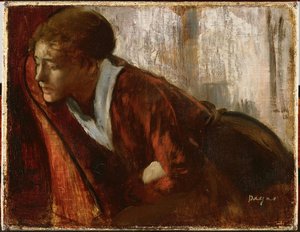
Experience Edgar Degas's 'Melancholy,' a poignant portrait capturing introspection and emotion. This masterpiece from 1874, housed at the Phillips Collection, showcases his signature style & psychological depth.
Biografia artysty
Edgar Degas – rewolucyjny malarz francuski znany z fascynujących baletnic, paryskich scen i innowacyjnych technik – prawdziwy mistrz sztuki nowoczesnej.
About the painting
The Enigmatic Depths of “Melancholy” by Edgar Degas
Edgar Degas, a name synonymous with Impressionism yet profoundly resistant to easy categorization, offers us in "Melancholy" (1874) a work that transcends simple portraiture. Housed within the esteemed Phillips Collection, this painting isn’t merely a depiction of a woman; it's an invitation into the quiet contemplation of the human psyche—a testament to Degas’s extraordinary ability to capture not just appearances but the very essence of emotion. The piece immediately draws the eye with its carefully orchestrated composition: a woman, partially veiled by a curtain, positioned within a space defined by rich, layered colors and subtle gestures. It's a scene pregnant with unspoken narratives, inviting viewers to become active participants in deciphering her inner world.
Degas’s artistic vision is rooted in his meticulous observation of the world around him, a characteristic that aligns perfectly with his self-proclaimed status as a realist. He wasn’t interested in grand historical scenes or idealized beauty; instead, he sought to portray the everyday lives of ordinary people—and here, particularly, the complexities of female experience. The painting's palette is masterfully controlled – the dominant red of the woman’s clothing and furnishings creates a vibrant focal point, expertly balanced against the cooler blues and greens that permeate the background. This interplay of color isn’t merely decorative; it subtly reinforces the mood of introspection and perhaps even sadness that permeates the scene.
Symbolism Woven into the Fabric of the Image
The most striking element of “Melancholy” is undoubtedly the woman herself, her face partially obscured by the curtain. This deliberate concealment isn’t simply a stylistic choice; it functions as a potent metaphor for the barriers we erect between ourselves and our own emotions. The curtain becomes a visual representation of the ‘veil’ separating the external world from the internal landscape—a space where thoughts, feelings, and memories reside in quiet contemplation. Her downward gaze, tilted slightly to the left, is crucial. It speaks volumes about her state of mind: she's not looking outward, but inward, lost in a private reverie.
Beyond this central image, subtle details contribute to the painting’s layered symbolism. The arrangement of furniture—a sofa, a fireplace—suggests a domestic setting, yet it feels strangely sterile and devoid of warmth. This contributes to the overall sense of isolation and melancholy. Even the lighting, with its dramatic interplay of light and shadow, reinforces this mood, casting long shadows that seem to deepen the woman’s solitude.
A Masterpiece within the Context of Symbolism
“Melancholy” is a pivotal work in Degas's oeuvre, firmly situated within the broader context of Symbolist painting. Emerging in the late 19th century, Symbolism sought to explore the realm of subjective experience—the hidden depths of human consciousness and the power of emotions. Artists like Edvard Munch and James Ensor were deeply influenced by this movement’s emphasis on capturing inner states rather than simply representing external reality. Degas, while resisting the label of “Impressionist,” shared many affinities with Symbolists in his interest in portraying psychological complexity and emotional nuance.
The painting's creation coincided with a period of significant social and cultural change—a time when traditional values were being questioned and new forms of artistic expression were emerging. Degas’s willingness to delve into the darker aspects of human experience, as evidenced by “Melancholy,” reflects this broader shift in sensibility. It’s a work that speaks not only to the artist's personal vision but also to the anxieties and uncertainties of his era.
A Legacy Enduring Through Reproduction
“Melancholy” remains a profoundly moving artwork, captivating viewers with its evocative atmosphere and subtle symbolism. Its influence can be seen in countless subsequent works of art—from Expressionist paintings that sought to convey intense emotional states to contemporary artists who continue to explore the complexities of human psychology. For those seeking to experience Degas’s genius firsthand, TopImpressionists offers meticulously crafted hand-painted reproductions of this iconic masterpiece. These high-quality reproductions capture not only the painting's visual beauty but also its emotional depth, allowing you to bring this timeless work into your own home or office.
Beyond “Melancholy,” exploring Degas’s other works—such as “Dancers at the Barre” and “Ballet Rehearsal on the Set”—provides a deeper understanding of his artistic range and his fascination with movement, light, and human interaction. For further insight into Impressionism and Symbolism, we encourage you to visit “Discover the Musée Des Beaux-Arts Tourcoing, France” or consult resources like Wikipedia’s entry on Symbolist Painting.
Pytania i odpowiedzi
Do czego zaleca się wykorzystanie reprodukcji „Melancholy” – Hilaire-Germain-Edgar Degas?
Zalecanym zastosowaniem wydruku "Melancholy" jest Manifestacja artystyczna.
Jaka jest luminancja dzieła „Melancholy” – Hilaire-Germain-Edgar Degas?
Jasność zarejestrowana dla „Melancholy” – Hilaire-Germain-Edgar Degas wynosi Najciemniejszy.
Jaka paleta barw została wykorzystana w „Melancholy” – Hilaire-Germain-Edgar Degas?
Kolory dzieła "Melancholy" tworzą Barwy ziemi paletę barw. Klasyfikacja ta opisuje dominujące rodziny kolorystyczne.
Quick facts and art quiz
About Hilaire-Germain-Edgar Degas

Hilaire-Germain-Edgar Degas
1834 - 1917, Francja
Biografia artysty
A Life Immersed in Movement
Edgar Degas, właśc. Hilaire-Germain-Edgar de Gas, urodził się w Paryżu w 1834 roku, a zmarł w 1917 roku również w Paryżu. Był artystą o fascynujących sprzecznościach – często grupowany z impresjonistami, takimi jak Monet, Renoir i inni, którzy zrewolucjonizowali malarstwo w drugiej połowie XIX wieku – aktywnie jednak odrzucał tę etykietę, identyfikując się raczej jako realistę. Ta zaangażowanie wynikało z jego dokładnego obserwowania otaczającego go świata oraz oddania w wiernym odwzorowywaniu go bez zbędnych upiększeń. Wczesne życie Degasa było komfortowe i mieszczańskie; jego ojciec był bankierem, a matka pochodziła z rodziny kreolskiej z Nowego Orleanu. Ten pochodzenie zapewniło mu dostęp do edukacji i szkolenia artystycznego, choć często naruszał akademicki schemat. Początkowo zapisał się na Lycée Louis-le-Grand, ale prawdziwa jego edukacja rozpoczęła się, gdy zaczął kopiować dzieła w Luwrze, doskonaląc swoje umiejętności i rozpalając pasję do sztuki klasycznej. Jednak ścieżka Degasa nie była liniowa – charakteryzowała się stałą kwestionowaniem i reevaluacją norm artystycznych. Posiadał niezależny duch, który zdefiniował całe jego życie twórcze.Beyond Impressionism: A Unique Artistic Vision
Mimo że współcześni mu artyści, tacy jak Monet, poszukiwali ulotnych efektów światła na zewnątrz, Degas w dużej mierze pracował w ograniczeniach swojego warsztatu, starannie konstruując sceny na podstawie obserwacji i pamięci. Jego tematyka była zdecydowanie nowoczesna – odchodząc od historycznych lub mitologicznych tematów, które preferowali wielu malarzy akademickich. Znajdował inspirację w codziennym życiu paryżan: pralki, piosenkarki kabaretowe, krawczyne i, najbardziej znany, tancerki baletniczki. To fascynacja baletem definiuje dużą część jego twórczości. Degas nie malował jedynie pięknych balerinian; uwieczniał okrutną rzeczywistość ich zawodu – nieustanne próby, fizyczne zmęczenie, ulotne chwile wdzięku w świecie ciężkiej pracy. Jego kompozycje są często nietypowe, ustawiając postacie w nieoczekiwanych sposób i wykorzystując asymetryczne ułożenie elementów. Był mistrzem uchwycenia ruchu, nie poprzez rozmyte linie czy mgliste efekty, ale dzięki dokładnej obserwacji i starannemu odwzorowaniu formy. *Dancer, A Group of Dancers* i *Women Combing Their Hair* są doskonałym przykładem jego oddania w wiernym przedstawianiu ludzkiego ciała w ruchu oraz ujawnianiu złożoności współczesnego życia. Nie interesował go powierzchowny piękno; dążył do ukazania prawdy pod powierzchnią.Influences and Artistic Development
Ścieżka artystyczna Degasa była ukształtowana przez różnorodne wpływy. Jego wczesne szkolenie koncentrowało się na zasadach klasycznych, szczególnie na twórczości Jeana-Auguste-Dominique Ingresa, którego nacisk na rysunek i precyzję formy pozostawił trwały ślad. Jednak Degas podziwiał również realistów, takich jak Gustave Courbet, którzy kwestionowali akademickie konwenanse i promując przedstawianie współczesnego życia. Kluczowym momentem w jego rozwoju było jego związek z Camille Pissarro, liderem impresjonistów, który wprowadził go do innych artystów i zachęcił do eksperymentowania z nowymi technikami. Był oczarowany japońskimi drukami – Ukiyo-e – które wpłynęły na jego użycie asymetrycznych kompozycji, spłaszczonych perspektyw i odważnych wzorów. Eksperymentował również z fotografią, rozpoznając jej potencjał jako narzędzia do badania ruchu i uchwytywania ulotnych chwil w czasie. Ta gotowość do łączenia różnorodnych wpływów w swojej twórczości sprawia, że Degas wyróżnia się spośród innych i przyczynia się do unikalnego charakteru jego dzieł. Nie bał się czerpać inspirację z różnych źródeł, syntetyzując je w coś zupełnie nowego.Legacy and Lasting Impact
Edgar Degas zmarł w Paryżu w 1917 roku, pozostawiając po sobie twórczość, która nadal fascynuje i inspiruje odbiorców na całym świecie. Jego innowacyjny sposób kompozycji, mistrzowski rysunek i bezkompromisowe przedstawianie współczesnego życia miały głęboki wpływ na bieg historii sztuki. Otworzył drogę dla przyszłych pokoleń artystów, którzy poszukiwali wolności od tradycyjnych konwenansów i chcieliśćw nowej sposób reprezentować otaczający ich świat. Jego wpływ można dostrzec w twórczości Pabla Picassa i Henriego Matisa, wśród innych. Muzea na całym świecie – w tym Musée d'Orsay i Musée de l’Orangerie w Paryżu – przechowują znaczące zbiory jego obrazów, pasteli, rzeźb i rysunków, zapewniając, że jego dziedzictwo przetrwa dla kolejnych pokoleń. Degas nie był jedynie malarzem balerinian lub koni; był uważnym obserwatorem natury ludzkiej, mistrzem formy i ruchu oraz prawdziwym innowatorem, który zrewolucjonizował możliwości sztuki.Quick facts about Hilaire-Germain-Edgar Degas
- Artistic Movement Or Style: Impressionizm, Realizm
- Artists Or Movements Influenced By This Artist:
- Picasso
- Matisse
- Artists Who Influenced This Artist:
- Ingres
- Courbet
- Pissarro
- Date Of Birth: 1834
- Date Of Death: 1917
- Full Name: Hilaire-Germain-Edgar De Gas
- Nationality: Francuz
- Notable Artworks:
- Dancer and Tambourine
- The Ballet Class
- Degas w zielonym płaszczu
- Zgrupowanie balerinek
- Kobiety czeszące włosy
- Place Of Birth: Paryż, Francja
Podobne dzieła



Odkryj dzieła sztuki uporządkowane według tematów, stylów i cech charakterystycznych.


Hilaire-Germain-Edgar Degas
Melancholy
() ·
With its frame: · Hand-painted in oil on linen
Total