The Enigmatic Geometry of Rotary Demisphere
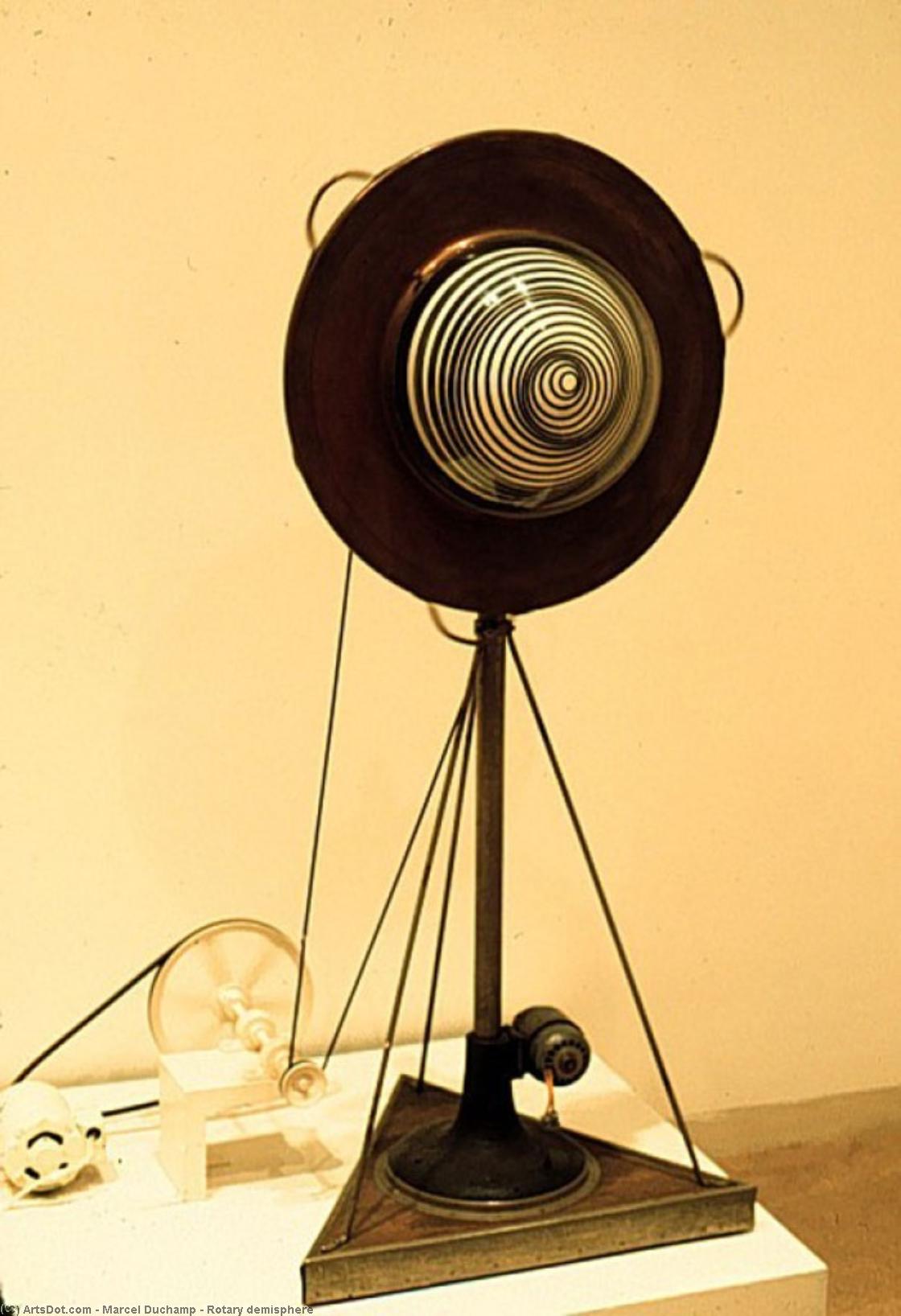
Marcel Duchamp’s Rotary Demisphere, created in 1925, isn't merely a painting; it’s an invitation to dismantle the very foundations of visual perception. This remarkable work, rendered in papier-mâché and meticulously assembled, transcends the boundaries of traditional art by challenging our ingrained assumptions about representation and spatial relationships. The piece immediately commands attention with its arresting circular form – a large, metallic demisphere reminiscent of an antique fan or perhaps a forgotten light fixture. However, it’s not the object itself that holds the primary intrigue, but rather the dynamic illusion it generates when rotated.
The photograph captures a moment frozen in time, revealing a complex interplay of elements. A clock, subtly positioned near the top left corner, and another clock towards the bottom right, serve as anchors within this shifting landscape, grounding the viewer while simultaneously emphasizing the work’s temporal dimension. Two small figures, their identities deliberately ambiguous, are nestled amongst the machinery – they could be observers, participants in a silent performance, or perhaps simply symbolic representations of the human experience caught within the mechanics of perception. Duchamp masterfully employs a copper collar and plexiglass dome to contain and amplify this visual effect, creating a contained spectacle that draws the eye into its mesmerizing spiral.
Dadaism’s Challenge to Artistic Conventions
Rotary Demisphere is deeply rooted in the spirit of Dadaism, the anti-art movement that emerged during World War I. Duchamp, along with fellow Dadaists, sought to reject established artistic norms and challenge the very definition of art itself. Rather than aiming for aesthetic beauty or skillful execution, they prioritized conceptual ideas and explored the role of chance, absurdity, and critique. This piece embodies this ethos perfectly – it’s not about creating a visually pleasing image but about provoking thought and disrupting conventional ways of seeing. Duchamp's intention wasn’t to depict reality faithfully; instead, he aimed to expose the mechanisms by which our brains construct meaning from sensory input.
The work’s creation coincided with Duchamp’s exploration of optical devices and his fascination with creating illusions. He was deeply interested in how vision operates – not as a passive reception of external stimuli but as an active, interpretive process. As documented in archival audio (available via the MoMA link), Duchamp described the experience of viewing the rotating demisphere: “Vision is produced internally, and what Duchamp is doing with the *Rotary Demisphere* is creating a kind of vision that doesn’t have anything to do with what’s out there in the world.” This statement encapsulates the core of his artistic strategy – to shift the focus from representation to perception itself.
A Testament to Precision and Conceptual Innovation
Despite its seemingly simple form, Rotary Demisphere represents a remarkable feat of engineering and craftsmanship. The intricate arrangement of gears, pulleys, and motors within the copper collar demonstrates Duchamp’s meticulous attention to detail and his willingness to embrace technological innovation as a means of artistic expression. The use of papier-mâché, combined with the polished metal components, creates a fascinating juxtaposition of materials – suggesting a dialogue between industrial precision and handmade artistry.
Furthermore, the inclusion of the engraved French phrase—"Rrose Sélavy et moi esquivons les ecchymoses des esquimaux aux mots exquis"—adds another layer of complexity to the work. This playful pun, referencing Duchamp’s pseudonym Rrose Sélavy and his exploration of language as a tool for subversion, underscores the artist's intellectual rigor and his commitment to challenging established conventions. Rotary Demisphere remains a pivotal work in the history of modern art, a testament to Duchamp’s revolutionary spirit and his enduring influence on generations of artists.


 Podgląd w skali
 Zamów wydruk
 Wyślij jako kartkę
 Udostępnij
 Szczegóły dzieła

 Pobierz
 Podobne obiekty
 RTG
RTG Pokaz slajdów

 Rozwiń treść



