

 Podgląd w skali 1:1
 Wyślij jako kartkę
 Udostępnij
 Szczegóły dzieła
 Przewodnik

 Pobierz obraz
 Podobne obiekty
 RTG
RTG Pokaz slajdów
 Statystyki
Acadia
 Oil On Canvas
- WallArt
- American Modernism
 1923
1923 80.0 x 93.0 cm
Vibrant outdoor gathering scene by Maurice Brazil Prendergast (1923) captures a lively moment of leisure; discover this luminous piece of American modernism today.
 Rozwiń treść
Maurice Prendergast – kanadyjski malarz postimpresjonistyczny znany z żywych obrazów, scen miejskich i unikalnego stylu mozaikowego. Odkryj jego świat pełen światła i koloru!
Ręcznie malowana reprodukcja olejowa
Ręcznie malowany obraz olejny na płótnie, wykonany na zamówienie przez naszych artystów w wybranym przez Ciebie wymiarze i oprawie. ( Przełącz na wydania drukowane Przejdź do wersji cyfrowej)




P118B zł10

P118H zł10

P118W zł10

P438Z zł10

P508JH zł12

P508YH zł12

P805H zł10

P805Z zł10

P919BZ zł10

P919G zł10

P919XJ zł10

P959ZH zł10

P968JZ zł12

W106C zł8

W218G zł10

W218JH zł8

W218Y zł10

W307PJ zł10

W316G zł10

W316PJ zł8

W316Y zł10

W398PJ zł8

W4111J zł10

W500HY zł15

W500JH zł15

W692G zł12

W849H zł8

W940BG zł15

W953PJ zł8




Standardowy format
personalizowane
CM
INCH
Wybierz spośród naszych standardowych rozmiarów, które zachowują oryginalne proporcje dzieła sztuki.
Loading sizes...

szerokość
wysokość
Wpisz wymaganą szerokość i wysokość, aby obraz pasował do Twojej ramy lub ściany. Ponieważ jest to dzieło malowane ręcznie, w przypadku rozmiaru o innych proporcjach artysta może domalować nieco więcej wokół obrazu lub przyciąć jego fragmenty — wybór należy do Ciebie. Przed rozpoczęciem pracy prześlemy Ci cyfrową wizualizację do zatwierdzenia. Obraz widoczny na tej stronie nie przedstawia rzeczywistego efektu — jedynie wizualizacja oddaje realny rezultat.
Przykłady możliwych zmian: Zamień twarz na zdjęcie klienta; Dodaj zwierzę domowe (np. zamień kota na psa); Ukryj wiadomość w tle; Zmień krajobraz lub elementy tła.
Po złożeniu zamówienia zespół TopImpressionists.com skontaktuje się z klientem drogą mailową w celu uzyskania instrukcji i prześle wizualizację projektu
Po złożeniu zamówienia zespół TopImpressionists.com skontaktuje się z klientem drogą mailową w celu uzyskania instrukcji i prześle wizualizację projektu
Dostawa na całym świecie () w ciągu 3–4 tygodni zamiast standardowych 5 tygodni. (25 Październik). Bez kompromisów w kwestii jakości.

Bezpłatna ekspresowa wysyłka na cały świat

Wysokiej jakości płótno lniane

Pełne ubezpieczenie przesyłki

Gwarancja zwrotu należności celnych i podatków importowych

Gwarancja wiernego odwzorowania kolorów

100-dniowa polityka zwrotów (tylko w przypadku wad)

Gwarancja 100% zwrotu pieniędzy

Zniżka przy zakupie wielu sztuk
 Opcja ze szkłem jest dostępna wyłącznie w rozmiarach poniżej 110 cm

Acadia
Technika reprodukcji
Wymiary reprodukcji
-


Cena całkowita
zł 1032
A Luminous Afternoon in Acadia
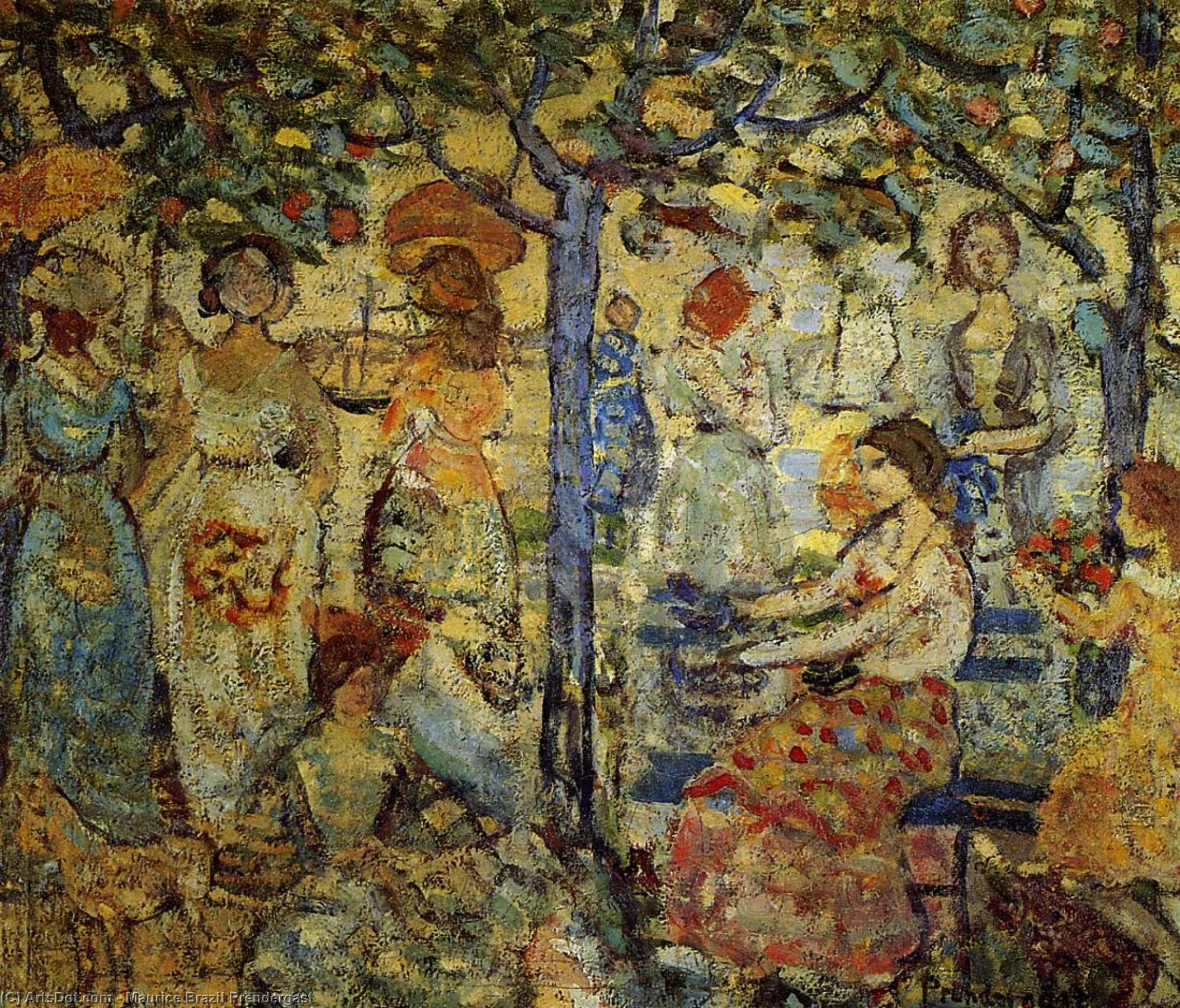
To gaze upon this depiction of Acadia is to step directly into a sun-dappled moment suspended outside the rush of modern life. Maurice Brazil Prendergast captures not merely a gathering, but an entire atmosphere—a vibrant tapestry woven from human connection and natural grace. The scene unfolds in what appears to be a lush, cultivated garden, a quintessential setting for leisurely social interaction. One can almost hear the murmur of conversation drifting through the leafy canopy overhead. The composition is rich with life; women are gathered under the sheltering embrace of trees, some seated at tables laden with objects that suggest domestic bounty—bowls and vases catching the light. Interspersed among them are men, one notably holding an umbrella, a detail that anchors the scene in a specific, temperate moment.
The Brushwork of Modern Light
Prendergast’s technique here is masterful, characteristic of his embrace of color and pattern. While the subject matter evokes traditional genre painting—a celebration of leisure—the execution pulses with modernist energy. His handling of oil on canvas allows light to become a tangible element within the artwork itself. Notice how the sunlight filters through the foliage, creating dappled patterns across the figures and the ground below. This luminosity is not simply decorative; it defines the mood. The artist uses color relationships to guide the eye, drawing us deeper into the social nucleus of the painting while simultaneously allowing our gaze to wander over the carefully placed details—the curve of a bench in the lower right, the suggestion of a chair waiting patiently in the foreground.
Context and Evocative Symbolism
Painted in 1923, this work sits at a fascinating crossroads in American art history. While Prendergast’s career spanned various influences, this piece embodies a yearning for idyllic community amidst the burgeoning complexities of the early 20th century. The garden itself functions as a potent symbol—a cultivated space representing harmony and civilized life, yet it is animated by the raw energy of its inhabitants. The gathering suggests themes of memory, shared experience, and the enduring power of human fellowship. It speaks to an idealized moment of respite, making it deeply resonant for contemporary viewers seeking connection.
Bringing Arcadia Home
For collectors or designers looking to infuse a space with warmth, history, and sophisticated color, this reproduction offers unparalleled depth. The scale of 80 x 93 cm allows the narrative complexity to breathe, ensuring that every figure and object contributes to the overall sense of joyous occasion. Owning a piece echoing Prendergast’s vision is not just acquiring art; it is curating an emotional landscape—a permanent reminder of sunlit afternoons spent in beautiful company. It promises to transform any room into a place of cultured repose, bathed in perpetual, gentle light.
Pytania i odpowiedzi
Czy „Acadia” – Mauricio Prendergast to dzieło o jasnej czy ciemnej kolorystyce?
„Acadia” charakteryzuje się ogólną jasnością na poziomie balanced, a jej luminancja wynosi Soft Shadow.
Pod jakimi innymi nazwiskami znany jest Mauricio Prendergast?
Mauricio Prendergast jest znany/a również pod pseudonimami: Maurice Brazil Prendergast, Maurizio Prendergast.
Jak zbudowana jest kompozycja kolorystyczna „Acadia” – Mauricio Prendergast?
Analiza kolorystyczna dzieła „Acadia” – Mauricio Prendergast ukazuje Balanced kontrast oraz Strong Color Unity harmonię.
Podobne dzieła


Biografia artysty
A Life Painted in Light: The World of Maurice Brazil Prendergast
Maurice Brazil Prendergast, a name perhaps less immediately recognizable than some of his contemporaries, nevertheless occupies a vital and luminous space within the narrative of American modernism. Born on October 10, 1858, amidst the rugged beauty of St. John’s, Newfoundland, his early life was shaped by an unusual upbringing – a family operating a subarctic trading post. This initial exposure to a stark, elemental landscape would subtly inform his later artistic vision, even as his world shifted dramatically with the family's relocation to Boston following the failure of their business venture. It was in Boston that young Maurice’s artistic inclinations began to blossom, nurtured by an apprenticeship with a commercial artist – a formative experience that instilled within him a sensitivity to color and pattern which would become hallmarks of his mature style. This early training wasn’t about grand academic tradition; it was about visual communication, about capturing attention, and this pragmatic foundation proved surprisingly potent as he evolved into a sophisticated Post-Impressionist painter.Parisian Influences and the Shaping of a Style
The true crucible for Prendergast's artistic development lay in Paris. From 1891 to 1895, he immersed himself in the vibrant art scene, studying at both the Académie Colarossi and the Académie Julian. These institutions provided him with technical grounding, but it was his encounters with the burgeoning avant-garde that truly ignited his imagination. He wasn’t simply absorbing techniques; he was witnessing a revolution in artistic thought. The influence of James McNeill Whistler, discovered through Canadian painter James Morrice, proved particularly significant, fostering an appreciation for aestheticism and harmonious color arrangements. Later exposure to artists like Édouard Vuillard and Pierre Bonnard cemented his path towards Post-Impressionism, while encosignificant encounters with the works of Vincent van Gogh and Georges Seurat during retrospectives in Paris broadened his understanding of expressive form and color theory. He didn’t adopt any single style wholesale; instead, he synthesized these diverse influences into something uniquely his own – a mosaic-like approach to painting characterized by flattened forms, bold outlines, and jewel-toned hues. His palette was rich and vibrant, often employing complementary colors to create dazzling visual effects.The Eight and Beyond: Finding His Place in American Art
Upon returning to Boston in 1895, Prendergast began to forge his distinctive artistic identity. He initially worked primarily in watercolor and monotype, mediums that allowed him to explore the delicate nuances of light and color with remarkable freedom.- His subject matter often centered on scenes of modern life – leisurely moments in parks, bustling city streets, and vibrant waterfronts.
- These weren’t merely depictions of reality; they were carefully constructed compositions designed to evoke a sense of joy, vitality, and urban energy.
Technique and Style
Prendergast’s technique was characterized by a remarkable control of color and form. He employed loose, expressive brushstrokes to create a sense of spontaneity and movement, while simultaneously maintaining a meticulous attention to detail. His paintings are often described as tapestry-like or resembling mosaics, reflecting his deliberate arrangement of shapes and colors to achieve a harmonious visual effect. He was particularly adept at capturing the effects of light and shadow, using subtle gradations of color to create a sense of depth and atmosphere. His use of watercolor allowed for luminous washes and delicate details, while his work in oils provided him with greater control over texture and tone. Prendergast’s style evolved considerably throughout his career, reflecting his ongoing exploration of artistic ideas and techniques.A Legacy of Light and Pattern
Despite facing health challenges throughout much of his career, Preendergast continued to exhibit and refine his artistic vision until his death in 1924. He remained a bachelor, finding companionship and support in his close relationship with his brother Charles, also an artist. His work, often overlooked during his lifetime, has since been recognized for its pioneering spirit and enduring beauty. Prendergast’s influence can be seen in the work of later American artists who embraced abstraction and explored the expressive potential of color and pattern. He was a master of capturing atmosphere and mood, transforming ordinary scenes into captivating visual experiences. His paintings are not simply representations of places; they are evocations of feelings – a sense of warmth, light, and the simple joys of being alive. He stands as a testament to the power of individual vision, an artist who dared to forge his own path and create a world painted in light and pattern, leaving behind a legacy that continues to inspire and delight audiences today.Exploring Prendergast’s World Today
Fortunately, experiencing Maurice Brazil Preendergast's artistry is readily accessible. His works are held in prominent collections such as the Smithsonian American Art Museum and the National Gallery of Art, offering opportunities for direct engagement with his vibrant canvases. Numerous online resources, including those provided by these institutions, allow art enthusiasts to delve deeper into his life and work. Furthermore, reproductions and scholarly analyses are available through platforms like TopImpressionists, providing a comprehensive overview of his artistic journey and lasting impact on the landscape of American art. His paintings continue to resonate with contemporary viewers, reminding us of the enduring power of beauty, observation, and the transformative potential of color.
Mauricio Prendergast
1858 - 1924 , Kanada”
Krótka nota
- Artistic Movement Or Style: Postimpresjonizm
- Artists Or Movements Influenced By This Artist:
- The Eight
- Amerykańskie sztuki
- Artists Who Influenced This Artist:
- James Whistler
- Gustave Courtois
- Date Of Birth: 10 października 1858
- Date Of Death: 1 lutego 1924
- Full Name: Maurice Brazil Prendergast
- Nationality: Kanadyjsko-amerykański
- Notable Artworks:
- Umbrellas w deszczu
- Śnieg w Salem
- Nierozpoznane
- Place Of Birth: St. John's, Kanada
Powiązane artykuły

The Soul of Impressionism: Why Oil on Canvas Captures Eternal Light and Timeless Emotion
Discover the enchanting alchemy of Impressionism. Explore how the mastery of oil on canvas, through glazing and impasto, captures eternal light and emotion. Perfect for lovers of Monet and Van Gogh seeking the profound depth of hand-painted fine art.

Capturing the Soul of Nature: A Journey Through the Sublime Majesty of American Romanticism
Explore the breathtaking beauty of American Romanticism. Discover how Hudson River School masters captured the sublime spirit of the wilderness through luminous oil landscapes and emotional depth. A journey into the soul of nature for the true art enthusiast.

The Unvarnished Truth: A Cultural Journey Through the Soul of American Realism
Explore the profound beauty of American Realism. From the Ashcan School's urban grit to intimate portraits, discover how artists captured the authentic soul of a nation through unvarnished truth and masterful observation.
Odkryj dzieła sztuki uporządkowane według tematów, stylów i cech charakterystycznych.


