
Przedstawiony: · Wraz z ramą:
 Podgląd w skali 1:1
 Wyślij jako kartkę
 Udostępnij
 Szczegóły dzieła
 Przewodnik

 Pobierz obraz
 Podobne obiekty
 RTG
RTG Pokaz slajdów
 Pytania i odpowiedzi
 Statystyki


zł 1150
Ręcznie malowana reprodukcja olejowa
Ręcznie malowany obraz olejny na płótnie, wykonany na zamówienie przez naszych artystów w wybranym przez Ciebie wymiarze i oprawie. ( Przełącz na wydania drukowane Przejdź do wersji cyfrowej)
Wymiar
·Standardowy format
personalizowane
CM
INCH
Wybierz spośród naszych standardowych rozmiarów, które zachowują oryginalne proporcje dzieła sztuki.
Ładowanie rozmiarów...

szerokość
wysokość
Wpisz wymaganą szerokość i wysokość, aby obraz pasował do Twojej ramy lub ściany. Ponieważ jest to dzieło malowane ręcznie, w przypadku rozmiaru o innych proporcjach artysta może domalować nieco więcej wokół obrazu lub przyciąć jego fragmenty — wybór należy do Ciebie. Przed rozpoczęciem pracy prześlemy Ci cyfrową wizualizację do zatwierdzenia. Obraz widoczny na tej stronie nie przedstawia rzeczywistego efektu — jedynie wizualizacja oddaje realny rezultat.
 Dowiedz się więcej
Wykończenie
·
Białe krawędzie zł1

rozmyte krawędzie zł1

Przedłużony zł1

P118B zł10

P118H zł10

P118W zł10

P438Z zł10

P508JH zł12

P508YH zł12

P805H zł10

P805Z zł10

P919BZ zł10

P919G zł10

P919XJ zł10

P959ZH zł10

P968JZ zł12

W106C zł8

W218G zł10

W218JH zł8

W218Y zł10

W307PJ zł10

W316G zł10

W316PJ zł8

W316Y zł10

W398PJ zł8

W4111J zł10

W500HY zł15

W500JH zł15

W692G zł12

W849H zł8

W940BG zł15

W953PJ zł8

H24-GOLD zł30

H24-SILVER zł30

H36-GOLD zł45

H36-SILVER zł45
Dostarczane w ochronnej tubie, gotowe do oprawienia przez Twojego ramiarza.
Dodatki
opcjonalneCo obejmują dodatki?
Przykłady możliwych zmian: Zastąpienie twarzy zdjęciem klienta; Dodanie zwierzęcia (np. zamiana kota na psa); Ukrycie wiadomości w tle; Zmiana krajobrazu lub elementów tła.
Po złożeniu zamówienia zespół TopImpressionists.com skontaktuje się z klientem drogą mailową w celu uzyskania instrukcji i prześle podgląd projektu
Po złożeniu zamówienia zespół TopImpressionists.com skontaktuje się z klientem drogą mailową w celu uzyskania instrukcji i prześle podgląd projektu
Dostawa na całym świecie () w ciągu 3–4 tygodni zamiast standardowych 5 tygodni. (8 Listopad). Bez kompromisów w kwestii jakości.
Lakier ochronny
Etykieta obiektu
Szczegóły grawerowanej brązowej tabliczki
This elegant plaque features the artist's name and the title of the artwork, finely engraved for a timeless presentation.
It is made from bronze with a refined, elegant finish. The text is precisely laser-engraved for a sharp and permanent result. Measuring 9x2 cm, the plaque is compact yet easy to read. It's built to be durable and scratch-resistant, offering a professional, museum-quality look. Mounting is simple thanks to the included adhesive backing.
Szczegóły przezroczystej tabliczki akrylowej
The plaque includes essential engraved details such as the artist's name, the title of the artwork, the date it was created, the type of media used-like oil on canvas or watercolor-a brief description of the piece, and a QR code that links to the complete artwork information.
It is crafted from clear acrylic, offering a sleek, modern appearance. The text is UV-engraved in black to ensure strong visual contrast. With a size of 10x15 cm, it ensures optimal readability. It comes equipped with two metal hooks for secure wall mounting. The plaque is designed to be weather-resistant, making it suitable for various environments, and it includes interactive features that work seamlessly with smartphone scanning.
Szczegóły czarnej tabliczki akrylowej
This elegant plaque includes engraved information such as the artist's name, the title of the artwork, the date it was created, the type of media used (like oil on canvas or watercolor), a short description of the artwork, and a QR code for quick access to more information.
The plaque itself is made from refined black acrylic with a premium finish. The text is laser-engraved in white for high contrast and readability. Its size is 10x15 cm, designed to be easy to read. It comes with two metal hooks for professional mounting. The design is sleek and fits any interior style. It is also weather-resistant and durable, with built-in digital integration for mobile compatibility.
Opcja ze szkłem jest dostępna wyłącznie w rozmiarach poniżej 110 cm
 Opcja ze szkłem jest dostępna wyłącznie w rozmiarach poniżej 110 cm
- Bezpłatna ekspresowa wysyłka na cały świat
- Wysokiej jakości płótno lniane
- Pełne ubezpieczenie przesyłki
- Gwarancja zwrotu należności celnych i podatków importowych
- Gwarancja wiernego odwzorowania kolorów
- 100-dniowa polityka zwrotów (tylko w przypadku wad)
- Gwarancja 100% zwrotu pieniędzy
- Zniżka przy zakupie wielu sztuk


Opis obiektu
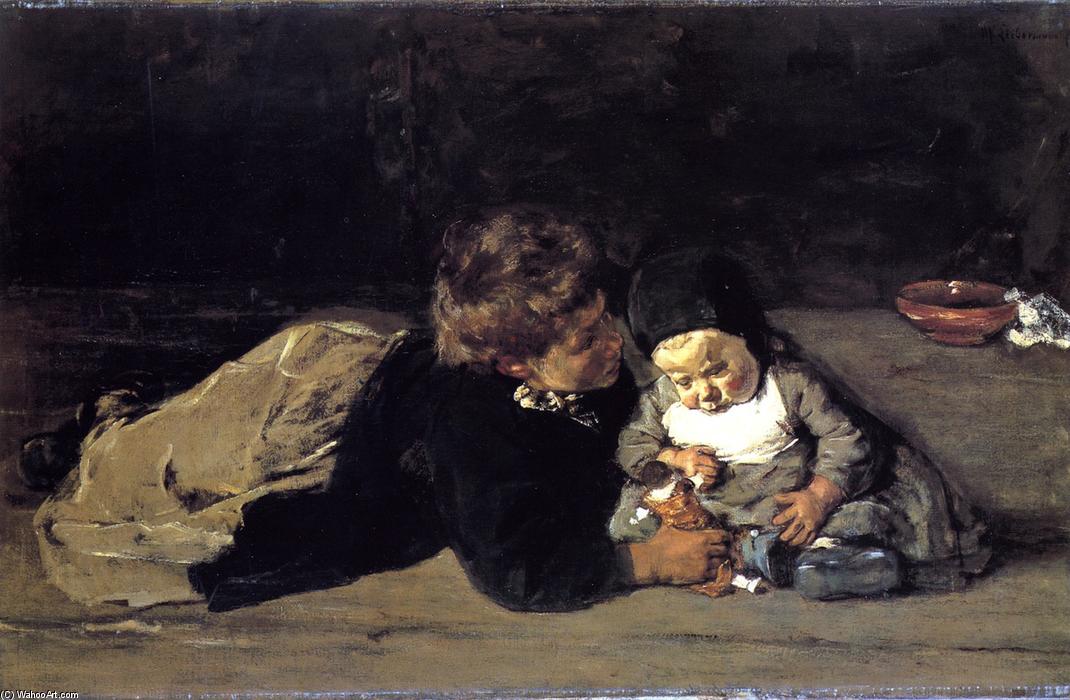
This painting by Max Liebermann exemplifies Impressionistic style, characterized by loose brushwork and tonal variations to depict a heartwarming scene of human interaction. Employing wet-on-wet technique on canvas, Liebermann skillfully captures fleeting moments with sensitivity to light and color, reflecting themes of caregiving and connection within an understated interior setting.
Biografia artysty
Max Liebermann (1847-1935): Pionier niemieckiego impresjonizmu, znany z obrazów z życia codziennego, portretów i idyllicznych krajobrazów. Jego twórczość inspiruje do wolności artystycznej.
O obrazie
A Tender Encounter in Monochrome
In the quietude of Max Liebermann’s 1876 masterpiece, “The Siblings,” time seems to suspend its forward march, allowing a singular moment of human connection to breathe. This monochrome triumph is far more than a mere study of figures; it is a profound exploration of familial tenderness and the soft, unspoken language of intimacy. As the eye meets the canvas, one is immediately drawn into a world of diffused light and tonal harmony, where a man and a child are captured in a fleeting tableau of closeness. The painting transcends its simple subject matter to become a distillation of emotion, rendered with a precision that speaks to the soul as much as it does to the intellect.
The composition is masterfully understated, centering the viewer's attention on the intimate core of the foreground. Here, the figures occupy a simple ground plane, their proximity creating a palpable sense of warmth and protection. While subtle, indistinct individuals linger in the background, they serve only as contextual anchors, ensuring that the primary focus remains fixed upon the bond between the two central subjects. This arrangement creates an inviting depth, drawing collectors and admirers alike into a private, domestic sanctuary that feels both timeless and deeply personal.
Impressionistic Light and Fluid Technique
Liebermann, a leading proponent of Impressionism in Germany, utilizes a technique that prioritizes the ephemeral quality of light over the rigid constraints of photographic realism. Through the skillful application of a wet-on-wet technique, the artist allows colors and tones to blend seamlessly across the canvas, generating a soft, hazy luminescence. This method imbues the scene with an ethereal glow, as if the very air within the room is heavy with memory and quietude. The brushstrokes are loose and organic, characteristic of the Impressionist movement, favoring the suggestion of texture and form over meticulous, sharp-edged detail.
The monochromatic palette—a sophisticated arrangement of blacks, whites, and varying shades of gray—plays a crucial role in the painting's atmospheric success. By stripping away the distraction of color, Liebermann directs our attention to the subtle interplay of shadow and light. This tonal mastery creates a sense of depth and volume, where the soft edges of clothing and facial features emerge from the shadows with a gentle, rhythmic grace. For the interior designer, such a piece offers a sophisticated anchor for a room, providing a neutral yet emotionally resonant focal point that complements both classical and contemporary decor.
A Legacy of Emotion and Connection
To understand “The Siblings,” one must consider the historical currents flowing through Liebermann’s early career. Painted during his formative years in Paris and Weimar, the work reflects the burgeoning fascination with capturing everyday life and subjective experience that defined the era. Much like his contemporaries Monet and Renoir, Liebermann sought to move beyond academic stiffness, embracing a style that mirrored the shifting moods of the natural and domestic worlds. This piece stands as a testament to his ability to translate the essence of human experience onto canvas.
Beyond its technical brilliance, the painting carries a profound symbolic weight. The focus on the relationship between the man and the child evokes universal themes of caregiving, protection, and the enduring strength of familial bonds. There is a palpable sense of nostalgia and quiet contemplation within the frame, making it an ideal acquisition for those who seek art that offers more than mere decoration. It is a piece that invites long periods of reflection, offering a window into a moment of shared attention that remains as poignant today as it was in 1876.
Pytania i odpowiedzi
Jak technika i ruch łączą się w "The Siblings"?
„The Siblings” – Max Liebermann łączy technikę Oil On Canvas z nurtem Impressionistic Style. Technika i styl określają sposób wykonania oraz estetykę dzieła.
Z jakiej techniki wykorzystano "The Siblings"?
Technika wykonania dzieła „The Siblings” – Max Liebermann to Oil On Canvas. Reprodukcje mają na celu wierne oddanie wyglądu tej techniki.
W jaki sposób nurt i epoka przenikają się w „The Siblings” – Max Liebermann?
W „The Siblings” – Max Liebermann nurt Impressionistic Style łączy się z epoką – Wiek XIX.
Najważniejsze informacje i quiz o sztuce
O Max Liebermann

Max Liebermann
1847 - 1935, Niemcy
Biografia artysty
A Life Immersed in Light: The World of Max Liebermann
Max Liebermann, a name synonymous with the vibrant and nuanced development of Impressionism in Germany, was born on July 20, 1847, in Berlin. His early life, steeped in the comforts of a prosperous Jewish family – his father a successful textile manufacturer – seemed destined for a path far removed from the artistic realm. However, a deliberate shift towards intellectual pursuits at the University of Berlin, followed by studies in Weimar, Paris, and the Netherlands, ignited a passion that would forever transform his life and legacy. Liebermann’s journey wasn't simply about acquiring technical skills; it was a profound engagement with the world around him, a desire to capture not just what he saw, but the very essence of experience itself. This inherent sensitivity to light, color, and atmosphere became the hallmark of his distinctive style – an Impressionism uniquely German in its sensibility.Embracing Impressionism: A Dialogue with Paris
Liebermann’s artistic evolution was inextricably linked to his exposure to the revolutionary currents sweeping through France. The boldness of Édouard Manet, his rejection of rigid academic conventions, and his focus on depicting contemporary life resonated deeply within Liebermann's soul. He wasn’t merely a passive observer; he actively engaged with these new ideas, adapting them to his own artistic vision. While he admired the Parisian Impressionists – Monet, Renoir, Degas – he didn’t simply replicate their techniques. Instead, he infused his work with a distinctly German perspective, characterized by a brighter palette, looser brushstrokes, and a focus on scenes of bourgeois leisure and the tranquil beauty of his beloved garden near Lake Wannsee. This garden, a sanctuary from the turbulent world outside, became a recurring motif, a space where light danced upon foliage, and the simple pleasures of summer were immortalized on canvas. Liebermann’s early paintings often depicted scenes of everyday life – working-class laborers, bustling marketplaces, and intimate domestic moments – rendered with an honesty and respect that challenged the prevailing romanticized aesthetic of the time. These weren't intended as social commentaries, but rather as genuine portrayals of human existence, imbued with dignity and a profound appreciation for the beauty of ordinary life.The Berlin Secession: A Catalyst for Change
Recognizing the stifling constraints imposed by the traditional art establishment in Germany – particularly the rigid control exerted by the Prussian Academy of Arts – Liebermann became a pivotal figure in the formation of the Berlin Secession in 1898. This avant-garde movement, alongside artists like Kirchner and Nolde, represented a radical departure from established norms, providing a platform for artistic innovation and independent expression. Liebermann’s leadership of the Secession for over a decade was instrumental in challenging conventional notions of art and paving the way for modern German art. The Secession wasn't merely a group of artists; it was a declaration – a bold assertion of artistic freedom and a commitment to exploring new possibilities beyond the confines of academic tradition. This spirit of rebellion extended far beyond the realm of painting, influencing other areas of culture and contributing to a broader shift in societal attitudes towards art and creativity.A Master of Portraiture and Beyond
While his landscapes and scenes of everyday life are undoubtedly celebrated, Liebermann’s contribution to the art world extends significantly through his masterful portraiture. Over two hundred commissioned portraits attest to his skill and insight – works that capture not just likenesses, but the very essence of his subjects' personalities. Portraits of Albert Einstein, Paul von Hindenburg, and numerous other prominent figures demonstrate Liebermann’s ability to delve beneath the surface, revealing the inner lives of those he depicted through subtle gestures, expressions, and carefully observed details. Beyond portraiture, Liebermann also produced a significant body of prints, further showcasing his technical skill and artistic vision. His work spanned a wide range of subjects – from religious scenes to depictions of rural life – reflecting his diverse interests and evolving style.Legacy and Historical Context
Max Liebermann’s legacy is complex and layered, inextricably intertwined with the tumultuous events of 20th-century Germany. Following the rise of Nazism, he bravely resigned from the Prussian Academy of Arts in 1933, a courageous act of defiance against a regime that increasingly threatened artistic freedom and Jewish identity. Despite facing persecution and discrimination, Liebermann continued to paint, finding solace and purpose in his art until his death on February 8, 1935, in Berlin. Tragically, his wife, Martha, took her own life in 1943 to avoid deportation, a heartbreaking testament to the horrors of the Holocaust. For many years after World War II, Liebermann’s work was somewhat overlooked, overshadowed by the darker chapters of German history. However, in recent decades, there has been a renewed appreciation for his contributions to German Impressionism and modern art – recognizing him not only as a brilliant painter but also as a courageous advocate for artistic expression and a symbol of resistance against tyranny. His paintings continue to captivate viewers with their luminous beauty, insightful observations, and enduring humanity.Key Achievements & Lasting Influence
- “The Twelve-Year-Old Jesus in the Temple”: This early work sparked considerable debate due to its unconventional depiction of a Semitic-looking Jesus, challenging traditional religious iconography.
- Leadership of the Berlin Secession: His pivotal role in leading this avant-garde movement challenged artistic norms and paved the way for modern art in Germany.
- Presidency of the Prussian Academy of Arts: A significant recognition of his artistic merit, though ultimately compromised by the rise of Nazism.
- Masterful Portraiture: His ability to capture the essence of his subjects in over 200 commissioned portraits cemented his reputation as a leading portrait painter.
- Influence on German Impressionism: Liebermann successfully translated the principles of Impressionism into a uniquely German context, inspiring generations of artists.
Krótkie informacje o Max Liebermann
- Artistic Movement Or Style: Impressionizm
- Artists Or Movements Influenced By This Artist: ['Secesja Berlin']
- Artists Who Influenced This Artist:
- Manet
- Millet
- Date Of Birth: 20 lipca 1847
- Date Of Death: 8 lutego 1935
- Full Name: Max Liebermann
- Nationality: Niemiec
- Notable Artworks:
- Dziecko w kapeluszu
- Kąpiący się chłop
- Dom starców
- Place Of Birth: Berlin, Niemcy
Podobne dzieła


Odkryj dzieła sztuki uporządkowane według tematów, stylów i cech charakterystycznych.


Max Liebermann
The Siblings
() ·
Wraz z ramą: · Ręcznie malowane farbami olejnymi na płótnie lnianym
Suma