

Shown: · With its frame:
 Podgląd w skali 1:1
 Wyślij jako kartkę
 Udostępnij
 Szczegóły dzieła
 Przewodnik

 Pobierz obraz
 Podobne obiekty
 RTG
RTG Pokaz slajdów
 Q&A
Q&A Statystyki


zł 1045
Ręcznie malowana reprodukcja olejowa
Ręcznie malowany obraz olejny na płótnie, wykonany na zamówienie przez naszych artystów w wybranym przez Ciebie wymiarze i oprawie. ( Przełącz na wydania drukowane Przejdź do wersji cyfrowej)
Size
·Standardowy format
personalizowane
CM
INCH
Wybierz spośród naszych standardowych rozmiarów, które zachowują oryginalne proporcje dzieła sztuki.
Loading sizes...

szerokość
wysokość
Wpisz wymaganą szerokość i wysokość, aby obraz pasował do Twojej ramy lub ściany. Ponieważ jest to dzieło malowane ręcznie, w przypadku rozmiaru o innych proporcjach artysta może domalować nieco więcej wokół obrazu lub przyciąć jego fragmenty — wybór należy do Ciebie. Przed rozpoczęciem pracy prześlemy Ci cyfrową wizualizację do zatwierdzenia. Obraz widoczny na tej stronie nie przedstawia rzeczywistego efektu — jedynie wizualizacja oddaje realny rezultat.
 Dowiedz się więcej
Finish
·
White zł1

Blurside zł1

Extended zł1

P118B zł10

P118H zł10

P118W zł10

P438Z zł10

P508JH zł12

P508YH zł12

P805H zł10

P805Z zł10

P919BZ zł10

P919G zł10

P919XJ zł10

P959ZH zł10

P968JZ zł12

W106C zł8

W218G zł10

W218JH zł8

W218Y zł10

W307PJ zł10

W316G zł10

W316PJ zł8

W316Y zł10

W398PJ zł8

W4111J zł10

W500HY zł15

W500JH zł15

W692G zł12

W849H zł8

W940BG zł15

W953PJ zł8

H24-GOLD zł30

H24-SILVER zł30

H36-GOLD zł45

H36-SILVER zł45
Shipped in a protective tube, ready for your own framer.
Above 105 cm the frame is shipped as a kit for a professional framer — read the details.
Extras
optionalWhat do the extras include?
Examples of what can be changed: Replace face with customer photo; Add pet (e.g., replace cat with dog); Include hidden message in background; Change background landscape or elements.
After order, TopImpressionists.com team will email client for instructions and provide a mockup preview
After order, TopImpressionists.com team will email client for instructions and provide a mockup preview
Dostawa na całym świecie () w ciągu 3–4 tygodni zamiast standardowych 5 tygodni. (30 Październik). Bez kompromisów w kwestii jakości.
Lakier ochronny
Etykieta obiektu
Szczegóły grawerowanej brązowej tabliczki
This elegant plaque features the artist's name and the title of the artwork, finely engraved for a timeless presentation.
It is made from bronze with a refined, elegant finish. The text is precisely laser-engraved for a sharp and permanent result. Measuring 9x2 cm, the plaque is compact yet easy to read. It's built to be durable and scratch-resistant, offering a professional, museum-quality look. Mounting is simple thanks to the included adhesive backing.
Szczegóły przezroczystej tabliczki akrylowej
The plaque includes essential engraved details such as the artist's name, the title of the artwork, the date it was created, the type of media used-like oil on canvas or watercolor-a brief description of the piece, and a QR code that links to the complete artwork information.
It is crafted from clear acrylic, offering a sleek, modern appearance. The text is UV-engraved in black to ensure strong visual contrast. With a size of 10x15 cm, it ensures optimal readability. It comes equipped with two metal hooks for secure wall mounting. The plaque is designed to be weather-resistant, making it suitable for various environments, and it includes interactive features that work seamlessly with smartphone scanning.
Szczegóły czarnej tabliczki akrylowej
This elegant plaque includes engraved information such as the artist's name, the title of the artwork, the date it was created, the type of media used (like oil on canvas or watercolor), a short description of the artwork, and a QR code for quick access to more information.
The plaque itself is made from refined black acrylic with a premium finish. The text is laser-engraved in white for high contrast and readability. Its size is 10x15 cm, designed to be easy to read. It comes with two metal hooks for professional mounting. The design is sleek and fits any interior style. It is also weather-resistant and durable, with built-in digital integration for mobile compatibility.
Opcja ze szkłem jest dostępna wyłącznie w rozmiarach poniżej 110 cm
 Opcja ze szkłem jest dostępna wyłącznie w rozmiarach poniżej 110 cm
- Bezpłatna ekspresowa wysyłka na cały świat
- Wysokiej jakości płótno lniane
- Pełne ubezpieczenie przesyłki
- Gwarancja zwrotu należności celnych i podatków importowych
- Gwarancja wiernego odwzorowania kolorów
- 100-dniowa polityka zwrotów (tylko w przypadku wad)
- Gwarancja 100% zwrotu pieniędzy
- Zniżka przy zakupie wielu sztuk


Opis obiektu
Biografia artysty
Klasyczne obraz Rousseau „Pythagoras wychodzący z podziemia” prezentuje umiejętności Poussina i jego fascynację klasyczną estetyką. Znajdź więcej dzieł tego mistrza sztuki na WikiArt!
About the painting
A Moment Frozen in Time: Poussin’s ‘Two Silver Birches’
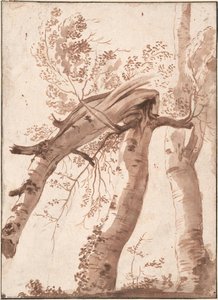
Nicolas Poussin's “Two Silver Birches, the Front One Fallen,” painted circa 1629, isn’t merely a depiction of trees; it’s a carefully constructed meditation on mortality, harmony, and the enduring power of classical ideals. Emerging from his formative years in France and culminating in his profound immersion within the Roman artistic landscape, Poussin sought to synthesize the sensual richness of Venetian painting with the rigorous order and intellectual depth of antiquity. This work, created during a pivotal period of his career, exemplifies this ambition – a quiet yet profoundly resonant scene that speaks volumes about the artist’s evolving philosophy.
The painting immediately draws the eye with its stark simplicity. Two birch trees dominate the composition, their silvery bark rendered with an almost luminous quality. The tree on the right stands tall and proud, branches reaching skyward as if in defiant grace, while its counterpart lies prone at the base of the canvas, a fallen sentinel marking the passage of time. The absence of leaves is deliberate; it strips away the seasonal distractions, focusing instead on the skeletal beauty of the trees themselves – a motif frequently associated with death and remembrance within classical art. This reduction to essential form allows Poussin to explore the underlying structure of nature, mirroring his broader interest in geometric principles and mathematical harmony.
The Language of Line and Light
Poussin’s technique is characterized by an exquisite control of line and light. He employs a meticulous layering of thin washes of paint – a hallmark of his style – to build up the forms with remarkable precision. The branches, particularly those of the upright birch, are delineated with delicate, almost hesitant strokes, creating a sense of movement and vulnerability. The fallen tree is rendered with a slightly heavier touch, suggesting its weight and the inevitability of decay. Light plays a crucial role in shaping the scene; it seems to emanate from an unseen source, bathing the trees in a soft, diffused glow that enhances their silvery sheen. This masterful manipulation of light not only creates visual beauty but also imbues the painting with a sense of spiritual depth.
Noticeably, Poussin includes a human figure – a small, dark silhouette standing near the base of the fallen tree. The identity and purpose of this figure remain deliberately ambiguous, adding another layer of complexity to the work. Some scholars interpret it as representing contemplation or perhaps even mourning, while others see it as a symbol of humanity’s relationship with nature—a witness to its cycles of growth and decline. The figure's presence subtly anchors the scene in the realm of human experience, reminding us that even within the grandeur of the natural world, we are confronted by our own mortality.
Symbolism Rooted in Antiquity
The birch tree itself carries a rich symbolic weight throughout Western art history. Often associated with purity, resilience, and the afterlife, it frequently appears in funerary monuments and depictions of mourning. Its slender form and delicate branches evoke images of fragility and vulnerability, while its ability to withstand harsh winters speaks to an enduring spirit. Poussin’s choice of birch trees aligns perfectly with his engagement with classical themes – particularly those found in Roman mythology and literature, where the tree frequently served as a symbol of transition and renewal.
Furthermore, the fallen tree can be interpreted as a representation of *memento mori*—a reminder of death. This concept was central to Renaissance art, serving as a powerful tool for prompting reflection on the transience of earthly life. Poussin’s painting, therefore, transcends mere botanical observation; it becomes a poignant meditation on the cyclical nature of existence and the inevitability of loss. The composition invites us to contemplate our own place within this grand scheme, fostering a sense of both melancholy and acceptance.
A Timeless Masterpiece for Reproduction
TopImpressionists offers meticulously crafted hand-painted reproductions of “Two Silver Birches, the Front One Fallen,” allowing you to bring this iconic work into your home or office. Our artists replicate Poussin’s delicate brushwork and masterful use of light with unparalleled precision, ensuring that every detail is faithfully reproduced. Whether you are an art enthusiast, a collector seeking to expand your collection, or an interior designer searching for a touch of classical elegance, our reproductions provide a beautiful and authentic representation of this timeless masterpiece. Experience the profound beauty and intellectual depth of Poussin’s vision – a moment frozen in time, brought vividly back to life.
Pytania i odpowiedzi
Czy w „Two Silver Birches, the Front One Fallen, c. 1629” – Nikola Poussin zastosowano silne kontrasty czy raczej łagodne harmonie?
W "Two Silver Birches, the Front One Fallen, c. 1629" Gentle kontrast łączy się z Unified Palette harmonią.
Co przedstawia „Two Silver Birches, the Front One Fallen, c. 1629” – Nikola Poussin i jaki ma nastrój?
"Two Silver Birches, the Front One Fallen, c. 1629" przedstawia birches, trees, fallen tree, tranquility, poussin, landscape, classical, harmony, a jego nastrojowy charakter można określić jako Calm.
W jaki sposób nurt i epoka przenikają się w „Two Silver Birches, the Front One Fallen, c. 1629” – Nikola Poussin?
"Two Silver Birches, the Front One Fallen, c. 1629" należy do nurtu French Baroque Painting, a jego twórca tworzył w epoce – Wczesna nowożytność.
Quick facts and art quiz
About Nikola Poussin

Nikola Poussin
1594 - 1665, Francja
Biografia artysty
Nicolas Poussin - A Life Steeped in Classical Reverie
Nicolas Poussin, a name synonymous with the grandeur of French Baroque painting, was nonetheless a soul deeply rooted in Italian soil for much of his artistic life. Born in Les Andelys, Normandy, in June 1594, his early years remain somewhat veiled in mystery, yet they undoubtedly laid the foundation for a career that would become pivotal in shaping the classical tradition within French art. Though he briefly studied in Paris during the early 1610s, absorbing influences from lesser-known artists of the time—primarily Jean Baptiste Oudry and Nicolas Tourigny—it was his journey to Rome in 1624 that truly ignited his artistic destiny. This wasn’t merely a geographical relocation; it was an immersion into the heart of antiquity, a pilgrimage to the very source of inspiration that would define his aesthetic vision. Poussin's initial forays into painting were marked by a sensuous quality reminiscent of Venetian masters like Titian—particularly in his early landscapes—yet even in these works, a nascent sense of order and intellectual rigor began to emerge—a foreshadowing of the style he would so masterfully refine. He experimented with color palettes inspired by Venetian painters, capturing atmospheric effects with remarkable subtlety.The Roman Years: Forging a Classical Ideal
Rome proved to be more than just a studio for Poussin; it became his intellectual crucible. He found himself amidst a vibrant circle of scholars, archaeologists, and fellow artists, notably Cassiano dal Pozzo, whose profound understanding of classical antiquity profoundly influenced the artist’s approach. Dal Pozzo's dedication to meticulously documenting ancient remains instilled in Poussin a deep respect for historical accuracy and a desire to imbue his paintings with a sense of timelessness. This period saw Poussin move away from the flamboyant exuberance of some of his contemporaries, instead embracing a style characterized by clarity, balance, and a deliberate emphasis on linear composition. He meticulously studied Raphael’s works—particularly *The School of Athens*—absorbing their harmonious arrangements and graceful forms, while simultaneously drawing inspiration from ancient sculptures and literary sources like Ovid's *Metamorphoses*. His paintings began to populate with figures drawn from classical history and mythology, rendered not as mere decorative elements but as embodiments of moral virtues and philosophical ideals. He sought to emulate Raphael’s masterful use of perspective and idealized forms, striving for a visual elegance that transcended the conventions of his time.Influences and Artistic Development
Poussin's artistic development was shaped by several key influences. Initially drawn to Venetian painting—particularly Titian’s luminous color palettes—he quickly recognized the superiority of Raphael’s classical style as a model for achieving artistic excellence. He absorbed the principles of linear perspective, mastering techniques that allowed him to create illusionistic depth and convey a sense of grandeur. Furthermore, his engagement with humanist scholarship fostered an appreciation for moral philosophy and informed his thematic choices. The rediscovery of classical sculpture—particularly Michelangelo’s Pietà—provided him with visual references that would resonate throughout his oeuvre. He diligently studied the works of Agrippa Vespasiani and Andrea Palladio, incorporating architectural elements into his landscapes to heighten their sense of scale and harmony.Major Achievements: Mythological Narratives and Landscape Visions
Poussin’s artistic output was remarkably diverse, yet consistently united by his commitment to these core principles. He achieved international renown for his monumental mythological paintings—particularly *Et in Arcadia ego*, which became a symbol of humanist contemplation on mortality and the enduring power of memory. This masterpiece exemplifies his mastery of classical composition and his ability to convey profound philosophical ideas through visual imagery. Beyond mythology, he produced stunning landscapes that captured the beauty and sublimity of nature with unparalleled sensitivity. His series depicting the Seasons—a testament to his artistic virtuosity—demonstrated his command of color and light, creating vistas that evoked a sense of serenity and timelessness. He skillfully blended realism with idealized forms, elevating landscape painting to new heights of aesthetic achievement.A Lasting Legacy: Shaping French Art
Despite spending the majority of his career abroad—primarily in Rome—Poussin’s influence on French art was immense. He briefly returned to Paris in 1640 at the behest of Cardinal Richelieu, appointed as First Painter to the King—a position he held until his death in 1665—but found himself stifled by the demands and intrigues of court life. He soon returned to Rome, where he continued to paint until his final days, refining his style and exploring new artistic horizons. His dedication to classical principles helped establish a standard for artistic training and practice within France, influencing generations of artists who followed. Artists like Jacques-Louis David and Paul Cézanne openly acknowledged their debt to Poussin’s rigorous approach and intellectual depth—a testament to an artist who sought not simply to depict the world but to elevate it through the lens of reason and beauty. He became a cornerstone of French Classicism, securing his place as one of the most celebrated painters of his era.- Notable Works: *The Death of Germanicus*, *The Seven Sacraments Series*, *A Roman Road*, *Orion Blinded Searching for the Sun*, *The Seasons*.
- Key Characteristics: Classical Composition, Linearity, Historical and Mythological Themes, Serene Landscapes.
Quick facts about Nikola Poussin
- Artistic Movement Or Style: Barok Klasyczny
- Artists Or Movements Influenced By This Artist:
- Jacques-Louis David
- Paul Cézanne
- Artists Who Influenced This Artist:
- Raphael
- Titian
- Date Of Birth: 1594
- Date Of Death: 1665
- Full Name: Nicolas Poussin
- Nationality: Francuzi
- Notable Artworks:
- Święcenia
- Wenus prezentująca uzbrojenie dla Eneusza
- Zimowa Rozkosz
- Place Of Birth: Les Andelys, Francja
Odkryj dzieła sztuki uporządkowane według tematów, stylów i cech charakterystycznych.


Nikola Poussin
Two Silver Birches, the Front One Fallen, c. 1629
() ·
With its frame: · Hand-painted in oil on linen
Total