

Przedstawiony: · Wraz z ramą:
 Podgląd w skali 1:1
 Wyślij jako kartkę
 Udostępnij
 Szczegóły dzieła
 Przewodnik

 Pobierz obraz
 Podobne obiekty
 RTG
RTG Pokaz slajdów
 Pytania i odpowiedzi
 Statystyki


zł 1052
Ręcznie malowana reprodukcja olejowa
Ręcznie malowany obraz olejny na płótnie, wykonany na zamówienie przez naszych artystów w wybranym przez Ciebie wymiarze i oprawie. ( Przełącz na wydania drukowane Przejdź do wersji cyfrowej)
Wymiar
·Standardowy format
personalizowane
CM
INCH
Wybierz spośród naszych standardowych rozmiarów, które zachowują oryginalne proporcje dzieła sztuki.
Ładowanie rozmiarów...

szerokość
wysokość
Wpisz wymaganą szerokość i wysokość, aby obraz pasował do Twojej ramy lub ściany. Ponieważ jest to dzieło malowane ręcznie, w przypadku rozmiaru o innych proporcjach artysta może domalować nieco więcej wokół obrazu lub przyciąć jego fragmenty — wybór należy do Ciebie. Przed rozpoczęciem pracy prześlemy Ci cyfrową wizualizację do zatwierdzenia. Obraz widoczny na tej stronie nie przedstawia rzeczywistego efektu — jedynie wizualizacja oddaje realny rezultat.
 Dowiedz się więcej
Wykończenie
·
Białe krawędzie zł1

rozmyte krawędzie zł1

Przedłużony zł1

P118B zł10

P118H zł10

P118W zł10

P438Z zł10

P508JH zł12

P508YH zł12

P805H zł10

P805Z zł10

P919BZ zł10

P919G zł10

P919XJ zł10

P959ZH zł10

P968JZ zł12

W106C zł8

W218G zł10

W218JH zł8

W218Y zł10

W307PJ zł10

W316G zł10

W316PJ zł8

W316Y zł10

W398PJ zł8

W4111J zł10

W500HY zł15

W500JH zł15

W692G zł12

W849H zł8

W940BG zł15

W953PJ zł8

H24-GOLD zł30

H24-SILVER zł30

H36-GOLD zł45

H36-SILVER zł45
Dostarczane w ochronnej tubie, gotowe do oprawienia przez Twojego ramiarza.
Dodatki
opcjonalneCo obejmują dodatki?
Przykłady możliwych zmian: Zastąpienie twarzy zdjęciem klienta; Dodanie zwierzęcia (np. zamiana kota na psa); Ukrycie wiadomości w tle; Zmiana krajobrazu lub elementów tła.
Po złożeniu zamówienia zespół TopImpressionists.com skontaktuje się z klientem drogą mailową w celu uzyskania instrukcji i prześle podgląd projektu
Po złożeniu zamówienia zespół TopImpressionists.com skontaktuje się z klientem drogą mailową w celu uzyskania instrukcji i prześle podgląd projektu
Dostawa na całym świecie () w ciągu 3–4 tygodni zamiast standardowych 5 tygodni. (3 Listopad). Bez kompromisów w kwestii jakości.
Lakier ochronny
Etykieta obiektu
Szczegóły grawerowanej brązowej tabliczki
This elegant plaque features the artist's name and the title of the artwork, finely engraved for a timeless presentation.
It is made from bronze with a refined, elegant finish. The text is precisely laser-engraved for a sharp and permanent result. Measuring 9x2 cm, the plaque is compact yet easy to read. It's built to be durable and scratch-resistant, offering a professional, museum-quality look. Mounting is simple thanks to the included adhesive backing.
Szczegóły przezroczystej tabliczki akrylowej
The plaque includes essential engraved details such as the artist's name, the title of the artwork, the date it was created, the type of media used-like oil on canvas or watercolor-a brief description of the piece, and a QR code that links to the complete artwork information.
It is crafted from clear acrylic, offering a sleek, modern appearance. The text is UV-engraved in black to ensure strong visual contrast. With a size of 10x15 cm, it ensures optimal readability. It comes equipped with two metal hooks for secure wall mounting. The plaque is designed to be weather-resistant, making it suitable for various environments, and it includes interactive features that work seamlessly with smartphone scanning.
Szczegóły czarnej tabliczki akrylowej
This elegant plaque includes engraved information such as the artist's name, the title of the artwork, the date it was created, the type of media used (like oil on canvas or watercolor), a short description of the artwork, and a QR code for quick access to more information.
The plaque itself is made from refined black acrylic with a premium finish. The text is laser-engraved in white for high contrast and readability. Its size is 10x15 cm, designed to be easy to read. It comes with two metal hooks for professional mounting. The design is sleek and fits any interior style. It is also weather-resistant and durable, with built-in digital integration for mobile compatibility.
Opcja ze szkłem jest dostępna wyłącznie w rozmiarach poniżej 110 cm
 Opcja ze szkłem jest dostępna wyłącznie w rozmiarach poniżej 110 cm
- Bezpłatna ekspresowa wysyłka na cały świat
- Wysokiej jakości płótno lniane
- Pełne ubezpieczenie przesyłki
- Gwarancja zwrotu należności celnych i podatków importowych
- Gwarancja wiernego odwzorowania kolorów
- 100-dniowa polityka zwrotów (tylko w przypadku wad)
- Gwarancja 100% zwrotu pieniędzy
- Zniżka przy zakupie wielu sztuk


Opis obiektu
Paul Sérusier (1864-1927) emerged as a key figure in the Symbolist movement, profoundly impacting the development of Synthetism and cloisonnism. His collaboration with Gauguin at Pont-Aven solidified his reputation as an innovator, establishing him as one of France’s foremost artists.
Biografia artysty
Paul Sérusier (1864-1927) – francuski malarz, pionier abstrakcji i ważny członek grupy Les Nabis. Znany z obrazu "Talisman" oraz eksperymentów z cloisonnizmem i wpływu na rozwój sztuki nowoczesnej.
O obrazie
A Primal Encounter in Breton Color
In the vibrant tapestry of late nineteenth-century French art, few works capture the raw, unbridled energy of folk tradition quite like Paul Sérusier's La Lutte bretonne. Completed in 1890, this masterpiece serves as a profound window into the soul of Brittany, moving far beyond a mere depiction of a wrestling match to become an evocative exploration of human struggle and cultural identity. The scene unfolds with an immediate, visceral intensity, placing the viewer directly within a circle of onlookers gathered to witness a physical altercation between two men. As they grapple in the center of the frame, the surrounding crowd—composed largely of women adorned in the iconic, intricate white coifs of Breton tradition—stands as a silent, watchful collective, their presence grounding the chaotic movement of the fighters in a sense of communal ritual.
The painting is a triumph of Cloisonnism, a bold stylistic departure from the soft, atmospheric nuances of traditional Impressionism. Heavily influenced by the mentorship of Paul Gauguin, Sérusier utilized thick, dark outlines to encase patches of saturated color, much like the leaded glass of a cathedral window. This technique strips away unnecessary anatomical detail in favor of a powerful, flattened graphic impact. The artist’s palette is particularly striking; he employs energetic bursts of reds and yellows that seem to pulse against the canvas, mirroring the heat and exertion of the wrestling match itself. For the discerning collector or interior designer, this use of pigment offers a dynamic focal point, capable of injecting a sense of rhythmic vitality and warmth into any sophisticated space.
Symbolism and the Spirit of the Nabis
Beyond its surface-level action, La Lutte bretonne is steeped in the symbolic preoccupations of the Nabis movement. During this era, artists sought to reject the polished, artificial perfection of the Parisian salons, turning instead toward what they perceived as the "primitive" and authentic beauty of rural life. The wrestling match serves as a potent metaphor for opposing forces—the tension between strength and vulnerability, or perhaps the struggle of tradition against the encroaching modernity of the Belle Époque. Every brushstroke is an intentional step away from realism and toward Synthetism, where the goal is to synthesize the external observation of nature with the internal emotional response of the artist.
To possess a reproduction of this work is to invite a piece of art history into one's home that celebrates the beauty of the unadorned and the profound depth of folk heritage. The painting does not merely decorate a wall; it commands attention through its structural boldness and its ability to evoke a sense of timelessness. Whether placed in a contemporary gallery setting or a classic study, Sérusier’s work continues to resonate with anyone moved by the intersection of raw human emotion and the deliberate, masterful application of color and form.
Pytania i odpowiedzi
Jak zbudowana jest kompozycja kolorystyczna „La lutte bretonne” – Paul Sérusier?
Kompozycja kolorystyczna „La lutte bretonne” – Paul Sérusier łączy w sobie Bold kontrast z Unified Palette harmonią.
Jak opisany jest nastrój dzieła „La lutte bretonne” – Paul Sérusier?
"La lutte bretonne" ma Serene atmosferę.
Jaki dominujący odcień przenika „La lutte bretonne” – Paul Sérusier?
Dominującym odcieniem w „La lutte bretonne” – Paul Sérusier jest Green to Violet Spectrum.
Najważniejsze informacje i quiz o sztuce
O Paul Sérusier

Paul Sérusier
1864 - 1927, Francja
Biografia artysty
Early Life and Artistic Beginnings
Paul Sérusier, a pivotal figure in the development of modern art, was born on November 9th, 1864, in the heart of Paris. His upbringing within a prosperous family instilled in him a deep appreciation for culture and learning. Unlike many artists of his time who hailed from privileged backgrounds, Sérusier’s father, a successful businessman involved in the perfume industry, provided him with an unusually comprehensive education. He studied philosophy, Greek, and Latin at Lycée Condorcet, a prestigious institution renowned for its rigorous academic standards. This classical foundation would later profoundly influence his artistic approach, shaping his understanding of form, composition, and symbolism. It was during this period that Sérusier encountered Maurice Denis and Édouard Vuillard, two fellow students who would become lifelong friends and collaborators – individuals whose shared intellectual curiosity and artistic aspirations proved to be a fertile ground for innovation. The encounter with these influential figures marked the beginning of his journey towards breaking away from traditional academic painting.The Pont-Aven Years: Cloisonnism and the Nabis
Sérusier’s artistic trajectory took a decisive turn in 1888 when he traveled to Pont-Aven, a small village nestled in Brittany – a region that would become inextricably linked with his life's work. It was here, amidst the rugged beauty of the Breton landscape and under the guidance of Paul Gauguin, that Sérusier encountered the revolutionary concept of *cloisonnism*. Gauguin encouraged him to abandon meticulous representation and instead focus on capturing the essence of a scene through bold, flat shapes delineated by dark outlines – akin to stained glass windows. This technique, characterized by its stark contrast between color and line, allowed Sérusier to distill his perceptions into their purest form, moving away from imitation towards an expressionistic approach. This period also witnessed the formation of *Les Nabis*, a small but influential group of artists who shared a common desire to break free from the constraints of Impressionism and explore new avenues for artistic expression. Alongside Maurice Denis, Pierre Bonnard, and Édouard Vuillard, Sérusier sought to create art that was both decorative and emotionally resonant – a synthesis of form and feeling.Key Works and Artistic Innovations
Sérusier’s most celebrated work, *The Talisman* (1888), exemplifies his pioneering approach to abstraction. Painted during his time in Pont-Aven, the canvas is a vibrant explosion of color and simplified forms – a radical departure from traditional landscape painting. The composition, inspired by a Breton forest, utilizes bold, non-naturalistic colors and flattened shapes to evoke a sense of atmosphere and emotion rather than a literal depiction of the scene. Other notable works include *L’Averse* (1893), a poignant portrayal of a rainy day in Brittany; *Portrait of Paul Ranson* (1890), a striking example of his ability to capture personality through simplified forms; and *Melancholy* (1890), a deeply evocative depiction of human emotion. Sérusier’s later works, such as *The Snake Eaters* (1894) and *Panneau Bretonne avec enfants* (1894), continued to explore themes of nature, spirituality, and the complexities of human experience. His work served as a bridge between Impressionism and the emerging movements of Synthetism and Cubism.Legacy and Influence
Paul Sérusier’s impact on the development of modern art is undeniable. His experimentation with abstraction, his embrace of *cloisonnism*, and his founding of *Les Nabis* paved the way for subsequent generations of artists to explore new forms of expression. His work influenced figures such as Maurice Denis, Pierre Bonnard, and Édouard Vuillard, who went on to become leading proponents of Synthetism. Sérusier’s emphasis on color and emotion, his rejection of traditional representational techniques, and his exploration of spiritual themes continue to resonate with artists today. He taught at the École Ranson, further disseminating his innovative ideas and shaping the artistic landscape of early 20th-century Paris. Paul Sérusier died on October 7, 1927, in Morlaix, leaving behind a legacy as one of the most important and influential figures in the history of modern art – a true pioneer who dared to break free from convention and forge his own unique artistic path.Krótkie informacje o Paul Sérusier
- Artistic Movement Or Style: Postimpresjonizm
- Artists Or Movements Influenced By This Artist: ['Nabis']
- Artists Who Influenced This Artist:
- Paul Gauguin
- Maurice Denis
- Date Of Birth: 9 listopada 1864
- Date Of Death: 7 października 1927
- Full Name: Louis-Paul-Henri Sérusier
- Nationality: Francuz
- Notable Artworks:
- Talizman
- Krajobraz w Bois d’Amour
- Place Of Birth: Paryż, Francja
Podobne dzieła


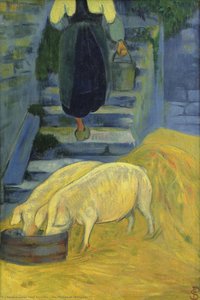


Odkryj dzieła sztuki uporządkowane według tematów, stylów i cech charakterystycznych.


Paul Sérusier
La lutte bretonne
() ·
Wraz z ramą: · Ręcznie malowane farbami olejnymi na płótnie lnianym
Suma