

Przedstawiony: · Wraz z ramą:
 Podgląd w skali 1:1
 Wyślij jako kartkę
 Udostępnij
 Szczegóły dzieła
 Przewodnik

 Pobierz obraz
 Podobne obiekty
 RTG
RTG Pokaz slajdów
 Pytania i odpowiedzi
 Statystyki

zł 1248
Ręcznie malowana reprodukcja olejowa
Ręcznie malowany obraz olejny na płótnie, wykonany na zamówienie przez naszych artystów w wybranym przez Ciebie wymiarze i oprawie. ( Przełącz na wydania drukowane Przejdź do wersji cyfrowej)
Wymiar
·Standardowy format
personalizowane
CM
INCH
Wybierz spośród naszych standardowych rozmiarów, które zachowują oryginalne proporcje dzieła sztuki.
Ładowanie rozmiarów...

szerokość
wysokość
Wpisz wymaganą szerokość i wysokość, aby obraz pasował do Twojej ramy lub ściany. Ponieważ jest to dzieło malowane ręcznie, w przypadku rozmiaru o innych proporcjach artysta może domalować nieco więcej wokół obrazu lub przyciąć jego fragmenty — wybór należy do Ciebie. Przed rozpoczęciem pracy prześlemy Ci cyfrową wizualizację do zatwierdzenia. Obraz widoczny na tej stronie nie przedstawia rzeczywistego efektu — jedynie wizualizacja oddaje realny rezultat.
 Dowiedz się więcej
Wykończenie
·
Białe krawędzie zł1

rozmyte krawędzie zł1

Przedłużony zł1

P118B zł10

P118H zł10

P118W zł10

P438Z zł10

P508JH zł12

P508YH zł12

P805H zł10

P805Z zł10

P919BZ zł10

P919G zł10

P919XJ zł10

P959ZH zł10

P968JZ zł12

W106C zł8

W218G zł10

W218JH zł8

W218Y zł10

W307PJ zł10

W316G zł10

W316PJ zł8

W316Y zł10

W398PJ zł8

W4111J zł10

W500HY zł15

W500JH zł15

W692G zł12

W849H zł8

W940BG zł15

W953PJ zł8

H24-GOLD zł30

H24-SILVER zł30

H36-GOLD zł45

H36-SILVER zł45
Dostarczane w ochronnej tubie, gotowe do oprawienia przez Twojego ramiarza.
Dodatki
opcjonalneCo obejmują dodatki?
Przykłady możliwych zmian: Zastąpienie twarzy zdjęciem klienta; Dodanie zwierzęcia (np. zamiana kota na psa); Ukrycie wiadomości w tle; Zmiana krajobrazu lub elementów tła.
Po złożeniu zamówienia zespół TopImpressionists.com skontaktuje się z klientem drogą mailową w celu uzyskania instrukcji i prześle podgląd projektu
Po złożeniu zamówienia zespół TopImpressionists.com skontaktuje się z klientem drogą mailową w celu uzyskania instrukcji i prześle podgląd projektu
Dostawa na całym świecie () w ciągu 3–4 tygodni zamiast standardowych 5 tygodni. (7 Listopad). Bez kompromisów w kwestii jakości.
Lakier ochronny
Etykieta obiektu
Szczegóły grawerowanej brązowej tabliczki
This elegant plaque features the artist's name and the title of the artwork, finely engraved for a timeless presentation.
It is made from bronze with a refined, elegant finish. The text is precisely laser-engraved for a sharp and permanent result. Measuring 9x2 cm, the plaque is compact yet easy to read. It's built to be durable and scratch-resistant, offering a professional, museum-quality look. Mounting is simple thanks to the included adhesive backing.
Szczegóły przezroczystej tabliczki akrylowej
The plaque includes essential engraved details such as the artist's name, the title of the artwork, the date it was created, the type of media used-like oil on canvas or watercolor-a brief description of the piece, and a QR code that links to the complete artwork information.
It is crafted from clear acrylic, offering a sleek, modern appearance. The text is UV-engraved in black to ensure strong visual contrast. With a size of 10x15 cm, it ensures optimal readability. It comes equipped with two metal hooks for secure wall mounting. The plaque is designed to be weather-resistant, making it suitable for various environments, and it includes interactive features that work seamlessly with smartphone scanning.
Szczegóły czarnej tabliczki akrylowej
This elegant plaque includes engraved information such as the artist's name, the title of the artwork, the date it was created, the type of media used (like oil on canvas or watercolor), a short description of the artwork, and a QR code for quick access to more information.
The plaque itself is made from refined black acrylic with a premium finish. The text is laser-engraved in white for high contrast and readability. Its size is 10x15 cm, designed to be easy to read. It comes with two metal hooks for professional mounting. The design is sleek and fits any interior style. It is also weather-resistant and durable, with built-in digital integration for mobile compatibility.
Opcja ze szkłem jest dostępna wyłącznie w rozmiarach poniżej 110 cm
 Opcja ze szkłem jest dostępna wyłącznie w rozmiarach poniżej 110 cm
- Bezpłatna ekspresowa wysyłka na cały świat
- Wysokiej jakości płótno lniane
- Pełne ubezpieczenie przesyłki
- Gwarancja zwrotu należności celnych i podatków importowych
- Gwarancja wiernego odwzorowania kolorów
- 100-dniowa polityka zwrotów (tylko w przypadku wad)
- Gwarancja 100% zwrotu pieniędzy
- Zniżka przy zakupie wielu sztuk


Opis obiektu
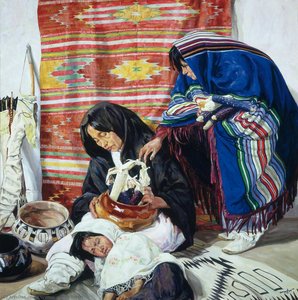
Explore Walter Ufer’s ‘Sleep,’ a poignant oil painting of Native American women in Taos. Discover realism, rich detail & cultural symbolism – a unique 20th-century artwork.
Biografia artysty
Walter Ufer (1876-1936) to urodzony w Niemczech artysta amerykański, słynący z poruszających obrazów życia Indian w Taos. Kluczowy członek „Taos Ten”, znany z scen rodzajowych i żywych pejzaży. Poznaj jego sztukę i działalność.
O obrazie
The Weight of Tradition: An Encounter with Walter Ufer’s “Sleep”
Walter Ufer's "Sleep," painted in 1923, isn’t merely a depiction of three Native American women; it’s an immersion into a world steeped in ritual and profound reverence. The painting immediately draws the viewer in with its rich tapestry of color – predominantly warm reds, oranges, and browns that evoke the earth itself, grounded by cooler blues and greens woven through the textiles and pottery. This palette isn't simply decorative; it speaks to the cultural heritage of the subjects, hinting at a deep connection to the land and ancestral traditions. The composition is carefully orchestrated, centering on the kneeling woman as a focal point, yet subtly inviting us into the periphery of the scene, suggesting an active participation in this sacred space.
Ufer’s masterful technique reveals layers of painstaking detail. He employs a layered oil painting approach, building up texture with deliberate brushstrokes that create a palpable sense of roughness on the clothing – perhaps representing the wear and tear of daily life intertwined with ceremonial garb – while simultaneously rendering the pottery with smooth, almost polished surfaces. This juxtaposition speaks to the duality inherent in Native American culture: the balance between practicality and spirituality, the tangible and the intangible. The lighting, soft and diffused, isn’t dramatic; it's deliberately muted, casting subtle shadows that lend a sense of solemnity and depth to the figures and objects, as if illuminating a secret whispered within a sacred space.
A Window into Taos: Contextualizing Ufer’s Vision
To fully appreciate “Sleep,” it's crucial to understand its historical context. Painted in 1923, during his time in Taos Pueblo, New Mexico, the artwork represents a pivotal moment in Walter Ufer’s career and his deep engagement with Native American culture. He was part of the "Taos Ten," a group of artists who sought to document and celebrate the lives and traditions of the region's indigenous communities. This wasn’t simply an act of observation; it was a deliberate attempt at understanding and portraying these cultures with respect and authenticity, a rare undertaking for American art at the time.
Ufer’s background as a German-born artist profoundly shaped his approach. His training in Europe instilled a meticulous attention to detail and a sophisticated understanding of composition – elements he skillfully translated into his depictions of Native American life. However, it was his immersion within the Taos community that truly informed his work, allowing him to capture not just appearances but also the spirit and essence of these traditions. The painting’s realism is tempered by an underlying sense of mystery, inviting viewers to contemplate the deeper meanings embedded within the scene.
Symbolism Woven into the Fabric
The details within “Sleep” are laden with symbolic significance. The intricately patterned rug serves as a visual anchor, framing the central figures and providing a rich backdrop that speaks to the importance of storytelling and communal life within Native American culture. The pottery, often adorned with geometric designs and natural motifs, represents both artistic skill and spiritual connection – a tangible link to ancestors and the earth. The women themselves, engaged in what appears to be a ritualistic activity, are not simply subjects; they embody generations of tradition, wisdom, and connection to the divine.
The act depicted—kneeling in reverence—suggests healing or a profound spiritual ceremony. The quiet dignity of the figures, coupled with the muted colors and soft lighting, evokes a sense of solemnity and timelessness. It’s an image that transcends mere representation, offering a glimpse into a world governed by ancient beliefs and deeply rooted traditions.
A Legacy of Authenticity: Reproductions and Beyond
Walter Ufer's "Sleep" remains a powerful testament to the beauty and complexity of Native American culture. TopImpressionists offers high-quality, hand-painted reproductions that faithfully capture the painting’s rich detail and evocative atmosphere. These reproductions are more than just images; they are windows into another world—a world of sacred rituals, profound traditions, and enduring wisdom. Investing in a reproduction is an investment in preserving this important piece of American art history and honoring the legacy of Walter Ufer's insightful portrayal.
Pytania i odpowiedzi
W jaki sposób "Sleep" balansuje światło i cień?
Zarejestrowane wartości dla „Sleep” – Walter Ufer to: jasność bright, luminancja Gentle Luminance.
Jaki nastrój oddaje „Sleep” – Walter Ufer w ramach nurtu Contemporary Realism?
Melancholic emocja dzieła „Sleep” współgra z jego stylem Contemporary Realism.
Kto jest autorem dzieła "Sleep" i do jakiego nurtu ono należy?
"Sleep" powstało autorstwa Walter Ufer w stylu Contemporary Realism. Artysta oraz nurt definiują tradycję tego dzieła.
Najważniejsze informacje i quiz o sztuce
O Walter Ufer

Walter Ufer
1876 - 1936, Niemcy
Biografia artysty
Dusza Południowego Zachodu: Życie i Dziedzictwo Waltera Ufera
Walter Ufer jawi się jako postać kluczowa dla amerykańskiego impresjonizmu, malarz, którego pociągnięcia pędzla robiły znacznie więcej niż tylko chwytanie światła; one chwytały samo tętno kultury. Urodzony w 1876 roku w Hückeswagen w Niemczech, Ufer przemierzył drogę ku wysokim pustyniom Nowego Meksyku, którą wybrukowano rygorystycznym europejskim szkoleniem oraz głęboko zakorzenioną ciekawością ludzkiej kondycji. Jego wczesne lata zostały ukształtowane przez niemiecko-amerykańską diasporę w Louisville w stanie Kentucky, gdzie po raz pierwszy zaczął chłonąć bogate tekstury swojego dziedzictwa. Ten fundamentalny okres, naznaczony studiami nad litografią i grafiką, obdarował go techniczną precyzją, która w późniejszym czasie pozwoliła mu z niespotykaną biegłością operować złożonością światła i cienia.
Dążenie do artystycznej doskonałości zaprowadziło go w transformującą odyseję po całej Europie. Jako wędrowny czeladnik, Ufer zanurzył się w różnorodnych tradycjach artystycznych kontynentu, doskonaląc swoją technikę w prestiżowych akademiach w Hamburgu i Dreźnie. Ten okres intensywnej ekspansji intelektualnej i twórczej znalazł swój punkt kulminacyjny w czasie spędzonym w Monachium, gdzie poświęcił się intensywnej praktyce studyjnej. Kiedy w końcu powrócił do Stanów Zjednoczonych w 1911 roku, przywiózł ze sobą wyrafinowaną europejską wrażliwość, gotową na głębokie spotkanie z surowymi, skąpanymi w słońcu krajobrazami amerykańskiego Zachodu.
Wizjoner „Taos Ten”
Rok 1914 stał się definitywnym punktem zwrotnym w życiu Ufera oraz w całej trajektorii sztuki amerykańskiej. Wkraczając do Taos Pueblo w Nowym Meksyku, stał się częścią niezwykłej rewolucji artystycznej. Dołączając do wpływowej grupy znanej jako „Taos Ten”, Ufer stał się centralną postacią kolektywu, który dążył do wyjścia poza zwykłe malarstwo pejzałowe w stronę bardziej autentycznego, wizceralnego przedstawienia życia rdzennych Amerykanów. W przeciwieństwie do wielu swoich współczesnych, którzy postrzegali Południowy Zachód przez romantyczną lub kolonialną soczewkę, Ufer podchodził do swoich tematów z głębokim szacunkiem i uważnością na godność codziennego istnienia.
Jego twórczość stała się mostem między europejskimi technikami impresjonistycznymi a surową, duchową energią ludu Pueblo. Nie był jedynie obserwatorem, lecz kronikarzem rytuałów, krajobrazów i cichych rytmów życia wspólnoty. Kluczowym elementem tej ewolucji twórczej była jego relacja z Jimem Mirabalem, Indianinem z Taos, który służył zarówno jako muza, jak i współpracownik Ufera. Dzięki tej więzi artysta zyskał intymne zrozumienie kulturowych niuansów definiujących ten region, co pozwoliło mu nasycić swoje płótna poczuciem żywej prawdy, która rezonowała daleko poza granicami Nowego Meksyku.
Technika, Symbolizm i Znaczenie Historyczne
Twórczość Ufera charakteryzuje się mistrzowskim panowaniem nad kolorem oraz odważnym, ekspresyjnym nakładaniem farby. Jego styl, choć zakorzeniony w zasadach amerykańskiego impresjonizmu, często skłaniał się ku bardziej mocnemu i teksturowanemu podejściu, które oddawało żar pustynnego słońca oraz ciężar ziemi. Wykorzystywał światło nie tylko po to, by rozświetlić formę, ale by wywoływać emocje – tworząc sceny, w których atmosfera wydaje się przesycona historią i tradycją.
Historyczne znaczenie Waltera Ufera tkwi w jego zdolności do wyniesienia malarstwa rodzajowego do rangi głębokiego manifestu społecznego i kulturowego. Do jego najważniejszych osiągnięć należą:
- Autentyczna reprezentacja: przełamanie „malowniczych” stereotypów życia Indian, aby przedstawić bardziej wielowymiarowy i zhumanizowany portret ludu Taos.
- Synteza artystyczna: udane połączenie formalnego wykształcenia akademickiego zdobytą w Niemczech z żywym, nieokiełznanym duchem amerykańskiego Południowego Zachodu.
- Dziedzictwo Taos Ten: odegranie kluczowej roli w ustanowieniu Taos jako czołowego miejsca dla amerykańskiego modernizmu i żywego centrum sztuki skupionej na kulturze rdzennej.
Dziś obrazy Ufera pozostają trwałym świadectwem okresu intensywnego przenikania się kultur. Jego zdolność do splatania technicznej rygorystyczności europejskiej edukacji z duchową głębią kultury Pueblo sprawia, że jego dzieła wciąż zachwycają, zapraszając współczesnych widzów, by poprzez jego sugestywne i mistrzowskie oczy, stali się świadkami ponadczasowego ducha doliny Taos.
Krótkie informacje o Walter Ufer
- Artistic Movement Or Style: Impresjonizm Taos
- Artists Or Movements Influenced By This Artist: ['']
- Artists Who Influenced This Artist: ['']
- Date Of Birth: 1876
- Date Of Death: 1936
- Full Name: Walter Ufer
- Nationality: Niemiecko-amerykańska
- Notable Artworks:
- Jej córka
- Budowniczowie pustyni
- Po nich
- Place Of Birth: Hückeswagen, Niemcy


Walter Ufer
Sleep
() ·
Wraz z ramą: · Ręcznie malowane farbami olejnymi na płótnie lnianym
Suma