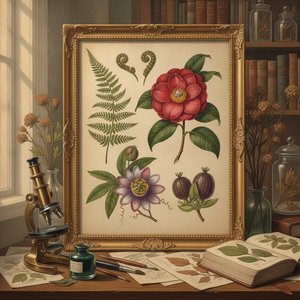
A Botanical Soul in an Age of Elegance
Born into the vibrant cultural landscape of New York City in 1867, Margaret Neilson Armstrong was a woman whose life blossomed at the intersection of scientific precision and artistic whimsy. As the daughter of the renowned stained-glass artist Maitland Armstrong, she was immersed from birth in an environment where beauty and craftsmanship were paramount. Her education at Bryn Mawr College provided the intellectual scaffolding for her future triumphs, as she mastered the delicate complexities of botany alongside the nuances of literature. This rare duality—the eye of a scientist and the heart of a poet—would become the defining characteristic of her creative output, allowing her to capture the natural world with an unparalleled sense of both accuracy and grace.The Art Nouveau Vision
Armstrong’s artistic identity was inextricably linked to the sweeping, organic movements of the Art Nouveau era. She possessed a singular ability to translate the rhythmic, flowing lines of nature into the structured medium of book cover design. Her work often featured the characteristic motifs of the period: sinuous tendrils, asymmetrical compositions, and a sophisticated use of color that breathed life into paper and cloth. In masterpieces such as "Flowers of the Dusk", one can witness her mastery of this aesthetic. Through the use of stylized floral elements and elegant gold accents, she created much more than mere bindings; she crafted miniature gateways to other worlds. Her designs were not merely decorative but were deeply symbolic, utilizing the language of flowers to evoke themes of growth, fragility, and the enduring beauty of the ephemeral.A Lasting Legacy of Flora and Fiction
While her prowess as a designer earned her acclaim, it was her profound dedication to documenting the American landscape that secured her place in art history. Her seminal work, Field Book of Western Wild Flowers (1915), stands as a monumental achievement, blending meticulous botanical illustration with a deep reverence for the flora of the American West. This publication remains a treasured relic for both scientists and aesthetes, representing a perfect harmony between empirical observation and artistic expression. Yet, Armstrong’s creative spirit was not confined to the garden; she was also a versatile storyteller, venturing into the realms of mystery, romance, and biography. Her literary endeavors showcased a psychological depth and narrative dexterity that mirrored the complexity of the natural forms she so loved to draw. Through her multifaceted career, Margaret Neilson Armstrong left behind a legacy that continues to inspire, reminding us of the profound connection between the observant eye and the imaginative spirit.Pytania i odpowiedzi
Gdzie i w którym roku urodził(a) się Ellen Neame?
Ellen Neame urodził się w New York w 1868 roku.
Gdzie można znaleźć dzieła Ellen Neame pogrupowane według techniki?
Aby znaleźć wszystkie dzieła artysty Ellen Neame wykonane w danej technice, odwiedź stronę Wszystkie techniki.
Czy mogę przeglądać dzieła Ellen Neame według nastroju?
Prace Ellen Neame można przeglądać według nastroju na stronie Sztuka według nastroju, która grupuje dzieła artysty według ich przypisanego nastroju.
Jakich kolorów Ellen Neame używał najczęściej?
Sposób wykorzystania koloru przez Ellen Neame w pracach wymienionych na niniejsza strona można przestudiować na stronie Genom Palety artysty.