

 Visualizar na parede
 Compartilhar
 Compartilhar
 Detalhes
 Guia
Guia

 Baixar imagem
 Semelhantes
 Raio X
 Ver diaporama
 Q&A
Q&A Estatísticas
Jazz in the Winter

- 52.0 x 56.0 cm


Experience 'Jazz in the Winter' by Beryl Cook! This vibrant painting captures a lively pub scene filled with music, laughter, and unforgettable characters – a joyful celebration of community.
 Ler mais
Explore the vibrant world of Beryl Cook (1926-2008), Britain's beloved naive painter! Her comical scenes of everyday life – pubs, seaside fun & unique characters – offer a joyful and instantly recognizable artistic vision.
A obra de arte exibida nesta página é protegida por leis de direitos autorais, o que significa que não podemos criar ou vender legalmente uma reprodução idêntica. Esta proteção é aplicada por meio de acordos internacionais, tais como a Convenção de Berna e pelas leis nacionais, incluindo as estabelecidas por Lei de Direitos Autorais dos EUA - Título 17.
Este método cumpre plenamente as regulamentações de direitos autorais, pois não envolve a cópia ou duplicação da obra protegida. Em vez disso, trata-se de uma reinterpretação criativa — uma nova pintura que é influenciada pela original, mas não idêntica a ela.
Giclée / Impressão de Arte
Impressão giclée ou em tela de qualidade de museu, com produção rápida e opções flexíveis de acabamento. ( Comprar pintura feita à mão Alternar para Imagem Digital)




P118B €10

P118H €10

P118W €10

P438Z €10

P508JH €12

P508YH €12

P805H €10

P805Z €10

P919BZ €10

P919G €10

P919XJ €10

P959ZH €10

P968JZ €12

W106C €8

W218G €10

W218JH €8

W218Y €10

W307PJ €10

W316G €10

W316PJ €8

W316Y €10

W398PJ €8

W4111J €10

W500HY €15

W500JH €15

W692G €12

W849H €8

W940BG €15

W953PJ €8




Tamanho padrão
personalizado
CM
INCH
Escolha entre os nossos tamanhos pré-definidos que respeitam as proporções originais da obra de arte.
Loading sizes...

largura
altura
Insira a largura e a altura desejadas para se ajustarem à sua moldura ou parede. Uma impressão pode ser apenas cortada, nunca ampliada além da imagem original; portanto, um tamanho com proporções diferentes resultará na perda de parte da imagem. Enviamos uma maquete digital para sua aprovação antes de realizarmos a impressão. A imagem exibida nesta página não mostra o corte real — apenas a maquete o faz.
Entrega mundial () em 2 semanas, em vez das 4/5 semanas padrão. (1 Novembro)

Envio expresso gratuito para todo o mundo

Tela de Linho de Alta Qualidade

Seguro de transporte completo

Garantia de Reembolso de Impostos Alfandegários

Garantia de Fidelidade Cromática

Política de Devolução em 100 Dias (Apenas para Defeitos)

Garantia de reembolso de 100%

Oferta de desconto por quantidade
 A opção de vidro está disponível apenas para tamanhos inferiores a 110 cm

Jazz in the Winter
Giclée / Impressão de Arte
Tamanho da Reprodução
-


Preço Total
€ 61
A Snapshot of Social Harmony: Unpacking "Jazz in the Winter"
Beryl Cook’s “Jazz in the Winter,” painted in 1998, isn't merely a depiction of a bar scene; it’s a vibrant distillation of community and convivial warmth. The painting immediately draws the eye with its densely populated interior – a bustling room alive with activity, yet radiating an undeniable sense of relaxed joy. Cook masterfully captures the essence of a social gathering, eschewing photographic realism in favor of a stylized, almost cartoonish approach that nonetheless imbues the scene with remarkable life and character. The figures aren’t rendered as individuals, but rather as archetypes – the boisterous musician, the attentive listener, the woman enjoying a drink – each contributing to the overall feeling of shared pleasure.
- Subject Matter: A lively jazz club scene, capturing the atmosphere of social interaction and musical enjoyment.
- Style: Cook’s signature “naive” style—characterized by bold outlines, simplified forms, and a focus on expressive color rather than meticulous detail.
The Art of Observation: Beryl Cook's Technique
Cook’s technique is deceptively simple yet profoundly effective. She employs thick, layered brushstrokes, building up the image with vibrant blocks of color that immediately grab the viewer’s attention. The figures are rendered in a slightly flattened perspective, creating a sense of immediacy and drawing us directly into the scene. Notice how she uses repetition – the recurring patterns of clothing, hairstyles, and poses – to reinforce the feeling of a lively, familiar space. Her use of color is particularly noteworthy; warm reds, yellows, and oranges dominate, evoking the glow of stage lights and creating an atmosphere of warmth and excitement. The details are suggestive rather than explicit—a glimpse of a saxophone, a clinking glass, a raised hand – allowing the viewer’s imagination to fill in the gaps.
A Window into Bristol Life: Historical Context
Painted during a period of significant social change and cultural vibrancy in Bristol, England, “Jazz in the Winter” reflects the city's thriving music scene. Bristol was a major center for jazz in the late 20th century, with numerous clubs and venues hosting local and international musicians. Cook’s painting captures this spirit of musical innovation and community engagement. The choice of a jazz club as her subject matter speaks to the importance of music as a unifying force within society. Furthermore, Bristol's diverse population is subtly represented through the varied appearances and expressions of the figures depicted.
Symbolism and Emotional Resonance
Beyond its surface depiction of a social gathering, “Jazz in the Winter” carries deeper symbolic weight. The scene embodies a celebration of human connection—a reminder that even amidst the complexities of life, there’s always room for joy, laughter, and shared experiences. The musicians, central to the composition, represent creativity and expression, while the audience symbolizes appreciation and participation. Cook's figures are not presented as individuals but as members of a collective, suggesting a sense of belonging and mutual support. The painting evokes feelings of warmth, nostalgia, and a quiet contentment—a testament to Cook’s ability to capture the essence of everyday life with remarkable sensitivity and charm.
Bringing "Jazz in the Winter" Home
Reproductions of “Jazz in the Winter” offer a wonderful way to infuse your home with Beryl Cook's signature warmth and humor. Whether displayed as a vibrant wall hanging or incorporated into a larger collection, this painting is sure to spark conversation and bring a touch of joyful energy to any space. Consider framing it in a classic style to complement its naive aesthetic, or opt for a more contemporary frame to create a striking contrast. The painting’s enduring appeal lies in its ability to transport the viewer back to a simpler time—a time when community, music, and good company were at the heart of everyday life.
Perguntas e Respostas
Quem é o artista por trás de "Jazz in the Winter"?
O artista por trás de "Jazz in the Winter" é Beryl Cook. A obra está catalogada sob o nome de Beryl Cook.
Como "Jazz in the Winter" se insere na trajetória artística de Beryl Cook?
"Jazz in the Winter" integra a produção Naive Realism de Beryl Cook, cujos temas recorrentes incluem british social scenes, humor, villa-lobos, brazilian music, environmental activism, whales, white house, kennedy era.
"Jazz in the Winter", de Beryl Cook está em domínio público?
Informação de direitos autorais para "Jazz in the Winter", de Beryl Cook: a obra está em ainda protegido por direitos autorais. Isso determina se reproduções da imagem podem ser feitas livremente.
Biografia do Artista
A Life Painted in Bold Strokes: The World of Beryl Cook
Beryl Cook, OBE, remains a uniquely beloved figure in British art, an artist whose work bypassed the traditional art establishment to find its way directly into the hearts of the public. Born in Egham, Surrey, in 1926, her journey to becoming one of Britain’s most recognizable painters was anything but conventional. Unlike many artists who receive formal training from a young age, Cook didn't begin painting until her thirties. Her early life was marked by movement and varied experiences; after her parents separated, she moved with her mother and sisters to Reading, Berkshire, leaving school at fourteen to embark on a series of jobs. A brief foray into the world of modeling and showbusiness in London followed, before marriage to John Cook, a merchant navy officer, led to a life that would take her across continents. These experiences – the bustling streets of wartime London, the exotic landscapes of Southern Rhodesia (now Zimbabwe) where she produced her first painting, *Hangover*, in 1960 – all subtly informed the vibrant tapestry of scenes she would later depict on canvas. It was during this period that a seed was planted, a quiet observation of people and their interactions that would blossom into her distinctive artistic style.Capturing the Spirit of Everyday Life
Cook’s paintings are instantly recognizable for their bold colors, robust figures, and often humorous depictions of everyday life. She didn't paint grand historical narratives or lofty philosophical themes; instead, she focused on the ordinary – people enjoying themselves in pubs, women shopping, families picnicking by the sea, drag queen shows, hen nights. These weren’t scenes typically considered ‘high art,’ but Cook elevated them with her unique vision and empathetic eye. Her work possesses a remarkable energy, a sense of movement and vitality that draws the viewer into the scene. She had an almost photographic memory for faces and details, allowing her to recreate these moments with striking accuracy and personality. While seemingly naive in their execution, her paintings are far from simple; they reveal a keen understanding of human behavior and a genuine affection for her subjects. She wasn’t interested in portraying idealized beauty or social commentary, but rather in capturing the joy, exuberance, and sometimes awkwardness of being human.Influences and Artistic Development
Despite lacking formal training, Cook was deeply influenced by other artists. She greatly admired Stanley Spencer, recognizing a kinship in his bold compositions and robust figures. The influence of Edward Burra is also evident, particularly in her depictions of nightlife and unconventional characters. However, Cook diverged from Burra’s often darker and more cynical perspective, choosing instead to focus on the positive aspects of these scenes – the fun, the camaraderie, the sheer exuberance of life. She wasn't interested in depicting the seedier underbelly of society; her work is characterized by a warmth and humor that sets it apart. Her style evolved organically over time, becoming increasingly confident and expressive as she gained experience. The move to East Looe, Cornwall, in 1965, and later to Plymouth in 1968, provided the stability and inspiration she needed to fully dedicate herself to her art. It was a guest at the guesthouse she ran with her husband who first recognized her talent and facilitated her initial exhibition at the Plymouth Arts Centre in 1975 – an event that launched her career and garnered significant media attention, including a feature in *The Sunday Times*.Recognition and Legacy
From that pivotal exhibition onwards, Cook’s popularity soared. She exhibited regularly at the Portal Gallery in London, published numerous books of her artwork, and even collaborated with authors by providing illustrations for their novels. Her work resonated with a broad audience who appreciated its honesty, humor, and accessibility. In 1994, she received the Best Selling Published Artist Award from the Fine Art Trade Guild, and in 1995, was awarded the Order of the British Empire – an honor she accepted at a private ceremony in Plymouth due to her inherent shyness. Her paintings were reproduced on postage stamps, featured in exhibitions celebrating the Golden Jubilee, and even inspired animated films, *Bosom Pals*, voiced by prominent actors like Dawn French and Timothy Spall. Despite this widespread recognition, Cook remained remarkably grounded and unaffected by fame. She continued to paint prolifically until her death in 2008, leaving behind a vast body of work that continues to delight and inspire. Today, her paintings are held in public collections across the UK, including the Gallery of Modern Art in Glasgow, Bristol City Museum and Art Gallery, Plymouth Art Gallery, and Durham Museum. Beryl Cook’s legacy lies not just in her distinctive artistic style, but also in her ability to connect with people on a deeply emotional level, reminding us to find joy in the everyday moments of life.
Beryl Cook
1926 - 2008 , United Kingdom
Dados Rápidos
- Full Name: Beryl Cook
- Nationality: British
- Date Of Birth: 1926
- Date Of Death: 2008
- Place Of Birth: Egham, United Kingdom
- Notable Artworks:
- Hangover
- The Royal Couple
- Artistic Movement Or Style: Naive art
- Artists Who Influenced This Artist:
- Stanley Spencer
- Edward Burra
Artigos Relacionados

Francis Ferdinand Maurice Cook: A Study in Victorian Aestheticism & Landscape Evolution
Explore the captivating art of Sir Francis Ferdinand Maurice Cook – a British artist bridging Victorian traditions & Aestheticism. Discover his landscapes, collection history, and unique style. Expert analysis for collectors.

As 10 Pinturas Mais Famosas Dominadas pelo Branco da Neve | Arte e Decoração
Descubra as 10 pinturas mais icônicas dominadas pelo branco da neve! Explore a beleza de Monet, Van Gogh e Klimt. Arte para decoração com reproduções de museu na TopImpressionists.com.

Howard Cook: American Regionalism's Pursuit of Artistic Authenticity
Explore the life & art of Howard Cook, a pivotal figure in American Regionalism. Discover his stunning woodcuts, New Deal murals, and evolution from Expressionism – a deep dive for art enthusiasts.
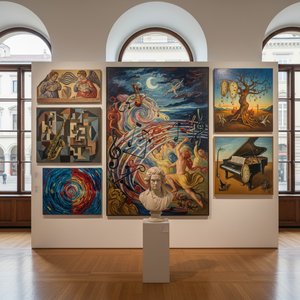
Harmonies on Canvas: Exploring the Visual Representation of Music in Art History
Explore the fascinating history of music's visual representation in art! From ancient symbolism to modern abstraction, discover how artists have captured sound and emotion on canvas. Expert insights & stunning examples.

Stuart Davis: Modernist Abstraction & the Vibrant Spirit of the Jazz Age
Explore the vibrant world of Stuart Davis, a pioneer of American Modernism. Discover his jazz-inspired paintings, signature style & investment potential. Expert insights for art collectors.