


 Compartilhar
 Compartilhar
 Detalhes
 Guia
Guia

 Baixar imagem
 Semelhantes
 Ver diaporama
 Q&A
Q&A Estatísticas
Coat


This striking blue wool coat by Cristóbal Balenciaga embodies the designer’s signature style – simplicity, innovation, and masterful craftsmanship. Featuring a bold shoulder line and voluminous silhouette achieved through seamless construction, it exemplifies Balenciaga's pioneering approach to garment design.
 Ler mais
Cristóbal Balenciaga: o mestre da alta-costura espanhola! Conheça suas criações revolucionárias, influências artísticas e um legado de elegância atemporal. Explore pinturas icônicas e sua história.
A obra de arte exibida nesta página é protegida por leis de direitos autorais, o que significa que não podemos criar ou vender legalmente uma reprodução idêntica. Esta proteção é aplicada por meio de acordos internacionais, tais como a Convenção de Berna e pelas leis nacionais, incluindo as estabelecidas por Lei de Direitos Autorais dos EUA - Título 17.
Este método cumpre plenamente as regulamentações de direitos autorais, pois não envolve a cópia ou duplicação da obra protegida. Em vez disso, trata-se de uma reinterpretação criativa — uma nova pintura que é influenciada pela original, mas não idêntica a ela.
Giclée / Impressão de Arte
Impressão giclée ou em tela de qualidade de museu, com produção rápida e opções flexíveis de acabamento. ( Comprar pintura feita à mão Alternar para Imagem Digital)




































Tamanho padrão
personalizado
CM
INCH
Escolha entre os nossos tamanhos pré-definidos que respeitam as proporções originais da obra de arte.
Loading sizes...

largura
altura
Insira a largura e a altura desejadas para se ajustarem à sua moldura ou parede. Uma impressão pode ser apenas cortada, nunca ampliada além da imagem original; portanto, um tamanho com proporções diferentes resultará na perda de parte da imagem. Enviamos uma maquete digital para sua aprovação antes de realizarmos a impressão. A imagem exibida nesta página não mostra o corte real — apenas a maquete o faz.
Entrega mundial () em 2 semanas, em vez das 4/5 semanas padrão. (31 Outubro)

Envio expresso gratuito para todo o mundo

Tela de Linho de Alta Qualidade

Seguro de transporte completo

Garantia de Reembolso de Impostos Alfandegários

Garantia de Fidelidade Cromática

Política de Devolução em 100 Dias (Apenas para Defeitos)

Garantia de reembolso de 100%

Oferta de desconto por quantidade
 A opção de vidro está disponível apenas para tamanhos inferiores a 110 cm

Coat
Giclée / Impressão de Arte
Tamanho da Reprodução
-


Preço Total
€ 61
Architectural Form and Materiality
Ivory wool twill provides the structural foundation for this blue garment. The fabric is manipulated to create a dramatic shoulder line, a silhouette that emerged from earlier experiments with tunic and sack dresses. Ten buttons are positioned at the front, offering subtle visual punctuation against the smooth expanse of the material. The construction minimizes seams to maintain structural integrity. By embedding the shoulder section directly into the coat’s architecture, the design achieves a unified, three-dimensional form. This technique allows the garment to hold its shape independently of the wearer, functioning with the precision of a sculpture.Historical Context and Aesthetic Influence
Created in 1960, this piece reflects the era's movement toward abstraction and simplified forms. The design draws from avant-garde influences, including Surrealism and Primitivism, mirroring a broader cultural shift toward minimalism. The use of heavy wool allows for the creation of autonomous volumes that stand away from the body's natural outline. The aesthetic aligns with the mid-century interest in geometric clarity. Much like the planar motifs found in contemporary Op Art, the coat prioritizes clean lines and understated textures. It represents a period where fashion moved toward architectural autonomy, focusing on the interplay between weight, drape, and space.Perguntas e Respostas
Como "Coat" equilibra luz e sombra?
Os valores registrados para "Coat", de Cristóbal Balenciaga são: balanced de brilho e Soft Shadow de luminância.
"Coat" permaneceu no país de origem do seu artista?
Sim – a obra de arte encontra-se no país de origem do artista. Cristóbal Balenciaga nasceu em Espanha, e o original de "Coat" encontra-se num museu em Espanha.
Qual técnica e estilo caracterizam "Coat", de Cristóbal Balenciaga?
"Coat", de Cristóbal Balenciaga combina a técnica de Photography com o estilo Post-impressionism. Técnica e movimento descrevem a execução e o estilo da obra.
Biografia do Artista
Early Life and Artistic Roots
Cristóbal Balenciaga Eizaguirre, a name synonymous with revolutionary elegance in the world of haute couture, was born on January 21, 1895, in the small Basque fishing village of Getaria, nestled within the rugged beauty of northern Spain. His origins were humble; his father, José Balenciaga Basurto, a mariner who tragically passed away when Cristóbal was just a boy, and his mother, Martina Eizaguirre Embil, a skilled seamstress who instilled in her son an early appreciation for the craft. Growing up amidst the rhythms of the sea and the quiet industry of needle and thread, Cristóbal’s childhood was deeply intertwined with the world of fashion – observing his mother's meticulous work and absorbing the artistry inherent in transforming fabric into wearable art. This formative environment, steeped in tradition and a profound respect for craftsmanship, would profoundly shape his future artistic vision. He spent much of his youth assisting his mother, learning the fundamentals of tailoring and dressmaking—skills that would later become the bedrock of his extraordinary career. It was during this period that he developed an innate understanding of fabric’s properties, its drape, and its potential for creating breathtaking silhouettes.The Spark of Parisian Inspiration
At the tender age of twelve, Cristóbal embarked on a journey to San Sebastián, a nearby coastal resort town, where he began his formal apprenticeship with a tailor. This experience provided him with invaluable technical training, exposing him to the intricacies of pattern making, cutting techniques, and garment construction—skills that would distinguish him from other couturiers of the time. However, it was a trip to Paris in 1910 that truly ignited his passion for haute couture. The city’s vibrant fashion scene, brimming with innovation and artistic expression, captivated him, fueling a desire to elevate his craft beyond the traditional norms of Spanish tailoring. He returned to Spain determined to pursue his dream of becoming a couturier, recognizing that Paris represented the epicenter of contemporary style and design. This pivotal experience solidified his ambition and set him on a path toward international recognition.A Rise to Prominence in Madrid and Barcelona
Following his Parisian sojourn, Cristóbal established his own fashion house, Eisa, initially in San Sebastián and later expanding its operations to include branches in Madrid and Barcelona. These ventures quickly gained popularity among Spain’s elite—the Spanish royal family, aristocracy, and socialites—attributing to his impeccable craftsmanship, innovative designs, and a keen understanding of the evolving tastes of the era. Balenciaga's early success was built upon a foundation of meticulous attention to detail, an unwavering commitment to quality, and a willingness to challenge conventional silhouettes. He skillfully blended traditional Spanish motifs with modern European influences, creating garments that were both elegant and distinctly his own. His designs reflected the spirit of a nation undergoing significant social and political change, capturing the dynamism and sophistication of the interwar years.Revolutionizing Women’s Fashion in Paris
In 1937, amidst the turmoil of the Spanish Civil War, Cristóbal made the bold decision to relocate his fashion house to Paris—the undisputed capital of haute couture. This move proved to be a watershed moment in his career, catapulting him to international prominence. He quickly established himself as a leading figure in the Parisian fashion scene, attracting a prestigious clientele that included some of the most influential women of the time – from Hollywood stars like Grace Kelly to socialites and royalty. Balenciaga’s designs were characterized by their sculptural forms, dramatic volumes, and an almost architectural precision—a departure from the softer, more flowing styles prevalent at the time. He was renowned for his ability to manipulate fabric into breathtaking shapes, creating garments that seemed to defy gravity. His influence extended far beyond mere aesthetics; he fundamentally altered the way women dressed, pioneering new silhouettes and challenging conventional notions of beauty.Legacy and Enduring Influence
Cristóbal Balenciaga’s legacy extends far beyond his own lifetime. He is widely regarded as “The Master” of haute couture—a title earned through his unparalleled technical skill, innovative designs, and unwavering commitment to perfection. His influence can be seen in the work of countless designers who followed in his footsteps, shaping the course of fashion for decades to come. The Musée Cristóbal Balenciaga, established in his birthplace of Getaria, serves as a testament to his enduring impact on the world of art and design—a place where visitors can immerse themselves in the beauty and artistry of his creations. Balenciaga’s designs continue to be celebrated for their timeless elegance, sculptural forms, and an almost otherworldly quality that transcends the boundaries of time and fashion trends. He remains a true icon of 20th-century style, a visionary who dared to challenge convention and redefine the possibilities of couture.
Cristóbal Balenciaga
1895 - 1972 , Espanha
Dados Rápidos
- Artistic Movement Or Style: Avant-garde / Surrealismo
- Artists Or Movements Influenced By This Artist:
- Christian Dior
- Coco Chanel
- Artists Who Influenced This Artist: ['Hubert de Givenchy']
- Date Of Birth: 21 de janeiro de 1895
- Date Of Death: 23 de março de 1972
- Full Name: Cristóbal Balenciaga Eizaguirre
- Nationality: Espanhol
- Notable Artworks:
- Estudo 'Song of Songs IV'
- Árvore Raízes
- Acrobata
- Place Of Birth: Getaria, Espanha
Artigos Relacionados

Cristóbal Balenciaga: Deconstructing Haute Couture's Architectural Legacy
Explore the revolutionary world of Cristóbal Balenciaga, the 'couturier's couturier'. Discover his architectural designs, lasting influence on haute couture, and guide to collecting rare pieces. A connoisseur’s resource.
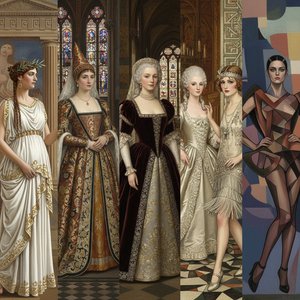
Style Through the Ages: Iconic Artworks That Defined the Evolution of Fashion Design
Explore the breathtaking intersection of fine art and high fashion. Discover how iconic masterpieces from Art Deco to Impressionism have shaped the world of luxury couture and timeless design in this curated visual journey.

Style on Canvas: The Timeless Allure of Fashion Illustration Artworks
Discover the exquisite world of fashion illustration art. From Art Deco elegance to bespoke oil reproductions, explore how timeless sartorial beauty transforms luxury interiors through masterfully crafted canvas works and curated historical masterpieces.

Draped Narratives: Fashion as Symbol & Subject in Historical Art
Explore the fascinating history of fashion as a symbol of power & status in art! Discover masterpieces from Gainsborough to Tissot and learn how clothing shaped societal narratives. Find museum-quality reproductions at TopImpressionists.

Gianfranco Ferré: Deconstructing Haute Couture – A Legacy of Architectural Form
Explore the revolutionary world of Gianfranco Ferré, 'the architect of fashion.' Discover his architectural approach to haute couture, iconic Dior designs, and lasting influence on luxury style. A deep dive for collectors & enthusiasts.
Explore obras de arte organizadas por temas, estilos e características.


