
Exibido: · Com a moldura:
 Visualizar na parede
 Compartilhar
 Compartilhar
 Detalhes
 Guia
Guia

 Baixar imagem
 Semelhantes
 Raio X
 Ver diaporama
 Perguntas e Respostas
 Estatísticas

€ 262
Reprodução em Óleo Feita à Mão
Óleo sobre tela pintado à mão no tamanho e moldura de sua escolha, feito sob encomenda pelos nossos artistas. ( Alternar para Impressão Alternar para Imagem Digital)
Tamanho
·Tamanho padrão
personalizado
CM
INCH
Escolha entre os nossos tamanhos pré-definidos que respeitam as proporções originais da obra de arte.
Carregando tamanhos...

largura
altura
Insira a largura e a altura desejadas para se ajustarem à sua moldura ou parede. Como esta obra é pintada à mão, para um tamanho com proporções diferentes, o artista poderá pintar um pouco mais ao redor da imagem ou reduzir ligeiramente a composição — você escolhe. Enviamos uma maquete digital para sua aprovação antes de iniciar a pintura. A imagem exibida nesta página não representa o resultado real — apenas a maquete mostra o resultado final.
 Leia mais
Finalizar
·
Branco €1

Bordas esfumaçadas €1

Bordas estendidas €1

P118B €10

P118H €10

P118W €10

P438Z €10

P508JH €12

P508YH €12

P805H €10

P805Z €10

P919BZ €10

P919G €10

P919XJ €10

P959ZH €10

P968JZ €12

W106C €8

W218G €10

W218JH €8

W218Y €10

W307PJ €10

W316G €10

W316PJ €8

W316Y €10

W398PJ €8

W4111J €10

W500HY €15

W500JH €15

W692G €12

W849H €8

W940BG €15

W953PJ €8

H24-GOLD €30

H24-SILVER €30

H36-GOLD €45

H36-SILVER €45
Enviado em um tubo protetor, pronto para ser emoldurado por você.
Extras
opcionalO que os extras incluem?
Exemplos do que pode ser alterado: Substituir o rosto pela foto do cliente; Adicionar um animal de estimação (ex: substituir gato por cachorro); Incluir uma mensagem oculta no fundo; Alterar a paisagem ou elementos do fundo.
Após o pedido, a equipe da TopImpressionists.com enviará um e-mail ao cliente para instruções e fornecerá uma prévia da montagem
Após o pedido, a equipe da TopImpressionists.com enviará um e-mail ao cliente para instruções e fornecerá uma prévia da montagem
Entrega mundial () em 3 a 4 semanas, em vez das 5 semanas padrão. (9 Novembro). Sem comprometer a qualidade.
Verniz de Proteção
Etiqueta de identificação
Detalhes da Placa de Bronze Gravada
This elegant plaque features the artist's name and the title of the artwork, finely engraved for a timeless presentation.
It is made from bronze with a refined, elegant finish. The text is precisely laser-engraved for a sharp and permanent result. Measuring 9x2 cm, the plaque is compact yet easy to read. It's built to be durable and scratch-resistant, offering a professional, museum-quality look. Mounting is simple thanks to the included adhesive backing.
Detalhes da Placa de Acrílico Transparente
The plaque includes essential engraved details such as the artist's name, the title of the artwork, the date it was created, the type of media used-like oil on canvas or watercolor-a brief description of the piece, and a QR code that links to the complete artwork information.
It is crafted from clear acrylic, offering a sleek, modern appearance. The text is UV-engraved in black to ensure strong visual contrast. With a size of 10x15 cm, it ensures optimal readability. It comes equipped with two metal hooks for secure wall mounting. The plaque is designed to be weather-resistant, making it suitable for various environments, and it includes interactive features that work seamlessly with smartphone scanning.
Detalhes da Placa de Acrílico Preto
This elegant plaque includes engraved information such as the artist's name, the title of the artwork, the date it was created, the type of media used (like oil on canvas or watercolor), a short description of the artwork, and a QR code for quick access to more information.
The plaque itself is made from refined black acrylic with a premium finish. The text is laser-engraved in white for high contrast and readability. Its size is 10x15 cm, designed to be easy to read. It comes with two metal hooks for professional mounting. The design is sleek and fits any interior style. It is also weather-resistant and durable, with built-in digital integration for mobile compatibility.
A opção de vidro está disponível apenas para tamanhos inferiores a 110 cm
 A opção de vidro está disponível apenas para tamanhos inferiores a 110 cm
- Envio expresso gratuito para todo o mundo
- Tela de Linho de Alta Qualidade
- Seguro de transporte completo
- Garantia de Reembolso de Impostos Alfandegários
- Garantia de Fidelidade Cromática
- Política de Devolução em 100 Dias (Apenas para Defeitos)
- Garantia de reembolso de 100%
- Oferta de desconto por quantidade


Descrição do Item
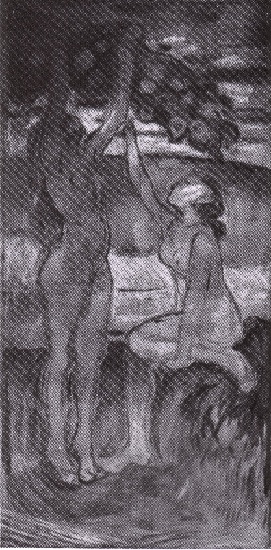
A hauntingly beautiful black and white Expressionist study of two women amidst nature, Edvard Munch's Harvest captures profound themes of loss and mortality, inviting you to explore this evocative masterpiece.
Biografia do Artista
Explore a vida e obra de Edvard Munch, o mestre expressionista que capturou a angústia e a alma moderna em obras icônicas como 'O Grito'. Descubra um artista único!
Sobre a pintura
A Somber Symphony in Monochrome
In the quiet, evocative depths of Edvard Munch's 1909 masterpiece, "Harvest," we encounter a world where the boundaries between the physical landscape and the human psyche begin to dissolve. This striking black and white canvas serves as more than a mere depiction of a pastoral moment; it is a profound meditation on the cyclical nature of life, loss, and the enduring embrace of the natural world. As an exemplar of Expressionism, the painting eschews the objective clarity of realism to instead prioritize the visceral, emotional truth of the scene. Through a deliberate use of tonal variation and gestural brushwork, Munch invites the viewer into a space of quiet contemplation, where the rustle of leaves and the stillness of the figures suggest a moment suspended in time.
The composition is masterfully centered around two female figures positioned within a grove of trees. There is an intimate, almost voyeuristic quality to their placement, as if we have stumbled upon a private vigil. Munch employs a flattened perspective that heightens this sense of intimacy, bringing the background foliage into a closer, more pressing relationship with the subjects. The trees themselves, rendered with loose and spontaneous lines, reach upward like skeletal fingers, partially obscuring the sky and creating a sense of enclosure. This lack of rigid geometric structure allows for a dynamic portrayal of movement, where the organic shapes of the women's forms blend seamlessly into the irregular, textured contours of the landscape.
The Texture of Memory and Grief
To behold "Harvest" is to feel the weight of Munch’s personal history. The artist’s life was profoundly shaped by the shadows of mortality, specifically the premature deaths of his mother and sister from tuberculosis. These early traumas infused his work with a haunting preoccupation with grief and the fragility of existence. In this piece, the monochromatic palette—a spectrum of somber grays and deep blacks—acts as a visual echo of such sorrow. The absence of vibrant color strips away any superficial distractions, forcing the eye to focus on the impasto technique, where thick, layered applications of paint create a rugged, tactile surface. This textural richness mirrors the weathered landscape, suggesting that even in decay, there is a profound, textured beauty.
For the discerning collector or interior designer, "Harvest" offers an unparalleled emotional depth that can anchor a room with its quiet intensity. The painting does not demand attention through loud colors but commands it through atmospheric resonance. It functions as a window into the soul of Expressionism, making it an ideal centerpiece for spaces designed for reflection and intellectual engagement. Whether viewed as a study in light and shadow or as a symbolic narrative of life's fleeting nature, the artwork provides a sophisticated layer of storytelling to any curated collection.
Ultimately, Munch’s "Harvest" remains a timeless exploration of the human condition. It captures the tension between the vulnerability of the individual and the indomitable strength of nature. By embracing imperfection through his gestural strokes and avoiding the trap of photographic precision, Munch achieves a level of emotional resonance that continues to captivate modern audiences. It is a piece that does not merely sit upon a wall; it breathes with the heavy, beautiful rhythm of memory and the eternal cycle of the earth.
Perguntas e Respostas
As cores de "Harvest" parecem intensas ou suaves?
"Harvest", de Edvard Munch apresenta uma intensidade de cor Monochromatic.
Qual é a saturação e a intensidade de "Harvest", de Edvard Munch?
"Harvest", de Edvard Munch apresenta uma saturação Muted e uma intensidade Monochromatic.
Que harmonia de cores apresenta "Harvest", de Edvard Munch?
A harmonia de cores de "Harvest" é definida como Unified Palette.
Informações rápidas e quiz de arte
Sobre Edvard Munch

Edvard Munch
1863 - 1944, Suécia
Biografia do Artista
Uma Vida Imersa em Sombras: O Mundo de Edvard Munch
Edvard Munch, nascido em 1863 no cenário austero da Noruega, foi um artista cuja obra se tornou sinônimo das ansiedades e turbulências emocionais da era moderna. Sua vida, profundamente marcada pela perda e por uma melancolia persistente, serviu como a fonte primordial de sua arte expressiva. Desde uma infância assombrada pelas mortes prematuras de sua mãe e irmã – ambas vítimas da tuberculose – Munch desenvolveu uma obsessão inquietante pela mortalidade, doença e fragilidade da existência humana. Essas experiências não eram meros detalhes biográficos; tornaram-se o núcleo de sua visão artística, alimentando uma exploração implacável do interior, dos medos, da dor e da saudade. A crença religiosa estrita de seu pai e suas próprias lutas contra a doença mental contribuíram para um sentimento de pavor que permeou o mundo de Munch, moldando não apenas sua vida pessoal, mas também a linguagem simbólica de suas pinturas. Ele não se limitava a retratar cenas; externalizava um estado interno, traduzindo angústia psicológica em forma visual.
A Gênese da Expressão: Influências e Desenvolvimento Artístico
A jornada artística de Munch começou com treinamento formal na Escola Real de Arte e Design em Kristiania (Oslo), mas foi seu encontro com os círculos boêmios e a filosofia niilista de Hans Jæger que realmente incendiou sua criatividade. Jæger incentivou Munch a abandonar os estilos acadêmicos convencionais e, em vez disso, mergulhar nas profundezas de sua própria experiência subjetiva, um conceito que ele chamou de “pintura da alma”. Essa mudança crucial marcou o início do estilo distinto de Munch – caracterizado por emoção crua, formas distorcidas e rejeição da representação naturalista. Suas viagens a Paris na década de 1890 o expuseram ao movimento pós-impressionista em ascensão, onde absorveu influências de artistas como Paul Gauguin, Vincent van Gogh e Henri de Toulouse-Lautrec. O uso ousado da cor, as pinceladas expressivas e a intensidade psicológica desses mestres ressoaram profundamente com as inclinações artísticas de Munch. Ele não estava simplesmente imitando suas técnicas; estava sintetizando-as em algo exclusivamente seu – uma linguagem visual capaz de transmitir as emoções humanas mais profundas e perturbadoras. Seu tempo em Berlim também se mostrou crucial, aproximando-o do dramaturgo August Strindberg, cuja exploração de temas psicológicos alimentou ainda mais suas investigações artísticas.
Visões Icônicas: Principais Obras e seu Peso Simbólico
A obra de Munch é povoada por imagens que se tornaram profundamente arraigadas na consciência coletiva. O Grito, talvez sua obra mais icônica, transcende seu status de pintura para se tornar um símbolo universal da angústia existencial. A paisagem turbulenta e a face contorcida da figura incorporam um grito primal contra a indiferença do universo. Madonna, uma peça controversa e profundamente pessoal, explora temas de sexualidade, maternidade e mortalidade com uma franqueza inquietante. Motivos recorrentes como A Criança Doente – inspirada na perda de sua irmã Sophie – servem como lembretes pungentes do trauma da infância de Munch e do espectro sempre presente da morte. Melancolia I & II, representações poderosas de profunda tristeza e isolamento, revelam uma vulnerabilidade que é ao mesmo tempo profundamente pessoal e universalmente identificável. Essas obras não são meramente representações da realidade externa; são janelas para a alma do artista, oferecendo aos espectadores um vislumbre implacável dos cantos mais escuros da psique humana. Munch não tinha como objetivo criar imagens bonitas; ele buscou transmitir a verdade – mesmo que essa verdade fosse dolorosa e perturbadora.
Um Legado Duradouro: Significado Histórico e Influência Contínua
A contribuição de Edvard Munch para a arte moderna é imensurável. Ele se destaca como uma figura fundamental no desenvolvimento do Expressionismo, abrindo caminho para artistas que priorizaram a emoção subjetiva sobre a representação objetiva. Sua exploração implacável de experiências humanas universais – amor, perda, ansiedade e morte – continua a ressoar com o público hoje, solidificando seu lugar como uma das figuras mais influentes e duradouras da história da arte. Seu trabalho impactou profundamente as gerações subsequentes de artistas, influenciando movimentos como o Expressionismo Alemão e além. Ele ousou confrontar os aspectos mais sombrios da condição humana, desafiando noções convencionais de beleza e representação artística. Mesmo após alcançar fama e reconhecimento – culminando na criação do Museu Munch em Oslo – sua vida pessoal permaneceu turbulenta, marcada por períodos de instabilidade mental e isolamento. No entanto, apesar de tudo, ele continuou a criar, deixando para trás um corpo de trabalho que continua a provocar, desafiar e inspirar. O legado de Munch não se resume apenas às pinturas em si; trata-se da coragem de confrontar as complexidades da existência humana e traduzir essas experiências em arte que fala às partes mais profundas do nosso ser.
Informações rápidas sobre Edvard Munch
- Artistas Que O Influenciaram:
- Paul Gauguin
- Van Gogh
- Toulouse-Lautrec
- Artistas/Movimentos Influenciados: ['Expressionismo Alemão']
- Data Da Morte: 23 de janeiro de 1944
- Data De Nascimento: 12 de dezembro de 1863
- Local De Nascimento: Ådalsbruk, Suécia
- Movimento Artístico: Expressionismo
- Nacionalidade: Norueguês
- Nome Completo: Edvard Munch
- Obras Notáveis:
- O Grito
- Madonna
- A Criança Doente
Explore obras de arte organizadas por temas, estilos e características.


Edvard Munch
Harvest
() ·
Com a moldura: · Pintura a óleo sobre linho feita à mão
Total