

Exibido: · Com a moldura:
 Visualizar na parede
 Compartilhar
 Compartilhar
 Detalhes
 Guia
Guia

 Baixar imagem
 Semelhantes
 Raio X
 Ver diaporama
 Perguntas e Respostas
 Estatísticas
- 191.0 x 152.0 cm


€ 239
Reprodução em Óleo Feita à Mão
Óleo sobre tela pintado à mão no tamanho e moldura de sua escolha, feito sob encomenda pelos nossos artistas. ( Alternar para Impressão Alternar para Imagem Digital)
Tamanho
·Tamanho padrão
personalizado
CM
INCH
Escolha entre os nossos tamanhos pré-definidos que respeitam as proporções originais da obra de arte.
Carregando tamanhos...

largura
altura
Insira a largura e a altura desejadas para se ajustarem à sua moldura ou parede. Como esta obra é pintada à mão, para um tamanho com proporções diferentes, o artista poderá pintar um pouco mais ao redor da imagem ou reduzir ligeiramente a composição — você escolhe. Enviamos uma maquete digital para sua aprovação antes de iniciar a pintura. A imagem exibida nesta página não representa o resultado real — apenas a maquete mostra o resultado final.
 Leia mais
Finalizar
·
Branco €1

Bordas esfumaçadas €1

Bordas estendidas €1

P118B €10

P118H €10

P118W €10

P438Z €10

P508JH €12

P508YH €12

P805H €10

P805Z €10

P919BZ €10

P919G €10

P919XJ €10

P959ZH €10

P968JZ €12

W106C €8

W218G €10

W218JH €8

W218Y €10

W307PJ €10

W316G €10

W316PJ €8

W316Y €10

W398PJ €8

W4111J €10

W500HY €15

W500JH €15

W692G €12

W849H €8

W940BG €15

W953PJ €8

H24-GOLD €30

H24-SILVER €30

H36-GOLD €45

H36-SILVER €45
Enviado em um tubo protetor, pronto para ser emoldurado por você.
Extras
opcionalO que os extras incluem?
Exemplos do que pode ser alterado: Substituir o rosto pela foto do cliente; Adicionar um animal de estimação (ex: substituir gato por cachorro); Incluir uma mensagem oculta no fundo; Alterar a paisagem ou elementos do fundo.
Após o pedido, a equipe da TopImpressionists.com enviará um e-mail ao cliente para instruções e fornecerá uma prévia da montagem
Após o pedido, a equipe da TopImpressionists.com enviará um e-mail ao cliente para instruções e fornecerá uma prévia da montagem
Entrega mundial () em 3 a 4 semanas, em vez das 5 semanas padrão. (4 Novembro). Sem comprometer a qualidade.
Verniz de Proteção
Etiqueta de identificação
Detalhes da Placa de Bronze Gravada
This elegant plaque features the artist's name and the title of the artwork, finely engraved for a timeless presentation.
It is made from bronze with a refined, elegant finish. The text is precisely laser-engraved for a sharp and permanent result. Measuring 9x2 cm, the plaque is compact yet easy to read. It's built to be durable and scratch-resistant, offering a professional, museum-quality look. Mounting is simple thanks to the included adhesive backing.
Detalhes da Placa de Acrílico Transparente
The plaque includes essential engraved details such as the artist's name, the title of the artwork, the date it was created, the type of media used-like oil on canvas or watercolor-a brief description of the piece, and a QR code that links to the complete artwork information.
It is crafted from clear acrylic, offering a sleek, modern appearance. The text is UV-engraved in black to ensure strong visual contrast. With a size of 10x15 cm, it ensures optimal readability. It comes equipped with two metal hooks for secure wall mounting. The plaque is designed to be weather-resistant, making it suitable for various environments, and it includes interactive features that work seamlessly with smartphone scanning.
Detalhes da Placa de Acrílico Preto
This elegant plaque includes engraved information such as the artist's name, the title of the artwork, the date it was created, the type of media used (like oil on canvas or watercolor), a short description of the artwork, and a QR code for quick access to more information.
The plaque itself is made from refined black acrylic with a premium finish. The text is laser-engraved in white for high contrast and readability. Its size is 10x15 cm, designed to be easy to read. It comes with two metal hooks for professional mounting. The design is sleek and fits any interior style. It is also weather-resistant and durable, with built-in digital integration for mobile compatibility.
A opção de vidro está disponível apenas para tamanhos inferiores a 110 cm
 A opção de vidro está disponível apenas para tamanhos inferiores a 110 cm
- Envio expresso gratuito para todo o mundo
- Tela de Linho de Alta Qualidade
- Seguro de transporte completo
- Garantia de Reembolso de Impostos Alfandegários
- Garantia de Fidelidade Cromática
- Política de Devolução em 100 Dias (Apenas para Defeitos)
- Garantia de reembolso de 100%
- Oferta de desconto por quantidade


Descrição do Item
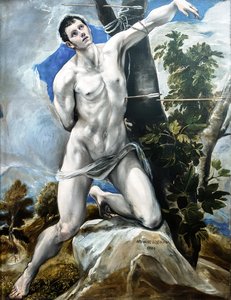
El Greco's dramatic "Saint Sebastian" (1576–1579) embodies Mannerist fervor & spiritual torment. Explore this iconic masterpiece—a poignant depiction of martyrdom & divine grace—in Toledo Cathedral.
Biografia do Artista
Explore a obra-prima de El Greco: 'São Francisco Recebendo as Estigmas'. Uma intensa representação da fé, sofrimento e graça divina em uma pintura icônica do século XVI.
Sobre a pintura
Saint Sebastian (El Greco): A Study in Suffering and Faith
Doménikos Theotokópoulos, universally known as El Greco—“the Greek”—stands apart from his contemporaries as an artist whose life and oeuvre defied easy categorization. Born in Crete in 1541, under Venetian rule, his artistic journey traversed Venice and Rome before finding its ultimate expression in the spiritual heartland of Spain: Toledo. He wasn’t merely a product of these places; he synthesized their influences into something wholly unique—a style that anticipated the emotional intensity of Expressionism and the fragmented forms of Cubism centuries later.
El Greco's mastery resided not just in his technical prowess but also in his profound understanding of religious iconography. Trained initially within the Byzantine tradition, he instilled in himself a meticulous attention to detail and an unwavering devotion to portraying spiritual truths with visceral immediacy. This foundational grounding wouldn’t confine him; he boldly embraced new artistic horizons, signing his works in Greek—often appending “Krḗs”—Crete—as a proud declaration of his origins, even as he ventured into uncharted stylistic territories.
The genesis of El Greco's distinctive style can be traced back to his formative years in Crete and Venice. Influenced by Byzantine art’s solemn grandeur and Venetian painting’s vibrant color palettes, El Greco developed a visual language characterized by elongated figures, dramatic lighting, and an overwhelming preoccupation with conveying emotional depth—elements that would become hallmarks of his oeuvre.
Stylistic Innovation & Mannerism
El Greco's artistic vision decisively rejected the prevailing aesthetic conventions of the Renaissance, opting instead for Mannerism—a movement that prioritized expressive distortion over idealized beauty. This stylistic choice is evident throughout his paintings, where figures are rendered with exaggerated proportions and contorted poses, reflecting a deliberate departure from classical ideals.
Consider Saint Sebastian (1576–1579), arguably El Greco’s most iconic work. The painting exemplifies Mannerist principles with its elongated figure of Saint Sebastian—a stylistic device that lends an ethereal quality to his suffering—and the dramatic use of chiaroscuro—the stark contrast between light and shadow—that intensifies the emotional impact.
El Greco's technique is characterized by loose brushwork, layering of paint, and a masterful manipulation of color. He achieved remarkable textural richness through visible brushstrokes, creating luminous skin tones and conveying palpable emotion. The artist’s meticulous attention to detail—particularly in capturing expressive gestures—contrasts sharply with the stylistic simplification favored by Renaissance artists.
Historical Context & Symbolism
Saint Sebastian's creation coincided with the Counter-Reformation—a period of fervent religious fervor within the Catholic Church following the Protestant Reformation. El Greco’s Toledo residence profoundly influenced his artistic output, providing him with a fertile environment for exploring themes of faith, sacrifice, and spiritual torment.
The painting depicts Saint Sebastian—a Roman soldier martyred for his Christian faith in the 3rd century AD—who became a popular saint during times of plague, invoked as a protector against disease due to the association of arrows with pestilence. El Greco’s depiction transcends mere historical representation; it embodies profound symbolism reflecting anxieties about mortality and divine grace.
The upward gaze of Saint Sebastian signifies a plea for divine intervention—a yearning for solace amidst suffering—while the desolate landscape rendered in muted earth tones evokes a sense of isolation and spiritual desolation. The artist’s masterful use of chiaroscuro amplifies these emotional resonances, drawing the viewer's eye to Saint Sebastian’s anguished expression.
Influence & Legacy
El Greco’s stylistic innovations anticipated developments in later artistic movements—Expressionism and Cubism—demonstrating his enduring influence on subsequent generations of artists. His distinctive visual language continues to inspire contemporary painters and designers, cementing his place as one of the most transformative figures in European art history.
Perguntas e Respostas
As cores de "Saint Sebastian", de El Greco são vibrantes ou suaves?
A cor de "Saint Sebastian" apresenta Suave de saturação e Monocromático de intensidade.
Posso usar realidade aumentada para ver "Saint Sebastian", de El Greco no meu ambiente?
A página de Prévia em RA de "Saint Sebastian", de El Greco utiliza realidade aumentada para mostrar a obra em seu próprio espaço, através de um dispositivo compatível.
Qual era a idade de El Greco quando "Saint Sebastian" foi criada?
El Greco criou "Saint Sebastian" aos 36 anos. O artista nasceu em 1541 e a obra data de 1577.
Informações rápidas e quiz de arte
Sobre El Greco

El Greco
1541 - 1614, Grécia
Biografia do Artista
Doménikos Theotokópoulos, called El Greco
Doménikos Theotokópoulos, universally known as El Greco – “the Greek” – stands as one of the most enigmatic and influential figures in Western art history. Born around 1541 in Crete, then under Venetian rule, his artistic journey transcended geographical boundaries and stylistic conventions, establishing him as a pioneer whose vision anticipated movements like Expressionism and Cubism centuries later. More than just a painter, El Greco was a sculptor and architect who embodied the spirit of his time—a testament to faith, innovation, and an unwavering pursuit of artistic truth.Early Training and Cretan Roots
El Greco’s formative years were steeped in Byzantine tradition. Crete, at that time a bastion of Orthodox Christianity, nurtured a rich artistic heritage characterized by meticulous detail, symbolic imagery, and profound spiritual contemplation. He received his initial training within this environment, mastering the techniques of icon painting—a craft demanding unwavering precision and an understanding of theological concepts. This foundational knowledge would profoundly shape his subsequent artistic endeavors, informing his approach to composition, color palette, and expressive gesture. The influence of Byzantine art is palpable in his early works, particularly *Saint Titus*, where the drapery folds are rendered with astonishing realism and imbued with a sense of solemn dignity—a hallmark of Cretan painting during the Renaissance.Venetian Exposure: Embracing Innovation
Around 1567, El Greco embarked on a transformative voyage to Venice, Italy’s artistic epicenter at the time. This relocation marked a pivotal moment in his artistic development, exposing him to the groundbreaking innovations championed by Titian, Tintoretto, and Veronese—masters who had revolutionized painting with their mastery of color, perspective, and dramatic lighting. He eagerly absorbed their techniques, experimenting with looser brushwork and embracing the sensual qualities of oil paint—a departure from the more restrained mediums favored in Crete. The Venetian influence is vividly apparent in *Saint Sebastian*, painted shortly after his arrival, where anatomical accuracy blends seamlessly with theatrical chiaroscuro—creating a scene brimming with emotional intensity. This encounter with Venetian art propelled him toward a bolder stylistic vision, one that would ultimately define his legacy.Roman Aspirations and Mannerist Influence
El Greco’s ambition extended beyond Venice; he sought recognition in Rome, the heart of the Renaissance and papal patronage. Despite facing considerable competition within the Roman art world—a realm dominated by established artists and conservative tastes—he persevered, honing his skills and producing a series of works that showcased his talent for capturing psychological nuance and conveying profound emotion. However, El Greco struggled to gain widespread acclaim in Rome, finding it difficult to secure commissions from influential patrons. Nevertheless, he absorbed the stylistic precepts of Mannerism—a movement characterized by elongated figures, distorted perspectives, and stylized compositions—further enriching his artistic repertoire. This exposure to Mannerist aesthetics contributed to the distinctive elongation of his figures and the unsettling grandeur of his canvases—elements that would become synonymous with El Greco’s style.Toledo: Spiritual Synthesis and Artistic Zenith
In 1577, El Greco established himself in Toledo, Spain—a city steeped in religious fervor during the Counter- Reformation and renowned for its magnificent cathedral and monastic institutions. This relocation proved to be instrumental in achieving his artistic zenith, providing him with a supportive environment and fostering collaborations with prominent patrons who recognized his singular genius. It was here that he produced his most celebrated paintings—works imbued with an unparalleled blend of Byzantine tradition, Venetian innovation, and Mannerist refinement. *The Burial of the Count of Orgaz*, considered El Greco’s masterpiece, exemplifies this synthesis perfectly—a monumental composition featuring elongated figures bathed in ethereal light, conveying a sense of spiritual transcendence that captivated audiences throughout Europe. His Toledo paintings stand as enduring symbols of faith, artistic ambition, and the transformative power of creative vision—solidifying his place among the greatest artists of all time.Informações rápidas sobre El Greco
- Artistic Movement Or Style: Mannerismo e Barroco
- Artists Who Influenced This Artist:
- Titian
- Tintoretto
- Date Of Birth: 1541
- Full Name: Doménikos Theotokópoulos
- Nationality: Grega
- Notable Artworks:
- Burial of the Count of Orgaz
- View of Toledo
- El Espolio
- Saint Sebastian
- Place Of Birth: Crete, Greece
Explore obras de arte organizadas por temas, estilos e características.


El Greco
Saint Sebastian
() ·
Com a moldura: · Pintura a óleo sobre linho feita à mão
Total