

Shown: · With its frame:
 Visualizar na parede
 Compartilhar
 Compartilhar
 Detalhes
 Guia
Guia

 Baixar imagem
 Semelhantes
 Raio X
 Ver diaporama
 Q&A
Q&A Estatísticas


€ 239
Reprodução em Óleo Feita à Mão
Óleo sobre tela pintado à mão no tamanho e moldura de sua escolha, feito sob encomenda pelos nossos artistas. ( Alternar para Impressão Alternar para Imagem Digital)
Size
·Tamanho padrão
personalizado
CM
INCH
Escolha entre os nossos tamanhos pré-definidos que respeitam as proporções originais da obra de arte.
Loading sizes...

largura
altura
Insira a largura e a altura desejadas para se ajustarem à sua moldura ou parede. Como esta obra é pintada à mão, para um tamanho com proporções diferentes, o artista poderá pintar um pouco mais ao redor da imagem ou reduzir ligeiramente a composição — você escolhe. Enviamos uma maquete digital para sua aprovação antes de iniciar a pintura. A imagem exibida nesta página não representa o resultado real — apenas a maquete mostra o resultado final.
 Leia mais
Finish
·
White €1

Blurside €1

Extended €1

P118B €10

P118H €10

P118W €10

P438Z €10

P508JH €12

P508YH €12

P805H €10

P805Z €10

P919BZ €10

P919G €10

P919XJ €10

P959ZH €10

P968JZ €12

W106C €8

W218G €10

W218JH €8

W218Y €10

W307PJ €10

W316G €10

W316PJ €8

W316Y €10

W398PJ €8

W4111J €10

W500HY €15

W500JH €15

W692G €12

W849H €8

W940BG €15

W953PJ €8

H24-GOLD €30

H24-SILVER €30

H36-GOLD €45

H36-SILVER €45
Shipped in a protective tube, ready for your own framer.
Above 105 cm the frame is shipped as a kit for a professional framer — read the details.
Extras
optionalWhat do the extras include?
Examples of what can be changed: Replace face with customer photo; Add pet (e.g., replace cat with dog); Include hidden message in background; Change background landscape or elements.
After order, TopImpressionists.com team will email client for instructions and provide a mockup preview
After order, TopImpressionists.com team will email client for instructions and provide a mockup preview
Entrega mundial () em 3 a 4 semanas, em vez das 5 semanas padrão. (30 Outubro). Sem comprometer a qualidade.
Verniz de Proteção
Etiqueta de identificação
Detalhes da Placa de Bronze Gravada
This elegant plaque features the artist's name and the title of the artwork, finely engraved for a timeless presentation.
It is made from bronze with a refined, elegant finish. The text is precisely laser-engraved for a sharp and permanent result. Measuring 9x2 cm, the plaque is compact yet easy to read. It's built to be durable and scratch-resistant, offering a professional, museum-quality look. Mounting is simple thanks to the included adhesive backing.
Detalhes da Placa de Acrílico Transparente
The plaque includes essential engraved details such as the artist's name, the title of the artwork, the date it was created, the type of media used-like oil on canvas or watercolor-a brief description of the piece, and a QR code that links to the complete artwork information.
It is crafted from clear acrylic, offering a sleek, modern appearance. The text is UV-engraved in black to ensure strong visual contrast. With a size of 10x15 cm, it ensures optimal readability. It comes equipped with two metal hooks for secure wall mounting. The plaque is designed to be weather-resistant, making it suitable for various environments, and it includes interactive features that work seamlessly with smartphone scanning.
Detalhes da Placa de Acrílico Preto
This elegant plaque includes engraved information such as the artist's name, the title of the artwork, the date it was created, the type of media used (like oil on canvas or watercolor), a short description of the artwork, and a QR code for quick access to more information.
The plaque itself is made from refined black acrylic with a premium finish. The text is laser-engraved in white for high contrast and readability. Its size is 10x15 cm, designed to be easy to read. It comes with two metal hooks for professional mounting. The design is sleek and fits any interior style. It is also weather-resistant and durable, with built-in digital integration for mobile compatibility.
A opção de vidro está disponível apenas para tamanhos inferiores a 110 cm
 A opção de vidro está disponível apenas para tamanhos inferiores a 110 cm
- Envio expresso gratuito para todo o mundo
- Tela de Linho de Alta Qualidade
- Seguro de transporte completo
- Garantia de Reembolso de Impostos Alfandegários
- Garantia de Fidelidade Cromática
- Política de Devolução em 100 Dias (Apenas para Defeitos)
- Garantia de reembolso de 100%
- Oferta de desconto por quantidade


Descrição do Item
Biografia do Artista
Explore James Whistler (1834-1903): artista americano do Tonalismo e Esteticismo. Descubra 'Mãe Whistler', nocturnes, retratos e sua filosofia "arte pela arte". Uma figura inovadora da arte vitoriana.
About the painting
A Study in Shadow and Silence: Whistler’s Self-Portrait of 1858
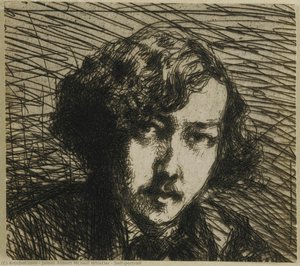
James Abbott McNeill Whistler's "Self-portrait," etched in 1858, isn’t merely a likeness; it’s a carefully constructed meditation on perception, light, and the very nature of artistic expression. This deceptively simple image, rendered in stark black and white, immediately draws the viewer into a world of quiet contemplation – a world that reflects Whistler's burgeoning aesthetic philosophy. The portrait depicts a man with short hair, gazing downward, his features etched with a subtle melancholy. A neatly trimmed mustache adds to an air of restrained formality, while the tie suggests a connection to the social conventions of the time, yet he subtly resists their full embrace.
- The Etching Technique: Whistler was a pioneer in etching, meticulously controlling every line and tonal value. The delicate lines of this portrait demonstrate his mastery of the medium, creating an astonishingly detailed surface despite its monochrome palette. Notice how he uses hatching – closely spaced parallel lines – to build up areas of shadow, suggesting depth and volume with remarkable subtlety.
- Compositional Restraint: The subject occupies a significant portion of the frame, anchoring the image while allowing ample negative space around him. This deliberate emptiness invites the viewer to focus entirely on the figure itself, fostering a sense of intimacy and solitude.
Echoes of Aestheticism
Whistler’s “Self-portrait” is deeply rooted in the aesthetic movement that was gaining momentum throughout Europe during this period. Rejecting the prevailing Victorian emphasis on moralistic narratives and historical subject matter, aesthetes like Whistler sought to elevate art to its purest form – an end in itself. They believed that art should be judged solely on its beauty and sensory impact, divorced from didactic or narrative content. This portrait embodies that philosophy perfectly; it’s not a story being told, but rather an experience of visual contemplation.
The year 1858 was pivotal for Whistler. He was beginning to establish his artistic identity, experimenting with tonal values and exploring the interplay between light and shadow – techniques he would later refine into his signature “Nocturnes.” This self-portrait can be seen as a preliminary study for these future works, a focused investigation of how color (represented here through value) could evoke mood and atmosphere.
Symbolism in Subtlety
While the portrait avoids overt symbolism, there are subtle clues that enrich its meaning. The downward gaze suggests introspection, perhaps even a degree of sadness or weariness. It’s not a triumphant or assertive pose; rather, it conveys a sense of quiet observation and self-awareness. The tie, while present, isn't overly emphasized – it hints at societal expectations without demanding adherence to them. Whistler was deliberately blurring the lines between art and life, suggesting that beauty could be found in the everyday, even in the act of simply looking.
Furthermore, consider the stark contrast between light and shadow. Whistler masterfully uses chiaroscuro – the dramatic interplay of light and dark – to sculpt the man’s face and create a sense of three-dimensionality. This technique not only enhances the visual impact but also contributes to the overall mood of quiet contemplation.
A Timeless Reflection
Whistler's "Self-portrait" of 1858 remains a powerfully evocative work, offering a glimpse into the mind of an artist grappling with his own identity and artistic vision. It’s a testament to Whistler’s innovative approach to etching and his commitment to aesthetic principles. A reproduction of this piece offers more than just a visual representation; it provides a window into a pivotal moment in art history – a moment when the pursuit of beauty was championed above all else. Its quiet intensity continues to resonate with viewers today, inviting us to pause, reflect, and appreciate the subtle power of a carefully crafted image.
Perguntas e Respostas
Em qual museu se encontra a obra original de "Self-portrait"?
"Self-portrait", de James Abbott McNeill Whistler está em exibição no Smithsonian’s National Museum of Asian Art, Washington, D.C., Estados Unidos da América. A referência ao museu diz respeito à obra original, não a reproduções.
Por que o status de direitos autorais de "Self-portrait" é como é?
"Self-portrait", de James Abbott McNeill Whistler está em em domínio público — seus direitos autorais expiraram. O período de direitos autorais conta a partir do falecimento do artista, ocorrido em 1903.
"Self-portrait" é uma obra famosa do Aestheticism and Symbolism?
"Self-portrait", de James Abbott McNeill Whistler é classificada como Recognized e pertence ao movimento Aestheticism and Symbolism.
Quick facts and art quiz
About James Abbott McNeill Whistler

James Abbott McNeill Whistler
1834 - 1903, Estados Unidos
Biografia do Artista
A Vida Moldada pelo Esteticismo: O Mundo de James Abbott McNeill Whistler
James Abbott McNeill Whistler, nascido em Lowell, Massachusetts em 1834, foi uma figura perpetuamente em conflito com a convenção – um pintor que defendeu “a arte pela arte” durante uma era obcecada com narrativas moralizadoras. Sua vida inicial, marcada por frequentes mudanças de residência devido à carreira de engenheiro ferroviário de seu pai, inculcou nele um senso de adaptabilidade e exposição a ambientes diversos. Um breve e infeliz período em West Point provou ser inadequado para sua inclinação artística, seguido por trabalho com a Pesquisa Costeira e Geodésica dos EUA que, embora atrasasse, não extinguiu sua paixão crescente pela arte. Esses anos formativos foram caracterizados por um talento inato para o desenho e um desejo resoluto de trilhar seu próprio caminho como artista profissional, uma busca que o levaria eventualmente à travessia do Atlântico e ao coração da avant-garde europeia. As sementes da rebelião artística de Whistler foram plantadas cedo, nutrindo-se por uma alma que resistia à conformidade e abraçava a exploração estética acima de tudo.Inícios Parisienses e Cultivação do Estilo
O momento crucial na jornada artística de Whistler chegou com sua mudança para Paris em 1855. Lá, sob a tutela de Sébastien Bouré, ele aperfeiçoou suas habilidades em pintura a óleo, aquarela e gravura, absorvendo as influências dos pintores realistas franceses e da Escola Barbizon. No entanto, Whistler transcendeu rapidamente a mera imitação, desenvolvendo um estilo distinto caracterizado por harmonias tonais e efeitos atmosféricos. Ele não estava interessado em replicar a realidade; ao invés disso, buscava capturar sua *essência*, seus estados de espírito fugazes e nuances sutis. Este período marcou uma mudança crucial da precisão representacional para uma exploração da forma estética pura. Seus primeiros trabalhos já prenunciavam o delicado equilíbrio entre observação e abstração que definiria seu estilo maduro. Foi em Paris que Whistler começou a articular sua crença de que a arte deveria ser julgada apenas por suas qualidades estéticas, livre de narrativas didáticas ou moralizadoras – uma filosofia que se tornaria a pedra angular de sua prática artística e um traço definidor do movimento Estético.Nocturnes, Retratos e a Busca pela Harmonia
A visão artística de Whistler cristalizou-se em vários temas e escolhas estilísticas-chave. Ele defendeu o conceito de “a arte pela arte”, rejeitando narrativas carregadas de moral ou comentários sociais. Sua obra tornou-se um exercício na captura de nuances sutis de luz, cor e atmosfera – uma busca que levou a seus icônicos *Nocturnes*. Essas pinturas atmosféricas de cenas crepusculares, frequentemente retratando o Rio Tamisa à noite, não tinham como objetivo ser representações literais, mas sim impressões evocativas, estudos em harmonia tonal e humor. Ele empregava com frequência paletas limitadas e pinceladas delicadas, criando uma sensação de beleza etérea e contemplação silenciosa. Retratos também ocupavam um lugar central em sua prática, embora ele abordasse-os com uma sensibilidade única. Whistler não estava preocupado em capturar representações perfeitas; ao invés disso, concentrava-se na organização formal e nas relações tonais, tratando seus retratados como elementos composicionais dentro de um quadro estético cuidadosamente construído. Obras como *Arrangement in Grey and Black No. 1* – mais conhecida como *Whistler’s Mother* – demonstram essa abordagem perfeitamente, transformando um retrato familiar em uma imagem icônica da maternidade vitoriana através de seu uso magistral de forma e tom.Controvérsia, Influência e Legado Duradouro
A carreira de Whistler não foi isenta de controvérsias. A famosa ação judicial movida contra ele pelo crítico John Ruskin em 1878, desencadeada por *Nocturne in Black and Gold – The Falling Rocket*, tornou-se um momento marcante na história da arte. Whistler defendeu com sucesso sua autonomia artística, argumentando que suas pinturas não tinham como objetivo ser representações literais, mas sim arranjos estéticos de cor e forma. Este caso elevou seu perfil e desencadeou debates importantes sobre a natureza da crítica de arte e da liberdade artística. Além desta batalha legal, a influência de Whistler se estendeu amplamente. Ele foi profundamente inspirado por gravuras japonesas (ukiyo-e), que informaram seus princípios composicionais e sua ênfase em padrões decorativos, bem como o domínio tonal dos pintores espanhóis como Velázquez. Sua defesa de “a arte pela arte” impactou profundamente o movimento Estético na Inglaterra e nos Estados Unidos, abrindo caminho para o modernismo e desafiando as noções convencionais sobre o propósito da arte. Ele deixou um legado indelével na arte americana, inspirando gerações de artistas a abraçar abordagens formalistas e explorar o potencial expressivo da cor e da composição.Quick facts about James Abbott McNeill Whistler
- Artistic Movement Or Style: Tonalismo e Esteticismo
- Artists Or Movements Influenced By This Artist:
- Movimento Estético
- Modernismo
- Artists Who Influenced This Artist:
- Velázquez
- Xilogravuras japonesas
- Date Of Birth: 10 de julho de 1834
- Date Of Death: 17 de julho de 1903
- Full Name: James Abbott McNeill Whistler
- Nationality: Americano
- Notable Artworks:
- Mãe Whistler
- Nocturno em Azul e Prata
- Arranjo em Cinza e Preto No. 1
- Place Of Birth (City And Country): Lowell, Massachusetts
Obras Relacionadas





Explore obras de arte organizadas por temas, estilos e características.




James Abbott McNeill Whistler
Self-portrait
() ·
With its frame: · Hand-painted in oil on linen
Total