


 Visualizar em escala
 Enviar
 Compartilhar
 Ver detalhes
 Guia de Obras do Aluno

 Baixar imagem
 Semelhantes
 Raio X
 Apresentação de slides
 Estatísticas
Interior
 Oil On Canvas
- WallArt
- Post-Impressionism
 1902
1902- 19th Century
 51.0 x 67.0 cm
Experience the intimate post-impressionist mood of Vuillard's 'Interior,' featuring rich color planes from 1902; discover this cozy masterpiece today.
 Ver mais
Jean-Édouard Vuillard (1868-1940) foi um pintor francês e membro dos Nabis, conhecido por cenas íntimas de interiores, estilo decorativo e influência no modernismo como Cubismo. Explore sua arte!
Reprodução em Óleo Feita à Mão
Óleo sobre tela pintado à mão no tamanho e moldura de sua escolha, feito sob encomenda pelos nossos artistas. ( Alternar para Impressão Ver Imagem Digital)




P118B €10

P118H €10

P118W €10

P438Z €10

P508JH €12

P508YH €12

P805H €10

P805Z €10

P919BZ €10

P919G €10

P919XJ €10

P959ZH €10

P968JZ €12

W106C €8

W218G €10

W218JH €8

W218Y €10

W307PJ €10

W316G €10

W316PJ €8

W316Y €10

W398PJ €8

W4111J €10

W500HY €15

W500JH €15

W692G €12

W849H €8

W940BG €15

W953PJ €8




Padrão
sob medida
CM
INCH
Escolha entre os nossos tamanhos pré-definidos que respeitam as proporções originais da obra de arte.
Loading sizes...

largura
altura
Digite a largura e a altura de que necessita, para se ajustar à sua moldura ou à sua parede. Esta obra é pintada à mão, por isso, para um tamanho com uma proporção diferente, o artista pode pintar um pouco mais ao redor da imagem ou cortar um pouco — você escolhe. Enviamos-lhe uma maquete digital para aprovação antes de a pintura começar. A imagem exibida nesta página não mostra o resultado real — apenas a maquete mostra.
Exemplos do que pode ser personalizado: Substituir o rosto pela foto do cliente; Adicionar um animal de estimação (ex: substituir gato por cão); Incluir uma mensagem oculta no fundo; Alterar a paisagem ou elementos do fundo.
Após o pedido, a equipa TopImpressionists.com enviará um e-mail ao cliente para solicitar instruções e fornecer uma prévia do esboço.
Após o pedido, a equipa TopImpressionists.com enviará um e-mail ao cliente para solicitar instruções e fornecer uma prévia do esboço.
Entrega mundial () em 3 a 4 semanas, em vez das 5 semanas padrão. (22 Outubro). Sem comprometer a qualidade.

Envio expresso gratuito para todo o mundo

Tela de Linho Premium

Seguro de transporte total

Garantia de Reembolso de Impostos Alfandegários

Garantia de Fidelidade de Cor

Política de Devolução em 100 Dias (Apenas para Defeitos)

Garantia de reembolso de 100%

Desconto para múltiplas unidades
 A opção de vidro está disponível apenas para tamanhos inferiores a 110 cm

Interior
Técnica de Reprodução
Dimensões da Reprodução
-


Preço Total
€ 236
An Intimate Glimpse into Parisian Life
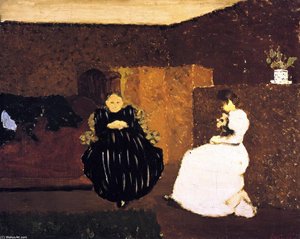
Jean-Édouard Vuillard’s "Interior," painted in 1902, transports us immediately into the hushed, warmly lit embrace of a private Parisian dwelling. This is not merely a depiction of furniture and figures; it is an immersion into a moment suspended in time—a tableau vivant of quiet companionship. The composition centers around two figures settled within the room, their presence lending an immediate sense of intimacy to the scene. One person occupies a chair near the left edge, while another rests closer to the heart of the picture plane. The arrangement suggests conversation, shared contemplation, and the deep comfort found in familiar company.
The Artistry of Les Nabis: Color and Pattern
To understand this work is to understand the revolutionary spirit of Les Nabis. As a key member of this avant-garde collective, Vuillard moved beyond the fleeting light captured by his predecessors. Instead, he focused on the decorative potential inherent in everyday life. In "Interior," we see this philosophy manifest through flattened planes of color and pattern. The room itself becomes an active participant in the narrative; patterned wallpaper, draped fabrics, and the arrangement of objects—the dining table set with a book, the nearby bowl, the two elegant vases—all contribute to a rich tapestry of visual texture. Vuillard masterfully uses these decorative elements not just for beauty, but to build up the very structure of the pictorial space.
Technique and Atmosphere: A Study in Domesticity
The technique employed here is characteristic of post-impressionism’s turn toward interiority. The light filtering in from an unseen source, perhaps near the window view glimpsed beyond, does not illuminate sharply; rather, it permeates, softening edges and deepening shadows into rich, velvety tones. This careful handling of color creates a palpable atmosphere—one that is both cozy and slightly melancholic. For those who appreciate interior design, the painting offers a profound study in domestic harmony. The inclusion of the couch on the right, alongside the structured dining area, suggests a life lived richly within these walls.
Symbolism of Shared Space
Beyond the visible objects, "Interior" resonates with deeper symbolic currents. The gathering of people and possessions speaks to the human need for connection against the backdrop of modern urbanity. The stillness captured by Vuillard is itself a statement—a celebration of the quiet moments that define a life well-lived. Owning a reproduction of this piece allows one to bring not just a painting, but an entire mood into your own space: one of cultured repose and deep, enveloping warmth.
Perguntas e Respostas
Que saturação e intensidade apresenta "Interior" de Jean-Edouard Vuillard?
As cores de "Interior" de Jean-Edouard Vuillard apresentam uma saturação Balanced Soft com uma intensidade Balanced.
Que emoção a obra "Interior" do Post-Impressionism transmite?
"Interior" carrega um tom emocional Comforting dentro do movimento Post-Impressionism.
Que tema e atmosfera combinam em "Interior" de Jean-Edouard Vuillard?
"Interior" apresenta interior scene, people indoors, dining table, cozy atmosphere, post-impressionism, french art, e o seu estado de espírito registrado é Serene.
Obras Relacionadas





Biografia do Artista
**early life and artistic beginnings**
Jean-Édouard Vuillard, a name synonymous with the subtle beauty of Parisian interiors and the evocative dance of color, was born on November 11, 1868, in Cuiseaux, a small village nestled within the Saône-et-Loire region of France. His early life unfolded amidst modest circumstances; his father, a retired naval captain, transitioned to a career as a tax collector after his military service. Vuillard’s mother, Marie Vuillard, a skilled seamstress, provided the family with stability and instilled in her son an appreciation for detail and craftsmanship – qualities that would profoundly influence his artistic vision. Following his father's retirement in 1877, the family relocated to Paris, settling into a building on Rue de Chabrol, later moving to Rue Daunou where his mother operated her sewing workshop. This early exposure to Parisian life, coupled with a scholarship awarded for his academic performance at the Lycée Condorcet, set the stage for Vuillard’s artistic journey. During his time at the Lycée, he developed a deep admiration for the works of Michelangelo and classical sculptures, honing his observational skills and laying the groundwork for his future explorations of form and composition. It was here that he encountered Ker-Xavier Roussel, who would later become both a friend and fellow artist, and whose counsel steered Vuillard away from a potential military career – a path ultimately deemed unsuitable for his burgeoning artistic aspirations. Vuillard’s formal training began at the École des Beaux-Arts in Paris, where he immersed himself in the study of traditional techniques and artistic principles, though it was through informal connections and independent exploration that he truly discovered his unique voice.**the nabis movement and its influence**
Emerging from the vibrant crucible of late 19th-century Parisian art, Jean-Édouard Vuillard became a pivotal figure within the Nabis group – a collective of artists who sought to redefine the boundaries of painting. The Nabis, meaning “prophets” in Hebrew, were deeply influenced by the Symbolist movement and the radical ideas of Paul Gauguin, particularly his use of flattened space, bold color palettes, and symbolic imagery. Vuillard’s artistic trajectory intersected with those of fellow Nabis members such as Maurice Denis, Pierre Bonnard, and Aurélien Lugné-Poe, forging a collaborative spirit that fueled their experimentation and innovation. The group's philosophy centered on the belief that art should transcend mere representation, instead conveying emotional truths and spiritual insights through carefully orchestrated color relationships and simplified forms. Vuillard’s paintings often featured areas of pure color – vibrant reds, blues, and greens – arranged in a manner reminiscent of Japanese woodblock prints, which were experiencing a surge in popularity among European artists at the time. His interiors, in particular, became characterized by their exploration of spatial effects, utilizing flattened planes of color to create a sense of depth and atmosphere. This approach, profoundly influenced by Japanese aesthetics, marked a significant departure from traditional academic painting and paved the way for later developments in Cubism and Abstract Expressionism. The Nabis’s commitment to artistic freedom and their rejection of conventional norms established Vuillard as a key player in the transition towards modern art.**vuillard's later work and legacy**
Following the dissolution of the Nabis group in 1900, Jean-Édouard Vuillard embarked on a period of artistic exploration that saw him refine his style while retaining his core principles. While he continued to produce intimate interior scenes – often depicting familiar settings such as his mother’s apartment and the homes of friends – his approach evolved, incorporating greater detail and a heightened sense of realism. In the 1920s and 1930s, Vuillard turned his attention to portraiture, capturing the likenesses of prominent figures in French industry and the arts within their everyday environments. These portraits, rendered with remarkable sensitivity and psychological insight, offer glimpses into the lives of individuals who shaped the cultural landscape of his time. Notably, he painted portraits of Misia Natanson, the wife of his dealer Jos Hessel, a woman who became an enduring presence in his life and work. Vuillard’s later years were marked by a continued dedication to his craft, producing a prolific body of work that reflects both his artistic evolution and his deep appreciation for the beauty of ordinary moments. His legacy as one of France's most influential modern artists is firmly established, with his paintings continuing to captivate audiences worldwide.**key works and exhibitions**
The artistic output of Jean-Édouard Vuillard is richly documented in numerous museums across Europe and North America. The Musée de la Révolution Française in Paris houses a significant collection of his works, offering a comprehensive overview of his career. Notable paintings include “La Patrie en Danger” (1892), a poignant depiction of a young man condemned to death for blasphemy during the Ancien Régime – a subject that reflects Vuillard’s interest in social commentary and historical narratives. His later works, such as portraits of French industry and arts figures, can be found in collections at institutions like the Musée d'Orsay in Paris and the Art Institute of Chicago. Vuillard’s influence extends beyond individual paintings; his innovative approach to color and composition has resonated throughout the history of modern art, inspiring generations of artists to explore new possibilities in visual expression.**conclusion**
Jean-Édouard Vuillard's artistic journey is a testament to the power of observation, intuition, and creative vision. From his humble beginnings in Cuiseaux to his recognition as a pivotal figure in the Nabis movement and beyond, Vuillard’s work embodies a unique synthesis of formal innovation and emotional depth. His ability to capture the essence of everyday life – the quiet intimacy of domestic interiors, the subtle nuances of human interaction – has secured his place among the most celebrated artists of the 20th century. His legacy continues to inspire, reminding us that beauty can be found in the simplest of moments and that art possesses the capacity to illuminate the complexities of the human experience.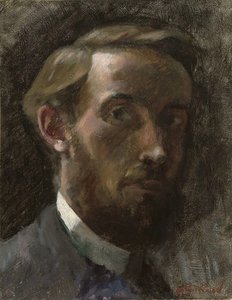
Jean-Edouard Vuillard
1868 - 1940 , França
Informações Rápidas
- Artistic Movement Or Style: Nabis
- Artists Or Movements Influenced By This Artist:
- Cubismo
- Fauvismo
- Artists Who Influenced This Artist: ['Paul Gauguin']
- Date Of Birth: 11 Nov 1868
- Date Of Death: 21 Jun 1940
- Full Name: Jean-Édouard Vuillard
- Nationality: Francês
- Notable Artworks:
- Interior Verde
- Mulher Dormindo
- Place Of Birth: Cuiseaux, França
Artigos Relacionados

Beyond the Light: Discovering the Soul and Emotional Depth of Post-Impressionism
Embark on a cultural journey through Post-Impressionism. Discover the profound emotional depth of masters like Van Gogh and Cézanne, exploring how they moved beyond light to capture the very soul of human experience through vibrant color and symbolic form.
Explore obras de arte organizadas por temas, estilos e características.


