

Exibido: · Com a moldura:
 Visualizar na parede
 Compartilhar
 Compartilhar
 Detalhes
 Guia
Guia

 Baixar imagem
 Semelhantes
 Raio X
 Ver diaporama
 Perguntas e Respostas
 Estatísticas
- 205.0 x 173.0 cm


€ 240
Reprodução em Óleo Feita à Mão
Óleo sobre tela pintado à mão no tamanho e moldura de sua escolha, feito sob encomenda pelos nossos artistas. ( Alternar para Impressão Alternar para Imagem Digital)
Esta obra está protegida por direitos autorais
A obra de arte exibida nesta página é protegida por leis de direitos autorais, o que significa que não podemos criar ou vender legalmente uma reprodução idêntica. Esta proteção é aplicada por meio de acordos internacionais, tais como a Convenção de Berna e pelas leis nacionais, incluindo as estabelecidas por Lei de Direitos Autorais dos EUA - Título 17.
Como uma alternativa respeitosa e legal, oferecemos obras de arte personalizadas e pintadas à mão, inspiradas na obra original. Nossos artistas profissionais e experientes estudam cuidadosamente o estilo, a atmosfera e a essência artística da obra original para criar uma peça nova e única que evoque a mesma sensação — permanecendo como uma criação original por direito próprio.
Este método cumpre plenamente as regulamentações de direitos autorais, pois não envolve a cópia ou duplicação da obra protegida. Em vez disso, trata-se de uma reinterpretação criativa — uma nova pintura que é influenciada pela original, mas não idêntica a ela.
 Leia mais
Tamanho
·Tamanho padrão
personalizado
CM
INCH
Escolha entre os nossos tamanhos pré-definidos que respeitam as proporções originais da obra de arte.
Carregando tamanhos...

largura
altura
Insira a largura e a altura desejadas para se ajustarem à sua moldura ou parede. Como esta obra é pintada à mão, para um tamanho com proporções diferentes, o artista poderá pintar um pouco mais ao redor da imagem ou reduzir ligeiramente a composição — você escolhe. Enviamos uma maquete digital para sua aprovação antes de iniciar a pintura. A imagem exibida nesta página não representa o resultado real — apenas a maquete mostra o resultado final.
Finalizar
·
Branco €1

Bordas esfumaçadas €1

Bordas estendidas €1

P118B €10

P118H €10

P118W €10

P438Z €10

P508JH €12

P508YH €12

P805H €10

P805Z €10

P919BZ €10

P919G €10

P919XJ €10

P959ZH €10

P968JZ €12

W106C €8

W218G €10

W218JH €8

W218Y €10

W307PJ €10

W316G €10

W316PJ €8

W316Y €10

W398PJ €8

W4111J €10

W500HY €15

W500JH €15

W692G €12

W849H €8

W940BG €15

W953PJ €8

H24-GOLD €30

H24-SILVER €30

H36-GOLD €45

H36-SILVER €45
Enviado em um tubo protetor, pronto para ser emoldurado por você.
Extras
opcionalO que os extras incluem?
Exemplos do que pode ser alterado: Substituir o rosto pela foto do cliente; Adicionar um animal de estimação (ex: substituir gato por cachorro); Incluir uma mensagem oculta no fundo; Alterar a paisagem ou elementos do fundo.
Após o pedido, a equipe da TopImpressionists.com enviará um e-mail ao cliente para instruções e fornecerá uma prévia da montagem
Após o pedido, a equipe da TopImpressionists.com enviará um e-mail ao cliente para instruções e fornecerá uma prévia da montagem
Entrega mundial () em 3 a 4 semanas, em vez das 5 semanas padrão. (3 Novembro). Sem comprometer a qualidade.
Verniz de Proteção
Etiqueta de identificação
Detalhes da Placa de Bronze Gravada
This elegant plaque features the artist's name and the title of the artwork, finely engraved for a timeless presentation.
It is made from bronze with a refined, elegant finish. The text is precisely laser-engraved for a sharp and permanent result. Measuring 9x2 cm, the plaque is compact yet easy to read. It's built to be durable and scratch-resistant, offering a professional, museum-quality look. Mounting is simple thanks to the included adhesive backing.
Detalhes da Placa de Acrílico Transparente
The plaque includes essential engraved details such as the artist's name, the title of the artwork, the date it was created, the type of media used-like oil on canvas or watercolor-a brief description of the piece, and a QR code that links to the complete artwork information.
It is crafted from clear acrylic, offering a sleek, modern appearance. The text is UV-engraved in black to ensure strong visual contrast. With a size of 10x15 cm, it ensures optimal readability. It comes equipped with two metal hooks for secure wall mounting. The plaque is designed to be weather-resistant, making it suitable for various environments, and it includes interactive features that work seamlessly with smartphone scanning.
Detalhes da Placa de Acrílico Preto
This elegant plaque includes engraved information such as the artist's name, the title of the artwork, the date it was created, the type of media used (like oil on canvas or watercolor), a short description of the artwork, and a QR code for quick access to more information.
The plaque itself is made from refined black acrylic with a premium finish. The text is laser-engraved in white for high contrast and readability. Its size is 10x15 cm, designed to be easy to read. It comes with two metal hooks for professional mounting. The design is sleek and fits any interior style. It is also weather-resistant and durable, with built-in digital integration for mobile compatibility.
A opção de vidro está disponível apenas para tamanhos inferiores a 110 cm
 A opção de vidro está disponível apenas para tamanhos inferiores a 110 cm
- Envio expresso gratuito para todo o mundo
- Tela de Linho de Alta Qualidade
- Seguro de transporte completo
- Garantia de Reembolso de Impostos Alfandegários
- Garantia de Fidelidade Cromática
- Política de Devolução em 100 Dias (Apenas para Defeitos)
- Garantia de reembolso de 100%
- Oferta de desconto por quantidade


Descrição do Item
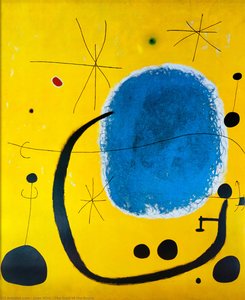
O Ouro do Azul de Joan Miró é uma obra expressionista abstrata com formas cósmicas e fundo amarelo. Explore esta obra icônica no WikiArt!
Biografia do Artista
Descubra o universo surrealista de Joan Miró! Pinturas abstratas e símbolos catalães em obras-primas que celebram sonhos e beleza artística. Uma figura essencial da arte moderna!
Sobre a pintura
O Ouro do Azul
A obra O Ouro do Azul, de Joan Miró, ergue-se como um testemunho da inovação surrealista e da audácia do expressionismo abstrato — uma pintura que transcende a mera representação visual para mergulhar em reinos de emoção subconsciente e maravilha cósmica.
Criada em 1967, este óleo monumental sobre tela, medindo 205 x 173 cm, reside na Fundació Joan Miró, em Barcelona, Espanha — um local que ressalta sua importância dentro do legado do artista e do cânone mais amplo da arte moderna.
Composição Visual e Técnica
A pintura cativa imediatamente com seu tom amarelo dominante — uma cor escolhida não apenas pelo apelo estético, mas para imbuir a cena com uma aura de calor, otimismo e energia radiante. Em seu núcleo, encontra-se uma grande forma circular azul e texturizada, que parece à deriva contra este pano de fundo dourado; trata-se de uma interrupção deliberada da perspectiva convencional que espelha a rejeição de Miró às convenções acadêmicas.
Circundando este elemento central, encontram-se formas abstratas intrincadas — linhas pretas, pontos e formas menores — que evocam imagens reminiscentes de corpos celestes: estrelas, planetas e nebulosas. Estes elementos não são meramente decorativos; eles representam um esforço consciente para acessar a mente inconsciente — uma marca registrada da filosofia artística de Miró.
Miró alcançou esta composição dinâmica através de uma pincelada magistral — traços soltos e expressivos que transmitem movimento e espontaneidade. O artista utilizou técnicas de veladura para construir camadas de cor, resultando em uma superfície luminosa que captura as sutis nuances de luz e sombra.
Estilo Artístico e Simbolismo
O estilo de Miró está firmemente enraizado no Surrealismo, mas simultaneamente abraça elementos do Expressionismo Abstrato — uma fusão que reflete sua fascinação pela imaginação infantil e sua crença na arte como um veículo para explorar temas universais. Ele evitou deliberadamente o realismo, priorizando a representação simbólica em vez da descrição literal.
O próprio título — “O Ouro do Azul” — sugere um diálogo poético entre a solidez terrena (o ouro) e a expansão celestial (o azul). O círculo azul simboliza o céu — um reino de sonhos e possibilidades infinitas — enquanto o fundo amarelo encarna o sol — representando vitalidade, iluminação e aspiração espiritual.
Além disso, o uso da repetição por parte de Miró — particularmente no posicionamento de círculos e linhas — cria uma sensação de ritmo e harmonia. Estes motivos visuais ressoam com crenças cosmológicas antigas, sugerindo uma ordem subjacente dentro do caos aparente.
Contexto Histórico e Relevância
Pintada em meados da década de 1960, O Ouro do Azul exemplifica o compromisso inabalável de Miró com a experimentação artística e sua recusa em conformar-se às tendências predominantes.
Esta obra posiciona-se ao lado de outras obras-primas de sua trajetória — como Blue III e Cabeza de campesino catalán — para consolidar a posição de Miró como um pioneiro da arte moderna e uma influência duradoura nas gerações subsequentes de artistas.
Para aqueles que buscam apreciar a beleza profunda e a profundidade intelectual da abstração surrealista, O Ouro do Azul oferece uma oportunidade incomparável de se envolver com a estética visionária de Miró.
Perguntas e Respostas
Qual é a proporção de "O Ouro do Azul", de Joan Miró e quais são as suas dimensões?
"O Ouro do Azul", de Joan Miró possui as proporções de uma obra em Orientação vertical de 205 x 173 cm.
Com que idade Joan Miró criou "O Ouro do Azul"?
Joan Miró tinha 74 anos quando criou "O Ouro do Azul" em 1967. A idade é calculada a partir do ano de nascimento do artista, 1893.
"O Ouro do Azul" está em domínio público?
"O Ouro do Azul", de Joan Miró está em ainda protegido por direitos autorais. Este status determina como a imagem da obra pode ser reproduzida.
Informações rápidas e quiz de arte
Sobre Joan Miró

Joan Miró
1893 - 1983, Espanha
Biografia do Artista
A Catalan Visionary: The Life and Art of Joan Miró
Joan Miró i Ferrà, born in Barcelona in 1893, stands as one of the most significant figures in 20th-century art. His journey was not merely a progression through styles but an exploration of inner worlds, translating dreams, memories, and Catalan identity onto canvas with a uniquely poetic visual language. From humble beginnings marked by illness and initial parental reservations about his artistic pursuits, Miró persevered, driven by an innate need to express the intangible—the emotions, sensations, and subconscious currents that lie beneath the surface of reality. His early life was steeped in the traditions of Barcelona, a city brimming with architectural marvels thanks to Antoni Gaudí, whose organic forms would subtly influence Miró’s later abstractions. The goldsmithing profession of his father instilled an appreciation for meticulous craftsmanship, while the rugged Catalan landscape became a recurring motif and source of inspiration throughout his career.Early Influences and the Path to Surrealism
Miró's formal artistic training began at La Llotja in Barcelona, where he honed his skills in traditional techniques. However, it was exposure to the avant-garde movements sweeping through Paris that truly ignited his creative evolution. The vibrant colors of Fauvism and the fragmented forms of Cubism resonated deeply, prompting him to move to Paris in 1920. This period proved pivotal as he encountered artists like Pablo Picasso and began experimenting with increasingly abstract compositions. Yet, Miró didn’t simply adopt these styles; he synthesized them, forging a path toward his own distinctive aesthetic. He sought to distill forms to their essence, stripping away representational details in favor of symbolic shapes and evocative colors. This exploration led him to the Surrealist group in 1924, aligning him with artists such as Max Ernst and Salvador Dalí. While embracing the Surrealist interest in the subconscious, Miró maintained a unique sensibility—his work was less about shocking imagery or Freudian symbolism than it was about creating a world of playful forms and poetic suggestion. He believed that art should be free from rational constraints, allowing for spontaneous expression and imaginative exploration.The Language of Symbols: Key Works and Artistic Innovations
Throughout the 1920s and 30s, Miró developed his signature visual vocabulary—a universe populated by biomorphic shapes, floating forms, and vibrant colors. The Farm (1922), often considered a cornerstone of his oeuvre, exemplifies this transition. It’s not merely a depiction of rural life but an evocation of Catalan identity and a symbolic representation of the natural world. The painting utilizes earthy tones contrasted with bursts of crimson and yellow—colors that mirror the vibrancy of the Catalan countryside and imbue the scene with a sense of primal energy. His collaborative spirit led to innovative techniques like *grattage*, pioneered with Max Ernst in 1926 for designs intended for Sergei Diaghilev's ballet, where textures were revealed by scraping paint across canvas. This technique allowed Miró to liberate forms from conventional representation, emphasizing surface qualities and creating a tactile experience for the viewer. The Dutch Interiors (1928) series demonstrated his ability to reinterpret the Old Masters through a distinctly modern lens, transforming domestic scenes into dreamlike abstractions. He approached Rembrandt’s portraits with an eye attuned to the subtleties of emotion and gesture, distilling them into simplified geometric shapes—a bold departure from traditional portraiture. Painting (1933), with its striking palette and dynamic composition, encapsulates Miró’s exploration of the subconscious and his rejection of conventional artistic boundaries. The painting's swirling lines and amorphous forms convey a sense of movement and disorientation, mirroring the anxieties of the era while simultaneously celebrating the boundless potential of imagination. Beyond painting, Miró fearlessly experimented with sculpture, ceramics, and printmaking, expanding his creative horizons and demonstrating a remarkable versatility.Legacy and Enduring Influence
Joan Miró's impact on 20th-century art is undeniable. He wasn’t simply a painter; he was a visionary who challenged the very definition of artistic expression. His work paved the way for abstract expressionism and continues to inspire artists across disciplines. He established two foundations—the Fundació Joan Miró in Barcelona (1975) and the Fundació Pilar i Joan Miró in Palma de Mallorca (1981)—ensuring that his legacy would endure, providing spaces for artistic exploration and education. Throughout his long career, he remained committed to pushing boundaries, questioning conventions, and exploring the depths of human imagination. Miró’s art is a testament to the power of abstraction, symbolism, and poetic expression—a vibrant celebration of life, dreams, and the enduring spirit of Catalan culture. His work continues to resonate with audiences worldwide, inviting us to enter a world where anything is possible and the boundaries between reality and fantasy blur into a captivating dance of color and form. He died in Palma de Mallorca in 1983, leaving behind an unparalleled body of work that remains a beacon of creativity and innovation.Informações rápidas sobre Joan Miró
- Artistic Movement Or Style: Surrealismo
- Artists Who Influenced This Artist:
- Pablo Picasso
- Van Gogh
- Date Of Birth: 20 Abril 1893
- Date Of Death: 25 Dezembro 1983
- Full Name: Joan Miró i Ferrà
- Nationality: Espanhol
- Notable Artworks:
- A Fazenda
- La Poetisa
- Dutch Interiors
- Place Of Birth: Barcelona, Espanha
Explore obras de arte organizadas por temas, estilos e características.


Joan Miró
O Ouro do Azul
() ·
Com a moldura: · Pintura a óleo sobre linho feita à mão
Total