
Shown: · With its frame:
 Visualizar na parede
 Compartilhar
 Compartilhar
 Detalhes
 Guia
Guia

 Baixar imagem
 Semelhantes
 Raio X
 Ver diaporama
 Q&A
Q&A Estatísticas
- 43.0 x 57.0 cm


€ 239
Reprodução em Óleo Feita à Mão
Óleo sobre tela pintado à mão no tamanho e moldura de sua escolha, feito sob encomenda pelos nossos artistas. ( Alternar para Impressão Alternar para Imagem Digital)
Esta obra está protegida por direitos autorais
A obra de arte exibida nesta página é protegida por leis de direitos autorais, o que significa que não podemos criar ou vender legalmente uma reprodução idêntica. Esta proteção é aplicada por meio de acordos internacionais, tais como a Convenção de Berna e pelas leis nacionais, incluindo as estabelecidas por Lei de Direitos Autorais dos EUA - Título 17.
Como uma alternativa respeitosa e legal, oferecemos obras de arte personalizadas e pintadas à mão, inspiradas na obra original. Nossos artistas profissionais e experientes estudam cuidadosamente o estilo, a atmosfera e a essência artística da obra original para criar uma peça nova e única que evoque a mesma sensação — permanecendo como uma criação original por direito próprio.
Este método cumpre plenamente as regulamentações de direitos autorais, pois não envolve a cópia ou duplicação da obra protegida. Em vez disso, trata-se de uma reinterpretação criativa — uma nova pintura que é influenciada pela original, mas não idêntica a ela.
 Leia mais
Size
·Tamanho padrão
personalizado
CM
INCH
Escolha entre os nossos tamanhos pré-definidos que respeitam as proporções originais da obra de arte.
Loading sizes...

largura
altura
Insira a largura e a altura desejadas para se ajustarem à sua moldura ou parede. Como esta obra é pintada à mão, para um tamanho com proporções diferentes, o artista poderá pintar um pouco mais ao redor da imagem ou reduzir ligeiramente a composição — você escolhe. Enviamos uma maquete digital para sua aprovação antes de iniciar a pintura. A imagem exibida nesta página não representa o resultado real — apenas a maquete mostra o resultado final.
Finish
·
White €1

Blurside €1

Extended €1

P118B €10

P118H €10

P118W €10

P438Z €10

P508JH €12

P508YH €12

P805H €10

P805Z €10

P919BZ €10

P919G €10

P919XJ €10

P959ZH €10

P968JZ €12

W106C €8

W218G €10

W218JH €8

W218Y €10

W307PJ €10

W316G €10

W316PJ €8

W316Y €10

W398PJ €8

W4111J €10

W500HY €15

W500JH €15

W692G €12

W849H €8

W940BG €15

W953PJ €8

H24-GOLD €30

H24-SILVER €30

H36-GOLD €45

H36-SILVER €45
Shipped in a protective tube, ready for your own framer.
Above 105 cm the frame is shipped as a kit for a professional framer — read the details.
Extras
optionalWhat do the extras include?
Examples of what can be changed: Replace face with customer photo; Add pet (e.g., replace cat with dog); Include hidden message in background; Change background landscape or elements.
After order, TopImpressionists.com team will email client for instructions and provide a mockup preview
After order, TopImpressionists.com team will email client for instructions and provide a mockup preview
Entrega mundial () em 3 a 4 semanas, em vez das 5 semanas padrão. (1 Novembro). Sem comprometer a qualidade.
Verniz de Proteção
Etiqueta de identificação
Detalhes da Placa de Bronze Gravada
This elegant plaque features the artist's name and the title of the artwork, finely engraved for a timeless presentation.
It is made from bronze with a refined, elegant finish. The text is precisely laser-engraved for a sharp and permanent result. Measuring 9x2 cm, the plaque is compact yet easy to read. It's built to be durable and scratch-resistant, offering a professional, museum-quality look. Mounting is simple thanks to the included adhesive backing.
Detalhes da Placa de Acrílico Transparente
The plaque includes essential engraved details such as the artist's name, the title of the artwork, the date it was created, the type of media used-like oil on canvas or watercolor-a brief description of the piece, and a QR code that links to the complete artwork information.
It is crafted from clear acrylic, offering a sleek, modern appearance. The text is UV-engraved in black to ensure strong visual contrast. With a size of 10x15 cm, it ensures optimal readability. It comes equipped with two metal hooks for secure wall mounting. The plaque is designed to be weather-resistant, making it suitable for various environments, and it includes interactive features that work seamlessly with smartphone scanning.
Detalhes da Placa de Acrílico Preto
This elegant plaque includes engraved information such as the artist's name, the title of the artwork, the date it was created, the type of media used (like oil on canvas or watercolor), a short description of the artwork, and a QR code for quick access to more information.
The plaque itself is made from refined black acrylic with a premium finish. The text is laser-engraved in white for high contrast and readability. Its size is 10x15 cm, designed to be easy to read. It comes with two metal hooks for professional mounting. The design is sleek and fits any interior style. It is also weather-resistant and durable, with built-in digital integration for mobile compatibility.
A opção de vidro está disponível apenas para tamanhos inferiores a 110 cm
 A opção de vidro está disponível apenas para tamanhos inferiores a 110 cm
- Envio expresso gratuito para todo o mundo
- Tela de Linho de Alta Qualidade
- Seguro de transporte completo
- Garantia de Reembolso de Impostos Alfandegários
- Garantia de Fidelidade Cromática
- Política de Devolução em 100 Dias (Apenas para Defeitos)
- Garantia de reembolso de 100%
- Oferta de desconto por quantidade


Descrição do Item
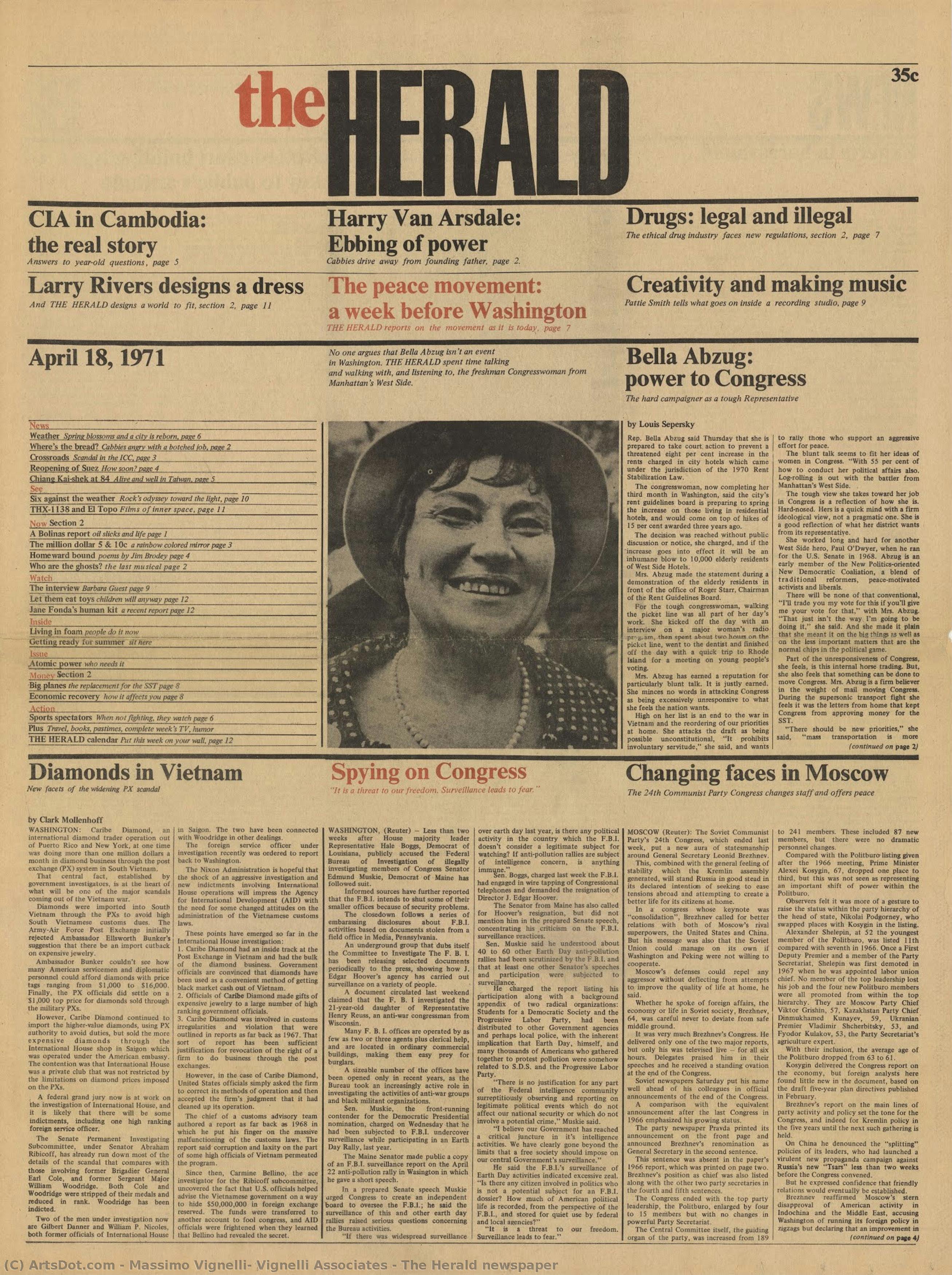
Experience the modernist grid design of The Herald newspaper by Massimo Vignelli (1971), showcasing vintage graphic communication art; discover this iconic piece today.
Biografia do Artista
Massimo Vignelli (1931-2014): Ícone do design italiano conhecido por projetos gráficos minimalistas, incluindo o mapa do metrô de Nova York & identidades corporativas. Explore seu legado!
About the painting
The Grid of Modern Communication: Vignelli's The Herald
To encounter this piece is to step directly into the vibrant, structured chaos of mid-century New York journalism. This reproduction of The Herald newspaper from April 1971, conceived by Massimo Vignelli and his associates, is far more than mere ephemera; it is a meticulously designed artifact of visual communication history. It captures a moment when design principles—simplicity, functionality, and rigorous structure—were being aggressively applied to the seemingly unruly medium of print journalism. The very act of presenting this newspaper front page transforms what might be considered disposable media into a profound study in modernist graphic discipline.
A Masterclass in Structured Design
Vignelli’s genius, always rooted in an almost architectural understanding of space, is on full display here. The description notes the structure: a rigid grid of six columns and sixteen modules per column. This underlying skeleton dictates every element—the placement of headlines like "Diamonds in Vietnam," the accompanying portrait of the smiling woman, and the smaller articles detailing everything from spying congress to changing leaves in Moscow. Vignelli’s commitment to using a single typeface, Times Roman, across various weights and sizes, speaks volumes about his belief in universal legibility. It is a powerful testament to the idea that restraint—the disciplined use of negative space and consistent typography—can generate an overwhelming sense of order and sophistication.
Historical Resonance and Materiality
The year 1971 places this work within a fascinating cultural nexus, post-war modernism grappling with the burgeoning media landscape. While the paper itself ultimately folded due to distribution issues, its surviving design remains potent. For the collector or designer, understanding this context is key. This piece speaks to an era obsessed with efficiency and clarity in information transfer. When considering a reproduction for your space, you are not just acquiring art; you are curating a dialogue about how we consume knowledge—a conversation between the fleeting headline and the enduring power of good design.
Symbolism of the Grid
The grid itself functions as the primary symbolic element. In an age where digital information often feels overwhelming, this physical manifestation of order offers a visual anchor. It symbolizes control, but not oppressive control; rather, it suggests that even complex narratives—the confluence of international events and local interest—can be organized into digestible, beautiful patterns. The interplay between the large, arresting photograph and the tightly packed textual modules creates a dynamic tension, mirroring the very energy of a bustling city like New York in that era.
Bringing Modernist Precision Home
For interior design or gallery display, this piece offers an unparalleled opportunity to inject intellectual rigor into a space. It pairs beautifully with minimalist furniture, mid-century modern accents, or any setting that appreciates the clean lines of 20th-century industrial aesthetics. Owning this reproduction is an homage to Massimo Vignelli’s lifelong dedication to elevating the mundane—the daily newspaper—into something enduringly beautiful and intellectually stimulating.
Perguntas e Respostas
A qual estilo pertence "The Herald newspaper"?
O movimento associado a "The Herald newspaper", de Massimo Vignelli, Vignelli Associates é Modernism. Esta classificação situa a obra entre artistas e obras de arte relacionados.
Para que tipo de uso se recomenda uma impressão de "The Herald newspaper"?
A recomendação de uso para uma impressão de "The Herald newspaper" é Statement.
Qual é a proporção de "The Herald newspaper", de Massimo Vignelli, Vignelli Associates e quais são as suas dimensões?
O formato de "The Herald newspaper" é Portrait e a obra original mede 43 x 57 cm. Ambas as informações são úteis ao planejar uma reprodução.
Quick facts and art quiz
About Massimo Vignelli, Vignelli Associates

Massimo Vignelli, Vignelli Associates
1931 - 2014, Itália
Biografia do Artista
Biography & Works of Massimo Vignelli
Massimo Vignelli (Italian, b.1931) was born in Milan, Italy. He is associated with the modernist tradition, as he commonly uses simplistic and geometric forms within his work. Vignelli began his professional career in Design when he studied architecture at the Politecnico di Milano and the Universita di Architettura in Venice. He decided to pursue his interest in general Design rather than becoming an architect. He has worked in many different Design fields, including interior, graphic, environmental, furniture, and product Design. He moved to New York in 1966 to lead the New York branch of Unimark International, a large Design firm that is responsible for many renowned corporate images, such as American Airlines, New York City subway, and the Washington D.C. metro. After leaving Unimark International, the designer founded Vignelli Associates, through which he has worked with clients such as IBM, Bloomingdales, and Knoll.
Through both his deep cultural commitment and his real comprehension of the design discipline, Vignelli crucially contributed to the design profession by keeping alive and also promoting the evolution of the fundamental principles that were developed by the Modern Movement during the early 20th century, thus revealing to everyone their ongoing validity.
A validity that we can see in his own design, as demonstrated by both the strength and functionality that still characterise it, and also by the interest toward Vignelli’s design shared by thousands of people from all over the world. The work of Vignelli indeed shows a timeless validity housed in its pragmatic, rational, and visually forceful nature.
Vignelli taught us to appreciate the functionality and elegance of simple, rational shapes—an aesthetic that is result of a deep cultural sensitivity, before being a matter of style or taste. His opera will always be an excellent example to make people understand the social value of design and to make designers understand the need to adopt a professional discipline that will allow to properly manage such a responsibility.
Early Years & Education
Massimo Vignelli’s fascination with Design began at a young age. He studied architecture at the Politecnico di Milano and the Universita di Architettura in Venice, where he honed his skills in spatial reasoning and structural analysis—skills that would prove invaluable throughout his career.
Castiglioni Brothers & Apprenticeship
His apprenticeship with the Castiglioni brothers – pioneers in Italian industrial design – solidified his belief in functionality, simplicity, and the power of elegant solutions to everyday problems. This formative period instilled in him a profound understanding of how Design could improve people’s lives.
Unimark International & American Airlines Logo
In 1965, Vignelli founded Unimark International, an agency that quickly gained prominence thanks to its innovative approach to corporate identity. Among his most celebrated achievements is the iconic logo for American Airlines—a bold statement in clarity and usability that continues to resonate today.
Vignelli Associates & The Subway Map
After leaving Unimark International, Vignelli established Vignelli Associates, partnering with Lella Vignelli. Together they created groundbreaking Design solutions spanning graphic design, interior design, product design, and architecture—most notably the redesign of the New York City Subway map in 1972.
Legacy & Influence
Massimo Vignelli’s impact extends far beyond individual projects; he fundamentally reshaped how we perceive Design itself. He championed typographic discipline, advocating for a limited palette of typefaces—believing that true creativity lies not in endless options but in masterful execution with carefully chosen tools.
His book, *The Vignelli Canon*, became a manifesto for designers, outlining his principles of clarity, simplicity, and enduring elegance. He wasn’t merely creating visually pleasing objects; he was striving to create order out of chaos, to communicate effectively, and to elevate the human experience through thoughtful Design.
Massimo Vignelli passed away in 2014, but his designs remain powerfully present, shaping our world with their enduring elegance and unwavering commitment to clarity.
Quick facts about Massimo Vignelli, Vignelli Associates
- Artistic Movement Or Style: Modernismo
- Artists Who Influenced This Artist:
- Achille Castiglioni
- Giulio Minoletti
- Date Of Birth: 1931
- Date Of Death: 2014
- Full Name: Massimo Vignelli
- Nationality: Italiano
- Notable Artworks:
- Mapa do metrô de Nova York
- Logo da American Airlines
- Embalagens Heller
- Knoll Design
- Place Of Birth: Milan, Itália
Explore obras de arte organizadas por temas, estilos e características.


Massimo Vignelli, Vignelli Associates
The Herald newspaper
() ·
With its frame: · Hand-painted in oil on linen
Total