
Exibido: · Com a moldura:
 Visualizar na parede
 Compartilhar
 Compartilhar
 Detalhes
 Guia
Guia

 Baixar imagem
 Semelhantes
 Raio X
 Ver diaporama
 Perguntas e Respostas
 Estatísticas


€ 262
Reprodução em Óleo Feita à Mão
Óleo sobre tela pintado à mão no tamanho e moldura de sua escolha, feito sob encomenda pelos nossos artistas. ( Alternar para Impressão Alternar para Imagem Digital)
Tamanho
·Tamanho padrão
personalizado
CM
INCH
Escolha entre os nossos tamanhos pré-definidos que respeitam as proporções originais da obra de arte.
Carregando tamanhos...

largura
altura
Insira a largura e a altura desejadas para se ajustarem à sua moldura ou parede. Como esta obra é pintada à mão, para um tamanho com proporções diferentes, o artista poderá pintar um pouco mais ao redor da imagem ou reduzir ligeiramente a composição — você escolhe. Enviamos uma maquete digital para sua aprovação antes de iniciar a pintura. A imagem exibida nesta página não representa o resultado real — apenas a maquete mostra o resultado final.
 Leia mais
Finalizar
·
Branco €1

Bordas esfumaçadas €1

Bordas estendidas €1

P118B €10

P118H €10

P118W €10

P438Z €10

P508JH €12

P508YH €12

P805H €10

P805Z €10

P919BZ €10

P919G €10

P919XJ €10

P959ZH €10

P968JZ €12

W106C €8

W218G €10

W218JH €8

W218Y €10

W307PJ €10

W316G €10

W316PJ €8

W316Y €10

W398PJ €8

W4111J €10

W500HY €15

W500JH €15

W692G €12

W849H €8

W940BG €15

W953PJ €8

H24-GOLD €30

H24-SILVER €30

H36-GOLD €45

H36-SILVER €45
Enviado em um tubo protetor, pronto para ser emoldurado por você.
Extras
opcionalO que os extras incluem?
Exemplos do que pode ser alterado: Substituir o rosto pela foto do cliente; Adicionar um animal de estimação (ex: substituir gato por cachorro); Incluir uma mensagem oculta no fundo; Alterar a paisagem ou elementos do fundo.
Após o pedido, a equipe da TopImpressionists.com enviará um e-mail ao cliente para instruções e fornecerá uma prévia da montagem
Após o pedido, a equipe da TopImpressionists.com enviará um e-mail ao cliente para instruções e fornecerá uma prévia da montagem
Entrega mundial () em 3 a 4 semanas, em vez das 5 semanas padrão. (8 Novembro). Sem comprometer a qualidade.
Verniz de Proteção
Etiqueta de identificação
Detalhes da Placa de Bronze Gravada
This elegant plaque features the artist's name and the title of the artwork, finely engraved for a timeless presentation.
It is made from bronze with a refined, elegant finish. The text is precisely laser-engraved for a sharp and permanent result. Measuring 9x2 cm, the plaque is compact yet easy to read. It's built to be durable and scratch-resistant, offering a professional, museum-quality look. Mounting is simple thanks to the included adhesive backing.
Detalhes da Placa de Acrílico Transparente
The plaque includes essential engraved details such as the artist's name, the title of the artwork, the date it was created, the type of media used-like oil on canvas or watercolor-a brief description of the piece, and a QR code that links to the complete artwork information.
It is crafted from clear acrylic, offering a sleek, modern appearance. The text is UV-engraved in black to ensure strong visual contrast. With a size of 10x15 cm, it ensures optimal readability. It comes equipped with two metal hooks for secure wall mounting. The plaque is designed to be weather-resistant, making it suitable for various environments, and it includes interactive features that work seamlessly with smartphone scanning.
Detalhes da Placa de Acrílico Preto
This elegant plaque includes engraved information such as the artist's name, the title of the artwork, the date it was created, the type of media used (like oil on canvas or watercolor), a short description of the artwork, and a QR code for quick access to more information.
The plaque itself is made from refined black acrylic with a premium finish. The text is laser-engraved in white for high contrast and readability. Its size is 10x15 cm, designed to be easy to read. It comes with two metal hooks for professional mounting. The design is sleek and fits any interior style. It is also weather-resistant and durable, with built-in digital integration for mobile compatibility.
A opção de vidro está disponível apenas para tamanhos inferiores a 110 cm
 A opção de vidro está disponível apenas para tamanhos inferiores a 110 cm
- Envio expresso gratuito para todo o mundo
- Tela de Linho de Alta Qualidade
- Seguro de transporte completo
- Garantia de Reembolso de Impostos Alfandegários
- Garantia de Fidelidade Cromática
- Política de Devolução em 100 Dias (Apenas para Defeitos)
- Garantia de reembolso de 100%
- Oferta de desconto por quantidade


Descrição do Item
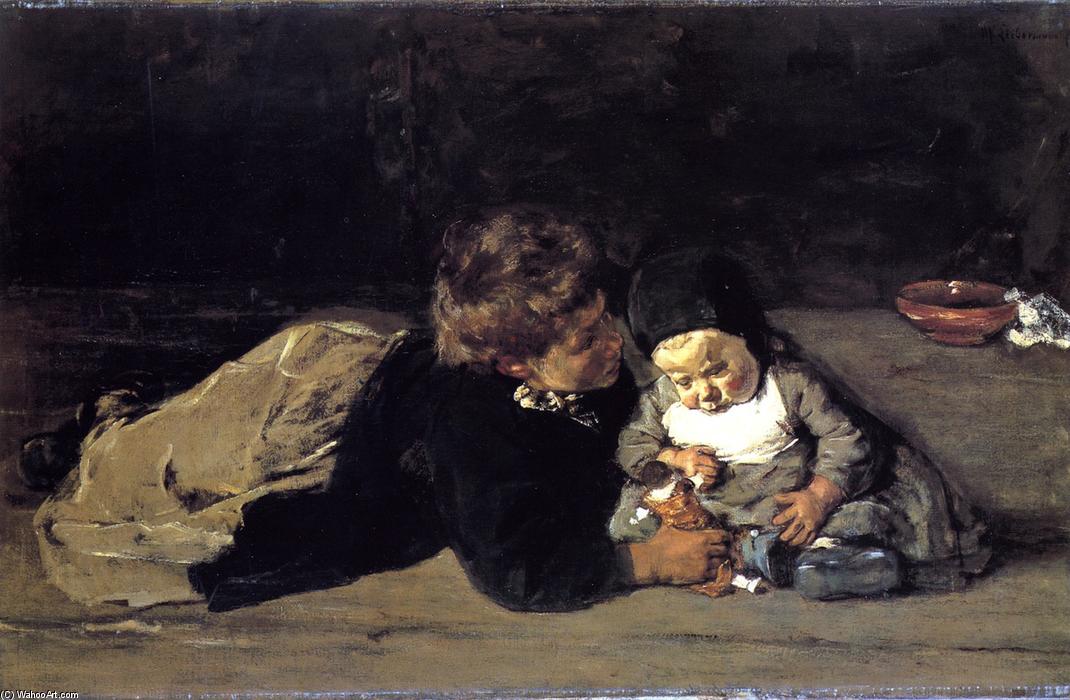
This painting by Max Liebermann exemplifies Impressionistic style, characterized by loose brushwork and tonal variations to depict a heartwarming scene of human interaction. Employing wet-on-wet technique on canvas, Liebermann skillfully captures fleeting moments with sensitivity to light and color, reflecting themes of caregiving and connection within an understated interior setting.
Biografia do Artista
Max Liebermann (1847-1935): Pintor expressionista alemão, conhecido por cenas de vida moderna, retratos e jardins serenos. Explore sua rica herança artística!
Sobre a pintura
A Tender Encounter in Monochrome
In the quietude of Max Liebermann’s 1876 masterpiece, “The Siblings,” time seems to suspend its forward march, allowing a singular moment of human connection to breathe. This monochrome triumph is far more than a mere study of figures; it is a profound exploration of familial tenderness and the soft, unspoken language of intimacy. As the eye meets the canvas, one is immediately drawn into a world of diffused light and tonal harmony, where a man and a child are captured in a fleeting tableau of closeness. The painting transcends its simple subject matter to become a distillation of emotion, rendered with a precision that speaks to the soul as much as it does to the intellect.
The composition is masterfully understated, centering the viewer's attention on the intimate core of the foreground. Here, the figures occupy a simple ground plane, their proximity creating a palpable sense of warmth and protection. While subtle, indistinct individuals linger in the background, they serve only as contextual anchors, ensuring that the primary focus remains fixed upon the bond between the two central subjects. This arrangement creates an inviting depth, drawing collectors and admirers alike into a private, domestic sanctuary that feels both timeless and deeply personal.
Impressionistic Light and Fluid Technique
Liebermann, a leading proponent of Impressionism in Germany, utilizes a technique that prioritizes the ephemeral quality of light over the rigid constraints of photographic realism. Through the skillful application of a wet-on-wet technique, the artist allows colors and tones to blend seamlessly across the canvas, generating a soft, hazy luminescence. This method imbues the scene with an ethereal glow, as if the very air within the room is heavy with memory and quietude. The brushstrokes are loose and organic, characteristic of the Impressionist movement, favoring the suggestion of texture and form over meticulous, sharp-edged detail.
The monochromatic palette—a sophisticated arrangement of blacks, whites, and varying shades of gray—plays a crucial role in the painting's atmospheric success. By stripping away the distraction of color, Liebermann directs our attention to the subtle interplay of shadow and light. This tonal mastery creates a sense of depth and volume, where the soft edges of clothing and facial features emerge from the shadows with a gentle, rhythmic grace. For the interior designer, such a piece offers a sophisticated anchor for a room, providing a neutral yet emotionally resonant focal point that complements both classical and contemporary decor.
A Legacy of Emotion and Connection
To understand “The Siblings,” one must consider the historical currents flowing through Liebermann’s early career. Painted during his formative years in Paris and Weimar, the work reflects the burgeoning fascination with capturing everyday life and subjective experience that defined the era. Much like his contemporaries Monet and Renoir, Liebermann sought to move beyond academic stiffness, embracing a style that mirrored the shifting moods of the natural and domestic worlds. This piece stands as a testament to his ability to translate the essence of human experience onto canvas.
Beyond its technical brilliance, the painting carries a profound symbolic weight. The focus on the relationship between the man and the child evokes universal themes of caregiving, protection, and the enduring strength of familial bonds. There is a palpable sense of nostalgia and quiet contemplation within the frame, making it an ideal acquisition for those who seek art that offers more than mere decoration. It is a piece that invites long periods of reflection, offering a window into a moment of shared attention that remains as poignant today as it was in 1876.
Perguntas e Respostas
Como o meio e o movimento se combinam em "The Siblings"?
"The Siblings", de Max Liebermann combina a técnica de Oil On Canvas com o estilo Impressionistic Style. Técnica e movimento descrevem a execução e o estilo da obra.
De que técnica é feita a obra "The Siblings"?
A técnica de "The Siblings", de Max Liebermann é Oil On Canvas. As reproduções visam reproduzir a aparência desta técnica.
Como o movimento e a época se encontram em "The Siblings", de Max Liebermann?
Em "The Siblings", de Max Liebermann, o movimento Impressionistic Style encontra a era Século XIX.
Informações rápidas e quiz de arte
Sobre Max Liebermann

Max Liebermann
1847 - 1935, Alemanha
Biografia do Artista
A Life Immersed in Light: The World of Max Liebermann
Born into a prosperous Jewish family in 1847 Berlin, Max Liebermann’s path to becoming one of Germany's foremost Impressionist painters wasn’t preordained. Initially steered towards the respectable professions of law and philosophy at the University of Berlin, his true calling resonated far more powerfully from the canvas than the courtroom. This early period of intellectual exploration, however, undoubtedly shaped his observant eye and thoughtful approach to depicting the world around him. It was a deliberate shift – studies in Weimar, Paris, and the Netherlands – that truly ignited his artistic passion, exposing him to diverse styles and laying the foundation for a career defined by capturing fleeting moments with an exquisite sensitivity to light and color. He wasn’t merely painting what he saw; he was translating the very essence of experience onto the canvas. Liebermann's early works often depicted scenes of everyday life, particularly those of the working class, rendered with a naturalism that challenged the prevailing romanticized aesthetic of the time. These paintings weren’t intended as social commentary, but rather as honest portrayals of human existence, imbued with dignity and respect.Embracing Impressionism in a German Context
Liebermann's artistic development was profoundly influenced by his exposure to French Realism and, crucially, the burgeoning Impressionist movement. The spirit of Édouard Manet – his boldness, his rejection of academic convention, his focus on contemporary life – resonated deeply with Liebermann. However, he didn’t simply replicate what he saw in Paris; instead, he adapted these principles to a German sensibility, creating an Impressionism uniquely his own. His palette became brighter, his brushstrokes looser and more spontaneous, and his subjects shifted towards scenes of bourgeois leisure and the tranquil beauty of his garden near Lake Wannsee. This garden, in particular, became a recurring motif throughout his career, offering a sanctuary from the rapidly changing world outside and providing endless inspiration for his explorations of light and atmosphere. He wasn’t just painting flowers and foliage; he was capturing the very feeling of summer, the warmth of the sun, the gentle breeze rustling through the leaves. Liebermann's early works often featured vibrant colors and a focus on capturing the effects of light, reflecting the influence of artists like Claude Monet and Pierre-Auguste Renoir. He sought to translate the fleeting impressions of nature onto his canvases, prioritizing atmosphere and color over precise detail.A Champion of Artistic Freedom
Liebermann wasn't content to simply paint; he actively championed artistic innovation and independence. Recognizing the stifling constraints imposed by the traditional art establishment, he became a driving force behind the Berlin Secession in 1898, leading this avant-garde group for over a decade. The Secession challenged conventional norms, providing a platform for artists working outside the confines of academic tradition. This commitment to artistic freedom extended beyond his own work; Liebermann believed passionately that artists should be free to explore their vision without interference from political or ideological pressures. His election to the Prussian Academy of Arts in 1909 and subsequent presidency in 1920 were testaments to his growing influence within the German art world, but these positions also brought him face-to-face with the rising tide of anti-Semitism and nationalism that would ultimately threaten his life’s work. The Secession fostered a spirit of experimentation and collaboration, encouraging artists to push boundaries and challenge established artistic conventions. Liebermann's leadership was instrumental in shaping the movement's identity and promoting its ideals.Shadows of a Changing World: Legacy and Resilience
The rise of Nazism cast a dark shadow over Liebermann’s later years. His principled stance against discrimination led to his resignation from the Prussian Academy in 1933, a courageous act that signaled his refusal to compromise his values. Despite facing increasing persecution, he continued to paint, finding solace and purpose in his art. He passed away in Berlin in 1935, leaving behind a rich legacy of paintings, prints, and a profound commitment to artistic freedom. His wife, Martha, tragically took her own life in 1943 to avoid deportation, a heartbreaking testament to the horrors of the Holocaust. For years after the war, Liebermann’s work was somewhat overlooked, but in recent decades there has been a renewed appreciation for his contributions to German Impressionism and modern art history. Today, he is remembered not only as a brilliant painter but also as a courageous advocate for artistic expression and a symbol of resistance against tyranny. His paintings continue to captivate viewers with their luminous beauty, insightful observations, and enduring humanity.Key Achievements & Lasting Influence
- “The Twelve-Year-Old Jesus in the Temple”: This early work sparked considerable debate due to its unconventional depiction of a Semitic-looking Jesus, challenging traditional religious iconography.
- Leadership of the Berlin Secession: His pivotal role in leading this avant-garde movement challenged artistic norms and paved the way for modern art in Germany.
- Presidency of the Prussian Academy of Arts: A significant recognition of his artistic merit, though ultimately compromised by the rise of Nazism.
- Masterful Portraiture: His ability to capture the essence of his subjects in over 200 commissioned portraits cemented his reputation as a leading portrait painter.
- Influence on German Impressionism: Liebermann successfully translated the principles of Impressionism into a uniquely German context, inspiring generations of artists.
Informações rápidas sobre Max Liebermann
- Artistic Movement Or Style: Impressionismo
- Artists Or Movements Influenced By This Artist: ['Impressionismo alemão']
- Artists Who Influenced This Artist:
- Manet
- Degas
- Date Of Birth: 20 Jul 1847
- Date Of Death: 8 Feb 1935
- Full Name: Max Liebermann
- Nationality: Alemão
- Notable Artworks:
- Jesus...
- Casa holandesa
- Retrato Einstein
- Place Of Birth: Berlim, Alemanha
Obras Relacionadas


Explore obras de arte organizadas por temas, estilos e características.


Max Liebermann
The Siblings
() ·
Com a moldura: · Pintura a óleo sobre linho feita à mão
Total