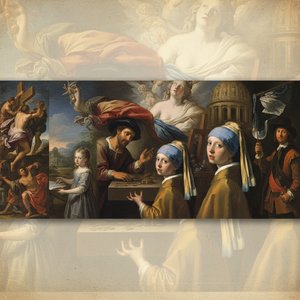
A Tuscan Sun in the Roman Baroque
Pietro Berrettini, known to history as Pietro da Cortona, emerged from the rolling hills of Tuscany in 1596 to become a defining figure of the Italian Baroque. Born in the town that would lend him his more familiar name, Cortona possessed an innate artistic sensibility nurtured early on by training under Andrea Commodi in Florence. However, it was Rome – the pulsating heart of artistic innovation – that truly ignited his genius. Arriving around 1612/3, he entered the studio of Baccio Ciarpi, immersing himself in a world where illusion and drama were rapidly reshaping the visual landscape. Cortona wasn’t merely absorbing techniques; he was poised to become a master of creating breathtaking spectacles for both church and palace. His early work already hinted at the grandeur that would characterize his mature style, demonstrating a keen understanding of composition and a growing confidence in translating complex narratives onto canvas and fresco. He quickly established himself as a sought-after artist, securing commissions that allowed him to hone his skills and develop his distinctive voice.
The Rise of an Illusionist
Cortona’s ascent was swift, fueled by talent and strategic patronage. The frescoes he executed in the church of Santa Bibiana (1624-1626), undertaken under the watchful eye of Gian Lorenzo Bernini, were pivotal. These works showcased not only his technical prowess but also a burgeoning ability to integrate architecture and painting into a unified, immersive experience. His style was already diverging from traditional approaches; he wasn’t simply decorating spaces, he was transforming them. The influence of earlier masters was evident – the rich color palettes of Titian and Paolo Veronese resonated in his work, while Raphael's compositional grace provided a foundation for his own dynamic arrangements. However, Cortona didn’t merely imitate; he synthesized these influences into something uniquely his own, characterized by a dramatic use of perspective and an increasing mastery of
trompe-l'œil, the art of deceiving the eye. Early commissions for the Sacchetti family – including “The Sacrifice of Polyxena,” “The Triumph of Bacchus,” and “The Rape of the Sabine” (1626) – further solidified his reputation, demonstrating a flair for theatricality and narrative complexity. These early successes weren’t merely displays of skill; they were statements of intent, foreshadowing the monumental projects that would define his career.
Palazzo Barberini: A Monumental Achievement
The year 1633 marked a turning point with the commission to decorate the Palazzo Barberini for Cardinal Francesco Barberini, nephew of Pope Urban VIII. This project wasn’t just another assignment; it was an opportunity to create a monumental statement of Baroque art and papal power. The *Allegory of Divine Providence and Barberini Power* that adorns the palace’s grand salon is arguably his most celebrated achievement. Here, Cortona unleashed the full force of his illusionistic skills. He created a swirling vortex of figures, gods, and allegorical representations, all seemingly suspended in mid-air, extending the architectural space beyond its physical limits. The ceiling isn't merely painted; it
is the space, an expansive realm where earthly power is legitimized by divine sanction. The dynamism, the vibrant colors, and the sheer scale of this work established Cortona as a leading figure of the Roman Baroque, rivaling even Bernini and Borromini in influence and acclaim. It became a model for subsequent ceiling decorations throughout Europe, inspiring generations of artists to push the boundaries of illusionistic painting. The Palazzo Barberini commission wasn’t simply about artistic execution; it was about crafting an ideology, visually representing the power and legitimacy of the Barberini family through masterful manipulation of space and form.
Beyond Frescoes: Architecture and Lasting Legacy
While celebrated primarily as a painter, Cortona was also a gifted architect, though fewer of his architectural designs were actually realized. His distinctive approach favored inventive forms and a harmonious integration with decorative elements. He continued to receive prestigious commissions throughout his career, including work at the churches of Santa Maria in Vallicella and San Nicola da Tolentino in Rome. These later projects demonstrate a refinement of his style, characterized by an even greater emphasis on dramatic lighting and emotional intensity. He returned to Florence in 1637 and again in 1640, leaving his mark on the Pitti Palace with frescoes representing the Four Ages of Man. Pietro da Cortona passed away in Rome in 1669, leaving behind a legacy that continues to resonate today. His innovative use of
trompe-l'œil, his masterful command of composition and color, and his ability to create immersive, emotionally charged environments cemented his place as one of the most important artists of the Baroque period. He didn’t just paint or build; he conjured worlds, inviting viewers to step into a realm where art and reality blurred, and the divine seemed within reach.
Influences and Artistic Kinship
- Early Influences: Cortona's formative years were shaped by Florentine masters like Andrea Commodi, instilling in him a foundation of draftsmanship and compositional principles.
- Roman Baroque Masters: His arrival in Rome exposed him to the revolutionary work of artists such as Annibale Carracci, Caravaggio, and later, Bernini and Borromini. He absorbed their dramatic use of light and shadow, dynamic compositions, and emotional intensity.
- Venetian Colorism: The rich color palettes and atmospheric effects of Venetian painters like Titian and Veronese profoundly influenced Cortona’s approach to painting, adding a sensual quality to his works.
- Pietro Paolo Ubaldini: A faithful follower who carried on the traditions established by Cortona, demonstrating the artist's lasting impact on subsequent generations of painters.
Cortona’s legacy extends beyond his individual masterpieces. He helped define the aesthetic vocabulary of the Roman Baroque, influencing countless artists and shaping the artistic landscape of 17th-century Europe. His ability to seamlessly blend painting, sculpture, and architecture created a holistic artistic experience that continues to captivate audiences today. He remains a testament to the power of art to transform space, evoke emotion, and celebrate both earthly grandeur and divine grace.



 Visualizar em escala
 Encomendar reprodução pintada à mão
 Enviar
 Compartilhar
 Ver detalhes

 Baixar
 Semelhantes
 Raio X
 Apresentação de slides
 Ver mais






































 A opção de vidro está disponível apenas para tamanhos inferiores a 110 cm