

 Visualizar na parede
 Compartilhar
 Compartilhar
 Detalhes
 Guia
Guia

 Baixar imagem
 Semelhantes
 Raio X
 Ver diaporama
 Perguntas e Respostas
 Estatísticas
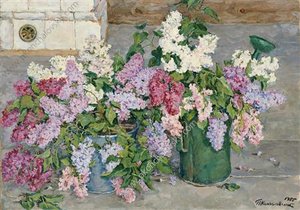
Lilac

- 79.0 x 95.0 cm


Experience Konchalovsky's 'Lilac,' a vibrant still life capturing the beauty of spring. This 1951 masterpiece blends Fauvist color with Russian artistry.
 Ler mais
Pyotr Konchalovsky (1876-1956) foi um pintor russo crucial, conhecido por seu estilo inovador que mistura Impressionismo, Fauvismo e Realismo Socialista. Explore seus paisagens, retratos e obras icônicas.
Giclée / Impressão de Arte
Impressão giclée ou em tela de qualidade de museu, com produção rápida e opções flexíveis de acabamento. ( Comprar pintura feita à mão Alternar para Imagem Digital)




P118B €10

P118H €10

P118W €10

P438Z €10

P508JH €12

P508YH €12

P805H €10

P805Z €10

P919BZ €10

P919G €10

P919XJ €10

P959ZH €10

P968JZ €12

W106C €8

W218G €10

W218JH €8

W218Y €10

W307PJ €10

W316G €10

W316PJ €8

W316Y €10

W398PJ €8

W4111J €10

W500HY €15

W500JH €15

W692G €12

W849H €8

W940BG €15

W953PJ €8




Tamanho padrão
personalizado
CM
INCH
Escolha entre os nossos tamanhos pré-definidos que respeitam as proporções originais da obra de arte.
Loading sizes...

largura
altura
Insira a largura e a altura desejadas para se ajustarem à sua moldura ou parede. Uma impressão pode ser apenas cortada, nunca ampliada além da imagem original; portanto, um tamanho com proporções diferentes resultará na perda de parte da imagem. Enviamos uma maquete digital para sua aprovação antes de realizarmos a impressão. A imagem exibida nesta página não mostra o corte real — apenas a maquete o faz.
Entrega mundial () em 2 semanas, em vez das 4/5 semanas padrão. (8 Novembro)

Envio expresso gratuito para todo o mundo

Tela de Linho de Alta Qualidade

Seguro de transporte completo

Garantia de Reembolso de Impostos Alfandegários

Garantia de Fidelidade Cromática

Política de Devolução em 100 Dias (Apenas para Defeitos)

Garantia de reembolso de 100%

Oferta de desconto por quantidade
 A opção de vidro está disponível apenas para tamanhos inferiores a 110 cm

Lilac
Giclée / Impressão de Arte
Tamanho da Reprodução
-


Preço Total
€ 62
Lilac by Pyotr Konchalovsky: A Study in Color and Memory
Pyotr Konchalovsky's "Lilac," painted in 1951, is a captivating still life that exemplifies the artist’s mastery of color and his ability to evoke a sense of quiet nostalgia. This piece, measuring 79 x 95 cm, showcases a simple yet profound arrangement of lilac blossoms nestled within a blue glass vase, set against a muted background. The artwork's enduring appeal lies in its harmonious composition and the emotional resonance it creates through Konchalovsky’s skillful use of color and brushwork.
Artistic Background & Style
Born in 1876 in Slavianka, Ukraine, Pyotr Konchalovsky was deeply immersed in the Russian art scene from a young age. His father's profession as an art publisher exposed him to a world of creativity and artistic expression. Konchalovsky received formal training at the Moscow School of Painting, Sculpture, and Architecture before becoming a prominent figure within the influential Jack of Diamonds group. This association positioned him at the forefront of Russian avant-garde movements, known for their experimentation with form and color.
"Lilac" reflects Konchalovsky's engagement with Fauvism, a style characterized by bold colors and energetic brushstrokes. While not strictly adhering to all tenets of Fauvism, the painting shares its emphasis on emotional expression through vibrant hues rather than strict representational accuracy. The artist’s technique involves visible brushwork, adding texture and dynamism to the composition.
Subject & Technique
The subject matter—a simple still life of lilacs in a blue vase—is rendered with remarkable sensitivity. Konchalovsky's choice of lilac is significant; these flowers often symbolize love, innocence, remembrance, and first love. The blue glass vase provides a striking contrast to the purple hues of the blossoms, creating visual interest and depth. The artist employs an oil on canvas technique, allowing for rich color saturation and textural variation. Thick impasto brushwork is particularly noticeable on the petals and foliage, giving the flowers a tactile quality that invites closer inspection.
The lighting appears to be natural, casting soft shadows that enhance the volume and form of the objects. The perspective is relatively simple, creating a sense of intimacy and drawing the viewer into the scene. Konchalovsky’s signature “W. Konradi-Schrein 1951” is discreetly placed in the upper left corner.
Symbolism & Emotional Impact
"Lilac" transcends its status as a mere still life; it's an exploration of memory, beauty, and the fleeting nature of time. The choice of lilacs evokes feelings of nostalgia and gentle reflection. The painting’s overall effect is one of tranquility and understated elegance. It invites viewers to pause and appreciate the simple pleasures in life—the beauty of a flower, the warmth of sunlight, and the quiet moments of contemplation.
Reproductions & Legacy
For art enthusiasts seeking to bring the timeless charm of "Lilac" into their homes or collections, high-quality, handmade oil painting reproductions are available. These meticulously crafted reproductions capture the essence of Konchalovsky’s original work, preserving its vibrant colors and textural richness. Pyotr Konchalovsky's contribution to Russian art remains significant, influencing generations of artists with his unique blend of traditional techniques and avant-garde sensibilities.
- Pyotr Konchalovsky: Still Life with Lilac
- Pyotr Konchalovsky: Lilac
- Pyotr Konchalovsky: Lilac
- Pyotr Konchalovsky: Lilac
To learn more about the artist, visit his page on Wikipedia: Petr Konchalovsky.
Perguntas e Respostas
Como faço para baixar a imagem de "Lilac", de Piotr Konchalovsky?
A imagem de "Lilac", de Piotr Konchalovsky pode ser baixada na página de download da obra: Download download de imagem digital em alta resolução.
A que período pertence a obra "Lilac", de Piotr Konchalovsky?
O período histórico de "Lilac", de Piotr Konchalovsky é Modern. Esta classificação situa a obra na história da arte.
A obra "Lilac" está disponível para download em alta resolução?
Para obter uma versão digital de "Lilac", de Piotr Konchalovsky, peça download de imagem digital em alta resolução em sua página Imagem Digital de Alta Resolução.
Obras Relacionadas



Biografia do Artista
A Life Immersed in the Russian Artistic Spirit
Pyotr Petrovich Konchalovsky, born February 21, 1876, in the village of Slavianka near Kharkiv, was more than just a painter; he was a visual chronicler of a Russia undergoing profound transformation. His artistic journey mirrored the nation’s own tumultuous passage through revolution and ideological shifts, marked by a relentless search for new forms of expression. Konchalovsky's upbringing steeped him in an atmosphere rich with intellectual and creative currents. His father, Petr Petrovich Konchalovsky, was a respected translator and art publisher whose Moscow home became a vibrant hub frequented by leading artists of the era—Valentin Serov, Mikhail Vrubel, Vasily Surikov all graced their residence after the family’s move to the capital in 1889. This early exposure wasn't merely observational; it instilled within young Pyotr a deep appreciation for artistic expression and laid the foundation for his future path. Weekends spent absorbing the masterpieces at the Tretyakov Gallery proved formative, shaping his aesthetic sensibilities with the power of Russian masters.From Parisian Influences to Avant-Garde Innovation
Konchalovsky’s formal training began at the Moscow School of Painting, Sculpture and Architecture, but a pivotal period followed in Paris from 1896 to 1898 at the Académie Julian. This immersion in the French art world proved transformative. He encountered the groundbreaking work of Paul Cézanne and Vincent van Gogh, artists who challenged conventional representation and explored new ways of perceiving form and color. A subsequent journey to Arles allowed him a deeper understanding of Van Gogh’s artistic vision—a pilgrimage into the heart of expressive intensity. Returning to Russia, he continued his studies at the Imperial Academy of Arts in Saint Petersburg, graduating in 1907. However, it was upon his return that Konchalovsky truly began to forge his own distinctive style. He became a central figure in the Russian avant-garde movement, co-founding the influential “Jack of Diamonds” (Knave of Diamonds) society in 1910. This group rejected academic traditions and championed experimentation, seeking inspiration not only from Western European modernism but also from Russia’s own folk art traditions—icons, tavern signs, and colorful popular prints known as *lubok*. He was a master of observation, capable of transforming the mundane into something extraordinary through the power of his vision.Navigating Shifting Ideologies: Style and Subject Matter
Konchalovsky’s artistic style evolved throughout his career, reflecting both personal exploration and the changing political climate of Russia. Initially influenced by Fauvism and Cézanne, his early works were characterized by bold colors, simplified forms, and a focus on structure. Paintings like “Still Life with a Coffeepot” exemplify this period, showcasing a vibrant palette and a dynamic composition. Following service in the Russian army during World War I, Konchalovsky’s style began to shift. The rise of Socialist Realism under the Soviet regime demanded art that served ideological purposes, celebrating socialist ideals and portraying prominent figures. While this represented a departure from his earlier avant-garde explorations, Konchalovsky adapted, becoming known for his ceremonial portraits. Despite these changes, he maintained a distinctive artistic voice, infusing even his more politically charged works with a sense of solidity and monumentality. Throughout his prolific career—estimated at over 5,000 pieces—he consistently explored still lifes, landscapes, and portraiture, demonstrating a remarkable versatility and unwavering commitment to the art of painting.A Prolific Output: Key Themes & Subjects
Konchalovsky’s vast body of work reveals recurring themes and subjects that demonstrate his artistic preoccupations. Still lifes were a constant throughout his career, allowing him to explore form, color, and composition in a controlled environment. He often depicted everyday objects—fruits, flowers, dishes—imbuing them with a sense of weight and presence. He was particularly drawn to the vibrant colors and textures of Russian folk art, which informed his approach to both still life and landscape painting. Landscapes, particularly those inspired by his travels, also held a special place in his oeuvre, capturing the beauty and grandeur of the natural world. However, it was perhaps in portraiture that Konchalovsky truly excelled, creating compelling likenesses of his contemporaries, often imbued with psychological depth. His portraits ranged from intimate depictions of family members to grand ceremonial representations of Soviet officials. He also experimented with genre scenes and historical subjects, demonstrating a willingness to tackle diverse artistic challenges. The sheer volume of his work—over 5,000 pieces—is a testament to his tireless dedication and unwavering commitment to the art of painting.Legacy and Enduring Significance
Pyotr Konchalovsky’s contribution to Russian art is undeniable. He bridged the gap between early modernism and Socialist Realism, navigating complex political currents while remaining a significant artistic force. His first solo exhibition at the Tretyakov Gallery in 1922 solidified his reputation as one of Russia's leading artists. Beyond his own work, Konchalovsky fostered a family deeply involved in the arts; his son, Mikhail Petrovich Konchalovsky, became a renowned film director, and his daughter, Natalia Konchalovskaya, was an accomplished artist herself. His paintings are not merely aesthetically pleasing objects but historical documents, reflecting the tumultuous period in which they were created. They offer valuable insights into the evolution of Russian art and the challenges faced by artists operating within a rapidly changing society. Konchalovsky’s ability to adapt while maintaining a distinctive style cemented his place as a key figure in Russian art history, leaving behind a legacy that continues to inspire and captivate audiences today.
Piotr Konchalovsky
1876 - 1956 , Rússia
Dados Rápidos
- Artistic Movement Or Style: Avant-garde, Fauvism, Realismo
- Artists Or Movements Influenced By This Artist:
- Mir Iskusstva
- Jack of Diamonds
- Artists Who Influenced This Artist:
- Cézanne
- Van Gogh
- Date Of Birth: 21/02/1876
- Date Of Death: 02/02/1956
- Full Name: Pyotr Petrovich Konchalovsky
- Nationality: Russo
- Notable Artworks:
- Natureza Morta
- Xaveco
- Retratos
- Place Of Birth: Kharkiv, Rússia
Artigos Relacionados

Victor Vasnetsov: Myth, Nationalism & the Revival of Russian Fairy Tale Painting
Explore the captivating world of Victor Vasnetsov, a co-founder of Russian folklorist painting. Discover his iconic works, influence on national identity, and lasting legacy in this expert guide.

Blossoms of Time: A Historical Journey Through Flower Painting
Explore the captivating history of flower painting! Discover Dutch masters, symbolic meanings, & botanical art. Expert insights & high-quality reproductions at TopImpressionists.

Blossoming Symbolism: A Historical Journey Through Flowers in Western Painting
Explore the rich history of flower symbolism in Western painting! Discover how artists from the Renaissance to Modernism used blossoms to convey meaning, emotion & beauty. Learn about iconic artworks and movements.

Silent Narratives: Exploring the Enduring Appeal of Still Life Painting Across Centuries
Explore the rich history of still life painting with TopImpressionists. Discover Dutch Masters, decode vanitas symbolism & learn about collecting timeless art. Expert insights and museum-quality reproductions.

Ivan Bilibin: A Synthesis of Folklore, Modernism & National Identity in Russian Illustration
Explore the enchanting world of Ivan Bilibin, a master Russian illustrator who synthesized folklore, Art Nouveau & national identity. Discover his iconic fairy tale illustrations and legacy with TopImpressionists.
Explore obras de arte organizadas por temas, estilos e características.
