


 Visualizar em escala
 Enviar
 Compartilhar
 Ver detalhes
 Guia de Obras do Aluno

 Baixar imagem
 Semelhantes
 Raio X
 Apresentação de slides
 Estatísticas
Street Scene with Snow


Discover Robert Henri's iconic 'Street Scene with Snow,' a masterpiece of American Realism capturing NYC nightlife and urban life. Explore Yale University Art Gallery’s stunning reproduction on TopImpressionists.
 Ver mais
Robert Henri (1865-1929): um pintor realista americano que capturou a vida urbana com honestidade e empatia, influenciando gerações de artistas. Conhecido por 'The Eight' e sua obra 'The Art Spirit'.
Giclée / Impressão de Arte
Impressão giclée ou em tela de qualidade de museu, com produção rápida e opções flexíveis de acabamento. ( Encomendar reprodução pintada à mão Ver Imagem Digital)




P118B €10

P118H €10

P118W €10

P438Z €10

P508JH €12

P508YH €12

P805H €10

P805Z €10

P919BZ €10

P919G €10

P919XJ €10

P959ZH €10

P968JZ €12

W106C €8

W218G €10

W218JH €8

W218Y €10

W307PJ €10

W316G €10

W316PJ €8

W316Y €10

W398PJ €8

W4111J €10

W500HY €15

W500JH €15

W692G €12

W849H €8

W940BG €15

W953PJ €8




Padrão
sob medida
CM
INCH
Escolha entre os nossos tamanhos pré-definidos que respeitam as proporções originais da obra de arte.
Loading sizes...

largura
altura
Digite a largura e a altura de que necessita, para se ajustar à sua moldura ou à sua parede. Uma impressão só pode ser cortada, nunca ampliada além da imagem original, pelo que um tamanho com uma proporção diferente perderá parte da imagem. Enviamos-lhe uma maquete digital para aprovação antes de imprimirmos qualquer coisa. A imagem apresentada nesta página não mostra o corte real — apenas a maquete o faz.
Entrega mundial () em 2 semanas, em vez das 4/5 semanas padrão. (22 Outubro)

Envio expresso gratuito para todo o mundo

Tela de Linho Premium

Seguro de transporte total

Garantia de Reembolso de Impostos Alfandegários

Garantia de Fidelidade de Cor

Política de Devolução em 100 Dias (Apenas para Defeitos)

Garantia de reembolso de 100%

Desconto para múltiplas unidades
 A opção de vidro está disponível apenas para tamanhos inferiores a 110 cm

Street Scene with Snow
Giclée / Impressão de Arte
Dimensões da Reprodução
-


Preço Total
€ 60
A Snapshot of Urban Life: Robert Henri’s Street Scene with Snow
Robert Henri's *Street Scene with Snow*, painted in 1902, stands as a cornerstone of American Realism and a testament to the Ashcan School’s unwavering commitment to portraying everyday life with unflinching honesty. Currently residing at Yale University Art Gallery in Hartford, Connecticut, this oil on canvas masterpiece transcends mere depiction; it captures a moment frozen in time—a gritty New York City street bathed in snow-illuminated light, offering viewers an intimate glimpse into the soul of its era.The Artist’s Vision: Henri's Bold Style and Technique
Henri’s distinctive artistic style is immediately recognizable through his masterful use of bold brushstrokes and vibrant colors. Unlike Impressionists who sought to capture fleeting impressions of light and atmosphere, Henri deliberately eschewed subtlety, prioritizing texture and expressive gesture. Thick impasto—the application of paint in thick layers—dominates the canvas surface, conveying a palpable sense of energy and dynamism. The artist’s palette leans towards muted tones – predominantly blues and browns – punctuated by splashes of yellow from streetlights, creating a harmonious balance between darkness and warmth. This technique wasn't merely stylistic; it reflected Henri’s belief that art should engage with the physicality of experience, mirroring the rough edges of urban existence.A Window into 1902 New York City
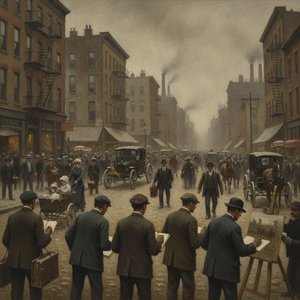
The scene unfolds on a darkened city street, meticulously rendered to convey the atmosphere of late at night during winter. Buildings loom in the background, punctuated by the spire of a church—a symbol of faith amidst the bustle of commerce and industry. Several figures populate the street: pedestrians bundled up against the snow, carrying umbrellas as they navigate the icy pavement; a horse-drawn carriage adds to the historical ambiance. Henri’s careful observation of detail isn't simply decorative; it serves to immerse the viewer in the sights and sounds of New York City at the turn of the century—a city grappling with rapid industrialization and social change.Symbolism Beyond Surface Appearance
Beyond its visual richness, *Street Scene with Snow* carries symbolic weight. The snow itself represents purity and renewal, juxtaposed against the grime and hardship of urban life. Henri’s deliberate choice to depict a commonplace street—rather than a grand boulevard or iconic landmark—underscores his conviction that beauty can be found in the ordinary. Furthermore, the artist's unflinching portrayal of human figures – individuals struggling to navigate their daily lives – speaks to themes of resilience and compassion. It’s a painting that invites contemplation on the dignity of labor and the importance of confronting uncomfortable truths about society.Similar Works and Artistic Influences
Robert Henri’s approach aligns closely with the broader artistic currents of his time, notably influenced by artists like George Morland who captured rural landscapes with remarkable detail and sensitivity. Similarly, Winslow Homer's watercolors—particularly *The Portage*—demonstrate a comparable dedication to portraying authentic human experience. Examining these kindred spirits illuminates Henri’s contribution to American art history and underscores the enduring power of realism as a means of conveying emotion and social commentary.- Explore Robert Henri’s page: Robert Henri
- Discover Yale University Art Gallery collection: Street Scene with Snow (57th Street, NYC.) Yale University Art Gallery
- Find more reproductions on TopImpressionists:Street Scene with Snow
Perguntas e Respostas
Por quais outros nomes Robert Henri é conhecido(a)?
Outros nomes registrados para Robert Henri, criador de "Street Scene with Snow", incluem Robert Henry Cozad.
Quão saturada é a paleta de "Street Scene with Snow"?
As cores de "Street Scene with Snow" de Robert Henri possuem uma saturação Subtle Color. A saturação descreve o quão vívidas ou suaves são as cores.
Onde posso baixar "Street Scene with Snow" de Robert Henri?
Um download está disponível para "Street Scene with Snow": a página de Baixar da obra oferece download de imagem digital em alta resolução.


Biografia do Artista
A Turbulent Genesis: The Early Life of Robert Henri
Robert Henri, born Robert Henry Cozad in Cincinnati, Ohio, in 1865, carried within him from the outset a sense of displacement and reinvention that would profoundly shape both his life and art. His childhood was far from idyllic; shadowed by the volatile relationship between his father, John Jackson Cozad—a man of ambition and risk as a gambler and real estate developer—and his mother, Theresa Gatewood Cozad. This instability culminated in a dramatic event in 1882: a fatal shooting over a land dispute that forced the family into flight, adopting new identities to escape retribution. Young Robert became Robert Henri, a deliberate severing from a past fraught with conflict and a symbolic rebirth as an artist. The westward journey through Nebraska and Colorado, culminating in a settling in New York City and then Atlantic City, instilled within him a deep empathy for those living on the fringes of society—an empathy that would become a defining characteristic of his artistic vision. This early experience of upheaval and reinvention fostered a spirit of independence and a commitment to portraying life as it truly was, unburdened by convention or societal expectation.Forging a New Vision: Artistic Development and Influences
Henri’s formal artistic education began at the Pennsylvania Academy of the Fine Arts in Philadelphia under Thomas Anshutz, where he honed his technical skills. However, it was his subsequent journey to Paris in 1888 that truly ignited his artistic awakening. Initially drawn to the academic tradition at the Académie Julian and influenced by masters like William-Adolphe Bouguereau and François Millet, Henri gradually gravitated towards Impressionism. Yet, he wasn’t content with merely replicating what he saw; he sought a more profound engagement with reality—a way to capture not just the fleeting effects of light but also the raw emotion and vitality of modern life. This quest led him to embrace a bolder, more direct approach, influenced by the Dutch Realist Franz Hals, whose loose brushwork and psychological insight resonated deeply with Henri’s own artistic sensibilities. He began experimenting with *pochades*, small wood panels used for quick sketches, encouraging spontaneity and immediacy in his work. Returning to America, he became a dedicated teacher, imparting not just technique but also a philosophy of art rooted in observation, honesty, and individual expression.Championing the Real: The Ashcan School and “The Eight”
Robert Henri’s impact on American art extended far beyond his own canvases; he became a catalyst for change, challenging the conservative norms of the established art world. He was a central figure in the emergence of the Ashcan School—a group of artists who dared to depict the gritty realities of urban life, from bustling city streets to crowded tenements. Henri’s commitment to realism and his rejection of academic pretension led him to organize “The Eight” in 1908—a collective of like-minded artists including William Glackens, George Luks, Everett Shinn, and John Sloan—who staged an independent exhibition as a direct protest against the restrictive policies of the National Academy of Design. This act of defiance was a watershed moment in American art history, signaling a shift away from European dominance and towards a uniquely American artistic voice. Henri’s paintings during this period, such as “Woman in Manteau” (1899) and his evocative portraits, captured the dignity and resilience of ordinary people, offering a powerful counterpoint to the idealized representations favored by the establishment.Legacy and Enduring Influence
Robert Henri’s influence on subsequent generations of American artists is immeasurable. As a teacher, he mentored a remarkable roster of talent, including Joseph Stella, Edward Hopper, Rockwell Kent, George Bellows, Norman Raeben, Louis D. Fancher, and Stuart Davis—artists who would go on to shape the course of 20th-century art. His book, *The Art Spirit*, published posthumously in 1923, remains a seminal text for aspiring artists, offering timeless wisdom on observation, technique, and the importance of artistic integrity. *Henri’s commitment to portraying life with honesty and empathy*, his rejection of convention, and his unwavering belief in the power of art to connect with audiences continue to inspire artists today. His paintings are not merely representations of reality; they are windows into the human condition—testaments to the beauty, struggle, and resilience of the human spirit. He left an indelible mark on American Realism, paving the way for a more democratic and inclusive art world that celebrated the everyday experiences of ordinary people. His legacy endures not only through his own masterful works but also through the countless artists he inspired to find their own voices and tell their own stories.
Robert Henri
1865 - 1929 , Estados Unidos da América
Informações Rápidas
- Artistic Movement Or Style: Ashcan School, Realismo
- Artists Or Movements Influenced By This Artist:
- Hopper
- The Eight
- Artists Who Influenced This Artist:
- Bouguereau
- Millet
- Date Of Birth: 24 Jun 1865
- Date Of Death: 12 Jul 1929
- Full Name: Robert Henry Cozad
- Nationality: Americano
- Notable Artworks:
- Mulher Lendo
- Neige
- Sissy
- Place Of Birth: Cincinnati, EUA
Artigos Relacionados
The Ashcan School: Capturing the Raw, Unfiltered Soul of Urban Life through American Realism
Discover the raw beauty of the Ashcan School. Explore how masters like Bellows and Henri captured the gritty, vibrant soul of early 20th-century New York through profound American Realism and evocative urban landscapes.

The Unvarnished Truth: A Cultural Journey Through the Soul of American Realism
Explore the profound beauty of American Realism. From the Ashcan School's urban grit to intimate portraits, discover how artists captured the authentic soul of a nation through unvarnished truth and masterful observation.
Explore obras de arte organizadas por temas, estilos e características.
