

Exibido: · Com a moldura:
 Visualizar na parede
 Compartilhar
 Compartilhar
 Detalhes
 Guia
Guia

 Baixar imagem
 Semelhantes
 Raio X
 Ver diaporama
 Perguntas e Respostas
 Estatísticas
- 24.0 x 15.0 cm


€ 240
Reprodução em Óleo Feita à Mão
Óleo sobre tela pintado à mão no tamanho e moldura de sua escolha, feito sob encomenda pelos nossos artistas. ( Alternar para Impressão Alternar para Imagem Digital)
Tamanho
·Tamanho padrão
personalizado
CM
INCH
Escolha entre os nossos tamanhos pré-definidos que respeitam as proporções originais da obra de arte.
Carregando tamanhos...

largura
altura
Insira a largura e a altura desejadas para se ajustarem à sua moldura ou parede. Como esta obra é pintada à mão, para um tamanho com proporções diferentes, o artista poderá pintar um pouco mais ao redor da imagem ou reduzir ligeiramente a composição — você escolhe. Enviamos uma maquete digital para sua aprovação antes de iniciar a pintura. A imagem exibida nesta página não representa o resultado real — apenas a maquete mostra o resultado final.
 Leia mais
Finalizar
·
Branco €1

Bordas esfumaçadas €1

Bordas estendidas €1

P118B €10

P118H €10

P118W €10

P438Z €10

P508JH €12

P508YH €12

P805H €10

P805Z €10

P919BZ €10

P919G €10

P919XJ €10

P959ZH €10

P968JZ €12

W106C €8

W218G €10

W218JH €8

W218Y €10

W307PJ €10

W316G €10

W316PJ €8

W316Y €10

W398PJ €8

W4111J €10

W500HY €15

W500JH €15

W692G €12

W849H €8

W940BG €15

W953PJ €8

H24-GOLD €30

H24-SILVER €30

H36-GOLD €45

H36-SILVER €45
Enviado em um tubo protetor, pronto para ser emoldurado por você.
Extras
opcionalO que os extras incluem?
Exemplos do que pode ser alterado: Substituir o rosto pela foto do cliente; Adicionar um animal de estimação (ex: substituir gato por cachorro); Incluir uma mensagem oculta no fundo; Alterar a paisagem ou elementos do fundo.
Após o pedido, a equipe da TopImpressionists.com enviará um e-mail ao cliente para instruções e fornecerá uma prévia da montagem
Após o pedido, a equipe da TopImpressionists.com enviará um e-mail ao cliente para instruções e fornecerá uma prévia da montagem
Entrega mundial () em 3 a 4 semanas, em vez das 5 semanas padrão. (8 Novembro). Sem comprometer a qualidade.
Verniz de Proteção
Etiqueta de identificação
Detalhes da Placa de Bronze Gravada
This elegant plaque features the artist's name and the title of the artwork, finely engraved for a timeless presentation.
It is made from bronze with a refined, elegant finish. The text is precisely laser-engraved for a sharp and permanent result. Measuring 9x2 cm, the plaque is compact yet easy to read. It's built to be durable and scratch-resistant, offering a professional, museum-quality look. Mounting is simple thanks to the included adhesive backing.
Detalhes da Placa de Acrílico Transparente
The plaque includes essential engraved details such as the artist's name, the title of the artwork, the date it was created, the type of media used-like oil on canvas or watercolor-a brief description of the piece, and a QR code that links to the complete artwork information.
It is crafted from clear acrylic, offering a sleek, modern appearance. The text is UV-engraved in black to ensure strong visual contrast. With a size of 10x15 cm, it ensures optimal readability. It comes equipped with two metal hooks for secure wall mounting. The plaque is designed to be weather-resistant, making it suitable for various environments, and it includes interactive features that work seamlessly with smartphone scanning.
Detalhes da Placa de Acrílico Preto
This elegant plaque includes engraved information such as the artist's name, the title of the artwork, the date it was created, the type of media used (like oil on canvas or watercolor), a short description of the artwork, and a QR code for quick access to more information.
The plaque itself is made from refined black acrylic with a premium finish. The text is laser-engraved in white for high contrast and readability. Its size is 10x15 cm, designed to be easy to read. It comes with two metal hooks for professional mounting. The design is sleek and fits any interior style. It is also weather-resistant and durable, with built-in digital integration for mobile compatibility.
A opção de vidro está disponível apenas para tamanhos inferiores a 110 cm
 A opção de vidro está disponível apenas para tamanhos inferiores a 110 cm
- Envio expresso gratuito para todo o mundo
- Tela de Linho de Alta Qualidade
- Seguro de transporte completo
- Garantia de Reembolso de Impostos Alfandegários
- Garantia de Fidelidade Cromática
- Política de Devolução em 100 Dias (Apenas para Defeitos)
- Garantia de reembolso de 100%
- Oferta de desconto por quantidade


Descrição do Item
Biografia do Artista
Descubra Simone Martini, mestre da elegância e graça! Suas pinturas góticas internacionais – como 'Maestà' – unem temas religiosos à sofisticação e detalhes deslumbrantes.
Sobre a pintura
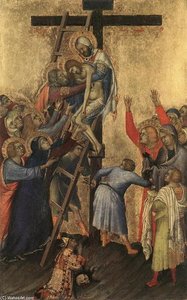
A Moment Frozen in Sorrow: Simone Martini’s Deposition
Simone Martini's *Deposition*, painted circa 1333, transcends mere depiction; it embodies the spiritual fervor and artistic sophistication characteristic of Siena during its golden age. Created amidst a period marked by profound religious contemplation and burgeoning humanist ideals—a fascinating crossroads between medieval piety and nascent Renaissance sensibilities—this masterpiece offers an unparalleled glimpse into the visual language of its time. The painting’s subject matter is undeniably solemn: Jesus Christ, having been crucified, lies upon a draped cloth, attended by Mary Magdalene, Nicodemus, Joseph of Arimathea, and several other figures representing grief and reverence. Martini skillfully captures this poignant tableau with an exquisite blend of meticulous detail and graceful elegance.- Style & Technique: Martini’s style is firmly rooted in International Gothic art, a movement renowned for its luminous color palettes, elongated figures, and painstaking realism—a deliberate departure from the stylized representations prevalent earlier in the century. The artist employs tempera paint on panel, a technique favored by Sienese artists of this era, resulting in vibrant hues that shimmer with an ethereal glow. Observe particularly the delicate rendering of drapery folds and facial expressions; Martini’s mastery lies in conveying emotion through subtle nuances of line and color.
- Historical Context: Siena during Martini's lifetime was a powerful ecclesiastical city, deeply invested in artistic patronage—a testament to its unwavering faith. The painting reflects the pervasive preoccupation with death and resurrection within Christian theology, mirroring the broader cultural anxieties surrounding mortality that underpinned much of medieval art. Furthermore, it speaks to the evolving understanding of Christ’s suffering as portrayed by humanist thinkers who began to question traditional interpretations.
Perguntas e Respostas
Que harmonia de cores apresenta "Deposition", de Simone Martini?
As cores de "Deposition", de Simone Martini apresentam uma harmonia Unified Palette. A harmonia descreve como as cores se relacionam entre si.
Como posso visualizar "Deposition", de Simone Martini em formato de apresentação de slides?
O diaporama de "Deposition" pode ser visualizado na página Apresentação de imagens da obra.
Qual ambiente combina com as cores de "Deposition", de Simone Martini?
Com sua paleta Earthy, "Deposition", de Simone Martini é recomendado para um Living Room. As cores são parte do motivo desta sugestão.
Informações rápidas e quiz de arte
Sobre Simone Martini

Simone Martini
1284 - 1344, Itália
Biografia do Artista
A Sienese Master of Elegance and Grace
Simone Martini, born around 1284 in the heart of Siena, Italy, stands as a pivotal figure in the transition from medieval to Renaissance art. He wasn’t merely a painter; he was an architect of elegance, a master of line and color who infused his works with a courtly refinement that distinguished him from contemporaries like Giotto. While historical accounts vary regarding his early training—some suggest apprenticeship under Duccio di Buoninsegna, the leading Sienese artist of the time, while others point to Florence and the influence of Giotto—Martini undeniably forged a unique artistic path. His brother-in-law, Lippo Memmi, was also an artist with whom he frequently collaborated, further enriching the vibrant artistic landscape of Siena. The city itself played a crucial role in shaping Martini’s aesthetic; Siena, a thriving center of commerce and culture, fostered an environment where art flourished, blending religious devotion with worldly sophistication.
The Flourishing of International Gothic
Martini's style is immediately recognizable for its departure from the more monumental forms favored in Florence. He embraced a delicate sensibility, characterized by flowing lines, soft decorative details, and an overall sense of grace. This aesthetic wasn’t born in isolation; it was profoundly influenced by external forces. The Via Francigena, a major pilgrimage route traversing Europe, brought with it artistic currents from France—particularly the refined elegance of French manuscript illumination and ivory carving. These influences are readily apparent in Martini's work, manifesting as intricate patterns, elongated figures, and a heightened attention to surface ornamentation. He didn’t simply copy these styles; he synthesized them with existing Sienese traditions, creating something entirely new. His paintings weren’t merely representations of religious scenes but rather elegant narratives imbued with emotional depth and visual poetry.
From Siena to Avignon: A Courtly Appointment
Martini's reputation extended beyond the borders of Italy, leading to a significant turning point in his career. In 1336, he accepted a commission from Pope Benedict XII to create frescoes for the Papal Palace in Avignon, France—a move that placed him at the heart of European power and patronage. This appointment wasn’t merely about artistic skill; it was a testament to Martini's ability to cater to the tastes of a sophisticated courtly audience. While in Avignon, he entered into a remarkable intellectual circle, befriending Francesco Petrarca—better known as Petrarch, the renowned humanist poet. The connection with Petrarch is particularly poignant, as Vasari and other sources suggest that Martini painted a portrait of Laura de Noves, Petrarch’s lifelong muse. Though the portrait itself is lost to time, its very existence speaks volumes about Martini's status as a celebrated artist capable of capturing not only physical likeness but also the essence of beauty and inspiration. The Annunciation with St. Margaret and St. Ansanus, created during his time in Florence before moving to Avignon, is a testament to this period, showcasing delicate beauty and refined aesthetic.
Major Works and Artistic Techniques
Martini’s most celebrated works exemplify the culmination of his artistic development. The *Maestà*, painted between 1312 and 1315 for the Palazzo Pubblico in Siena, remains a cornerstone of his legacy. This monumental fresco depicts the Virgin Mary enthroned with angels and saints, showcasing Martini's mastery of perspective, color, and composition. It’s a prime example of the International Gothic style—characterized by its elegance, refined details, and graceful figures. His *Saint Louis of Toulouse Crowning His Brother Robert of Anjou*, painted in 1317 during his time in Naples, demonstrates his ability to depict complex scenes with clarity and grace, while simultaneously imbuing them with a sense of courtly splendor. The *Annunciation* triptych, created for the Siena Cathedral (now housed in the Uffizi Gallery), is another significant work—a testament to Martini’s skill in creating emotionally resonant religious narratives. His equestrian portrait representing Guidoriccio da Fogliano, general of the Sienese republic, painted around 1328, stands as a pioneering example of this genre in Italy.
Legacy and Enduring Influence
Simone Martini’s impact on the development of European art cannot be overstated. He played a crucial role in disseminating the International Gothic style—a movement characterized by its elegance, refinement, and emphasis on decorative detail—across the continent. His influence extended to generations of artists who followed, shaping the course of late medieval and early Renaissance painting. Martini’s work wasn’t simply about technical skill; it was about creating a visual language that resonated with the sensibilities of his time—a language of beauty, grace, and spiritual devotion. Even today, his paintings continue to captivate viewers with their exquisite detail, harmonious compositions, and enduring sense of elegance. His frescoes in San Francesco d’Assisi demonstrate his mastery of large-scale decorative painting, while works like the Saint Catherine of Alexandria Polyptych showcase his unparalleled command of color and form. Simone Martini died in Avignon in 1344, leaving behind a legacy that continues to inspire awe and admiration centuries later—a testament to the enduring power of art to transcend time and touch the human spirit.
Informações rápidas sobre Simone Martini
- Artistic Movement Or Style: Gótico Internacional
- Artists Or Movements Influenced By This Artist: ['Escola Sienesa']
- Artists Who Influenced This Artist:
- Duccio di Buoninsegna
- Giotto
- Date Of Birth: c. 1284
- Date Of Death: 1344
- Full Name: Simone Martini
- Nationality: Italiano
- Notable Artworks:
- Maestà
- Anunciação
- Saint Louis
- Place Of Birth: Siena, Itália
Explore obras de arte organizadas por temas, estilos e características.


Simone Martini
Deposition
() ·
Com a moldura: · Pintura a óleo sobre linho feita à mão
Total