

Shown: · With its frame:
 Visualizar na parede
 Compartilhar
 Compartilhar
 Detalhes
 Guia
Guia

 Baixar imagem
 Semelhantes
 Raio X
 Ver diaporama
 Q&A
Q&A Estatísticas


€ 239
Reprodução em Óleo Feita à Mão
Óleo sobre tela pintado à mão no tamanho e moldura de sua escolha, feito sob encomenda pelos nossos artistas. ( Alternar para Impressão Alternar para Imagem Digital)
Size
·Tamanho padrão
personalizado
CM
INCH
Escolha entre os nossos tamanhos pré-definidos que respeitam as proporções originais da obra de arte.
Loading sizes...

largura
altura
Insira a largura e a altura desejadas para se ajustarem à sua moldura ou parede. Como esta obra é pintada à mão, para um tamanho com proporções diferentes, o artista poderá pintar um pouco mais ao redor da imagem ou reduzir ligeiramente a composição — você escolhe. Enviamos uma maquete digital para sua aprovação antes de iniciar a pintura. A imagem exibida nesta página não representa o resultado real — apenas a maquete mostra o resultado final.
 Leia mais
Finish
·
White €1

Blurside €1

Extended €1

P118B €10

P118H €10

P118W €10

P438Z €10

P508JH €12

P508YH €12

P805H €10

P805Z €10

P919BZ €10

P919G €10

P919XJ €10

P959ZH €10

P968JZ €12

W106C €8

W218G €10

W218JH €8

W218Y €10

W307PJ €10

W316G €10

W316PJ €8

W316Y €10

W398PJ €8

W4111J €10

W500HY €15

W500JH €15

W692G €12

W849H €8

W940BG €15

W953PJ €8

H24-GOLD €30

H24-SILVER €30

H36-GOLD €45

H36-SILVER €45
Shipped in a protective tube, ready for your own framer.
Above 105 cm the frame is shipped as a kit for a professional framer — read the details.
Extras
optionalWhat do the extras include?
Examples of what can be changed: Replace face with customer photo; Add pet (e.g., replace cat with dog); Include hidden message in background; Change background landscape or elements.
After order, TopImpressionists.com team will email client for instructions and provide a mockup preview
After order, TopImpressionists.com team will email client for instructions and provide a mockup preview
Entrega mundial () em 3 a 4 semanas, em vez das 5 semanas padrão. (1 Novembro). Sem comprometer a qualidade.
Verniz de Proteção
Etiqueta de identificação
Detalhes da Placa de Bronze Gravada
This elegant plaque features the artist's name and the title of the artwork, finely engraved for a timeless presentation.
It is made from bronze with a refined, elegant finish. The text is precisely laser-engraved for a sharp and permanent result. Measuring 9x2 cm, the plaque is compact yet easy to read. It's built to be durable and scratch-resistant, offering a professional, museum-quality look. Mounting is simple thanks to the included adhesive backing.
Detalhes da Placa de Acrílico Transparente
The plaque includes essential engraved details such as the artist's name, the title of the artwork, the date it was created, the type of media used-like oil on canvas or watercolor-a brief description of the piece, and a QR code that links to the complete artwork information.
It is crafted from clear acrylic, offering a sleek, modern appearance. The text is UV-engraved in black to ensure strong visual contrast. With a size of 10x15 cm, it ensures optimal readability. It comes equipped with two metal hooks for secure wall mounting. The plaque is designed to be weather-resistant, making it suitable for various environments, and it includes interactive features that work seamlessly with smartphone scanning.
Detalhes da Placa de Acrílico Preto
This elegant plaque includes engraved information such as the artist's name, the title of the artwork, the date it was created, the type of media used (like oil on canvas or watercolor), a short description of the artwork, and a QR code for quick access to more information.
The plaque itself is made from refined black acrylic with a premium finish. The text is laser-engraved in white for high contrast and readability. Its size is 10x15 cm, designed to be easy to read. It comes with two metal hooks for professional mounting. The design is sleek and fits any interior style. It is also weather-resistant and durable, with built-in digital integration for mobile compatibility.
A opção de vidro está disponível apenas para tamanhos inferiores a 110 cm
 A opção de vidro está disponível apenas para tamanhos inferiores a 110 cm
- Envio expresso gratuito para todo o mundo
- Tela de Linho de Alta Qualidade
- Seguro de transporte completo
- Garantia de Reembolso de Impostos Alfandegários
- Garantia de Fidelidade Cromática
- Política de Devolução em 100 Dias (Apenas para Defeitos)
- Garantia de reembolso de 100%
- Oferta de desconto por quantidade


Descrição do Item
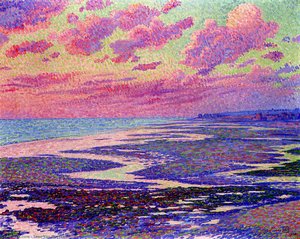
Experience Theo van Rysselberghe's 'Seascape,' a captivating Neo-Impressionist oil painting of a serene coastal scene. Admire the vibrant colors, dreamy atmosphere, and masterful brushwork in this iconic masterpiece.
Biografia do Artista
Descubra as vibrantes pinturas neoimpressionistas de Théo van Rysselberghe! Explore seus paisagens, retratos e cenas marroquinas – uma figura-chave dos Les XX, misturando luz e cor.
About the painting
A Symphony of Light and Sea: Theo van Rysselberghe’s “Seascape”
Theo van Rysselberghe's "Seascape," painted in 1893, isn’t merely a depiction of the ocean; it’s an immersion into a world where light dances upon water and tranquility reigns supreme. This oil on canvas, currently residing within the Indianapolis Museum of Art, embodies the heart of Post-Impressionism – a movement characterized by its vibrant color palettes, subjective perspectives, and a deliberate departure from strict realism. Van Rysselberghe, a pivotal figure bridging Impressionism and Neo-Impressionism, masterfully captures not just the visual elements of the seascape but also an elusive sense of mood and atmosphere, inviting the viewer into a contemplative space.
The painting immediately draws the eye to its luminous sky – a wash of yellows and blues that suggest both dawn and dusk. These aren’t the sharp, defined colors of traditional landscape art; instead, they bleed into one another with remarkable fluidity, creating an ethereal quality. Below this celestial expanse unfolds a deep azure ocean, punctuated by the gentle whitecaps of waves. The artist's brushstrokes are loose and expressive, avoiding meticulous detail in favor of conveying the *feeling* of movement and light. Two small boats navigate these waters, their forms subtly rendered against the vastness of the sea, hinting at human presence without dominating the scene.
Neo-Impressionism’s Dance with Light
Van Rysselberghe's approach aligns perfectly with the tenets of Neo-Impressionism. This movement, emerging in the late 19th century, built upon Impressionism but sought to introduce a more scientific and deliberate method to color theory. Artists like Van Rysselberghe employed “pointillism” – applying tiny dots of pure color to create an optical mixture when viewed from a distance. While not as rigorously executed as in works by Seurat or Signac, the influence is evident in the layering of colors and the overall effect of shimmering light. The painting’s vibrancy isn't achieved through blending on the palette but through the careful juxtaposition of individual hues.
The inclusion of a solitary figure near the left center adds an intriguing layer to the composition. This individual, seemingly lost in contemplation against the backdrop of the expansive sea, serves as a focal point for the viewer’s gaze. It's not a portrait in the traditional sense; rather, it represents humanity’s smallness and vulnerability when confronted with the immensity of nature. The figure’s presence subtly elevates the painting beyond a simple seascape, transforming it into a meditation on scale, perspective, and the human condition.
A Moroccan Echo & Belgian Roots
Van Rysselberghe's artistic journey was profoundly shaped by his extensive travels, particularly his sojourns in Morocco between 1882 and 1883. These experiences ignited a passion for capturing the intense light and vibrant colors of the North African landscape. The influence of these travels is palpable in “Seascape,” evident in the warm tones and the evocative depiction of the sea’s surface. His time in Morocco also fostered an appreciation for the interplay between color, shadow, and atmosphere – elements that he skillfully integrates into this painting.
Born in Ghent, Belgium, Van Rysselberghe's early training instilled a grounding in traditional realism. However, his travels and engagement with contemporary artistic movements propelled him toward a more expressive and subjective style. “Seascape” represents a harmonious synthesis of these influences – a testament to the artist’s ability to blend technical skill with emotional depth.
Capturing Tranquility: A Reproduction for Your Space
Reproductions of "Seascape" offer a remarkable opportunity to bring this evocative artwork into your home or office. The meticulous detail and vibrant colors are faithfully recreated, allowing you to experience the painting’s serene atmosphere firsthand. Whether displayed in a coastal room, a study, or a gallery wall, this reproduction serves as a constant reminder of the beauty and tranquility found within nature – a timeless piece that speaks to the soul.
Consider commissioning a hand-painted replica from TopImpressionists.com for an authentic experience, capturing the nuances of Van Rysselberghe’s technique and ensuring a treasured addition to your collection. The painting's legacy continues through these reproductions, allowing its beauty to be shared with a wider audience.
Perguntas e Respostas
Que sentimento transmite "Seascape", de Théo van Rysselberghe?
Em "Seascape", um clima Calm acompanha uma emoção Tranquil.
"Seascape", de Théo van Rysselberghe é uma pintura, um desenho ou uma gravura?
No catálogo, "Seascape", de Théo van Rysselberghe está registrado como WallArt. A categoria ajuda a encontrar obras semelhantes.
Quão harmoniosas são as cores de "Seascape", de Théo van Rysselberghe?
"Seascape", de Théo van Rysselberghe apresenta uma harmonia de cores Strong Color Unity.
Quick facts and art quiz
About Théo van Rysselberghe

Théo van Rysselberghe
1862 - 1926, Bélgica
Biografia do Artista
A Pioneer of Light: The Life and Art of Théo van Rysselberghe
Théophile “Théo” van Rysselberghe, born in Ghent, Belgium, in 1862, stands as a pivotal figure bridging the vibrant currents of Impressionism and the groundbreaking principles of Neo-Impressionism. His artistic journey wasn’t defined by immediate stylistic allegiance but rather by a continuous exploration fueled by travel, intellectual exchange, and an unwavering dedication to capturing the essence of light itself. Rooted in a comfortable bourgeois French-speaking family, van Rysselberghe's initial artistic training unfolded within the rigorous structure of the Ghent Academy under Theo Canneel, followed by further studies at the prestigious Académie Royale des Beaux-Arts in Brussels – institutions that instilled in him a foundational understanding of traditional realism. Early works like *Self-Portrait with Pipe* (1880) reveal this early grounding, characterized by meticulous detail and somber tones—a reflection of the prevailing artistic climate within Belgium at the time. Yet, even within these initial pieces, subtle hints began to emerge: a burgeoning sensitivity to light and color, foreshadowing the radical shifts that would characterize his later career. *Child in an Open Spot of the Forest* (1880) serves as a particularly poignant example, hinting at a brighter palette and looser brushwork—a nascent departure from the established norms.Moroccan Impressions: A Catalyst for Transformation
A truly transformative period commenced with van Rysselberghe’s extended sojourns in Morocco between 1882 and 1888. These immersive experiences acted as a profound catalyst, plunging him into a world saturated with vibrant colors, intense sunlight, and exotic landscapes—a dramatic contrast to the subdued tones of his earlier work. Paintings such as *Arabian Street Cobbler* (1882), *Arabian Boy* (1882), and *Resting Guard* (1883) vividly demonstrate this burgeoning fascination with capturing the effects of light upon form, moving decisively away from strict realism towards a more impressionistic sensibility. However, these travels were not merely acts of visual observation; they represented an immersion into a distinct culture—a broadening of his artistic horizons and a lifelong embrace of travel as a source of inspiration. The Moroccan experience fundamentally altered his perception of color and light, laying the groundwork for his future innovations. It was during this period that he began to experiment with capturing the fleeting effects of sunlight on surfaces, anticipating the techniques of Seurat and Signac.The Birth of Les XX: A Hub for Avant-Garde Art
Returning to Brussels in 1888, van Rysselberghe became a central figure in the burgeoning avant-garde scene. He played a crucial role in establishing *Les XX* (Les Vingt), an influential group of artists and writers dedicated to promoting innovative art forms—a collective that would profoundly shape the artistic landscape of Belgium. Alongside Octave Maus and Émile Verhaeren, van Rysselberghe spearheaded this movement, creating a platform for showcasing radical ideas and challenging established conventions. *Arabian Phantasia* (1884), a monumental painting depicting an exotic scene, stands as a testament to the group’s ambition and van Rysselberghe's growing confidence in his own artistic vision. The establishment of Les XX marked a turning point, providing him with a supportive environment for experimentation and collaboration—a space where he could refine his techniques and engage with fellow artists pushing the boundaries of contemporary art.Embracing Neo-Impressionism: A Scientific Approach to Color
The pivotal moment in van Rysselberghe’s artistic evolution arrived with his encounter with Georges Seurat's *A Sunday on La Grande Jatte* (1884–86) at the eighth Impressionist exhibition in Paris. Initially skeptical of Seurat’s meticulously planned “pointillist” technique—the systematic application of tiny dots of pure color—van Rysselberghe gradually came to appreciate its underlying scientific principles and potential for achieving luminous effects. He began experimenting with divisionism, the Neo-Impressionist method of separating colors into their constituent parts and allowing the viewer’s eye to blend them optically. This wasn't simply a technical shift; it represented a fundamental change in his approach to painting—a move towards a more analytical and objective representation of light and color. He forged close friendships with other Neo-Impressionist painters like Paul Signac, traveling with him along the French Riviera and exchanging ideas about technique and theory. Van Rysselberghe distinguished himself within the movement by applying pointillism not only to landscapes but also to portraiture, creating strikingly vibrant and psychologically insightful likenesses of his family and friends—works such as *Madame Charles Maus* (1890) are prime examples.Beyond Pointillism: A Lasting Legacy
While deeply committed to Neo-Impressionism for a significant period, van Rysselberghe eventually moved beyond its strict tenets in the late 1890s. He sought greater freedom in his brushwork and compositions, exploring new ways to express emotion and atmosphere. He continued to be a prolific artist, working in various media including furniture design, book illustration, and decorative arts. His influence extended far beyond Belgium, impacting artists like Piet Mondrian and Jan Toorop who were inspired by his innovative use of color and light. Van Rysselberghe’s legacy lies not only in his beautiful paintings but also in his role as a catalyst for artistic change—a champion of modernism who helped introduce new ideas and techniques to the Belgian art world. His works are now held in prominent museum collections worldwide, including the Musée du Luxembourg in Paris and the Museum voor Schone Kunsten in Ghent, ensuring that his contribution to the history of art continues to be celebrated and appreciated by generations to come. His dedication to exploring the interplay of light, color, and form cemented his place as a true pioneer of modern painting.Quick facts about Théo van Rysselberghe
- Artistic Movement Or Style: Neo-Impressionismo
- Artists Or Movements Influenced By This Artist:
- Les XX
- Piet Mondrian
- Artists Who Influenced This Artist:
- Georges Seurat
- Paul Signac
- Date Of Birth: 23 Nov 1862
- Date Of Death: 13 Dez 1926
- Full Name: Théophile van Rysselberghe
- Nationality: Bélgica
- Notable Artworks:
- Arabian Phantasia
- Madame Charles Maus
- Place Of Birth: Gante, Bélgica
Obras Relacionadas





Explore obras de arte organizadas por temas, estilos e características.


Théo van Rysselberghe
Seascape
() ·
With its frame: · Hand-painted in oil on linen
Total