

Exibido: · Com a moldura:
 Visualizar na parede
 Compartilhar
 Compartilhar
 Detalhes
 Guia
Guia

 Baixar imagem
 Semelhantes
 Raio X
 Ver diaporama
 Perguntas e Respostas
 Estatísticas
- 22.0 x 34.0 cm


€ 263
Reprodução em Óleo Feita à Mão
Óleo sobre tela pintado à mão no tamanho e moldura de sua escolha, feito sob encomenda pelos nossos artistas. ( Alternar para Impressão Alternar para Imagem Digital)
Tamanho
·Tamanho padrão
personalizado
CM
INCH
Escolha entre os nossos tamanhos pré-definidos que respeitam as proporções originais da obra de arte.
Carregando tamanhos...

largura
altura
Insira a largura e a altura desejadas para se ajustarem à sua moldura ou parede. Como esta obra é pintada à mão, para um tamanho com proporções diferentes, o artista poderá pintar um pouco mais ao redor da imagem ou reduzir ligeiramente a composição — você escolhe. Enviamos uma maquete digital para sua aprovação antes de iniciar a pintura. A imagem exibida nesta página não representa o resultado real — apenas a maquete mostra o resultado final.
 Leia mais
Finalizar
·
Branco €1

Bordas esfumaçadas €1

Bordas estendidas €1

P118B €10

P118H €10

P118W €10

P438Z €10

P508JH €12

P508YH €12

P805H €10

P805Z €10

P919BZ €10

P919G €10

P919XJ €10

P959ZH €10

P968JZ €12

W106C €8

W218G €10

W218JH €8

W218Y €10

W307PJ €10

W316G €10

W316PJ €8

W316Y €10

W398PJ €8

W4111J €10

W500HY €15

W500JH €15

W692G €12

W849H €8

W940BG €15

W953PJ €8

H24-GOLD €30

H24-SILVER €30

H36-GOLD €45

H36-SILVER €45
Enviado em um tubo protetor, pronto para ser emoldurado por você.
Extras
opcionalO que os extras incluem?
Exemplos do que pode ser alterado: Substituir o rosto pela foto do cliente; Adicionar um animal de estimação (ex: substituir gato por cachorro); Incluir uma mensagem oculta no fundo; Alterar a paisagem ou elementos do fundo.
Após o pedido, a equipe da TopImpressionists.com enviará um e-mail ao cliente para instruções e fornecerá uma prévia da montagem
Após o pedido, a equipe da TopImpressionists.com enviará um e-mail ao cliente para instruções e fornecerá uma prévia da montagem
Entrega mundial () em 3 a 4 semanas, em vez das 5 semanas padrão. (5 Novembro). Sem comprometer a qualidade.
Verniz de Proteção
Etiqueta de identificação
Detalhes da Placa de Bronze Gravada
This elegant plaque features the artist's name and the title of the artwork, finely engraved for a timeless presentation.
It is made from bronze with a refined, elegant finish. The text is precisely laser-engraved for a sharp and permanent result. Measuring 9x2 cm, the plaque is compact yet easy to read. It's built to be durable and scratch-resistant, offering a professional, museum-quality look. Mounting is simple thanks to the included adhesive backing.
Detalhes da Placa de Acrílico Transparente
The plaque includes essential engraved details such as the artist's name, the title of the artwork, the date it was created, the type of media used-like oil on canvas or watercolor-a brief description of the piece, and a QR code that links to the complete artwork information.
It is crafted from clear acrylic, offering a sleek, modern appearance. The text is UV-engraved in black to ensure strong visual contrast. With a size of 10x15 cm, it ensures optimal readability. It comes equipped with two metal hooks for secure wall mounting. The plaque is designed to be weather-resistant, making it suitable for various environments, and it includes interactive features that work seamlessly with smartphone scanning.
Detalhes da Placa de Acrílico Preto
This elegant plaque includes engraved information such as the artist's name, the title of the artwork, the date it was created, the type of media used (like oil on canvas or watercolor), a short description of the artwork, and a QR code for quick access to more information.
The plaque itself is made from refined black acrylic with a premium finish. The text is laser-engraved in white for high contrast and readability. Its size is 10x15 cm, designed to be easy to read. It comes with two metal hooks for professional mounting. The design is sleek and fits any interior style. It is also weather-resistant and durable, with built-in digital integration for mobile compatibility.
A opção de vidro está disponível apenas para tamanhos inferiores a 110 cm
 A opção de vidro está disponível apenas para tamanhos inferiores a 110 cm
- Envio expresso gratuito para todo o mundo
- Tela de Linho de Alta Qualidade
- Seguro de transporte completo
- Garantia de Reembolso de Impostos Alfandegários
- Garantia de Fidelidade Cromática
- Política de Devolução em 100 Dias (Apenas para Defeitos)
- Garantia de reembolso de 100%
- Oferta de desconto por quantidade


Descrição do Item
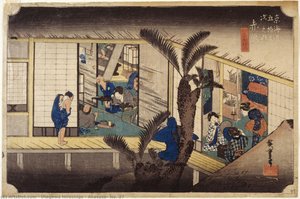
Discover 'Evening Snow at Kanbara' by Utagawa Hiroshige – a serene 1834 ukiyo-e print showcasing winter village life. Admire its monochrome beauty & tranquil composition.
Biografia do Artista
Utagawa Hiroshige foi um mestre do *ukiyo-e*, conhecido por paisagens poéticas e atmosféricas como as "53 Estações do Tōkaidō". Sua obra influenciou artistas ocidentais, marcando o início do Japonismo e eternizando a beleza da vida no Japão.
Sobre a pintura
A Moment Frozen in Time: The Essence of Utagawa Hiroshige
“Evening Snow at Kanbara,” a captivating woodblock print by the legendary Utagawa Hiroshige, isn't merely a depiction of a winter landscape; it’s an invitation to step into a serene and contemplative world. Created in 1834 during the vibrant Edo period, this piece embodies the core tenets of *ukiyo-e*, or “pictures of the floating world,” transforming everyday scenes into profound artistic statements. Hiroshige, often considered the last great master of this genre, possessed an extraordinary ability to capture not just the appearance of a place but also its very spirit – a quality powerfully evident in this evocative print.
The scene unfolds within a small Japanese village nestled amidst a vast expanse of snow-covered hills. The composition is deliberately restrained, prioritizing atmosphere and mood over meticulous detail. Buildings are rendered with simplified forms, their outlines softened by the printing technique, while figures – bundled in umbrellas against the biting cold – appear as fleeting glimpses of human life within this frozen landscape. This strategic use of negative space—the overwhelming presence of snow—draws attention to the delicate balance between humanity and nature, highlighting the resilience and quiet dignity of those who endure the harsh winter conditions.
The Language of Woodblock: Technique and Artistic Vision
Hiroshige’s mastery lies not only in his subject matter but also in his technical execution. The print is a testament to the intricate process of *ukiyo-e* production, relying on multiple woodblocks carved with painstaking precision. The base layer of grey tones establishes the foundational structure of the scene, while subtle gradations – achieved through layering and careful manipulation of ink—create depth and volume. Notice how the snow itself isn’t uniformly white; it’s infused with delicate shades of grey, suggesting the play of light and shadow as the sun dips below the horizon. The deliberate lack of strong shading contributes to the print's ethereal quality, lending a dreamlike atmosphere to the winter scene.
Furthermore, Hiroshige’s use of *bokashi*, or color gradation, is particularly noteworthy. This technique involved applying multiple layers of ink in varying concentrations to achieve subtle transitions and nuanced tonal effects—a hallmark of his style and a key element in conveying the atmospheric depth of the landscape. The monochrome palette, dominated by shades of grey and white, amplifies the sense of stillness and solitude, inviting viewers to contemplate the beauty of simplicity.
Symbolism and the Poetics of Nature
Beyond its aesthetic appeal, “Evening Snow at Kanbara” is rich in symbolic meaning. The snow itself represents purity, resilience, and the cyclical nature of life – a reminder that even amidst hardship, there’s an inherent beauty to be found. The villagers, huddled beneath their umbrellas, embody human adaptability and perseverance in the face of adversity. Their presence serves as a poignant counterpoint to the vastness and indifference of the natural world.
This print was part of Hiroshige's celebrated “Fifty-three Stations of the Tōkaidō” series, documenting his journey along Japan’s main highway. Each station offered a unique glimpse into the diverse landscapes and communities of Edo period Japan. Hiroshige’s ability to capture the essence of these locations—not just their physical appearance but also their atmosphere and spirit—solidified his reputation as one of the most influential artists in Japanese history, profoundly impacting both traditional *ukiyo-e* and later Western art movements like Impressionism.
Bringing Hiroshige’s Vision Home
Reproductions of “Evening Snow at Kanbara” offer a remarkable opportunity to bring this timeless masterpiece into your own space. Whether you choose an authentic woodblock print or a high-quality digital reproduction, the print's serene beauty and evocative atmosphere will undoubtedly enhance any room. Consider framing it in a simple, understated manner to allow the artwork’s inherent elegance to shine through – a subtle reminder of Hiroshige’s poetic vision and the enduring power of Japanese art.
Perguntas e Respostas
Qual disposição melhor se adapta ao formato de "Evening Snow at Kanbara", de Hiroshige?
O formato (Landscape) e o ambiente recomendado (Living Room) são as duas informações de posicionamento registradas para "Evening Snow at Kanbara", de Hiroshige.
Qual tamanho de reprodução é sugerido para "Evening Snow at Kanbara", de Hiroshige?
Recomenda-se o tamanho de impressão Medium para "Evening Snow at Kanbara". Outros tamanhos estão disponíveis com as mesmas proporções.
Qual paleta e cor predominante definem "Evening Snow at Kanbara"?
"Evening Snow at Kanbara" é definido por uma paleta Neutrals com destaque para Espresso (#474131).
Informações rápidas e quiz de arte
Sobre Hiroshige

Hiroshige
1797 - 1858, Japão
Biografia do Artista
A Poetic Vision of Edo Japan: The Life and Art of Utagawa Hiroshige
Utagawa Hiroshige, born Andō Tokutarō in 1797 in the bustling city of Edo (modern Tokyo), stands as a pivotal figure in the world of *ukiyo-e*, or “pictures of the floating world.” Though deeply rooted in the traditions of Japanese woodblock printing, Hiroshige transcended mere replication, imbuing his landscapes with a poetic sensibility that resonated profoundly both within Japan and, later, across the Western art world. His life unfolded during a period of relative peace and prosperity under the Tokugawa shogunate, yet also one marked by increasing social change and eventual westernization – forces that would ultimately contribute to the decline of *ukiyo-e* even as they amplified Hiroshige’s enduring legacy. Initially destined for a more conventional path within a samurai family—his father served as a fire warden—Hiroshige's artistic inclinations led him to apprenticeship under Utagawa Toyohiro, a master of the Utagawa school. This proved a crucial turning point, steering him away from the popular depictions of courtesans and actors favored by many *ukiyo-e* artists toward a focus on landscape, a genre he would ultimately redefine.From Genre Scenes to Evocative Landscapes
Hiroshige’s early work adhered to the conventions of his school, featuring portraits and scenes from daily life. However, it was his embrace of landscape that truly distinguished him. Influenced by earlier masters like Hokusai—whose *Thirty-six Views of Mount Fuji* had already captivated audiences—Hiroshige developed a unique style characterized by atmospheric perspective, subtle color palettes, and a profound sensitivity to the changing seasons. He didn’t merely depict places; he evoked their mood, capturing the essence of a particular moment in time. The series *The Fifty-three Stations of the Tōkaidō* (1833–1834), perhaps his most celebrated achievement, exemplifies this approach. This monumental work documented the journey along the Tōkaidō road, the main route connecting Edo and Kyoto, not as a straightforward travelogue but as a series of evocative vignettes—a sudden rain shower at Shono, a distant view of Mount Fuji from Kanaya, the bustling activity at Odawara. Each print is imbued with a sense of transience and quiet beauty, inviting viewers to experience the journey alongside the travelers. He masterfully employed *bokashi*, a technique involving multiple impressions to create subtle gradations of color, adding depth and atmosphere to his compositions. The use of layered blocks allowed him to build up complex textures and tonal variations, creating an illusion of three-dimensionality that was remarkably effective in capturing the nuances of light and shadow.A Master of Atmosphere and Technique
Hiroshige’s technical skill was as remarkable as his artistic vision. He wasn't simply interested in accurate representation; he sought to capture the *feeling* of a place. His use of color, though often restrained compared to some of his contemporaries, was crucial in achieving this effect. He frequently employed multiple blocks for a single color, allowing him to create nuanced shades and atmospheric effects that were incredibly difficult to replicate. The delicate washes of blue in his depictions of rain or mist, the warm hues of autumn foliage—these weren’t accidental; they were carefully considered elements designed to evoke specific emotions and sensations. Beyond *bokashi*, Hiroshige was adept at utilizing blank space – *ma* – a concept central to Japanese aesthetics, allowing areas of the print to “breathe” and enhancing the overall sense of tranquility. His series *One Hundred Famous Views of Edo* (1856–1858) further showcased his mastery, offering intimate glimpses into the life and landscapes of his beloved city. These prints weren’t simply depictions of buildings and streets; they were carefully constructed compositions that captured the energy and dynamism of Edo’s urban sprawl.Influence and Legacy
Hiroshige's work profoundly impacted both Japanese and Western art. His innovative use of color, atmospheric perspective, and his focus on capturing fleeting moments resonated with artists like Hokusai, whose *Thirty-Six Views of Mount Fuji* shared a similar aesthetic sensibility. The popularity of Hiroshige’s landscapes contributed to the rise of *Japonisme* in Europe during the late 19th century, inspiring Impressionist painters such as Monet and Degas to explore new ways of representing light, color, and atmosphere. Vincent van Gogh was particularly captivated by Hiroshige's prints, creating numerous copies that demonstrated his deep admiration for the Japanese master’s ability to convey emotion through landscape. Hiroshige’s legacy extends beyond individual artists; he helped establish landscape printmaking as a respected genre within *ukiyo-e*, paving the way for future generations of artists to explore this medium. His work continues to be celebrated today for its beauty, elegance, and profound sense of atmosphere.Notable Works
- The Fifty-three Stations of the Tōkaidō: Hiroshige’s most famous series, depicting the journey along the main road between Edo and Kyoto.
- One Hundred Famous Views of Edo: A captivating portrayal of life and landscapes in his beloved city.
- Influence on Vincent van Gogh's Japonaiserie Series: Including “Flowering Plum Tree after Hiroshige,” demonstrating Van Gogh’s deep admiration for the Japanese master.
Informações rápidas sobre Hiroshige
- Artistic Movement Or Style: *Ukiyo-e*
- Artists Or Movements Influenced By This Artist:
- Manet
- Monet
- Van Gogh
- Artists Who Influenced This Artist: ['Hokusai']
- Date Of Birth: 1797
- Date Of Death: 1858
- Full Name: Utagawa Hiroshige
- Nationality: Japonesa
- Notable Artworks:
- Cinquenta e três Estações do Tōkaidō
- Cem Vistas Famosas de Edo
- Place Of Birth: Tokyo, Japão
Explore obras de arte organizadas por temas, estilos e características.




Hiroshige
Evening Snow at Kanbara
() ·
Com a moldura: · Pintura a óleo sobre linho feita à mão
Total