

Exibido: · Com a moldura:
 Visualizar na parede
 Compartilhar
 Compartilhar
 Detalhes
 Guia
Guia

 Baixar imagem
 Semelhantes
 Raio X
 Ver diaporama
 Perguntas e Respostas
 Estatísticas

€ 240
Reprodução em Óleo Feita à Mão
Óleo sobre tela pintado à mão no tamanho e moldura de sua escolha, feito sob encomenda pelos nossos artistas. ( Alternar para Impressão Alternar para Imagem Digital)
Esta obra está protegida por direitos autorais
A obra de arte exibida nesta página é protegida por leis de direitos autorais, o que significa que não podemos criar ou vender legalmente uma reprodução idêntica. Esta proteção é aplicada por meio de acordos internacionais, tais como a Convenção de Berna e pelas leis nacionais, incluindo as estabelecidas por Lei de Direitos Autorais dos EUA - Título 17.
Como uma alternativa respeitosa e legal, oferecemos obras de arte personalizadas e pintadas à mão, inspiradas na obra original. Nossos artistas profissionais e experientes estudam cuidadosamente o estilo, a atmosfera e a essência artística da obra original para criar uma peça nova e única que evoque a mesma sensação — permanecendo como uma criação original por direito próprio.
Este método cumpre plenamente as regulamentações de direitos autorais, pois não envolve a cópia ou duplicação da obra protegida. Em vez disso, trata-se de uma reinterpretação criativa — uma nova pintura que é influenciada pela original, mas não idêntica a ela.
 Leia mais
Tamanho
·Tamanho padrão
personalizado
CM
INCH
Escolha entre os nossos tamanhos pré-definidos que respeitam as proporções originais da obra de arte.
Carregando tamanhos...

largura
altura
Insira a largura e a altura desejadas para se ajustarem à sua moldura ou parede. Como esta obra é pintada à mão, para um tamanho com proporções diferentes, o artista poderá pintar um pouco mais ao redor da imagem ou reduzir ligeiramente a composição — você escolhe. Enviamos uma maquete digital para sua aprovação antes de iniciar a pintura. A imagem exibida nesta página não representa o resultado real — apenas a maquete mostra o resultado final.
Finalizar
·
Branco €1

Bordas esfumaçadas €1

Bordas estendidas €1

P118B €10

P118H €10

P118W €10

P438Z €10

P508JH €12

P508YH €12

P805H €10

P805Z €10

P919BZ €10

P919G €10

P919XJ €10

P959ZH €10

P968JZ €12

W106C €8

W218G €10

W218JH €8

W218Y €10

W307PJ €10

W316G €10

W316PJ €8

W316Y €10

W398PJ €8

W4111J €10

W500HY €15

W500JH €15

W692G €12

W849H €8

W940BG €15

W953PJ €8

H24-GOLD €30

H24-SILVER €30

H36-GOLD €45

H36-SILVER €45
Enviado em um tubo protetor, pronto para ser emoldurado por você.
Extras
opcionalO que os extras incluem?
Exemplos do que pode ser alterado: Substituir o rosto pela foto do cliente; Adicionar um animal de estimação (ex: substituir gato por cachorro); Incluir uma mensagem oculta no fundo; Alterar a paisagem ou elementos do fundo.
Após o pedido, a equipe da TopImpressionists.com enviará um e-mail ao cliente para instruções e fornecerá uma prévia da montagem
Após o pedido, a equipe da TopImpressionists.com enviará um e-mail ao cliente para instruções e fornecerá uma prévia da montagem
Entrega mundial () em 3 a 4 semanas, em vez das 5 semanas padrão. (9 Novembro). Sem comprometer a qualidade.
Verniz de Proteção
Etiqueta de identificação
Detalhes da Placa de Bronze Gravada
This elegant plaque features the artist's name and the title of the artwork, finely engraved for a timeless presentation.
It is made from bronze with a refined, elegant finish. The text is precisely laser-engraved for a sharp and permanent result. Measuring 9x2 cm, the plaque is compact yet easy to read. It's built to be durable and scratch-resistant, offering a professional, museum-quality look. Mounting is simple thanks to the included adhesive backing.
Detalhes da Placa de Acrílico Transparente
The plaque includes essential engraved details such as the artist's name, the title of the artwork, the date it was created, the type of media used-like oil on canvas or watercolor-a brief description of the piece, and a QR code that links to the complete artwork information.
It is crafted from clear acrylic, offering a sleek, modern appearance. The text is UV-engraved in black to ensure strong visual contrast. With a size of 10x15 cm, it ensures optimal readability. It comes equipped with two metal hooks for secure wall mounting. The plaque is designed to be weather-resistant, making it suitable for various environments, and it includes interactive features that work seamlessly with smartphone scanning.
Detalhes da Placa de Acrílico Preto
This elegant plaque includes engraved information such as the artist's name, the title of the artwork, the date it was created, the type of media used (like oil on canvas or watercolor), a short description of the artwork, and a QR code for quick access to more information.
The plaque itself is made from refined black acrylic with a premium finish. The text is laser-engraved in white for high contrast and readability. Its size is 10x15 cm, designed to be easy to read. It comes with two metal hooks for professional mounting. The design is sleek and fits any interior style. It is also weather-resistant and durable, with built-in digital integration for mobile compatibility.
A opção de vidro está disponível apenas para tamanhos inferiores a 110 cm
 A opção de vidro está disponível apenas para tamanhos inferiores a 110 cm
- Envio expresso gratuito para todo o mundo
- Tela de Linho de Alta Qualidade
- Seguro de transporte completo
- Garantia de Reembolso de Impostos Alfandegários
- Garantia de Fidelidade Cromática
- Política de Devolução em 100 Dias (Apenas para Defeitos)
- Garantia de reembolso de 100%
- Oferta de desconto por quantidade


Descrição do Item
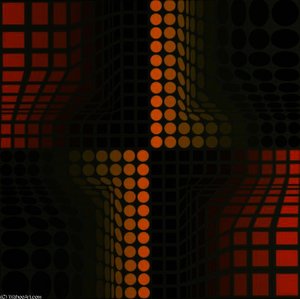
Vibrant abstract composition by Victor Vasarely, a key figure in Op Art, showcases dynamic geometric shapes and bold colors – yellow, orange, blue, and purple. Explore this captivating kinetic artwork and bring its visual energy into your space.
Biografia do Artista
Explore o universo geométrico de Victor Vasarely (1906-1997), pioneiro da Op Art e da arte cinética! Descubra suas abstrações óticas, ilusões visuais e influência duradoura na arte moderna.
Sobre a pintura
A Symphony of Geometric Perception: Exploring Victor Vasarely’s ‘Abstract Composition 6’
Victor Vasarely's “Abstract Composition 6” is more than just a colorful painting; it’s an invitation to reconsider the very nature of visual perception. Created by one of the foremost figures in Op Art, this vibrant work embodies the artist’s lifelong fascination with geometry and its impact on how we experience the world. Painted primarily in a dynamic palette of yellows, oranges, blues, and purples, the composition immediately draws the eye into a mesmerizing dance of shapes and patterns – triangles, squares, circles, and more – meticulously arranged to create an illusion of movement and depth. This isn't simply decorative art; it’s a rigorously constructed exploration of optical illusions, reflecting Vasarely’s deep engagement with scientific principles and his desire to translate mathematical concepts into tangible artistic forms.
The Genesis of Op Art: Bauhaus Roots and Kinetic Vision
Born in 1906 in Pécs, Croatia (then part of Austria-Hungary), Vasarely’s artistic trajectory began unexpectedly. Initially pursuing a medical degree, he abandoned this path in 1927 to embrace painting, ultimately finding his true calling within the burgeoning movement of Op Art – Optical Art. This pivotal shift was profoundly influenced by his studies at Sándor Bortnyik’s “Műhely” workshop, a school deeply rooted in the principles of functional design and geometric abstraction championed by the Bauhaus. The Bauhaus, with its emphasis on reducing form to its essential elements and exploring the relationship between art and industry, provided Vasarely with the theoretical framework for his groundbreaking work. He wasn't merely creating abstract images; he was attempting to capture the *effect* of visual perception – the way our eyes and brains interpret shapes and colors – a concept that would become central to Op Art’s success.
Technique and Illusion: A Masterclass in Visual Deception
Vasarely's technique was remarkably precise, relying on meticulous layering and the careful manipulation of color and scale. He employed a method he termed “static illusion,” creating the impression of movement through precisely controlled geometric forms. The seemingly random arrangement of shapes is, in fact, a carefully calculated system designed to trick the eye. Each element is rendered with exceptional clarity, contributing to the overall sense of depth and dynamism. The use of contrasting colors further enhances this effect, guiding the viewer’s gaze across the canvas and reinforcing the illusion of movement. This technique demanded not just artistic skill but also a deep understanding of optics and visual psychology – qualities that Vasarely possessed in abundance.
Symbolism and Emotional Resonance: Beyond Pure Geometry
While rooted in geometric abstraction, “Abstract Composition 6” possesses an undeniable emotional resonance. The vibrant colors evoke feelings of energy, excitement, and perhaps even a sense of wonder. Vasarely’s work isn't about representing the external world; it’s about exploring the internal landscape of perception itself. The dynamic composition can be interpreted as a reflection of the constant flux and change inherent in our experience – a visual representation of the ever-shifting patterns of thought and emotion. The piece invites contemplation on how we actively construct our reality through our sensory perceptions, making it a powerful statement about the subjective nature of vision.
Perguntas e Respostas
A qual artista "Abstract composition 6" é atribuída?
O artista por trás de "Abstract composition 6" é Victor Vasarely. A obra está catalogada sob o nome de Victor Vasarely.
Qual é a luminosidade percebida de "Abstract composition 6", de Victor Vasarely?
Em termos de luminosidade percebida, "Abstract composition 6", de Victor Vasarely é balanced.
Como faço para baixar a imagem de "Abstract composition 6", de Victor Vasarely?
Um download está disponível para "Abstract composition 6": a página de Download da obra oferece download de imagem digital em alta resolução.
Informações rápidas e quiz de arte
Sobre Victor Vasarely

Victor Vasarely
1906 - 1997, Croácia
Biografia do Artista
A Life Forged in Geometry: The World of Victor Vasarely
Victor Vasarely (Pécs, 9 de abril de 1906 — Paris, 15 de março de 1997) foi um pintor e artista gráfico húngaro-francês, cuja jornada para se tornar um pioneiro do Op Art e da arte cinética não foi predeterminada. Sua vida inicial prenunciava um caminho distante da tela; inicialmente, estudou medicina na Universidade Eötvös Loránd em Budapeste. No entanto, o fascínio pela expressão visual provou ser mais forte, levando-o a abandonar a medicina para o mundo da pintura em 1927, matriculando-se na Academia Podolini-Volkmann. Essa decisão marcou não apenas uma mudança de vocação, mas o início de uma exploração contínua dos princípios fundamentais que governam a percepção e a forma. Um momento crucial foi sua inscrição no workshop de Sándor Bortnyik – Műhely, uma escola profundamente influenciada pelo movimento Bauhaus. Ali, Vasarely absorveu os preceitos do design funcional e da abstração geométrica, sementes que floresceriam em seu estilo característico. Esses anos formativos não foram apenas sobre adquirir técnica; eram sobre desmontar as convenções artísticas tradicionais e abraçar uma nova linguagem visual enraizada na lógica e na precisão.Early Abstraction and the Dawn of Op Art
As décadas de 1920 e 1930 testemunharam a gradual partida de Vasarely da arte representacional, mergulhando mais profundamente no reino da abstração geométrica. Obras como “Estudo Azul” e “Estudo Verde”, criadas em 1929, exemplificam essa transição – uma renúncia deliberada do conteúdo narrativo em favor da forma pura e das relações de cores. Influenciado por mestres como Piet Mondrian e Kazimir Malevich, Vasarely não se contentava em simplesmente imitar seus estilos. Ele buscava transcender as composições estáticas de seus predecessores, visando uma dinâmica que engajaria ativamente a percepção do espectador. Essa busca o levou a Paris em 1930, onde se estabeleceu como designer gráfico e artista publicitário, aprimorando suas habilidades enquanto continuava a desenvolver sua visão artística única. Foi durante este período que começou a experimentar técnicas que mais tarde se tornariam marcas registradas do Op Art – manipulando formas e cores para criar ilusões de movimento e profundidade. As sementes foram plantadas para uma revolução na experiência visual.The Systematic Illusion: Defining a Movement
Na década de 1960, Victor Vasarely emergiu plenamente como uma figura proeminente no emergente movimento Op Art. Ao contrário de muitos artistas que se baseavam na intuição e na expressão espontânea, Vasarely abordava seu trabalho com uma metodologia distinta. Ele empregava grades e princípios matemáticos para gerar padrões que criavam poderosas ilusões ópticas – vibrações visuais, efeitos giratórios e sensações de profundidade onde não existiam fisicamente. Não se tratava de truque; era sobre revelar a dinâmica inerente à percepção em si. Ele acreditava na reprodutibilidade e no apelo popular, buscando democratizar a arte tornando-a acessível além dos limites das galerias e museus. Sua obra desafiou os espectadores a questionar sua própria experiência visual, forçando-os a participar ativamente da criação de significado. Essa interação deliberada com a percepção o diferenciava e consolidava seu lugar na vanguarda desse movimento. Ele não estava simplesmente pintando imagens; ele estava construindo experiências.Historical Significance
A contribuição de Vasarely à história da arte é multifacetada. Ele se moveu além das técnicas tradicionais de pintura para criar obras que engajam ativamente a percepção do espectador. Sua abordagem sistemática desafiou as noções convencionais de criatividade artística e abriu o caminho para a arte gerada por computador e o design digital. Ao abraçar a reprodutibilidade e as aplicações comerciais, Vasarely borrou os limites entre a arte fina e a cultura popular, deixando uma marca duradoura tanto em ambos os campos. Ele não estava simplesmente criando objetos esteticamente agradáveis; ele estava conduzindo experimentos visuais que revelaram verdades fundamentais sobre como vemos o mundo. Sua obra continua a ressoar hoje, lembrando-nos do poder da abstração, da beleza da geometria e das infinitas possibilidades da criatividade humana.Key Achievements and Legacy
A carreira de Vasarely foi marcada por inúmeras conquistas e um legado duradouro. Ele recebeu o Prêmio Guggenheim em Nova York em 1964 e o Prêmio de Melhor Exposição na Bienal de São Paulo em 1970. Sua obra influenciou profundamente a área do design gráfico, da moda, do design de interiores e até mesmo dos primeiros gráficos digitais. A Fundação Vasarely, estabelecida em Aix-en-Provence, garante a preservação e promoção de sua extensa obra, enquanto um evento notável – a inclusão de serigrafias a bordo da nave espacial soviético-francesa Salyut 7 em 1982 – simbolizou o reconhecimento global de sua arte e sua conexão com o empreendimento humano mais amplo de exploração.Informações rápidas sobre Victor Vasarely
- Artistic Movement Or Style: Op Art, Arte Cinética
- Artists Or Movements Influenced By This Artist:
- Design gráfico
- Design de interiores
- Artists Who Influenced This Artist:
- Piet Mondrian
- Kazimir Malevich
- Date Of Birth: 9 de abril de 1906
- Date Of Death: 15 de março de 1997
- Full Name: Victor Vasarely
- Nationality: Húngaro-Francês
- Notable Artworks:
- Zebra
- Markeb-Neg
- Vega
- Place Of Birth: Pécs, Croácia
Explore obras de arte organizadas por temas, estilos e características.




Victor Vasarely
Abstract composition 6
() ·
Com a moldura: · Pintura a óleo sobre linho feita à mão
Total