Visualizar na parede
 Compartilhar
 Compartilhar
 Detalhes
 Guia
Guia

 Baixar imagem
 Semelhantes
 Raio X
 Ver diaporama
 Q&A
Q&A Estatísticas
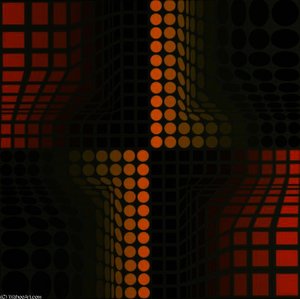
Caribe Negatif


Discover Victor Vasarely’s ‘Caribe Negatif.’ This iconic abstract painting features dynamic black squares & white circles – a key work of Op Art. Explore this unique piece today!
 Ler mais
Explore o universo geométrico de Victor Vasarely (1906-1997), pioneiro da Op Art e da arte cinética! Descubra suas abstrações óticas, ilusões visuais e influência duradoura na arte moderna.
A obra de arte exibida nesta página é protegida por leis de direitos autorais, o que significa que não podemos criar ou vender legalmente uma reprodução idêntica. Esta proteção é aplicada por meio de acordos internacionais, tais como a Convenção de Berna e pelas leis nacionais, incluindo as estabelecidas por Lei de Direitos Autorais dos EUA - Título 17.
Este método cumpre plenamente as regulamentações de direitos autorais, pois não envolve a cópia ou duplicação da obra protegida. Em vez disso, trata-se de uma reinterpretação criativa — uma nova pintura que é influenciada pela original, mas não idêntica a ela.
Giclée / Impressão de Arte
Impressão giclée ou em tela de qualidade de museu, com produção rápida e opções flexíveis de acabamento. ( Comprar pintura feita à mão Alternar para Imagem Digital)




P118B €10

P118H €10

P118W €10

P438Z €10

P508JH €12

P508YH €12

P805H €10

P805Z €10

P919BZ €10

P919G €10

P919XJ €10

P959ZH €10

P968JZ €12

W106C €8

W218G €10

W218JH €8

W218Y €10

W307PJ €10

W316G €10

W316PJ €8

W316Y €10

W398PJ €8

W4111J €10

W500HY €15

W500JH €15

W692G €12

W849H €8

W940BG €15

W953PJ €8




Tamanho padrão
personalizado
CM
INCH
Escolha entre os nossos tamanhos pré-definidos que respeitam as proporções originais da obra de arte.
Loading sizes...

largura
altura
Insira a largura e a altura desejadas para se ajustarem à sua moldura ou parede. Uma impressão pode ser apenas cortada, nunca ampliada além da imagem original; portanto, um tamanho com proporções diferentes resultará na perda de parte da imagem. Enviamos uma maquete digital para sua aprovação antes de realizarmos a impressão. A imagem exibida nesta página não mostra o corte real — apenas a maquete o faz.
Entrega mundial () em 2 semanas, em vez das 4/5 semanas padrão. (31 Outubro)

Envio expresso gratuito para todo o mundo

Tela de Linho de Alta Qualidade

Seguro de transporte completo

Garantia de Reembolso de Impostos Alfandegários

Garantia de Fidelidade Cromática

Política de Devolução em 100 Dias (Apenas para Defeitos)

Garantia de reembolso de 100%

Oferta de desconto por quantidade
 A opção de vidro está disponível apenas para tamanhos inferiores a 110 cm

Caribe Negatif
Giclée / Impressão de Arte
Tamanho da Reprodução
-


Preço Total
€ 61
A Symphony of Optical Dynamics
To encounter Victor Vasarely’s Caribe Negatif is to step away from the stillness of traditional viewing and enter a realm where the canvas breathes, vibrates, and dances before one's very eyes. This striking masterpiece serves as a definitive testament to the power of Op Art, presenting a dynamic field of deep black squares punctuated by an array of white circles in varying sizes. The arrangement is far from random; it is a carefully orchestrated interplay of positive and negative space, designed specifically to trigger a sense of visual vibration. As the eye wanders across the surface, the composition feels simultaneously contained within its square format and infinitely expansive, drawing the viewer into a rhythmic pulse that defies the flat nature of the medium.
The brilliance of this work lies in Vasarely’s mastery of geometric abstraction. Eschewing traditional representational painting, he focuses entirely on the perceptual effects achieved through the precise manipulation of form. Through the strategic placement of crisp, clean lines and contrasting shapes, he generates profound illusions of depth and three-dimensionality. The stark contrast between the obsidian background and the luminous white elements creates a tension that feels almost kinetic, as if the circles are floating or pulsating against a dark void. For the discerning collector or interior designer, this piece offers a sophisticated focal point that brings an energetic, modern intellectualism to any space.
Historical Resonance and Symbolic Depth
Created during a period of intense global fascination with science and technology, Caribe Negatif reflects the post-war era's obsession with the possibilities of human perception. During the mid-20th century, advancements in psychology and computer science fueled a surge of interest in optical illusions and kinetic art, movements to which Vasarely was a primary architect. His work does not merely sit upon a wall; it interacts with the viewer’s very understanding of stability and movement. The title itself, hinting at a connection to the Caribbean, suggests a hidden warmth or a tropical rhythm buried within the monochrome geometry, inviting us to find life within the mathematical precision.
Beyond its technical prowess, the artwork invites deep symbolic interpretation. The duality of black and white can be viewed as a meditation on presence and absence, light and shadow, or the fundamental balance of opposites. The varying sizes of the circles might symbolize celestial bodies or microscopic energy units, suggesting that even within a strictly controlled geometric plane, there is an infinite universe of motion. For those seeking to decorate a contemporary environment, a high-quality reproduction of this piece provides more than just aesthetic beauty; it offers a window into a visual revolution—a moment where art ceased to be a static window and became a living, breathing experience.
Perguntas e Respostas
De que forma o tema de "Caribe Negatif" se relaciona com os temas habituais de Victor Vasarely?
Entre os temas recorrentes de Victor Vasarely — op art influence, geometric abstraction, visual rhythm & order, minimalist aesthetic, cold color palette, systematic design, mathematical structure, early 20th-century art — "Caribe Negatif" traz seu próprio foco em abstract art, geometric design, circle pattern, visual rhythm, modern abstraction, op art style, black and white.
Para que uso é sugerida a reprodução de "Caribe Negatif", de Victor Vasarely?
Uma reprodução de "Caribe Negatif", de Victor Vasarely é recomendada para Statement. Esta sugestão decorre do tema, da atmosfera e das cores da obra.
O que "Caribe Negatif", de Victor Vasarely retrata e qual é a sua atmosfera?
"Caribe Negatif", de Victor Vasarely combina abstract art, geometric design, circle pattern, visual rhythm, modern abstraction, op art style, black and white com uma atmosfera Modern.
Biografia do Artista
A Life Forged in Geometry: The World of Victor Vasarely
Victor Vasarely (Pécs, 9 de abril de 1906 — Paris, 15 de março de 1997) foi um pintor e artista gráfico húngaro-francês, cuja jornada para se tornar um pioneiro do Op Art e da arte cinética não foi predeterminada. Sua vida inicial prenunciava um caminho distante da tela; inicialmente, estudou medicina na Universidade Eötvös Loránd em Budapeste. No entanto, o fascínio pela expressão visual provou ser mais forte, levando-o a abandonar a medicina para o mundo da pintura em 1927, matriculando-se na Academia Podolini-Volkmann. Essa decisão marcou não apenas uma mudança de vocação, mas o início de uma exploração contínua dos princípios fundamentais que governam a percepção e a forma. Um momento crucial foi sua inscrição no workshop de Sándor Bortnyik – Műhely, uma escola profundamente influenciada pelo movimento Bauhaus. Ali, Vasarely absorveu os preceitos do design funcional e da abstração geométrica, sementes que floresceriam em seu estilo característico. Esses anos formativos não foram apenas sobre adquirir técnica; eram sobre desmontar as convenções artísticas tradicionais e abraçar uma nova linguagem visual enraizada na lógica e na precisão.Early Abstraction and the Dawn of Op Art
As décadas de 1920 e 1930 testemunharam a gradual partida de Vasarely da arte representacional, mergulhando mais profundamente no reino da abstração geométrica. Obras como “Estudo Azul” e “Estudo Verde”, criadas em 1929, exemplificam essa transição – uma renúncia deliberada do conteúdo narrativo em favor da forma pura e das relações de cores. Influenciado por mestres como Piet Mondrian e Kazimir Malevich, Vasarely não se contentava em simplesmente imitar seus estilos. Ele buscava transcender as composições estáticas de seus predecessores, visando uma dinâmica que engajaria ativamente a percepção do espectador. Essa busca o levou a Paris em 1930, onde se estabeleceu como designer gráfico e artista publicitário, aprimorando suas habilidades enquanto continuava a desenvolver sua visão artística única. Foi durante este período que começou a experimentar técnicas que mais tarde se tornariam marcas registradas do Op Art – manipulando formas e cores para criar ilusões de movimento e profundidade. As sementes foram plantadas para uma revolução na experiência visual.The Systematic Illusion: Defining a Movement
Na década de 1960, Victor Vasarely emergiu plenamente como uma figura proeminente no emergente movimento Op Art. Ao contrário de muitos artistas que se baseavam na intuição e na expressão espontânea, Vasarely abordava seu trabalho com uma metodologia distinta. Ele empregava grades e princípios matemáticos para gerar padrões que criavam poderosas ilusões ópticas – vibrações visuais, efeitos giratórios e sensações de profundidade onde não existiam fisicamente. Não se tratava de truque; era sobre revelar a dinâmica inerente à percepção em si. Ele acreditava na reprodutibilidade e no apelo popular, buscando democratizar a arte tornando-a acessível além dos limites das galerias e museus. Sua obra desafiou os espectadores a questionar sua própria experiência visual, forçando-os a participar ativamente da criação de significado. Essa interação deliberada com a percepção o diferenciava e consolidava seu lugar na vanguarda desse movimento. Ele não estava simplesmente pintando imagens; ele estava construindo experiências.Historical Significance
A contribuição de Vasarely à história da arte é multifacetada. Ele se moveu além das técnicas tradicionais de pintura para criar obras que engajam ativamente a percepção do espectador. Sua abordagem sistemática desafiou as noções convencionais de criatividade artística e abriu o caminho para a arte gerada por computador e o design digital. Ao abraçar a reprodutibilidade e as aplicações comerciais, Vasarely borrou os limites entre a arte fina e a cultura popular, deixando uma marca duradoura tanto em ambos os campos. Ele não estava simplesmente criando objetos esteticamente agradáveis; ele estava conduzindo experimentos visuais que revelaram verdades fundamentais sobre como vemos o mundo. Sua obra continua a ressoar hoje, lembrando-nos do poder da abstração, da beleza da geometria e das infinitas possibilidades da criatividade humana.Key Achievements and Legacy
A carreira de Vasarely foi marcada por inúmeras conquistas e um legado duradouro. Ele recebeu o Prêmio Guggenheim em Nova York em 1964 e o Prêmio de Melhor Exposição na Bienal de São Paulo em 1970. Sua obra influenciou profundamente a área do design gráfico, da moda, do design de interiores e até mesmo dos primeiros gráficos digitais. A Fundação Vasarely, estabelecida em Aix-en-Provence, garante a preservação e promoção de sua extensa obra, enquanto um evento notável – a inclusão de serigrafias a bordo da nave espacial soviético-francesa Salyut 7 em 1982 – simbolizou o reconhecimento global de sua arte e sua conexão com o empreendimento humano mais amplo de exploração.
Victor Vasarely
1906 - 1997 , Croácia
Dados Rápidos
- Artistic Movement Or Style: Op Art, Arte Cinética
- Artists Or Movements Influenced By This Artist:
- Design gráfico
- Design de interiores
- Artists Who Influenced This Artist:
- Piet Mondrian
- Kazimir Malevich
- Date Of Birth: 9 de abril de 1906
- Date Of Death: 15 de março de 1997
- Full Name: Victor Vasarely
- Nationality: Húngaro-Francês
- Notable Artworks:
- Zebra
- Markeb-Neg
- Vega
- Place Of Birth: Pécs, Croácia
Artigos Relacionados

The Beauty of Less: A Sophisticated Guide to the Soul of Minimalist Art and Geometric Harmony
Discover the profound elegance of minimalist art. Explore how geometric abstraction and the beauty of reduction create serene, sophisticated spaces through our expert guide to finding soul and harmony in every line and shape.
Explore obras de arte organizadas por temas, estilos e características.