

Shown: · With its frame:
 Visualizar na parede
 Compartilhar
 Compartilhar
 Detalhes
 Guia
Guia

 Baixar imagem
 Semelhantes
 Raio X
 Ver diaporama
 Q&A
Q&A Estatísticas

€ 239
Reprodução em Óleo Feita à Mão
Óleo sobre tela pintado à mão no tamanho e moldura de sua escolha, feito sob encomenda pelos nossos artistas. ( Alternar para Impressão Alternar para Imagem Digital)
Size
·Tamanho padrão
personalizado
CM
INCH
Escolha entre os nossos tamanhos pré-definidos que respeitam as proporções originais da obra de arte.
Loading sizes...

largura
altura
Insira a largura e a altura desejadas para se ajustarem à sua moldura ou parede. Como esta obra é pintada à mão, para um tamanho com proporções diferentes, o artista poderá pintar um pouco mais ao redor da imagem ou reduzir ligeiramente a composição — você escolhe. Enviamos uma maquete digital para sua aprovação antes de iniciar a pintura. A imagem exibida nesta página não representa o resultado real — apenas a maquete mostra o resultado final.
 Leia mais
Finish
·
White €1

Blurside €1

Extended €1

P118B €10

P118H €10

P118W €10

P438Z €10

P508JH €12

P508YH €12

P805H €10

P805Z €10

P919BZ €10

P919G €10

P919XJ €10

P959ZH €10

P968JZ €12

W106C €8

W218G €10

W218JH €8

W218Y €10

W307PJ €10

W316G €10

W316PJ €8

W316Y €10

W398PJ €8

W4111J €10

W500HY €15

W500JH €15

W692G €12

W849H €8

W940BG €15

W953PJ €8

H24-GOLD €30

H24-SILVER €30

H36-GOLD €45

H36-SILVER €45
Shipped in a protective tube, ready for your own framer.
Above 105 cm the frame is shipped as a kit for a professional framer — read the details.
Extras
optionalWhat do the extras include?
Examples of what can be changed: Replace face with customer photo; Add pet (e.g., replace cat with dog); Include hidden message in background; Change background landscape or elements.
After order, TopImpressionists.com team will email client for instructions and provide a mockup preview
After order, TopImpressionists.com team will email client for instructions and provide a mockup preview
Entrega mundial () em 3 a 4 semanas, em vez das 5 semanas padrão. (30 Outubro). Sem comprometer a qualidade.
Verniz de Proteção
Etiqueta de identificação
Detalhes da Placa de Bronze Gravada
This elegant plaque features the artist's name and the title of the artwork, finely engraved for a timeless presentation.
It is made from bronze with a refined, elegant finish. The text is precisely laser-engraved for a sharp and permanent result. Measuring 9x2 cm, the plaque is compact yet easy to read. It's built to be durable and scratch-resistant, offering a professional, museum-quality look. Mounting is simple thanks to the included adhesive backing.
Detalhes da Placa de Acrílico Transparente
The plaque includes essential engraved details such as the artist's name, the title of the artwork, the date it was created, the type of media used-like oil on canvas or watercolor-a brief description of the piece, and a QR code that links to the complete artwork information.
It is crafted from clear acrylic, offering a sleek, modern appearance. The text is UV-engraved in black to ensure strong visual contrast. With a size of 10x15 cm, it ensures optimal readability. It comes equipped with two metal hooks for secure wall mounting. The plaque is designed to be weather-resistant, making it suitable for various environments, and it includes interactive features that work seamlessly with smartphone scanning.
Detalhes da Placa de Acrílico Preto
This elegant plaque includes engraved information such as the artist's name, the title of the artwork, the date it was created, the type of media used (like oil on canvas or watercolor), a short description of the artwork, and a QR code for quick access to more information.
The plaque itself is made from refined black acrylic with a premium finish. The text is laser-engraved in white for high contrast and readability. Its size is 10x15 cm, designed to be easy to read. It comes with two metal hooks for professional mounting. The design is sleek and fits any interior style. It is also weather-resistant and durable, with built-in digital integration for mobile compatibility.
A opção de vidro está disponível apenas para tamanhos inferiores a 110 cm
 A opção de vidro está disponível apenas para tamanhos inferiores a 110 cm
- Envio expresso gratuito para todo o mundo
- Tela de Linho de Alta Qualidade
- Seguro de transporte completo
- Garantia de Reembolso de Impostos Alfandegários
- Garantia de Fidelidade Cromática
- Política de Devolução em 100 Dias (Apenas para Defeitos)
- Garantia de reembolso de 100%
- Oferta de desconto por quantidade


Descrição do Item
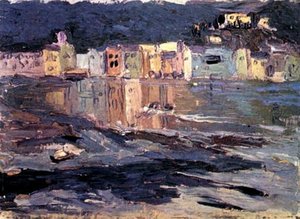
Wassily Kandinsky’s 1901 ‘Study for a Sluice’ is a captivating Post-Impressionist landscape showcasing a serene water scene with a white building, reflecting the artist's pioneering spirit and early exploration of abstraction. Discover or own this iconic artwork.
Biografia do Artista
Descubra Wassily Kandinsky (1866-1944), o pioneiro da arte abstrata! Explore seu expressionismo vibrante, temas espirituais e legado Bauhaus através de reproduções deslumbrantes.
About the painting
Wassily Kandinsky’s ‘Study for a Sluice’: A Dawn of Abstract Emotion
Wassily Kandinsky's 'Study for a Sluice,' painted in 1901, represents a pivotal moment not just in the artist’s career but in the very trajectory of modern art. This seemingly simple landscape – a serene body of water reflecting a white building nestled amongst trees – is far more than a picturesque depiction; it's an intensely personal and profoundly influential exploration of color and form that foreshadowed the rise of abstract expressionism. Born in Moscow in 1866, Kandinsky’s artistic journey was initially marked by a pragmatic pursuit of law and economics before a transformative encounter with Monet’s “Haystacks” ignited within him a fervent desire to translate inner experience onto canvas. This nascent impulse found further resonance in Wagner's opera "Lohengrin," fueling his ambition to move beyond representational accuracy and capture the essence of emotion through purely visual means.
Post-Impressionist Roots & Early Experimentation
‘Study for a Sluice’ firmly establishes Kandinsky within the Post-Impressionist movement, though he quickly sought to transcend its limitations. The painting's style is characterized by bold color choices and expressive brushwork – hallmarks of the period – yet it demonstrates an unprecedented focus on the *relationships* between colors rather than their objective depiction. Notice how the blues and greens of the water subtly shift and blend, creating a sense of movement and depth. The white building, rendered with simplified forms, acts as a focal point, drawing the eye while simultaneously contributing to the overall atmospheric effect. This early work reveals Kandinsky’s nascent desire to use color not merely to represent reality but to evoke feeling and spiritual experience – a core tenet of his later artistic philosophy.
Symbolic Resonance & Spiritual Intent
Beyond its formal qualities, ‘Study for a Sluice’ is laden with symbolic resonance. The “sluice” itself, a structure designed to control water flow, can be interpreted as representing the artist's own attempt to channel and direct his creative energies. The surrounding landscape – the water, the trees, the building – all contribute to a sense of tranquility and contemplation, suggesting a yearning for spiritual harmony. Kandinsky was deeply interested in the intersection of art, religion, and psychology, believing that color possessed inherent spiritual qualities. This painting exemplifies this belief, demonstrating how he sought to translate subjective experience into tangible form.
Technique & Reproduction – A Window to the Original
This hand-painted reproduction meticulously recreates Kandinsky’s original technique, capturing the nuances of his brushwork and color palette with remarkable fidelity. The artist employed a layering method, building up thin washes of paint to achieve the luminous effects characteristic of his work. The textured surface, achieved through multiple applications of pigment, adds depth and richness to the image, inviting close observation. TopImpressionists’s skilled artisans have painstakingly reproduced this artwork, ensuring that you receive a faithful representation of Kandinsky's vision – a piece that will undoubtedly become a treasured addition to any art collection or interior space.
Perguntas e Respostas
Quem criou "Study for a Sluice" e em qual estilo se encontra?
Wassily Wassilyevich Kandinsky criou "Study for a Sluice" dentro do movimento Post-Impressionist Landscape.
"Study for a Sluice" está disponível como uma impressão fine art?
"Study for a Sluice" está disponível como uma impressão fine art em tela de algodão ou papel canvas de arquivo. Os pedidos podem ser feitos na página de Impressão Fine Art, no tamanho de sua escolha.
De onde vêm os visitantes de "Study for a Sluice", de Wassily Wassilyevich Kandinsky?
Existe uma página de Estatísticas para "Study for a Sluice". Ela apresenta o gráfico de visitas mensais da obra e de outras obras do artista, com detalhamento por país e idioma.
Quick facts and art quiz
About Wassily Wassilyevich Kandinsky

Wassily Wassilyevich Kandinsky
1866 - 1944, Rússia
Biografia do Artista
A Life Immersed in Color and Spirit
Wassily Wassilyevich Kandinsky, nascido em Moscou em 1866, foi uma figura revolucionária que alterou irrevogavelmente o curso da arte moderna. Sua jornada não foi de um chamado artístico imediato; inicialmente destinado a uma carreira no direito e na economia na Universidade de Moscou, encontrou-se com a pintura impressionista – especificamente as “Palas” de Claude Monet – e uma experiência profundamente emocionante testemunhando a ópera "Lohengrin" de Wagner que acendeu dentro dele um desejo irreprimível de seguir a arte. Este momento crucial, ocorrendo por volta dos trinta anos, não marcou apenas uma mudança de carreira, mas uma transformação completa de perspectiva, abrindo-lhe o caminho para se tornar pioneiro na abstração. Em breve, mudou-se para Munique, matriculando-se na prestigiosa Academia de Artes e estudando sob Franz von Stuck, embora mesmo dentro do treinamento formal, o espírito de Kandinsky anelasse por explorar além dos limites convencionais.
As primeiras influências incluíam a arte folclórica russa, obtida através de uma expedição etnológica à região de Vologda em 1889, que despertou um fascínio pelas paletas de cores vibrantes e imagens simbólicas. Esta base se provou crucial enquanto ele começava a desenvolver sua linguagem artística única. Estas explorações iniciais não eram simplesmente uma preferência estética; estavam enraizadas em uma conexão cultural profunda e em uma compreensão crescente de como a arte poderia comunicar além da letra.
The Dawn of Abstraction: From Expressionism to Inner Necessity
As primeiras obras de Kandinsky revelam um forte viés expressionista, caracterizado por cores ousadas e intensidade emocional – peças como “Papeln (Poplars)” de 1902 exemplificam este período. No entanto, ele não estava satisfeito em simplesmente representar o mundo exterior; ele buscava expressar realidades internas, verdades espirituais que transcendiam a mera representação visual. Esta busca levou-o gradualmente para longe da arte representacional e em direção a uma exploração revolucionária de cor, forma e seu ressonância emocional.
Ele começou a acreditar que as cores possuíam efeitos psicológicos inerentes, capazes de evocar emoções e sensações específicas no espectador. Esta convicção estava intimamente ligada ao seu crescente interesse pela Teosofia, um movimento espiritual que enfatizava o conhecimento esotérico e a fraternidade universal. Ao se aprofundar nessas ideias, as pinturas de Kandinsky tornaram-se cada vez mais não objetivas, abandonando formas reconhecíveis em favor de composições abstratas impulsionadas por uma “necessidade interior”. Não era simplesmente abandonar a representação; era descobrir uma nova linguagem visual capaz de expressar os reinos intangíveis da emoção e da espiritualidade. Ele buscava criar um equivalente visual à música, onde cor e forma harmonizavam para evocar respostas emocionais profundas.
Geometric Harmony and Spiritual Resonance
O período seguinte ao seu envolvimento com o influente grupo de artistas Der Blaue Reiter (Os Cavaleiros Azuis), que co-fundou em Munique em 1911, viu uma evolução adicional no estilo de Kandinsky. Embora as primeiras obras frequentemente apresentassem formas fluidas e orgânicas, ele começou a explorar a abstração geométrica, concentrando-se na interação entre círculos, triângulos e quadrados. “Vários Círculos” (140 x 140 cm) é um exemplo primordial desta fase – uma composição dinâmica onde cor e forma interagem em uma dança harmoniosa, mas energética.
Esta geometria não era fria ou estéril; era imbuída de significado espiritual. Kandinsky acreditava que as formas geométricas possuíam significados simbólicos inerentes e sua disposição dentro da tela poderia evocar respostas emocionais específicas. Seus escritos teóricos, notavelmente “Sobre o Espiritual na Arte” (1911), articulavam estas crenças, lançando as bases para uma nova compreensão da arte abstrata como um meio de expressar verdades espirituais profundas. Ele argumentava que a arte não deveria ter como objetivo imitar a natureza, mas sim revelar o mundo interior do artista e se conectar com o espectador em um nível mais profundo e intuitivo.
Bauhaus Influence and Lasting Legacy
A eclosão da Primeira Guerra Mundial forçou Kandinsky a retornar à Rússia em 1914, mas após a Revolução Russa, ele encontrou-se cada vez mais em desacordo com o clima artístico dominante. Em 1920, aceitou uma posição de professor na escola Bauhaus na Alemanha, onde influenciou profundamente gerações de artistas com suas teorias sobre cor, forma e abstração. A Bauhaus forneceu um ambiente ideal para Kandinsky desenvolver ainda mais suas ideias e explorar novos caminhos criativos.
Ele continuou a experimentar com formas geométricas e cores vibrantes, frequentemente incorporando técnicas de impasto texturizado para criar superfícies texturizadas que adicionavam profundidade e complexidade às suas composições – como visto em obras posteriores como “Uma Festa Íntima” (1942). Após o fechamento ordenado pelo regime nazista da Bauhaus em 1933, Kandinsky se mudou para a França, onde permaneceu até sua morte. Seu impacto na arte moderna é imensurável; ele é amplamente reconhecido como um pioneiro do expressionismo abstrato e uma figura-chave no desenvolvimento da pintura não representacional. Suas obras são exibidas em importantes museus ao redor do mundo, incluindo a Galeria Tretyakov em Moscou, que abriga seu monumental “Composição VII”, um testemunho de sua visão artística e legado duradouro.
A exploração de Kandinsky da cor, forma e espiritualidade continua a inspirar artistas hoje, consolidando seu lugar como uma das figuras mais importantes da história da arte do século XX. Ele não pintou apenas pinturas; ele pintou emoções, ideias e a própria essência do espírito humano.
Quick facts about Wassily Wassilyevich Kandinsky
- Artistic Movement Or Style: Arte abstrata, Expressionismo
- Artists Or Movements Influenced By This Artist:
- Expressionismo
- Der Blaue Reiter
- Artists Who Influenced This Artist:
- Monet
- Wagner
- Date Of Birth: 1866
- Date Of Death: 1944
- Full Name: Wassily Wassilyevich Kandinsky
- Nationality: Russo, Francês
- Notable Artworks:
- Composição VII
- Sucessão
- An Intimate Party
- Place Of Birth: Moscou, Rússia



Explore obras de arte organizadas por temas, estilos e características.


Wassily Wassilyevich Kandinsky
Study for a Sluice
() ·
With its frame: · Hand-painted in oil on linen
Total